

2.0 Single-Family Design Guidelines
Countywide Design Guidelines
Chapter 2: Single-Family Design Guidelines
Section titled “Countywide Design Guidelines Chapter 2: Single-Family Design Guidelines”Amended September 9, 2022
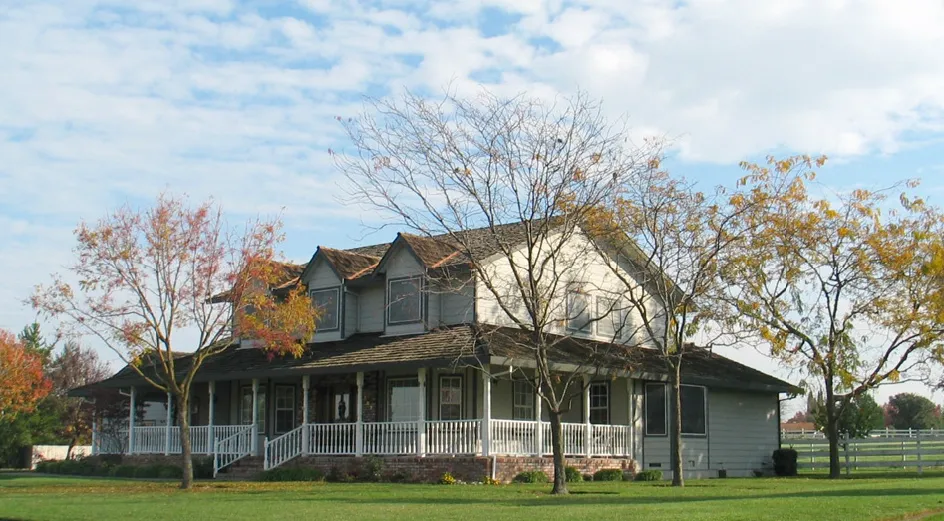
The primary goals of the Single-Family Guidelines are to ensure that new single-family development is a positive addition to the community and achieves the highest resident quality of life, whether in new or established neighborhoods. Single-family housing shall adhere to the applicable standards of the Zoning Code, unless alternatives can be justified by provisions of these Design Guidelines.
Single Family Design Review is based on three different areas of focus – Neighborhood Site Design, Building Design, and Landscaping/Site Elements.
Design Review Approval shall be applicable as follows:
-
For Subdivisions of 20 lots or more (new and previously approved tentative subdivision maps) and at a density of 8 dwelling units per net acre or less. Neighborhood Site Design Guidelines (Section 2.2) will be reviewed with the tentative subdivision map. Design Review of Building Design and Landscaping (Sections 2.3 and 2.4) is required, and may occur after the approval of the tentative map, but must occur prior to submittal for a building permit. Design Review of Building Design and Landscaping may be based on conceptual or illustrative drawings.
-
For Subdivisions at a density greater than of 8 dwelling units per net acre. Design review for Site Design, Building Design, and Landscaping (Sections 2.2, 2.3 and 2.4) is required concurrent with consideration of the tentative subdivision map.
-
For Subdivisions of less than 20 lots and at a density of 8 dwelling units per net acre or less, for custom lot subdivisions, and for tentative parcel maps. Neighborhood Site Design Guidelines (Section 2.2) will be reviewed with the tentative subdivision or parcel map. Design review for Building Design and Landscaping (Sections 2.3 and 2.4) may be required as a condition of approval in order to achieve General Plan objectives. The conditions of approval may specify the design objectives particular to the project (e.g. privacy to adjoining properties) to be evaluated prior to issuance of a building permit.
The three scenarios above are illustrated in the following matrix. The matrix also includes cases when Design Review is not applicable, unless as a condition of approval. Modular homes or homes manufactured off-site and built on-site shall also be subject to the standards applicable to single family residential development, including the Design Review process described in this section. Refer to Section 5.4.2.E of these guidelines related to cargo containers used as residential structures. Mobile or manufactured homes are also permitted in some single family residential districts and shall be subject to the use standards for mobile/manufactured homes and the development standards for mobile home subdivisions in the County Zoning Code.
KEY:
- B: Design Review required prior to building permit submittal
- M: Design Review required with map approval
- COA: Design Review required only if condition of approval. Review is triggered prior to building permit submittal.
- NR: Design Review is not required.
| Residential Development and Lot Division Scenarios 1 | Site Design/ Plot Plan | Building and Landscape Design |
|---|---|---|
| Residential subdivisions 20 lots or more, zoned RD-10 or greater. | M | M |
| Residential subdivisions 20 lots or more, zoned RD-7 or less. | M | B |
| Residential subdivisions less than 20 lots, custom lot subdivisions, and all other lot divisions not within a singlefamily residential zoning district | M | COA 2 |
| New homes on existing lots, remodels, additions or Accessory Dwelling Units (ADU) | NR | COA |
The process for using these design guidelines is to:
- Review the Community Context / Neighborhood Compatibility Type (Section 2.1)
- Respond to Neighborhood Site Design Standards (Section 2.2)
- Apply the Building Design Standards (Section 2.3)
- Apply the Landscape / Site Elements Design standards (Section 2.4)
- Apply Active Design Principles as designated by the “🚶” icon throughout Chapter 3.0
Design Review Submittals for Building Design shall include the following exhibits:
- Conceptual Building Elevations of proposed homes, and any accessory structures, including elevations of all sides.
- Illustrative Landscaping Plans for the front and side street yard areas, including irrigation plans. Landscaping Plans may be submitted concurrent with Water Conservation Plans.
- Illustrative Fencing Details for the front and side street yard areas.
- Landscaping and Fence Details for public areas.
- Streetscape Drawings, showing a continuous portion of typical street frontage elevations and a three-dimensional streetscape view showing relationship to adjoining properties.
The County Design Review process is separate from any Homeowner Association architectural review process, and it does not take into account Covenants, Conditions, and Restrictions (CC&Rs) that may be applicable to some neighborhoods.
2.1 Community Context
Section titled “2.1 Community Context”A major goal of the Single family Guidelines is to help single-family development be context sensitive and fit within its surroundings.
The County General Plan encourages infill of existing communities consistent with existing Community Plan and zoning designations, while striking a balance with the need to design new residential development that is compatible within the context of the project’s surroundings. The County General Plan and these Guidelines encourage continued investment in existing communities and recognize that new investment must often respond to market needs that may not be the same style and design as the existing neighborhood. These Guidelines seek design strategies to ensure new projects blend in with and complement their surroundings, and simultaneously enable property owners to develop at zoned densities. Innovation and creativity are encouraged to achieve highly livable neighborhoods.
An analysis of the appropriate community context within which a given project occurs is the first step in assessing appropriate design strategies for residential neighborhoods that meet the compatibility and livability goals of the Sacramento County General Plan.
2.2 Neighborhood Site Design
Section titled “2.2 Neighborhood Site Design”Design Principles
Section titled “Design Principles”The land use planning for tentative maps involve decisions affecting street layouts, lot configurations, connectivity, and parks/green spaces. This section identifies design guidelines for creating livable communities and at the same time reducing potential land use conflicts.
Rationale
Section titled “Rationale”Subdivision design deals with neighborhood compatibility, the public and private realm interface and meeting the livability goals of the County General Plan at both the community scale and internal subdivision scale.
Good site design is an inherent part of good neighborhood design. Site Design addresses street and block patterns, lot configurations, a home’s orientation and massing, and the overall layout with regard to its lot. For projects subject to design review per Section 2 in existing neighborhoods, the site design should respect the existing context where preservation of this context is a community goal.
General Design Standards and Guidelines
Section titled “General Design Standards and Guidelines”- Each project that proposes to divide land should result in lots that are consistent with and well suited to the land use designations and policies set forth in the General Plan and in any adopted community plans, including both maps and text. Potential population densities of residential lots should not exceed the densities set forth in the General Plan or community plans, unless otherwise specified in the Zoning Code.
- In areas with topography, the design of the project should preserve natural contours where the natural topography is the predominant character of the area. To achieve this purpose, grading restrictions or building location restrictions may be placed on the final map.
- 🚶 Where heritage and other healthy large canopy trees exist, steps should be taken to preserve and plan around them consistent with General Plan policies on tree preservation.
- Smaller lot sizes than that allowed in the underlying zoning district may be permitted so long as the average of all the lot sizes remain equal to or above the minimum zoned lot size.
2.2.1 Subdivision Street and Block Patterns
Section titled “2.2.1 Subdivision Street and Block Patterns”Design Principles
Section titled “Design Principles”Street and block patterns of new subdivisions should closely resemble the surrounding context in most cases, but poor design should not be repeated. Connections should be provided between new subdivisions and adjacent neighborhoods by streets as well as parks, open space systems and pedestrian/bike paths. Lot and block patterns should consider constraints such as topography and existing mature trees.
Rationale
Section titled “Rationale”Street and block patterns, and lot configurations are key contributors to the neighborhood fabric and character. Appropriate small-lot single-family subdivision design that fits the context and surrounding neighborhood helps maintain property values, increases the safety and security of all residents, promotes a “sense of place” and neighborly interaction, and improves mobility and quality of life for the community.
General Design Standards and Guideline
Section titled “General Design Standards and Guideline”- 🚶 Streets layout should reflect a street hierarchy consistent with the subdivisions location and internal needs. Streets shall be tree lined “complete streets” designed for pedestrian, bicycle, and vehicular use consistent with the Improvement Standards for the street’s hierarchical designation. As separated sidewalks provide a safer and healthier environment for pedestrians, they are especially important where the residential street is a connection to schools, parks, or other civic amenities. The County Improvement Standards contain standards on separated and attached sidewalks.
- All street widths must meet County standards for both public and private road classifications, except where a Specific Plan or Master Plan provides for alternative street design. Alternatives to the street standards may be justified in infill situations due to topography, neighborhood compatibility or similar reasons.
- 🚶 The circulation system should be logical, predictable, and designed to promote safety for all transportation modes, particularly pedestrians and bicyclists. Streets should connect to adjacent neighborhoods and provide direct access to schools, parks, community centers, and nearby retail for pedestrians, bicyclists, automobiles, transit and emergency vehicles.
- 🚶 A grid or modified grid pattern to provide connectivity and walkability is the preferred street and block pattern. Modifications may be approved to match existing neighborhood context.
- 🚶 Where residential subdivisions are located adjacent to an open space preserve, street and block patterns should achieve visual and physical access to open space areas.
- 🚶 Street patterns that create long uninterrupted sound walls should be avoided.
- 🚶 Residential streets within the subdivision design should be slower and pedestrian-oriented. Incorporate traffic calming measures such as traffic circles, chokers, enhanced crosswalks, and narrower streets.
- 🚶 Block lengths should be no more than 500 feet, especially for smaller lot developments (RD-5 and higher). For blocks that exceed 500 feet in length, mid-block paseos or pedestrian paths connecting to walking paths, bicycle lanes, schools and parks should be provided to ensure the walkability within the community. Larger lot subdivisions may have longer block lengths up to 750 feet.
- Street layout shall allow for adequate fire protection of all housing.
- 🚶 Existing healthy mature trees should be preserved and incorporated into site design to add to the neighborhood character.
- 🚶 Cul-de-sacs that side on to through streets or greenbelts should provide pedestrian access to connect to the adjacent through street. “Live-end” cul-de-sac design should be used to complement these areas and can include landscaping and benches.
- 🚶 Access walkways and/or off-street trails should be provided to community destinations such as open spaces, parks and schools, and commercial centers from the neighborhood, to enhance the pedestrian and bike movement and safety.
- Each parcel of land should front on a public street or be served by a private road approved pursuant to the Zoning Code which is a component of an approved local street pattern. Lots with homes that back onto a street are only allowed where traffic volumes render lots with homes that front onto a street as unsafe.
- Gated communities are allowed when consistent with community goals.
- Blocks should be laid out in a pattern that enables individual lots to maximize solar access so that such features as solar panels and daylighting can be incorporated into the design of the home. Layout for solar access needs to be balanced with preservation of existing mature trees and planting of new trees for shade.
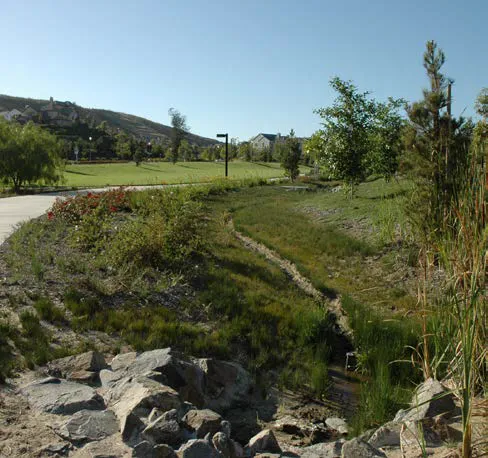
- Where possible, residential streets should incorporate gently sloped swales or bio-retention areas that contain native vegetation to capture and treat stormwater. Green street practices and cool pavements shall be utilized whenever possible. Front yards, parkways, planter strips, and cul-de-sac islands are good candidates for these facilities.
- Tree planting provides many health and sustainability benefits while contributing to community design and should be designed into new neighborhoods. Tree shading will help keep neighborhoods cooler during seasonally warm days, improve air quality, conserve water and provide health benefits to the residents.
2.2.2 Lot Size and Configurations
Section titled “2.2.2 Lot Size and Configurations”Design Principles
Section titled “Design Principles”Existing mature trees should be preserved and incorporated into the site design.
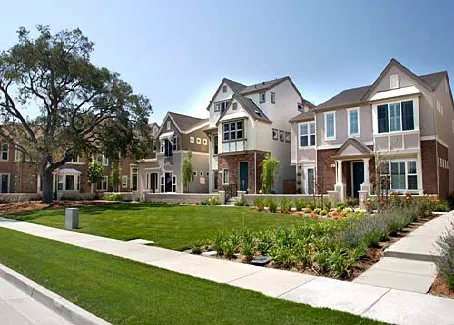
Each project that proposes to divide land should result in lots that are consistent with and well suited to the land use designations and policies set forth in the General Plan and in any adopted community plans, including both maps and texts. Potential population densities of residential lots should not exceed the densities set forth in the General Plan or community plans, or unless otherwise specified in the Zoning Code.
Rationale
Section titled “Rationale”The size and configuration of building lots affects the community character and residential livability.
General Design Standards and Guidelines
Section titled “General Design Standards and Guidelines”- Each lot should maintain a relative consistency with the predominant neighborhood development character. Lots that are found to be significantly out of character, either in area, frontage, shape, or access provisions, may be denied if it is found that such character differences may result in detrimental impacts on adjacent properties.
- Lot frontage requirements, as set forth in the County Zoning Code, may be satisfied in the case of lots on a curved street, the rounded end of a cul-de-sac, or on a bulb corner if the resulting lot frontage results in a streetscape and pedestrian access that meets other requirements of these design guidelines.
- Refer to Zoning Code Section 5.4.2 for lot size and width standards. Existing mature trees should be preserved and incorporated into site design.
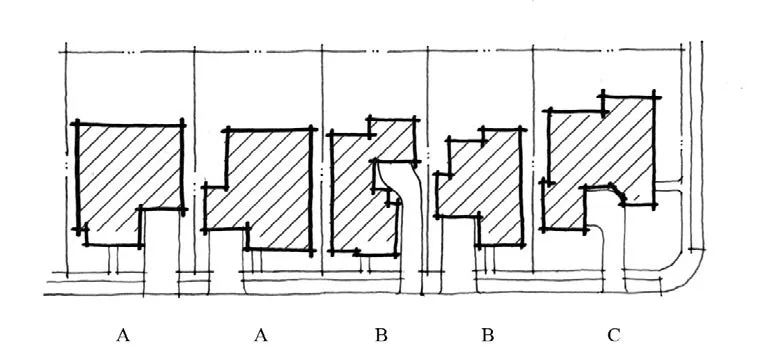
- Different interior lot widths on the same block may be acceptable along the street to create visual diversity.
- Street corners are better suited for larger and wider lots with structures that reduce the appearance of bulk and mass along the streetscape.
- Significant grade changes between lots should be gradually stepped or terraced in order to preserve natural topography to keep with community character. Grading at the property line shall be in conformance with the County Improvement Standards, with deviations from the maximum grading approved by the Planning Commission.
- Lots that back onto an arterial roadway or are adjacent to a land use with a higher intensity nonresidential zoning classification should incorporate landscaped buffer areas and deeper rear yards to mitigate potential noise, air quality, aesthetics, and land use compatibility impacts.
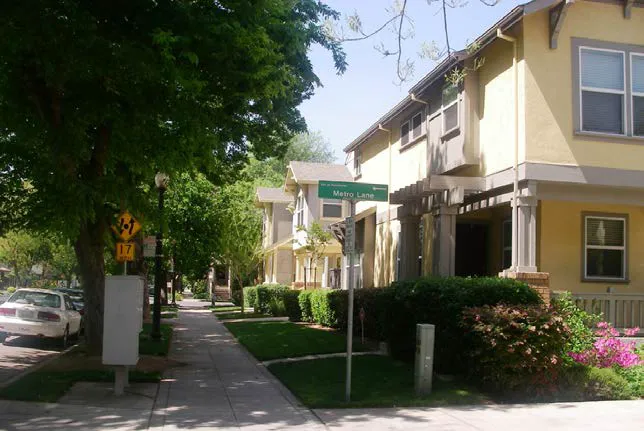
Figure 2.1 Varying lot widths within acceptable range can add greater diversity to a neighborhood.
2.2.3 Subdivision Entry Treatments
Section titled “2.2.3 Subdivision Entry Treatments”This section identifies guidelines for creating lot patterns that are best suited to the purpose for which the lots are created and, at the same time, create the least potential land use conflicts.
Design Principles
Section titled “Design Principles”Entry features should be well thought out as to the purpose they are intended to serve and provide for visitors and residents of the particular neighborhood. Entrances to individual neighborhood segments should help establish a hierarchy to circulation within the larger development, and provide individual identity for each segment while adhering to an overarching theme for the community. Signage, monumentation and landscaping also provide individual identity and branding for neighborhoods. These features provide a distinctive “gateway” to neighborhoods that can identify the unique characteristics of the area, help to create a “sense of place” and identity, while slowing traffic and enhancing the pedestrian experience.
Rationale
Section titled “Rationale”Entry features can establish a hierarchy to circulation that helps orient visitors and residents to communities and neighborhoods.
Well designed entries provide identity and help define access.
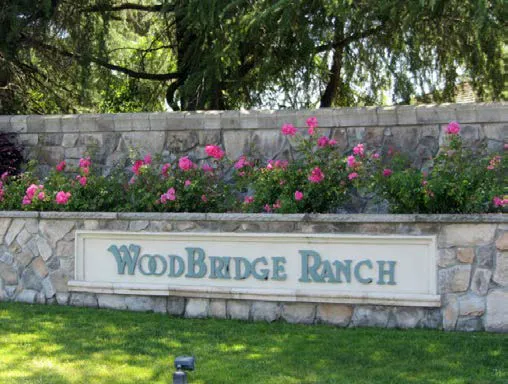
General Design Standards and Guidelines
Section titled “General Design Standards and Guidelines”- Common lots intended for entry features should include sufficient space to accommodate an organized landscape theme and other improvements such as theme walls, signage, water features, public art, pedestrian amenities such as seating or enhanced walkways/trellis features, and lighting.
- Entry features should be reflective and proportional to the size of the project.
- Entry features should be treated with complementary materials, colors, and forms to contribute to a consistent and recognizable community character.
- Entry signs should include the name of the community and other appropriate identifiers.
- Entry features should be designed to establish a hierarchy to the overall circulation within the larger development.
- Vertical elements should be used to define each entry by making them clearly visible.
- Lighting should be energy efficient and integrated into entry signage and monumentation elements.
- Facilitation of ongoing maintenance of entry features should be considered when designing these spaces.
- Entry walls should include a trim cap and should incorporate pillars, openings, or recesses/ changes in direction intermittently to avoid long, uninterrupted flat wall planes.
- Landscaping shall be included adjacent to a wall when open to public view and shall be used to soften and screen the hard edge appearance of the wall, consistent with Zoning Code requirements.
- Landscape trees, plants and materials should represent local vegetation and natural materials, and should be drought-tolerant (Refer to Table 2.3 and Figure 2.9 for a list of suggested native plant species).
- Entry monument walls, signage, and landscaping must comply with the required sight lines at corners for vehicles and pedestrians as set forth in the County Improvement Standards.
- Gated subdivisions shall have a controlled pedestrian access gate in addition to the vehicle entry gate. The vehicle entry and any gatehouse structure shall be located a sufficient distance from the cross street to accommodate vehicle stacking and provide adequate space for vehicle turn-around.
- 🚶 Enhanced pavement is encouraged at intersections and at transitions between the public and private areas, and should reflect circulation needs and safety for pedestrians, bicyclists, and vehicles.
- Use of cool pavement and permeable materials is recommended, especially in pedestrian areas, walkways, driveways, patios, plazas, etc.
Signs may be located within landscape medians.

2.3 Building Design
Section titled “2.3 Building Design”Building design addresses the built form of the home, along with its detailing. For projects subject to design review per Section 2, new homes in existing neighborhoods should respect the architectural style of established homes on the block.
For projects subject to design review per Section 2, new homes in existing neighborhoods may continue the trend of diversity in the existing neighborhood by bringing fresh new styles while still respecting the overall scale of the neighborhood.
Homes in new subdivisions shall have design variety but utilize a consistent design vocabulary to provide a sense of a unified neighborhood.
2.3.1 Building Setbacks and Orientation
Section titled “2.3.1 Building Setbacks and Orientation”Figure 2.2: Infill homes should be built to the average front setback, where appropriate. Left house: Existing house with minimum required setback. Central house: Infill house with average setback. Right house: Existing house with greater existing setback.
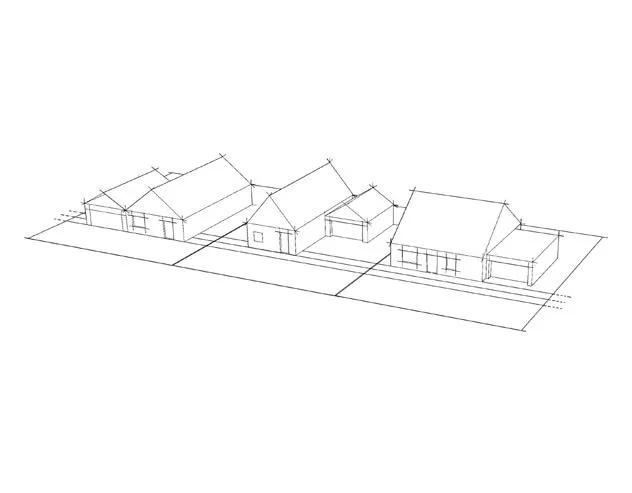
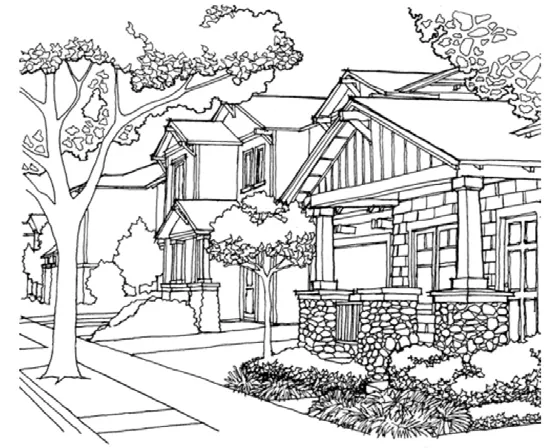
Figure 2.3: Front porches and entries are oriented toward the street providing visual interest and surveillance of the public realm.
Design Principles
Section titled “Design Principles”Setbacks of single-family residential buildings should be compatible with the character and setback of the homes along the street and adjacent blocks. Single-family buildings should address the streetscape by creating an interactive relationship with the public streets, sidewalks and open spaces; thereby promoting a sense of community and safety. Variable setbacks to create interest and creativity are encouraged.
Rationale
Section titled “Rationale”Building setbacks and orientation help establish the continuity and character of a neighborhood and help protect the privacy of neighbors. Appropriate setbacks provide a transition between public and private areas, allow for social interaction, provide functional spaces for outdoor activities, allow for light, fresh air circulation within buildings, and provide spaces for landscaping, trees, ground cover, and shrubs.
General Design Standards and Guidelines
Section titled “General Design Standards and Guidelines”- For single-family subdivisions, front yard setbacks along a street may vary by up to 25 percent from the required setback to create interest, but should contribute to the visual continuity of the block. Garage setbacks need to maintain a minimum 19-foot setback. Greater deviations would require a Special Development Permit.
- For projects subject to design review per Section 2, the front setback of new homes within an existing block should generally be an average of the setbacks of the other homes on the block.
- For projects subject to design review per Section 2, new structures in existing neighborhoods should reinforce the existing rhythm of building widths and side setbacks.
- 🚶 Homes should be oriented toward adjacent public streets by providing features such as entryways, windows, porches, stoops, and balconies along street frontages.
- Solar access for daylighting and solar panels should be considered when orienting buildings. Glazing should be located so as to maximize energy efficiency.
- Placement of windows should also consider the cooling benefits of Sacramento’s delta breezes.
- Vary the design and elevation of front porches to accommodate outdoor furniture and active uses by occupants while maintaining private yard areas.
- Horizontal sliding doors on main entries are highly discouraged.
2.3.2 Building Scale and Massing
Section titled “2.3.2 Building Scale and Massing”Design Principles
Section titled “Design Principles”A single-family residential project should be compatible with the overall scale and mass of adjacent neighborhoods. Small-lot single-family housing should conform to applicable design guidelines in the Multi Family Design Guidelines 3.0. If projects are subject to design review per Section 2, new homes in existing neighborhoods should respect the overall scale and mass of other homes in the neighborhood.
Rationale
Section titled “Rationale”Scale and mass are important characteristics of buildings within single-family neighborhoods. For projects subject to design review per Section 2, new homes in existing neighborhoods and additions to existing homes should respect earlier, established building forms by minimizing the appearance of bulk and mass through site layout and architectural design. Homes in new subdivisions should be part of an overall consistent scale and mass to create a sense of unity to their neighborhood.
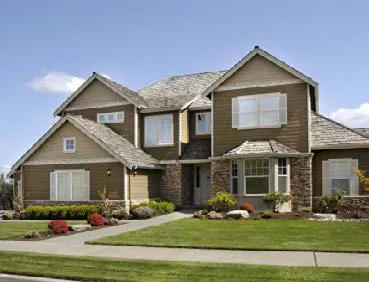
The facade of this home has been broken down into smaller components to reduce the appearance of mass.
General Design Standards and Guidelines
Section titled “General Design Standards and Guidelines”- For single-family subdivisions, provide variation in the streetscape with different heights, setbacks, and roof shapes of buildings.
- To maintain a compatible scale and massing of streetscape, provide that the rhythm, size, and proportions of openings (windows, doors) be compatible with each other.
- The mass of a larger structure should be broken down into smaller components that are similar in scale to other buildings in the neighborhood.
- Reduce the appearance of mass of the upper stories on two and three story homes.
- Facades should be articulated to break up the surface, add interest, and reduce the appearance of mass.
- Roof style and articulation should be compatible and in context with that of the subdivision or the existing neighborhood.
2.3.3 Design For Privacy
Section titled “2.3.3 Design For Privacy”Design Principles
Section titled “Design Principles”For projects subject to design review per Section 2.0, ensure that new single-family residential buildings in existing neighborhoods or additions in existing neighborhoods and those in new residential subdivisions are designed and constructed to protect the privacy of adjacent residential properties. This principle recognizes that adjacent residential properties have the ability to construct two-story structures consistent with zoning standards.
Rationale
Section titled “Rationale”Building height, the placement of windows and entries, setbacks, and landscaping all contribute to the level of privacy between adjacent properties. New two-story buildings with windows directly facing an adjacent residential home and private yard may adversely affect the privacy of adjacent units and shall be avoided.
Figure 2.4: Single-family privacy protection
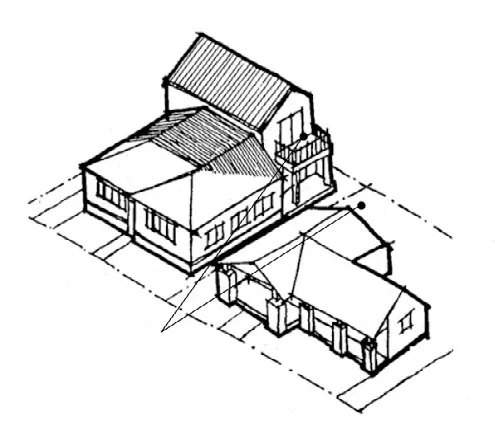
Privacy of the adjacent neighbor is impacted by the neighboring second-floor balcony.
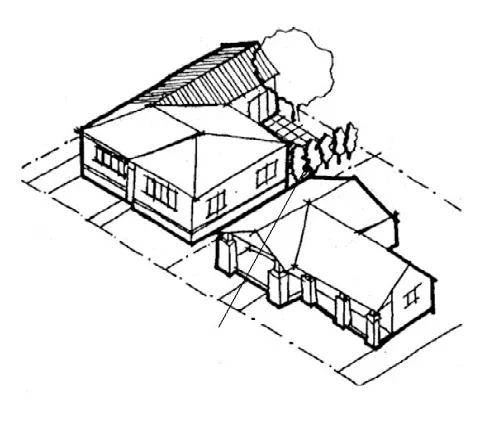
The direct view of the adjacent property is screened, respecting that neighbor’s privacy.
General Design Standards and Guidelines
Section titled “General Design Standards and Guidelines”- For projects subject to design review per Section 2.0, new two-story residential buildings directly adjacent to one-story residential buildings, should respect the privacy of adjacent one-story buildings (Figure 2.4).
- The direct line-of-sight between dwelling units, specifically bedrooms and bathrooms, should be avoided by orienting windows, balconies, and entryways so they do not directly face into adjacent property windows or private open space.
- Landscaping should be used as screening to enhance residential privacy.
2.3.4 Architectural Styles
Section titled “2.3.4 Architectural Styles”Design Principles
Section titled “Design Principles”For projects subject to design review per Section 2.0, building design should respect, enhance, and contribute positively to the predominant characteristic developments in the neighborhood. New homes in existing neighborhoods should be designed in a cohesive architectural style that complements the best examples of existing residential development on the block. If there is a mixture of styles on the block, then the design of infill construction may be more flexibly interpreted.
Rationale
Section titled “Rationale”Quality in detail and design contributes positively to the neighborhood. The use of cohesive, but different architectural “styles” and materials is intended to add variety to the buildings as is often found in neighborhoods that have evolved over time.
General Design Standards and Guidelines
Section titled “General Design Standards and Guidelines”- For single-family subdivisions, the building styles along the same street should be complementary and coordinated yet diverse. Variation of architectural styles along the same street is appropriate if the overall massing, form and setbacks of the homes is compatible.
- Production home development projects should provide a minimum of four different housing product types.
- New stylistic interpretations of traditional architecture are encouraged, but fundamental design principles such as proportions, scale, shapes and rhythm shall be utilized.
- Architectural features and detailing should be proportional to the scale of the home, as well as to other homes of a similar architectural style in the surroundings.
- Individual elements of a structure should be consistent with that structure’s overall design or style.
- No building facade shall consist of an unarticulated blank wall or unbroken series of garage doors.
- The structure should have appropriate finishes on all sides to provide continuity. Materials should appear substantial and integral to the structure; and shall be durable so as not to readily succumb to weathering and aging. Material changes not accompanied by changes in plane appear “tacked-on” and are strongly discouraged.
- For most architectural styles, exterior colors should be in context or compatible with those in its neighborhood.
- Corner lots should present attractive facades to both adjoining streets through elements such as wraparound porches, bays, entries, window treatments, and use of alternative materials such as brick and stone.
- Provide windows with views onto outdoor spaces for additional security and visual interest. Active uses, such as kitchens and living rooms, are encouraged to the front of the building for more “eyes on the street.”
- Energy conservation strategies should be employed including window shading devices, selection of colors to reduce heat gain, cool roofs, whole house energy systems, and use of high-quality insulation materials and radiant barriers to reduce energy consumption (especially the use of air conditioning during hot summer months), to the greatest extent possible.
- Inclusion of rain gardens and rain barrels to capture roof runoff is highly recommended.
- Use of recycled paint and other quality recycled materials is encouraged.
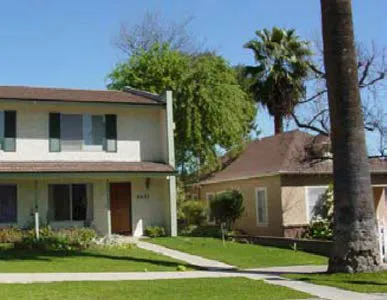
Inappropriate, incompatible scale and mass of newer infill housing on the left as compared to the preexisting house on the right
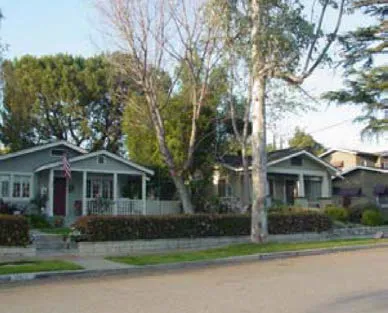
Appropriate, compatible scale and mass
2.3.5 Architectural Details
Section titled “2.3.5 Architectural Details”Design Principles
Section titled “Design Principles”For projects subject to design review per Section 2.0, buildings should be well articulated through building elements such as the roof, entryway, windows, porches, balconies and decorative trim, which should be stylistically cohesive and proportional to the overall structure. Color, materials, and texture should convey a high-quality appearance and shall be complementary to the surrounding area. Products shall be of a quality that is durable and does not readily show signs of weathering and aging.
Rationale
Section titled “Rationale”Use of stylistically cohesive, character defining elements enhances visual compatibility and attractiveness of the building. Use of appropriate details maintains the authenticity of the building style, and can help to create a well-articulated building facade and scale.
2.3.5.a. Elevations and Facades
Section titled “2.3.5.a. Elevations and Facades”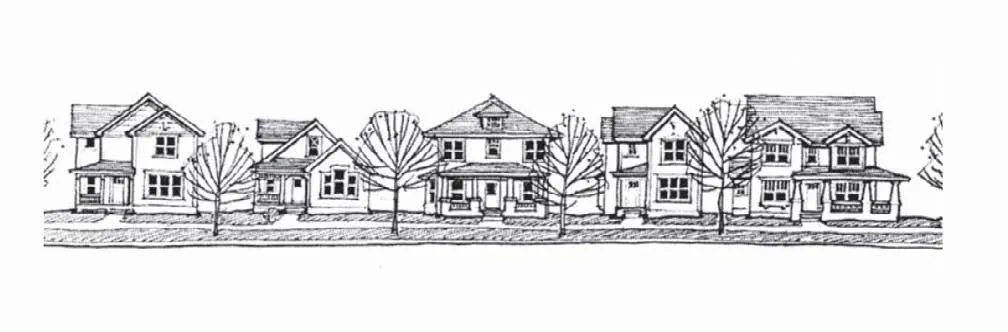 Figure 2.5: Streetscape diversity is achieved through different models and architectural treatments.
General Design Standards and Guidelines
Section titled “General Design Standards and Guidelines”- Attractive, well-articulated building facades should be created. Articulation can be achieved with windows, setbacks, entries, porches, and/or balconies. All elevations should be given design treatment with particular emphasis on those seen from the street or public way.
- Variety in use of materials is desirable. For projects in existing neighborhoods subject to design review per Section 2.0, the materials should complement existing neighborhood context.
- No building facade shall consist of an unarticulated blank wall or an unbroken series of garage doors.
- The structure should have appropriate finishes on all sides to provide continuity. Materials should appear substantial and integral to the structure; and shall be durable so as not to readily succumb to weathering and aging. Material changes not accompanied by changes in plane appear “tacked-on” and are strongly discouraged.
- For projects subject to design review per Section 2.0 and most architectural styles, exterior colors should be in context or compatible with those in its neighborhood.
- Corner lots should present attractive facades to both adjoining streets through elements such as wrap-around porches, bays, entries, window treatments, and use of alternative materials such as brick and stone.
- 🚶 Provide windows with views onto outdoor spaces for additional security and visual interest. Active uses, such as kitchens and living rooms, are encouraged to the front of the building for more “eyes on the street.”
- Energy conservation strategies should be employed including window shading devices, selection of colors to reduce heat gain, cool roofs, whole house energy systems, and use of high-quality insulation materials and radiant barriers to reduce energy consumption (especially the use of air conditioning during hot summer months), to the greatest extent possible.
- Inclusion of rain gardens and rain barrels to capture roof runoff is highly recommended.
- Use of recycled paint and other quality recycled materials is encouraged.
All elevations should be treated with the same high-quality details as the front of the house.
2.3.5.b. Roof Styles
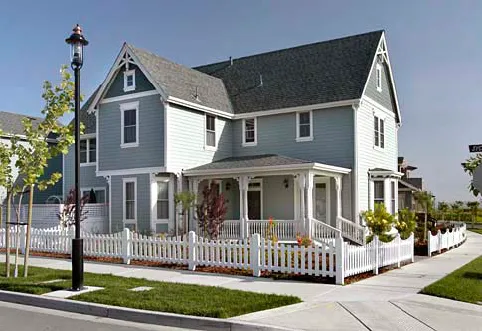
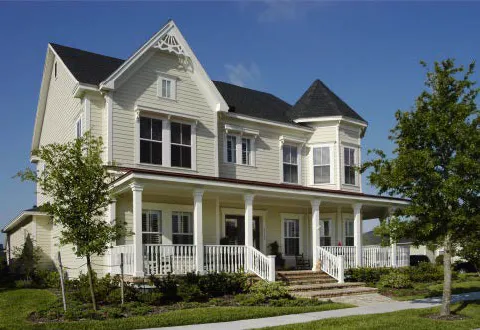
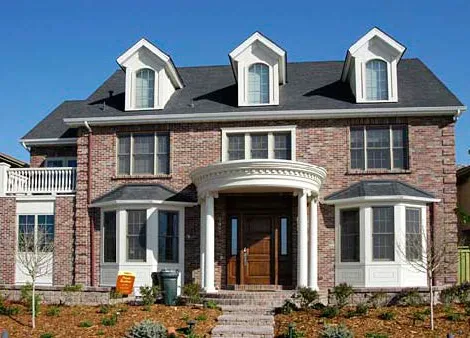
Section titled “2.3.5.b. Roof Styles”Coherent streetscape is achieved through consistent roof pitch.
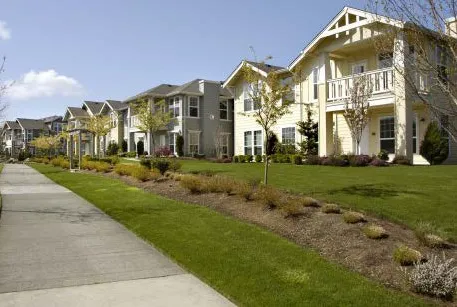
A series of gable dormers that are compatible with the scale of the main structure help break up the overall massing of the building while creating a rhythm.
General Design Standards and Guidelines
Section titled “General Design Standards and Guidelines”- Roof forms should be an integral part of the architectural design of the building. There should be a consistent relationship of slopes and pitches used on each building.
- For projects subject to design review per Section 2.0, the design of a roof on new homes in existing neighborhoods should fit in with designs of roofs on homes in the established neighborhood.
- For projects subject to design review per Section 2.0, new homes in existing neighborhoods should respect the primary roof pitch of the majority of existing homes on the block to allow for coherence of design, while displaying variety in details such as dormers and gable orientation.
- Flat roofs should be used only if it can be demonstrated that they fit in the overall design character of the neighborhood.
- Appropriate roof overhangs are encouraged to promote window shading and building longevity when appropriate to the architectural design of the home.
- Photovoltaic solar panels or solar shingles such as “solar slate” are encouraged to reduce the home’s use of energy from the grid.
- Homeowners are encouraged to consider roofing options that include recycled content.
- The use of “cool roof” options, including lighter colored, high albedo coatings and other “cool roofing” materials and applications are encouraged to achieve energy efficiency inside homes and reduce the heat island effect.
- The use of rooftop solar or wind turbine installations (where allowable) should be integrated into the overall home image and be non-obtrusive on the neighborhood imagery.
- Installation of radiant heat barriers and insulation in attic and rafters is encouraged to increase energy efficiency and interior livability.
2.3.5.c. Entry Features
Section titled “2.3.5.c. Entry Features”General Design Standards and Guidelines
Section titled “General Design Standards and Guidelines”- Entry features are encouraged on all new homes.
- Entry features should be built to a minimum depth of six (6) feet; however, shallower entry features will be considered with justification.
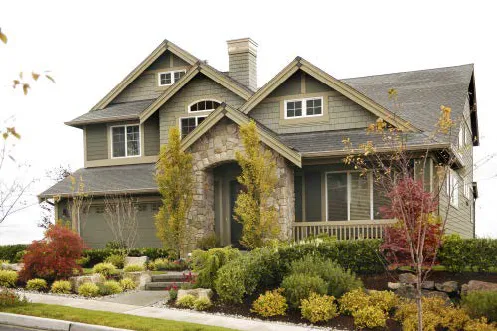
- The scale and style of porch, entry and portico elements should be consistent with the scale and style of the home and incorporate CPTED principles.
- Porch columns and railings should be constructed of high-quality materials that complement the materials used in the overall exterior of the home.
Raised porch and portico element with stone veneer accent.
2.3.5.d. Doors
Section titled “2.3.5.d. Doors”General Design Standards and Guidelines
Section titled “General Design Standards and Guidelines”- Exterior doors should be constructed of appropriate materials that complement the style of the home and provide security to the occupants.
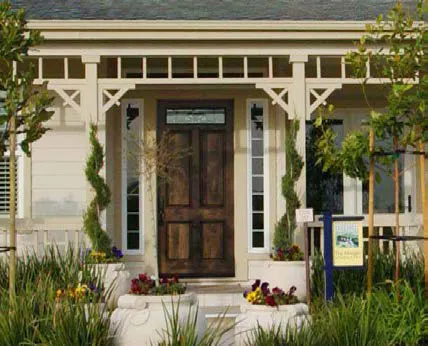
- Exterior doors should include raised panels, glass, or some other form of detailing and articulation.
- Horizontal sliding doors on main entries are highly discouraged.
Door with a transom window, sidelights and inset panels
2.3.5.e. Windows
Section titled “2.3.5.e. Windows”General Design Standards and Guidelines
Section titled “General Design Standards and Guidelines”- Windows should be designed to complement the style of the home.
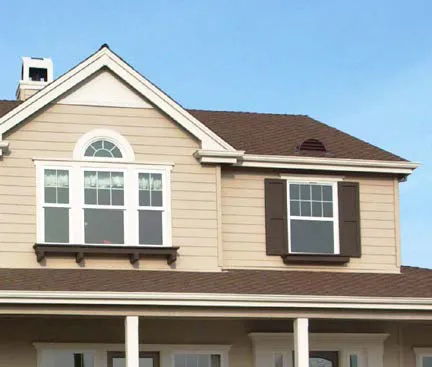
- Accent features such as sills, shutters, and canopies should be used at windows. Recessed windows should also be used where appropriate.
- A consistent window treatment should be used on all sides of the building.
- Reflective or tinted glass and opaque plastic skylights are discouraged.
- Provide overhangs or other shading devices, and select glazing that provides the greatest reduction in solar heat gain during the summer, when the sun is high overhead.
- Major glazing areas should generally face south to collect solar heat during the winter.
- Incorporate daylighting strategies such as: providing light shelves, glare control, courtyards, solar-tubes and skylights.
- Placement of windows should also consider the cooling benefits of Sacramento’s Delta breezes.
Various window features such as shutters and fanlight add interest to the building
2.3.5.f. SIDING
Section titled “2.3.5.f. SIDING”General Design Standards and Guidelines
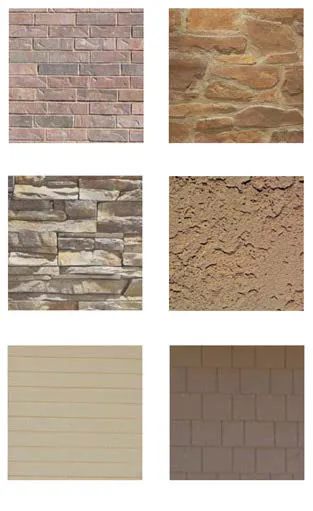
Section titled “General Design Standards and Guidelines”- For projects subject to design review per Section 2, use durable siding consistent with the style and character of the home. Siding materials for new homes in existing neighborhoods should complement the siding materials used on other homes on the block.
- Use high quality stucco application and appearance. The use of two materials, with one employed as wainscoting, can often add to the interest of the home, and lend a durable appearance.
- Highly reflective materials such as metals or glass should be avoided.
- Non-durable materials such as plastic, tin, and vinyl should be avoided.
- The color, texture, and bonding pattern of brick should be similar to established uses of brick in the neighborhood.
Examples of recommended building materials From left to right, top to bottom: Brick, Field ledge stone, Stacked stone, Stucco, Horizontal siding, Shingle siding
2.3.5.g. Lighting and Addresses
Section titled “2.3.5.g. Lighting and Addresses”General Design Standards and Guidelines
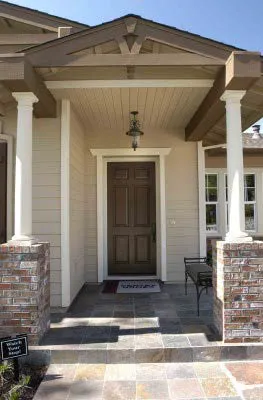
Section titled “General Design Standards and Guidelines”- 🚶 Exterior lighting contributes to the security of the home and should be pedestrian-oriented. Lighting fixtures shall provide adequate illumination of the front entry and building addresses so that both are clearly visible from the street, following CPTED guidelines. Recessed entryways should be clearly lit.
- The preferred location to display the address is affixed to the front of the home, clearly visible from the street.
- Exterior lighting should minimize light pollution caused by glare or spillage onto neighboring properties.
- In addition to the standards set forth in this section and 2.4.1 site and street lighting shall comply with Section 5 (Street Light Design) of the Sacramento County Improvement Standards.
- Energy efficient lighting strategies, including placing lights on timers or sensors, should be applied.
- Nighttime pollution of the sky is discouraged by following illumination levels required for safety per Illuminating Engineering Society of North America (IESNA).
Lighting fixtures should be of high quality, and recessed entryways clearly lit.
2.3.6 Garages
Section titled “2.3.6 Garages”Design Principle
Section titled “Design Principle”The garage should be placed in a way that minimizes its prominence on the public street. A range of different placement options is encouraged within the same block to create visual interest along the street. Garages on alleys are encouraged.
Rationale
Section titled “Rationale”De-emphasizing the appearance of the garage from the public street or open space and place higher emphasis on the active spaces such as the front entryway and porch enhances the streetscape and the pedestrian experience.
Design Guidelines
Section titled “Design Guidelines”- Varied planes and setbacks should be used for three or more adjacent garage doors.
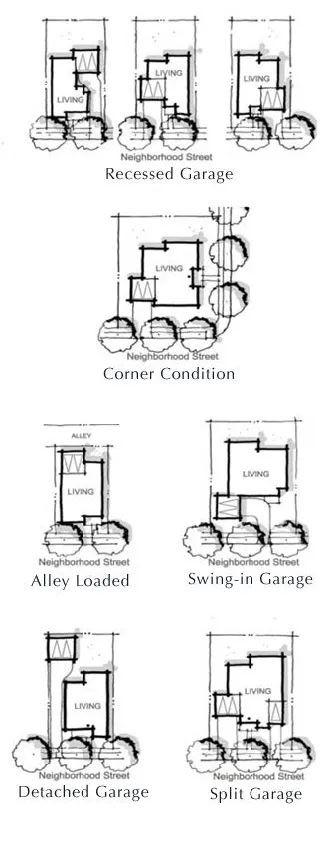
- A variety of garage placements should be created on the same block in order to de-emphasize garage doors and avoid garages from dominating the streetscape and the front of the house. Recessed garages, and garages placed at the side or rear of the home, are encouraged.
- Reduce the amount of expansive side-by-side concrete driveways by alternating the location of the garage so that two garages are not located side-by-side in single family developments, when feasible to do so.
Figure 2.6: Various garage and driveway orientation examples.
2.4 Landscaping / Site Elements
Section titled “2.4 Landscaping / Site Elements”The landscaping of a neighborhood has a major impact on establishing its character, sense of place, property values and livability. The landscaping of both the public and private spaces along a street contribute to how a neighborhood feels and how the street is used by its residents. People will walk more on safe and attractive tree lined streets. The trees’ natural canopies will also keep neighborhoods cooler during Sacramento’s seasonally hot days. Use of river friendly/drought-tolerant landscaping conserves water while remaining attractive year round. Site elements such as walls, fencing, sideyards, utilities, and storage enclosures, are an important ingredient of these landscapes and must be well designed as an integral part of the overall neighborhood. Placement of street furniture or a small corner plaza in key parts of the streetscape provides elements of public spaces to be enjoyed.
2.4.1 Planting and Landscaping
Section titled “2.4.1 Planting and Landscaping”Design Principle
Section titled “Design Principle”Residential subdivisions shall have a coherent overall landscape strategy including street trees as part of a “complete streets” design. Large common areas in the public realm should be considered for special landscape design treatment with public art as a consideration. Additionally, on-going maintenance of landscapes is essential to ensure long term neighborhood sustainability and success.
Individual residential lots should be designed to maximize opportunities for usable, attractive, and well-landscaped open spaces. Landscaping should complement the architectural design. The design and placement of driveways and walkways should allow for a maximum amount of “meaningful” landscaping to be incorporated into the site design. A variety of plantings should be selected and provided appropriately for their intended use. Special consideration should be given to creating environmental benefits, such as providing shade, using native drought tolerant planting, treating and/or reducing stormwater runoff, and providing habitat for the local species. All landscaping plans shall be coordinated with requirements of the Water Conservation Ordinance.
Rationale
Section titled “Rationale”Treatment of the landscape in the public and private areas is a major component of neighborhood creation, character, and compatibility. Landscaping can be used as a strong complement to buildings and to make a positive contribution to the aesthetics and function of the specific lot, building, and area. Landscaping of the individual lot can also provide for a smooth transition between the public and the private area and improve the safety along the streets. Landscaping and landscape maintenance are critical components of any successful residential project and shall be considered an essential part of the design and construction process, particularly for single-family residential developments.
Planter strip along a local residential road is planted with native vegetation and utilized as a stormwater treatment device.
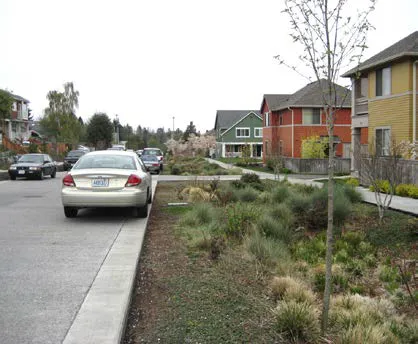
2.4.1.A Planting
Section titled “2.4.1.A Planting”Design Guidelines
Section titled “Design Guidelines”- Incorporate trees, shrubs, plants, groundcover, and grass areas within single-family development projects to create a well-designed landscaped environment for residents and those viewing from public areas.
- Front yard areas should be designed using landscape elements pertaining to form, horizontal and vertical lines, hardscape and softscape, and ornate qualities that are compatible to the primary structure.
- Visual openness should be maintained in front yards to provide for visual surveillance of the street and sidewalks.
- Visual focal points such as sculpture and public art are strongly encouraged to be integrated into subdivision common area landscaping.
- 🚶 To the extent feasible, existing mature trees and shrubs that represent existing significant landscaping shall be preserved.
- All plants should be given enough space to grow to their natural size.
- 🚶 Provide street trees in the front and side street yards of residential lots, consistent with Section 5.2.4.C of the Zoning Code.
- Air conditioning/mechanical equipment and trash enclosures should be placed out of view from the public right-of-way and should be screened with landscaping. Shading air conditioning equipment helps conserve energy.
- Unpaved areas should be planted with irrigated plant materials, and mulched where landscaping would be challenging to minimize weed growth and improve appearance.
- 🚶 For subdivisions, planting strips located between the sidewalk and street should be at a minimum six (6) feet wide to allow for a mature tree to grow. Planting strips less than six (6) feet wide must be consistent with the improvement standards and still provide for the planting of smaller canopy trees.
- 🚶 Provide sidewalk shading with the planting of street trees in the public realm, consistent with the County Improvement Standards.
- For subdivisions, marked entries should incorporate landscaped open space areas. Enhanced parkways and tree lined medians can create an attractive entrance and are encouraged.
- Various water conservation measures and systems to capture and treat stormwater should be employed through landscaping to the extent feasible, in accordance with the Water Conservation Ordinance and the River Friendly Landscape Design Toolkit.
- Primary selection of trees and plant species should be from the California native palette and other drought tolerant species. Invasive species are strongly discouraged (Refer to Table 2.3 for a list of suggested native plants selection).
- Hydrozoning-grouping plants by water needs for irrigation water efficiency should be implemented.
- Low water use groundcovers or plants should be planted. Use of high input water consuming decorative lawns is discouraged.
- Deciduous trees and shrubs that shade the west and south sides of the home are encouraged to minimize solar heat gain of the building.
- Shade trees should be strategically planted to shade pavement areas and air conditioners.
- Trees that become diseased, die or require removal, should be replaced in order to sustain the tree canopy and benefits provided by the landscape palette.
- Bare soils should be planted or mulched with bark, stone, or other suitable materials to avoid unnecessary runoff.
- Bio-retention areas or “rain gardens” are encouraged in the front and rear yard, where feasible.
- Utilize the River Friendly Landscape Design Toolkit for the new California landscape.
- Reduce yard waste by utilizing River-Friendly landscaping practices such as carefully selecting the right size plants for the yard, mulching, and providing for composting.
- For new subdivisions, street-side landscaping areas should be depressed and planted with native vegetation. Open curbs or curb cuts should be provided to allow for stormwater collection into these areas for filtration/infiltration.
- Garden or raised beds for growing vegetables are encouraged.
- 🚶 Use of known high allergen plantings is discouraged.
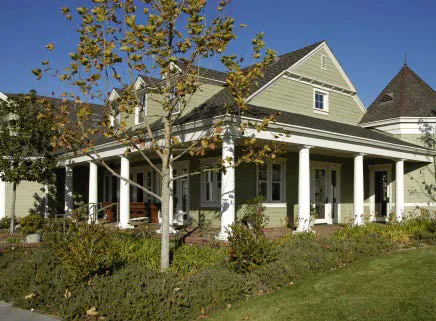
Shrubs and groundcover can provide a low-water landscape alternative to turf.
Native and low water-use ornamental plants can significantly reduce water consumption.
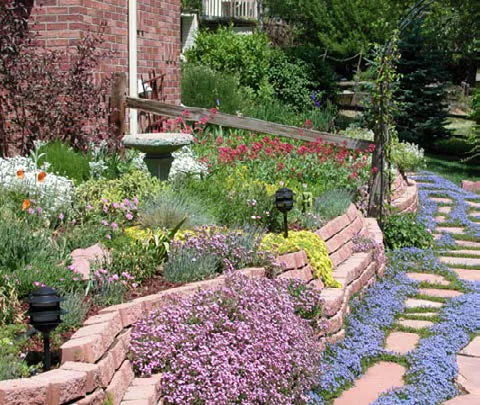
TABLE 2.2: INVASIVE PLANTS AND RECOMMENDED ALTERNATIVES
Section titled “TABLE 2.2: INVASIVE PLANTS AND RECOMMENDED ALTERNATIVES”(Source: River-Friendly Landscape Guidelines, Sacramento Stormwater Quality Partnership)
| LATIN NAME | COMMON NAME | NON-INVASIVE ALTERNATIVE |
|---|---|---|
| Cortaderia selloana C. jubata | Pampasgrass Jubatagrass | Leymus condensatus (Giant wildrye ‘Canyon Prince’) or Muhlenbergia rigens (Deergrass) |
| Cytisus scoparius C. striatus Genista monspessulana Spartium junceum Sesbania punicea | Scotch Broom Portuguese Broom French Broom Spanish Broom Scarlet Wisteria | Heteromeles arbutifolia (Toyon) or Ribes aureum (Golden Currant) or Salvia clevelandii (Cleveland Sage) |
| Eucalyptus camaldulensis E. globulus Tamarisk species | Red Gum Eucalyptus Blue Gum Eucalyptus Saltcedar | Populus fremontii (Fremont Cottonwood) or Quercus lobata (Valley oak) |
| Sapium sebiferum | Chinese Tallowtree | Cercis canadensis, C. occidentalis (Eastern Redbud, Western Redbud) |
| Hedera canariensis H. helix H. hibernica Vinca major Pennisetum setaceum | Algerian Ivy English Ivy Irish Ivy Big Periwinkle Fountaingrass | Achillea millefolium (Common Yarrow) or Ceanothus species (California Wild Lilac) or Heuchera maxima and hybrids Giant Alumroot/Coral Bells) Lavendula species (Lavender species) |
Figure 2.7: Samples of California Native and Drought-Tolerant Low Water-Use Plants
Section titled “Figure 2.7: Samples of California Native and Drought-Tolerant Low Water-Use Plants”California Native and Drought-Tolerant Low Water-Use Plants
 Nandina domestica
Heavenly Bamboo Harbour Dwarf
 Chitalpa X tashkentensis
Chitalpa Pink Dawn
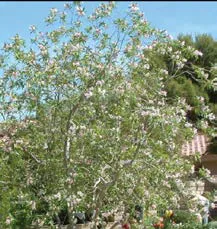 Leucophyllum zygophyllum
Cimarron Blue Ranger
 Perovskia x atriplicifolia
Lacey Blue Russian Sage
 Rhamnus californica Eve
Case Compact Coffeeberry
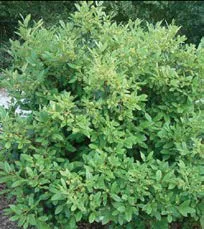 Salvia clevelandii
Winifred Gilman Blue Sage
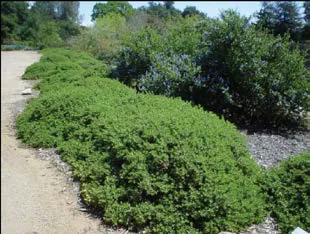 Salvia
Bee’s Bliss Creeping Sage
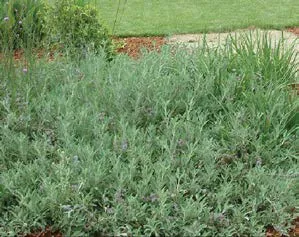 Baccharis pilularis
Twin Peaks #2 Ground Cover Baccharis

Ceanothus maritimus
Violet maritime ceanothus
2.4.1.b. Irrigation
Section titled “2.4.1.b. Irrigation”Design Guidelines
Section titled “Design Guidelines”- An automatic irrigation system that includes a controller with weather station, rain shut-off valves and sensors shall be installed and properly programmed in the front yard to provide consistent coverage of all planted areas consistent with the Water Conservation Ordinance. A home on a corner lot should have an automatic irrigation system that covers the yard fronting both streets.
- Turf and groundcover are more effectively irrigated with a conventional spray system. Head-to- head spray coverage is recommended. Avoid overspray onto sidewalks and adjacent properties.
- A drip irrigation system is recommended for vegetable beds, shrubs and trees to provide deeper, more even watering. Drip irrigation also permits greater water conservation than a conventional spray system.
- Irrigation controls must be screened from view by landscaping or other attractive site materials.
- Installation of rainbarrels, as an additional irrigation source, is highly encouraged.
Drip irrigation provides deeper watering and permits greater water conservation.
Figure 2.8: Single-Family Example #1 with Water-Conserving Landscape
Section titled “Figure 2.8: Single-Family Example #1 with Water-Conserving Landscape”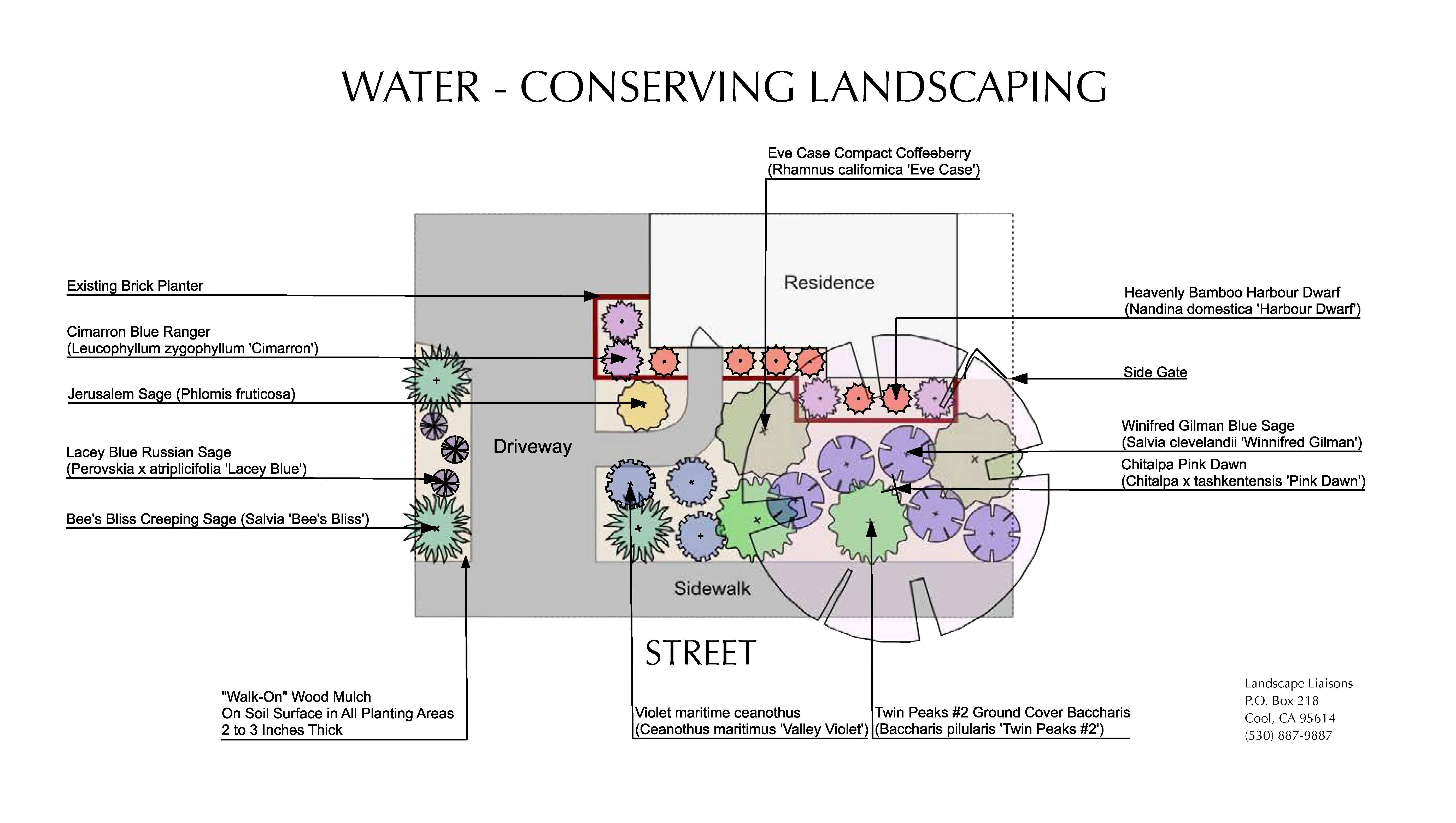
Figure 2.9: Single-Family Example #2 with Water-Conserving Landscape
Section titled “Figure 2.9: Single-Family Example #2 with Water-Conserving Landscape”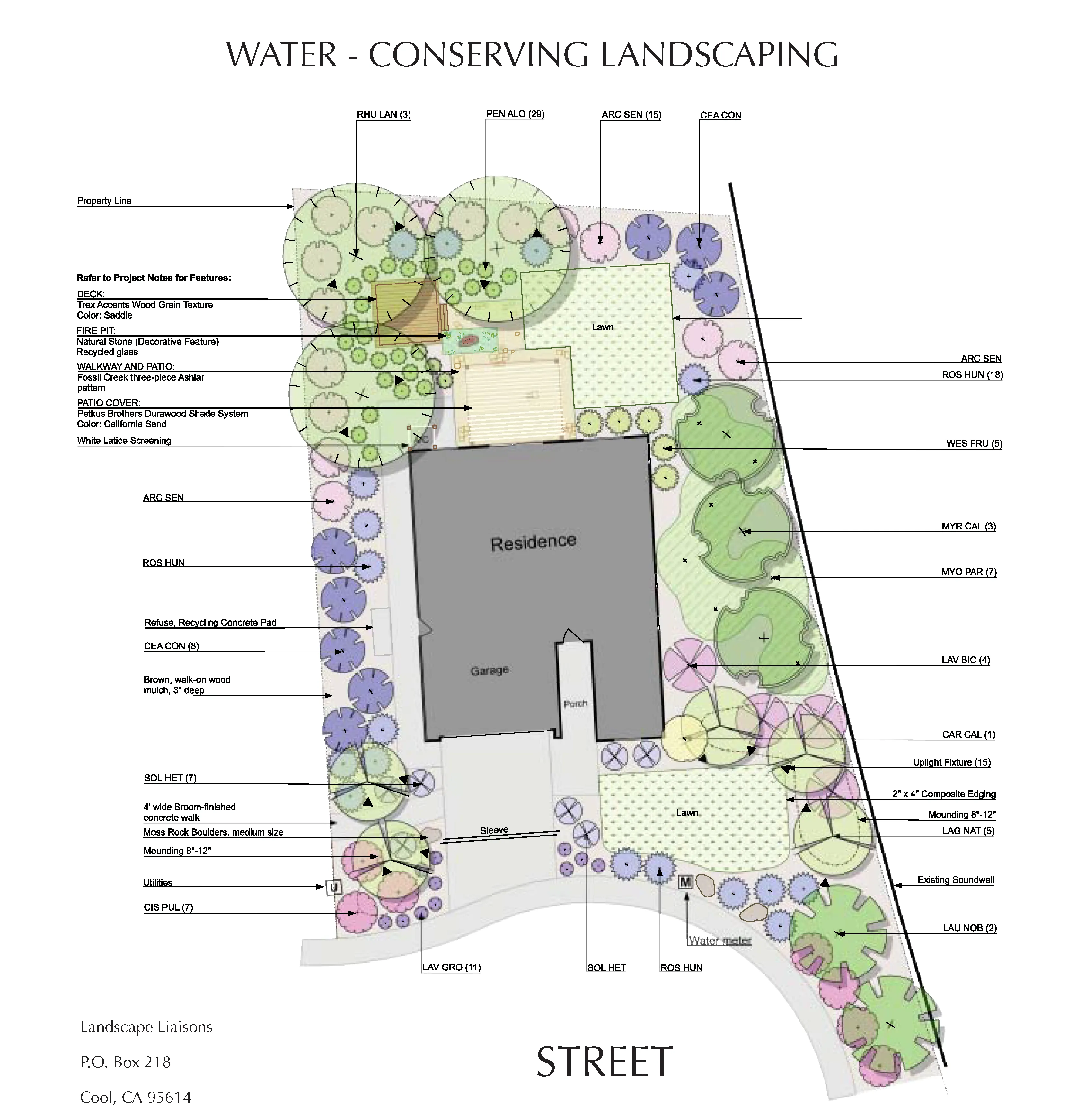
Figure 2.10: Single-Family Example #3 with Water-Conserving Landscape
Section titled “Figure 2.10: Single-Family Example #3 with Water-Conserving Landscape”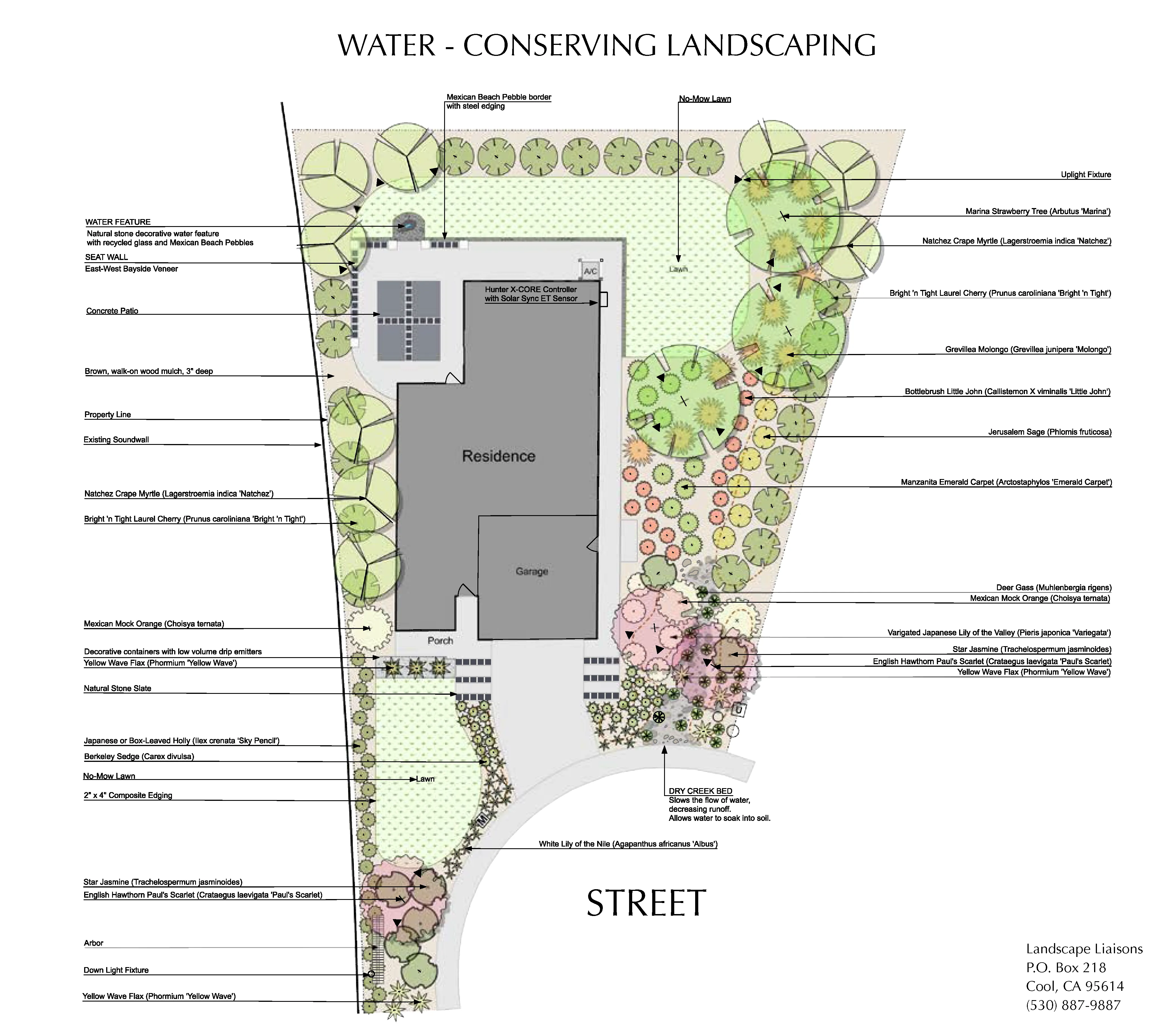
2.4.1.c. Paving And Hardscape Surfaces
Section titled “2.4.1.c. Paving And Hardscape Surfaces”Design Guidelines
Section titled “Design Guidelines”- The paving materials selected should contribute to the overall appearance of the home.
- Alternative paving surfaces, such as concrete pavers, brick, or stone are encouraged for driveway and walkway surfaces to reduce the appearance or large, paved areas. Use of pervious paving materials is encouraged.
- Alternative driveway and paving treatments (such as Ribbon or Hollywood driveways) are common in older neighborhoods and can provide guidance for new homes in existing neighborhoods for those projects subject to design review, per Section 2. Ribbon driveways are made up of two parallel strips of paving, with a strip of grass or pervious pavers between the paving strips to allow the rain water to soak in. This type of design minimizes impervious surfaces by only using conventional pavement on the area where a vehicle will be driving or parking, and not the surfaces between the wheels.
- Impervious surfaces should be minimized to the greatest extent possible to reduce stormwater runoff and urban heat island effect. Alternative paving surfaces such as permeable paver blocks and permeable concrete should be considered for driveways, walkways, and patios.
- Porous streets and sidewalks that allow stormwater to seep into the ground and adjacent drainage swales are recommended.
- Utilize cool pavement whenever possible to reduce urban heat island impacts.
- Integrate a variety of paving/hardscape treatments to reduce runoff and obtain the greatest benefits in cooling, groundwater infiltration and aesthetics.
Permeable interlocking concrete pavement combines stormwater infiltration, retention, and surface use (e.g. driveway) into one place, thereby reducing runoff volume.
2.4.2 Parks, Open Space and Drainage/Flood faCilities
Section titled “2.4.2 Parks, Open Space and Drainage/Flood faCilities”Design Guidelines
Section titled “Design Guidelines”- 🚶 Parks and open space should be integrated into neighborhoods to encourage outdoor recreation and preserve natural habitats. Size, type and location shall be sized and located as to support the community master plan goals.
- 🚶 Parks and open space should be strategically located in residential areas and be accessible via roadways, transit routes, and off-road pedestrian and bicycle trails and paseos (walkways) wherever possible.
- 🚶 Parks and open space areas should be used as methods to connect communities and neighborhoods and provide alternative modes of travel via sidewalks and trails.
- 🚶 Open space areas could be used to delineate community or neighborhood boundaries.
- 🚶 Neighborhood parks are encouraged to be centers of neighborhood activity and could be combined with schools, community recreation centers, libraries and other civic uses.
- Parks and open space areas should include linear parkways with off-street trails integrated with the transportation system. Public Safety is a high priority and CPTED principles should be applied to the design of off-street trails.
- Flood protection and drainage facilities shall be designed to provide multiple public benefits wherever possible. Facilities shall include multi-purpose improvements consisting of recreation, the environment, storm water runoff, water reclamation, infiltration, groundwater recharge, flood control, etc. Attractive land use basins, such as parks (in addition to Quimby land dedication requirements) or parkways with trails that also convey water to water quality basins or similar facilities and provide some water quality treatment are examples of desired multiple public benefit facilities.
- Open space should be connected to provide habitat corridors through urban environments.
2.4.3 Walls and Fences
Section titled “2.4.3 Walls and Fences”Design Principle
Section titled “Design Principle”Fencing must be of high-quality and durable materials that will enhance the overall character of the home and contribute to the positive appearance of the neighborhood.
Rationale
Section titled “Rationale”Well selected fencing adds to the overall character of the neighborhood while providing for privacy, security, and also visual surveillance of the public realm.
Design Guidelines
Section titled “Design Guidelines”- Fencing shall be located and constructed in conformance with the Zoning Code, Title III, Chapter 1, Article 5 “Regulations Pertaining to Walls and Fences.”
- Fencing must allow unobstructed visibility of the front entrance, and in the case of homes on corner lots, the front and any side entrances.
- The style, materials, and color of the fencing should complement the style, materials, and color of the home.
- High-quality materials, including wood, metal, stucco, and some forms of vinyl fencing, are acceptable fencing materials.
- Chain link fencing is highly discouraged for use as a front yard feature.
- Front yard fencing for new homes in existing neighborhoods is discouraged on blocks where the majority of the homes do not have front yard fencing.
- Landscaping shall be included as part of the design for any fence or wall and should be used to soften and screen large masses of blank walls.
- When fencing is proposed, a combination walls and fences using decorative fence elements such as tubular steel is preferred. Solid block walls shall use decorative block, pilasters and capping where visible to the public, consistent with the Zoning Code.
- Landscaping shall be included adjacent to a wall when open to public view and should be used to soften and screen the hard edge appearance of the wall, consistent with the Zoning Code.
- Use of materials that are consistent with the style of the home is encouraged.
Front yard fencing marks the transition from the public to the semi-private realm while allowing views to penetrate into the property.
Heavy landscaping reduces the visibility of a solid rear-yard wall and softens the hard edge appearance.
2.4.4 Utilities and Service
Section titled “2.4.4 Utilities and Service”Design Principle
Section titled “Design Principle”The visibility of utilities and storage facilities should be minimized by placing them at the side or rear of the home and screening them from view from the public street or open space.
Rationale
Section titled “Rationale”Utilities and service features are less attractive but necessary parts of a home. By placing these features away from public view and screening them, using fences and landscaping, the aesthetics of the neighborhood can be improved.
Placing mechanical units in suitable locations such as sides and niches of buildings, and screening from public view reduce visual impact.
Design Guidelines
Section titled “Design Guidelines”- Trash receptacles should be placed in the side or rear yard and adequately screened by landscaping or side yard fence. Trash areas should be designed to accommodate recycle bins. If trash receptacles are to be stored in the garage the garage must be able to allow user access to them.
- Storage sheds should be located in the rear yard and shall comply with setback requirements. Placement in the side yard is acceptable if the shed is adequately screened by landscaping or a side yard fence, when proposed with the initial home construction.
- Accessory structures should be similar in character and materials to the main building, but subordinate in massing, scale, and height when proposed with initial home construction.
- Antennae should be mounted at the rear of the home. Satellite dishes should be mounted on the home to minimize their visibility.
- Heating and cooling units should not be roof-mounted or placed at the front of the home. Heating and cooling units should be placed in the attic or at the side or rear of the home and screened by a side yard fence or landscaping. Solar panels do not need to be screened.
- Wherever possible utilities should be undergrounded.
- Where feasible, heating, ventilation, and air conditioning units should be placed on the north side of the primary structure or garage (if not the street side) to shade the units and minimize energy consumption.
- All new HVAC equipment shall meet SMUD’s latest guidelines for energy efficiency.
- Installation of building integrated solar panels and micro wind-turbines on the roof are encouraged and not precluded by any of the guidelines in this document.
- All new homes are subject to the State of California’s Building requirements. Efforts should be made to advance energy reductions and enhance conservation efforts to achieve the zero-net energy 2020 goals for new homes.
- Home electric vehicle chargers are encouraged.
- Plumbing systems that provide outdoor plumbing connection for use in greywater irrigation are encouraged, consistent with health requirements.
- Refer to the commercial design guidelines Section 4.4.6 for guidelines for wireless communication facilities.
The visibility of utilities and storage facilities shall be minimized by placing them at the side or rear of the home and screening them from view.
Footnotes
Section titled “Footnotes”-
If proposed residential development or other lot division request is in coordination with a rezone, the requirements for Design Review will be determined based on the proposed zoning designation. ↩
-
Building and landscape design proposed after a lot division within a non-single-family residential zoning district is approved, pursuant to Section 6.3.2.A, requires a Design Review regardless of Conditions of Approval. ↩