

4.0 Commercial Design Guidelines
Countywide Design Guidelines
Chapter 4: Commercial Design Guidelines
Section titled “Countywide Design Guidelines Chapter 4: Commercial Design Guidelines”The purpose of this chapter is to provide overall planning and sustainable design principles and guidelines for commercial projects. Commercial projects are divided into three forms: commercial districts, commercial corridors, and commercial centers. Commercial districts occur as major centers of regional or subregional commercial activity. Commercial corridors contain commercial activity and bisect many neighborhoods and often are public transit corridors. Commercial centers are smaller in scale and serve the commercial needs of the neighborhoods nearby. Projects within these three types are subject to the Commercial Design Guidelines which have the goal of providing commercial projects that are well designed to meet the community design goals of the Sacramento County General Plan.
Many existing commercial districts, corridors, and centers are characterized by their auto-oriented commercial past, individually developed projects and sites, and franchise architecture. Many of these older commercial developments require revitalization. These Commercial Design Guidelines are to be used to guide this revitalization and to provide standards for new commercial development in the County.
4.1 Understanding Context: Commercial Districts
Section titled “4.1 Understanding Context: Commercial Districts”Projects in commercial districts should further the economic and image objectives for the district and advance healthy and sustainable communities in the County. Each project should contribute to the streetscape, pedestrian and auto access objectives, architectural and signage design objectives for the site and surrounding area. To do this, projects will need to be planned and designed to complement both existing and anticipated future investment. Project applicants need to consider the following questions.
- Site connections: How can driveway and sidewalk connections increase the connectivity and accessibility to the site from adjacent neighborhoods and development?
- Building alignments: What are the typical building and landscape setbacks along public streets?
- Streetscape and landscape design: What type trees exist along public streets? Is there a landscape plan for the corridor or district?
- Roadway and parking lot design: How can parking lots and driveways be designed to increase connectivity and safety for pedestrians, people with disabilities, and bicyclists in the district?
- Architectural context: What are the strongest architectural features in the district and how can the project complement these themes or ideas?
- Signage design: How can an overall signage concept contribute to the graphic identity of the project and the district?
It is the intent that the response to these issues shall be based on these Commercial Design Guidelines and that they are evaluated on a community life cycle basis to maximize community benefit over time and encourage projects that serve as a catalyst for positive change.
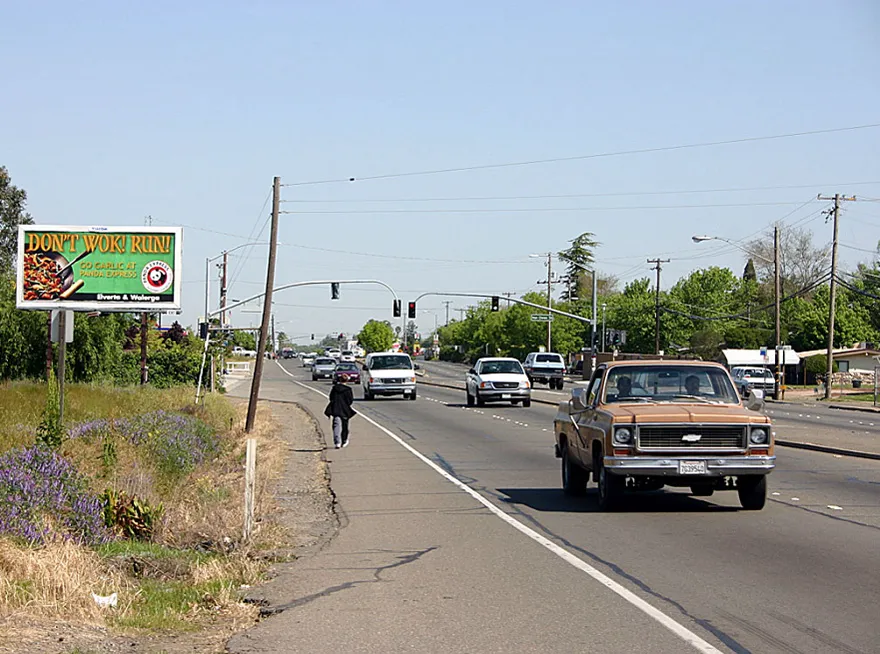
Many of Sacramento County’s commercial corridors were developed with a lack of focus on pedestrian safety, access and comfort; shared access to businesses to reduce cuts; and landscaping and undergrounding of utilities
4.2 Commercial District Site Design Principles and Guidelines
Section titled “4.2 Commercial District Site Design Principles and Guidelines”Commercial projects of all sizes should be planned and well designed as distinctive and competitive addresses with an emphasis on connections to the surrounding community. Their design should emphasize health and sustainability principles with strong provisions for pedestrian, people with disabilities and bicyclist access.
4.2.1 Community Design Objectives
Section titled “4.2.1 Community Design Objectives”Renovated and new development should reflect the implementation of community design principles and concepts for commercial districts, corridors, and projects.
Design Guidelines
- 🚶 Renovated and new projects should be designed to reinforce sustainable planning and design objectives for the surrounding district and neighborhood. This could include creation of gateways, tree-shaded parkways, open spaces, an interconnected system of pedestrian ways, or other design features.
- Renovated and new projects should be designed to reinforce sustainable planning and design objectives for the surrounding district and neighborhood. This could include creation of gateways, tree-shaded parkways, open spaces, an interconnected system of pedestrian ways, or other design features. Innovative project design is encouraged, so long as these designs respect the building form and scale of the surrounding area, with consideration of building heights, setbacks, orientation, architectural style, and landscape transitions.
- Renovated and new projects should be planned and designed so that the siting and shape of buildings contribute to the district’s identity and urban design concepts. This could include orientation and siting of buildings, composition of roof forms, and architectural treatments.
- The frontage of primary commercial roadways and connecting side streets should be enhanced by the design of commercial buildings and centers. They should improve streetscape, building edge and land use continuity. Service areas should be located so as not to disturb pedestrian circulation, land use continuity, or the function of adjacent land uses.
- 🚶 Providing openings to fences and sound walls can provide pedestrian and bicycle connections to adjacent neighborhoods and should include “live-end” features. Also used in cul-de-sacs, “live-ends” provide for pedestrian access at the ends to adjoining streets, open spaces, parking lots while permitting the access point to be used as a common outdoor space. “Live-ends” should be landscaped and can include benches, providing nice areas for sitting and socializing.
- 🚶 Paseos should be utilized to provide common outdoor spaces and allow for pedestrian access through the development, and connection to adjacent developments.
- Building and parking setbacks should be designed as an extension of the urban design concept for the district, neighborhood, or center. This includes the depth, edge treatment, pedestrian facility and landscaping of setback areas.
- 🚶 Renovated and new projects should support urban design concepts with open spaces that create gateways, act as collectors for pedestrian systems, or provide a social focal point for a project and the surrounding district.
- Renovated and new projects should have signage and graphic identity concepts that support both project and district planning and economic objectives.
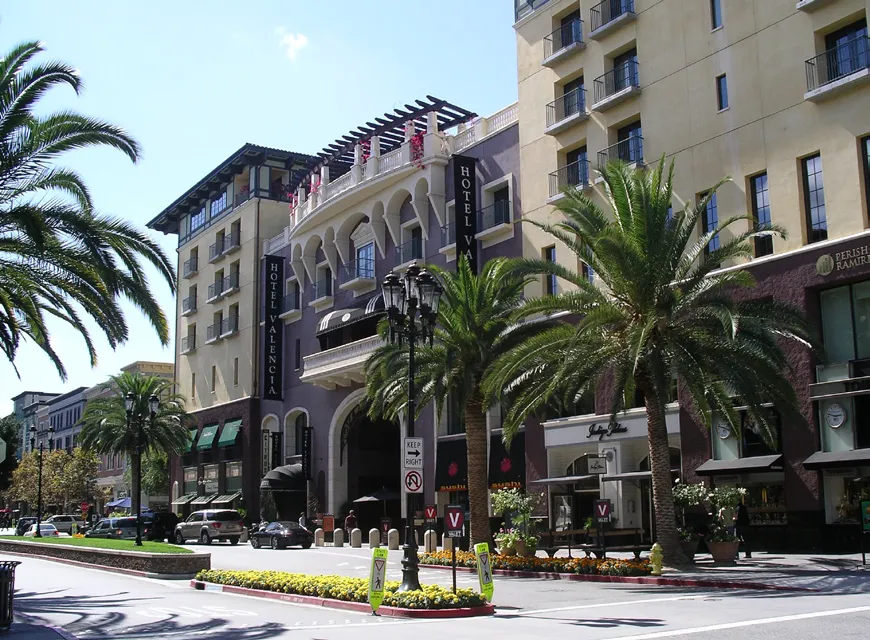
This street demonstrates desirable elements in a suburban street. It has a planting strip and pedestrian scaled lighting, and planting along parking areas. It combines the pedestrian friendly elements of shopping streets with the transportation needs of suburban streets.
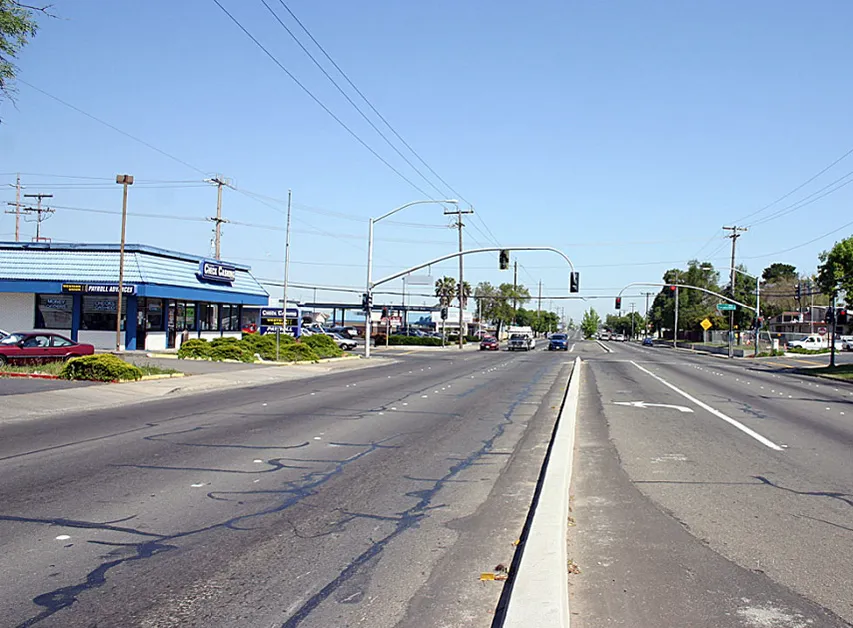
A typical commercial corridor street with a hodge-podge of streetscaping, curb cuts, building setbacks, and signage
4.2.2 Roadway Design and Streetscaping
Section titled “4.2.2 Roadway Design and Streetscaping”Landscape, lighting and signage for every project should contribute to the implementation of streetscape principles and concepts for commercial corridors or districts. Streetscape and landscaping should promote pedestrian activity and provide for pedestrian safety, access, comfort and connections while contributing to overall placemaking and objectives for commercial districts or centers. Landscaping and trees can be used to complement buildings and to make a positive contribution to the aesthetics and function of the specific site and area. These aesthetics contribute to the mental and emotional well-being of customers, and support economic activity. Landscaping helps reduce storm water runoff, filters water and captures carbon and air particulates to improve air and water quality, provides shade during summer months and lowers temperatures reducing heat island impacts.
It is the intent that projects be evaluated on a community life cycle basis to maximize community benefit over time and encourage projects that serve as a catalyst for change.
Design Guidelines
- 🚶 Renovated and new projects should have an inter-connected system of roadways, pedestrian walks and sidewalks. This system should connect to the district and neighborhood and should be safe and attractive to pedestrians and invite walking activity.
- Projects should possess an overall landscape and streetscape concept plan. The plan should reinforce the placemaking, connections, and shopping environment objectives for the project and surrounding district.
- Projects should provide an overall street lighting and furniture concept plan. The plan should identify the types and location of lighting fixtures and furniture. The lighting and furniture should be a coordinated “family” with color and style that complements site and architectural concepts and invites shoppers to use it. The lighting plan should use fixtures that are energy efficient, contribute to a safe environment and reduce impacts on dark skies.
- 🚶 Roadway and street design should incorporate various methods of traffic calming to support pedestrian circulation and active transportation objectives. This could include changing paving materials in crosswalks, undulations, reduced speeds, flashing beacons, etc.
- Use accent paving such as textured paving and paving blocks in driveways. Use of permeable concrete, cool pavements and pavers is desirable. Minimize and share driveways wherever possible.
- 🚶 Along streets with greater than 50,000 vehicles ADT, plant trees conducive to absorbing particulates including deodar cedar, valley oak, and redwoods. Utilize canopy trees for pedestrian areas to increase shading, cool the pavement and support walking.
Enhanced Suburban Street: Consists of detached sidewalks, auto-scale lighting and signage, landscaping added to public ROW, setback buildings, consolidate curb cuts, and connect parcels
Storefront Street: Consists of planting strip and street trees in ROW, pedestrian-scale lighting and signage, buildings along the street edge, connected sidewalks and storefronts, interconnected parking and drives, and parking behind buildings.
Hybrid Street: Consists of planting strip and street trees in ROW, pedestrian-scale lighting, Pedestrian and auto-scaled signage, some buildings along the street edge, connected sidewalks and storefronts, interconnected parking and drives, and parking behind or next to buildings.



4.2.3 Building Setbacks and Alignments
Section titled “4.2.3 Building Setbacks and Alignments”Buildings in established commercial addresses should have setbacks that support streetscape, circulation and image objectives for the district.
Design Guidelines
- 🚶 Buildings should be sited and designed to reinforce the pedestrian experience. Building edges should be transparent and provide a visually interesting shopping experience at a pedestrian’s pace.
- Buildings and centers should align and design building edges with adjacent projects so that they support overall urban design objectives for the district and shape and activate spaces and streetscape, and are compatible with adjacent projects yet balanced against the Design Guidelines.
- Building setbacks should contribute to overall streetscaping concepts for the district. The setbacks should be sized to support the size and spacing of trees and visual continuity of the district.
- When a project is located within a district with a design plan, or within an urban context including suburban locations in transition, shopping centers should define public street frontage with building edges and storefronts.
- 🚶 Urban and suburban areas in transition are generally the commercial corridors in existing communities. Shopping Centers and Commercial areas in new growth areas should be guided by design principles in Specific Plans, New Community Design Guidelines and other planning entitlements, and with use of these Design Guidelines to ensure that the built environment enhances and supports active design, the pedestrian experience, and healthy communities.
- 🚶 In non-urban locations, some public street frontage should be defined by building edges and storefronts as necessary to create a pedestrian experience.
- When necessary, setbacks should provide for landscape screening of parking and loading areas. This could include tall evergreen trees, shrubs, trellis, and/or berming.
- The corners of intersections should feature design components, such as storefronts and landscaping and should deemphasize parking lots.
- 🚶 All landscaping and paving shall consider the needs and safety of people with disabilities.
This street has many desirable elements for a suburban or neighborhood storefront. It has street trees, transparent and connected shops and stores, pedestrian scaled lighting and signage, and architectural variety. Even though it faces a parking lot, it makes for a pedestrian-friendly edge.
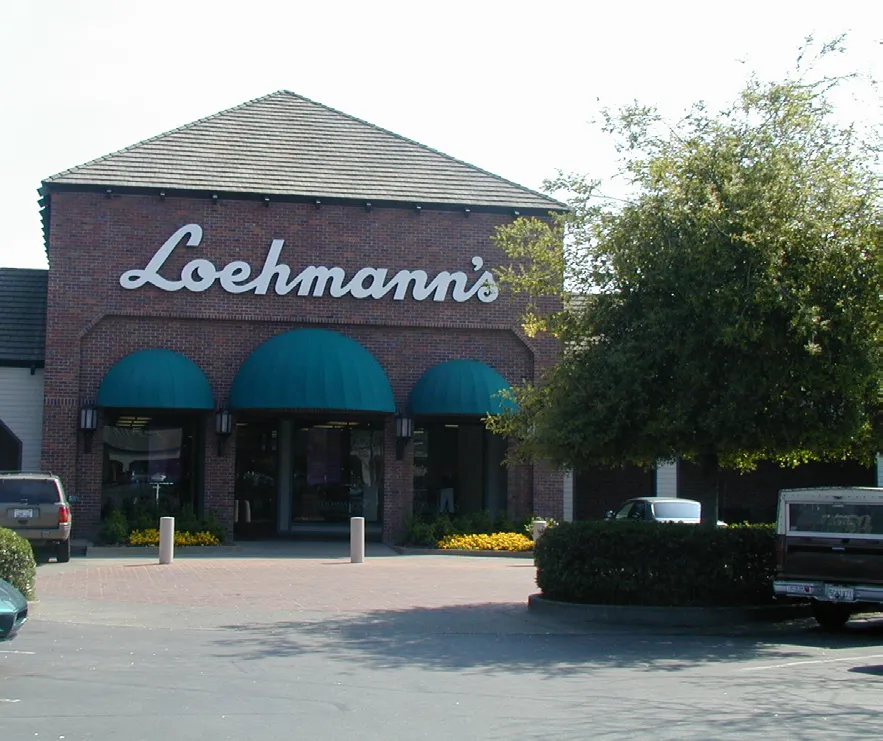
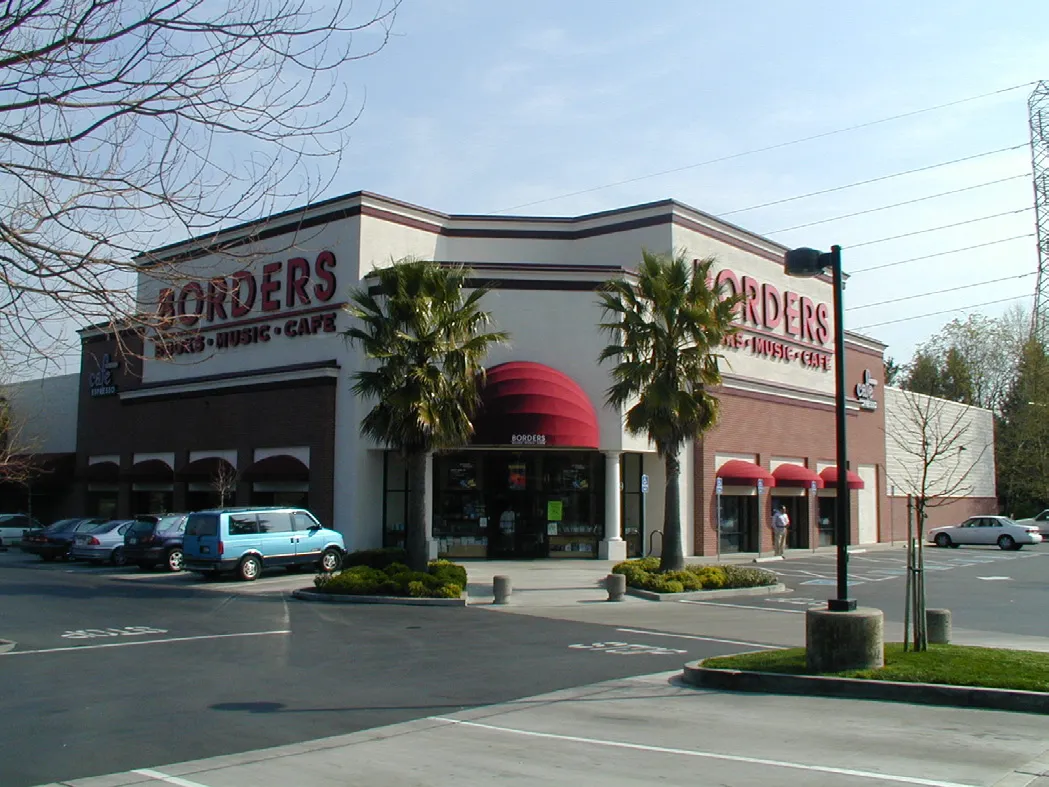
A suburban retail project with storefronts and entry facing the street.
4.2.4 Building Edges and Storefronts
Section titled “4.2.4 Building Edges and Storefronts”Building edges and storefronts should be planned and designed to be an integral part of a district’s pedestrian system.
Design Guidelines
- 🚶 Building edges should contribute to a safe, comfortable and interesting pedestrian shopping experience. At least eight (8) feet of unobstructed sidewalk should be provided along storefront edges.
- Display windows should comprise at least 33% of the width of the facade that faces a public street. When large blank walls are unavoidable, they shall be articulated with 3-dimensional elements, such as planters, and softened with vines and shrubs.
- Renovated and new commercial buildings and centers should have a clearly understood system of connected storefronts and entries. Sidewalks, streetscaping and building edges should be designed in a coordinated fashion.
- 🚶 Building edges and storefronts should be designed to reflect both auto-oriented and pedestrian-oriented merchandising needs of the tenants and district. Pedestrian safety, access and comfort should not be sacrificed by an auto-oriented design approach.
- 🚶 Corner and mid-block pad buildings should be oriented toward and have some transparency to the street. Drive-through windows should minimize their visual and functional impact on the sidewalk, safe pedestrian circulation routes, and community design objectives, as further addressed in Section 4.2.6.
4.2.5 Parking Lots and Driveways
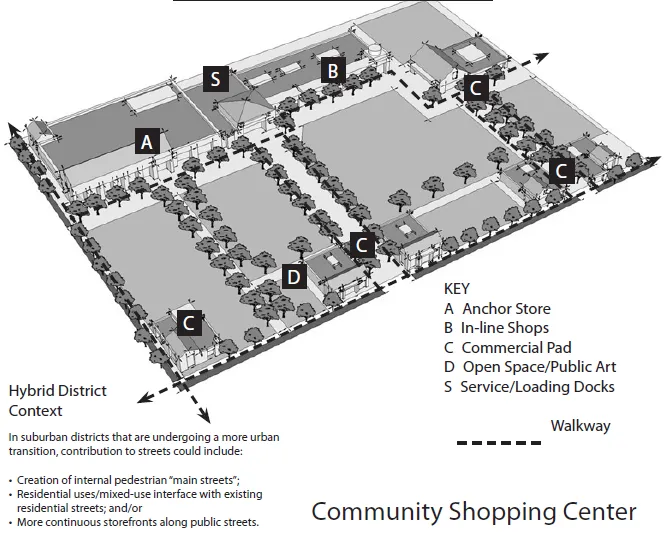
Section titled “4.2.5 Parking Lots and Driveways”COMMUNITY SHOPPING CENTERS
The illustration shows a site concept plan for a community commercial center.
The concept features:
- Buildings located along the street edge and parking in the interior of the site;
- Architectural variety and connected system of storefronts and displays;
- Interconnected driveways and walkway system with a small park; and
- Service areas located out of sight.
Parking lots and driveways should be planned to reduce the number of curb cuts; provide interconnectivity between sites; and designed to support pedestrian activity, safety, connections and comfort.
Design Guidelines
- Parking for commercial uses should be located next to or behind buildings. These parking areas should be divided up into smaller, landscaped lots with defined pedestrian connections.
- Renovated and new projects should be planned to reduce the number of curb cuts and driveways. Where possible, projects should share driveways and parking access with adjacent sites to provide an interconnected system of auto and service access points.
- 🚶 Projects should have a hierarchy of primary and secondary drives and roads. Primary driveways should be designed as streets. This includes incorporating sidewalks, streetscape and lighting to improve wayfinding and reinforcing site design and pedestrian connection concepts.
- 🚶 Parking lots and driveways should provide pedestrian connections to storefronts. Dedicated walkways through parking lots and sidewalks should be included in the design of access roadways. Distinguish walkways from driving surfaces using varied surface treatments, and raising walkways, separated or protected walkways or similar design approaches.
- 🚶 Traffic calming techniques should be employed in parking and driveway areas to support pedestrian circulation concepts.
- Parking areas should incorporate best practices that include: trees, lighting, landscaped storm water features, cool1 and pervious pavement and pavers. Plant trees and shrubs to soften the overall impact of parking areas and to provide shade and noise reduction, heat island cooling and improved air quality.
- Parking lots shall include trees to provide shade and reduce temperature, consistent with Zoning Code standards. Tree selection, planting approach and irrigation should provide for rapid growth and sustained health of shade trees. Small ornamental trees are appropriate for accent planting but should not be used as shade trees.
- 🚶 Trees and landscaping elements shall be used to organize large parking areas into recognizable smaller segments that reflect pedestrian circulation and site organization and scale.
- Lighting in parking areas should be LED lights or other acceptable high energy efficiency light, with automatic controls to dim lights after certain hours or when no one is present. Lighting shall be adequate to provide for a safe environment.
- Create textures, patterns, and colors in the design of paved parking areas, entries, or other high traffic pedestrian paths, to create visual interest and distinguish pedestrian routes from other paved areas. Do not design large monolithic areas of single color untextured paving.
- Use accent paving such as textured paving and paving blocks in driveways. Use of permeable concrete, cool pavements and pavers is desirable.
- Incorporate storm water quality measures into the parking areas to treat the storm runoff and enhance the parking areas by providing shade and reducing the amount of paving.
- Where feasible, provide for electric vehicle fast-charging stations, car and bike share locations, and other alternatives such as zip car.
- 🚶 Bike racks shall be designed with the most current designs that provide secure locking features and are attractive. Many bike racks double as public art to add interest.
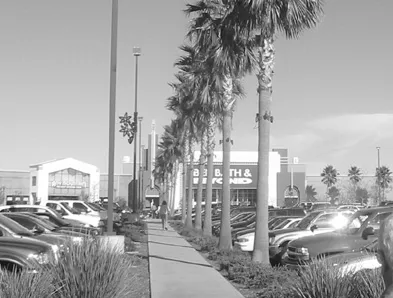
A well designed parking lot that includes many of the features called for in the design guidelines. In particular, this lot has canopy shade trees and thematic signage and lighting.
Clearly defined pedestrian walkways in the parking lot with a change in paving materials.
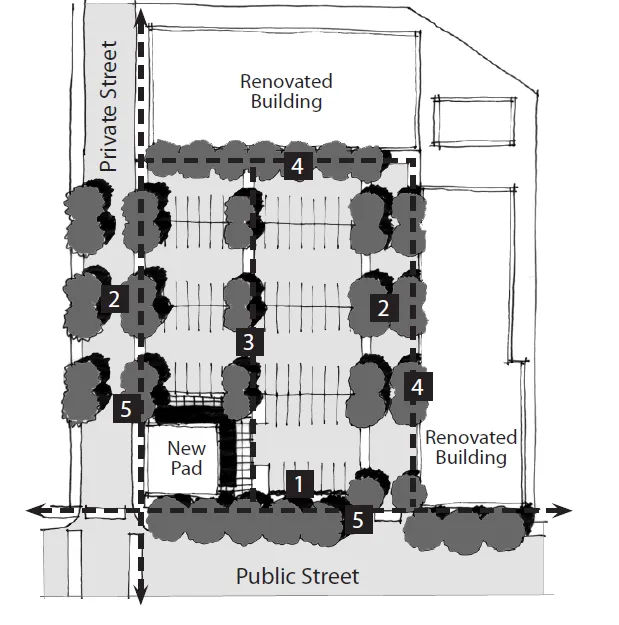
PARKING LOT DESIGN
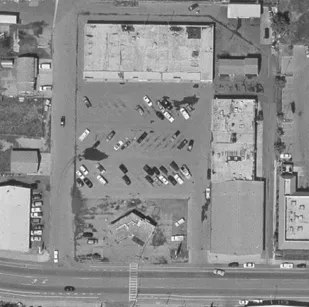
This sketch illustrates many desirable features of a retrofitted parking lot project that includes development of a new pad building.
The features include:
- Landscaped parking lot edges
- Shade trees to keep it cool
- Pedestrian walkways with a special paving treatment that connect to storefronts and adjacent development.
- Pedestrian scaled lighting in pedestrian areas
- Clear and well-designed entry signage
Existing center parking.
BIG BOX CENTERS
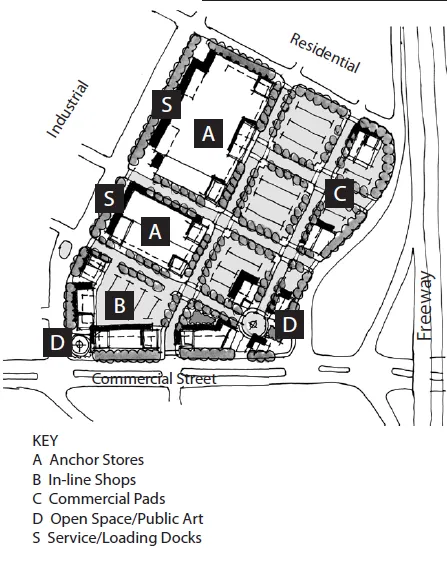
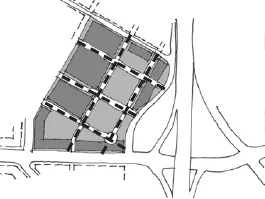
The illustration shows a site concept plan for a Big Box commercial center.
The concept features:
- Anchor and pad tenants in locations that are visible from freeway;
- Buildings located along the street edge and parking in the interior of the site;
- A flexible block pattern that can accommodate a variety of uses and provide a connected system of storefronts and displays;
- Interconnected driveways and walkway system with a small park; and
- Service areas located out of sight.
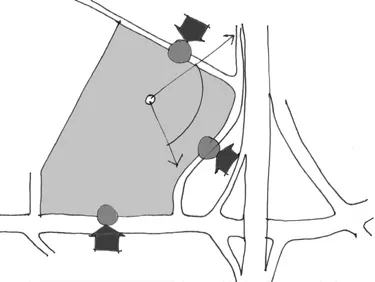
Access
- Three primary access points
- Visual access to freeway for anchor and pads
Organizational Pattern
- Flexible street and parking systems
- Defining internal and public street edges

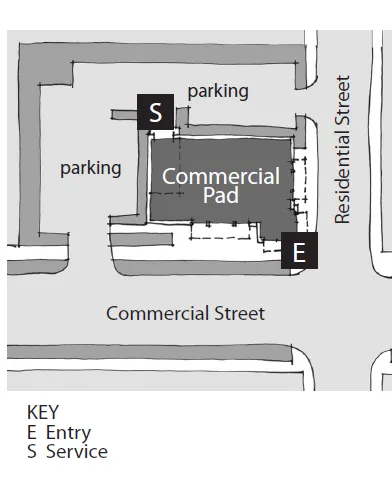
COMMERCIAL PAD PROJECT
The illustration shows a site concept plan for a commercial pad site.
The concept features:
- Buildings located along the street edge or corner with parking in the side and rear of the site;_
- Architectural interest and storefronts along street;
- A flexible block pattern that can accommodate a variety of uses and provide a connected system of storefronts and displays;
- Interconnected driveways and walkway system with adjacent sites; and
- Service areas located out of sight.
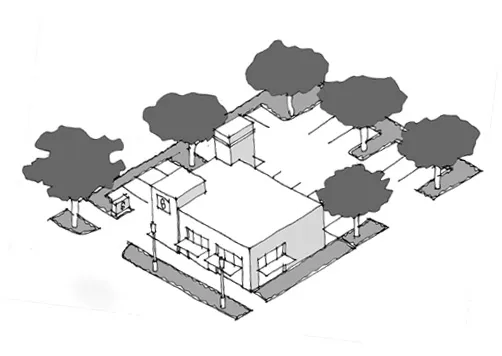
Mid-Block Site
- Parking in side and back
- Street orientation
- Connected and landscaped parking lots
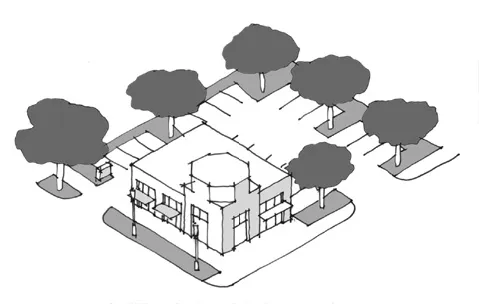
Corner Site
- Corner orientation with parking in rear and side
4.2.6 Drive-Through Businesses and Automobile Service Stations
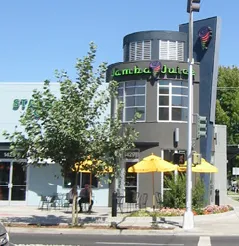
Section titled “4.2.6 Drive-Through Businesses and Automobile Service Stations”This section provides guidance for the development and review of drive-through businesses, as well as automotive service stations, automobile repair centers, and automobile washes, which are frequently provided in combination with each other. The County Zoning Code classifies and defines the following auto service uses:
- Automobile service stations address gas stations and convenience stores of all types, including:
- “Primary automobile service stations,” stand alone facilities devoted primarily to the retail sales of gasoline and similar motor fuels and the sale of travel aides and automobile accessories to the public, with auto service, repair, maintenance facilities hydrogen fueling stations, and electric vehicle charging stations as incidental or secondary uses; and
- “Secondary automobile service stations,” where the retail sales of gasoline and similar motor fuels, hydrogen fueling, or electric vehicle charging stations for the public is an incidental or secondary use to a primary commercial or business establishment, such as a grocery store or government center.
- Automobile repair centers, in which the primary use is repair of automobiles, are classified and defined in the County Zoning Code as “major automobile repairs” and “minor automobile repairs.”
- Automobile washes are facilities designed for the purpose of either self-service or automatic washing of automobiles, either as stand alone uses or as secondary uses to an automotive service station or other primary land use.
The design guidelines are flexibly structured to respond to varying site conditions and neighborhood settings. Automobile service stations in the County come in a variety of forms:
- Standalone neighborhood convenience gas stations and convenience stores;
- Traveler centers that may be combined with other services (typically restrooms, convenience retail, automated teller machines, automobile washes, food service, drive through restaurants, hydrogen fuel, and/or electric vehicle charging stations);
- A secondary or ancillary use to a retail or business establishment, providing gas pumps and other services, such as drive through restaurants, automobile washes, hydrogen fueling, and electric vehicle charging stations, to provide a one stop shop; and
- Other custom formats to serve special uses or business needs.
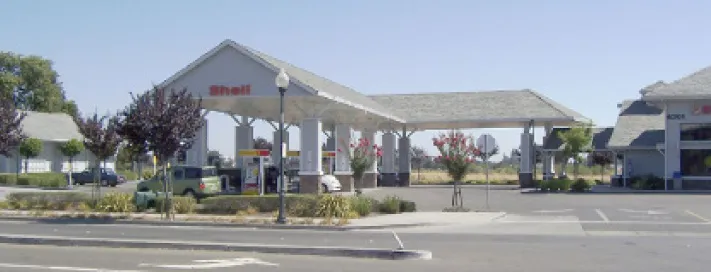
The trend towards multi-service convenience retail centers that are less autooriented and more retail-oriented in character creates an opportunity to better integrate drive through businesses and automobile service stations into the diverse context of the County, while promoting walkability and supporting the design of active communities. To this end, drive through businesses and automobile service uses should be designed with the following considerations:
- Balance business needs and standardized designs with the local sense of place of the community or neighborhood. Encourage design that is responsive to the local and regional context and contributes to the established or desired character and identity of the commercial or neighborhood area.
- Support a more pedestrian-friendly environment along public streets, particularly in urban and commercial settings, and in the organization of private streets internal to a project, to support the safe access of both automobiles and pedestrians.
- Provide quality architecture and landscape design that complements or ensures compatibility with adjacent land uses and on-site activities.
- Minimize impacts to adjacent land uses from on-site activities with appropriate siting of facilities, screening of service functions, and application of landscape buffers between uses.
- Coordinate the requirements of various on-site functions within a commercial or business center, particularly shared ingress and egress points and safe internal vehicular and pedestrian access and circulation.
Design Guidelines
Site and District Design
- Encourage design that is responsive to the local and regional context and contributes to established or desired character and identity of the commercial or neighborhood area. Projects should aim to enhance the community or neighborhood.
- 🚶 Projects should support a pedestrian-friendly environment along public streets and reinforce or enhance the streetscape image of the district or neighborhood.
- In urban areas and commercial corridors, building structures, such as convenience stores and lobbies and generous landscaping should be located close to the street, to help define the street edge. Within the more rural parts of the County, wider landscaped setbacks are preferable for consistency with setbacks of adjacent developments and structures.
- 🚶 Service windows and stacking lanes for drive-through businesses should have minimized impact on public streets, particularly at corner sites. These facilities should be located interior to the development to minimize conflicts with pedestrians and circulation, and should be appropriately screened. Screening for drive-through lanes located interior to the development may include, but is not limited to, landscape and/or architectural features such as low walls or fences, trellises, arbors, or other architectural features. Where a drive-through lane is located between a building and the public right-of-way, screening shall be accomplished with a combination of architectural features and landscaping.
- 🚶 Distinguish walkways from driving surfaces by using varied paving treatments and by raising walkways to curb level. Stacking lanes should also be clearly delineated from other driving surfaces.
- Design the majority of the pedestrian level façade facing the street highly transparent with clear glass windows and doors that animate public streets and maximize views in and out of the building.
- Provide weather protection at the main building entrance, for areas close to public transit stops, bicycle parking, walkways, and in places with pedestrian amenities.
- 🚶 Provide customer entrance doors clearly visible from public streets and directly accessible from the public sidewalk. Provide customer entrance doors that are close to parking areas.
- Locate required bicycle parking close to the building entrance in a manner that does not impede pedestrian movement.
- Locate access for stacking lanes away from public streets or driveways so that vehicle queues do not block traffic on public streets or affect on-site vehicular and pedestrian circulation. Locate driveway entrances and exits as far away from the street intersection as possible, designed in accordance with the County Improvement Standards.
- Locate noise-generating uses, including drive through speakers and music, repair shop operations and machinery, car wash openings, vacuum stations, loading and refuse areas and stacking lanes away from sensitive uses (e.g., housing, schools, and day care centers). Where this cannot be avoided, buffer noise impacts with landscaping or landscaped berms and attenuating fencing in accordance with the landscape and screening requirements of the County Zoning Code.
- Provide separate stacking lanes for two or more drive-through uses, such as a car wash and drive-through restaurant located on the same site.
Additional Siting Guidelines for Pump Islands and Automobile Washes:
- Design automobile service stations to provide clearance and unobstructed circulation for fuel delivery trucks.
- Pump island curbs or bollards are encouraged, to provide protection to fuel dispensing units.
- Openings to wash bays should not face an adjacent residential zoning district.
- Openings to wash bays should not face and/or should be screened from the public right-of-way (except at driveway access locations). Screening should consist of landscaping or a low decorative wall, in accordance with screening requirements in the County’s Zoning Code.
- Vacuuming or drying equipment should not be placed adjacent to a residential zoning district, unless separated from the residential zoning district with a building or other solid barrier; and should not be placed along a public street, unless adequately screened to reduce visibility.
Architecture
- The design of stand alone automobile service stations should conform to the dominant existing or planned character of the surrounding neighborhood. This can be accomplished through the use of similar forms, materials, and colors. In areas where no existing or little context exists, project applicants should work with the County to determine the character and design theme for the project.
- The design of a facility that occupies a pad or portion of a building within a larger commercial or business center should be compatible with or enhance the design elements of that center.
- Service station pump island canopies, including supporting columns and ancillary buildings should be architecturally compatible with the primary service building(s) in color, materials and building design.
- Drive-through elements should be architecturally integrated into the building rather than appearing to be applied or appear as an appendage to the building.
- All sides of a building should express consistent architectural detail and character. All site walls, screen walls, and pump island canopies, and other covered outdoor areas should be architecturally integrated with the building, with similar materials, colors, and details.
Landscaping
- The design of stand alone automobile service stations should conform to the dominant existing or planned character of the surrounding neighborhood. This can be accomplished through the use of similar forms, materials, and colors. In areas where no existing or little context exists, project applicants should work with the County to determine the character and design theme for the project.
- Incorporate landscaping that is compatible with the public realm landscape image and dominant existing or planned streetscape character of the commercial or neighborhood district.
- Landscaping should be provided near the primary building(s) to soften the structure and integrate it with the surrounding environment. Landscaping should be provided in accordance with the landscape requirements in the County Zoning Code.
- 🚶 Trees should be provided along pedestrian pathways to provide shade, reduce heat island effects, particularly in parking lots, and reduce glare.
- Where site constraints require the location of the drive-through lanes, drive through areas, driveways, or parking areas between the street and the building, the view of the lanes should be minimized with the use of screening, landscaping, and other design elements, such as low decorative walls. Plant street trees, shrubs or other vegetation along the edge of the street. Use trees, shrubs and low walls to screen automobiles and automobile lights from view, while allowing visibility into the site.
- Landscaping and other screening should be installed to control the effects of facility operations, such as light, noise and vehicular movement adjacent to an existing residential or agricultural-residential use or zoning district and other sensitive uses. Refer to the County Zoning Code for landscape buffer and screening requirements adjacent to residential and agricultural-residential zoning districts.
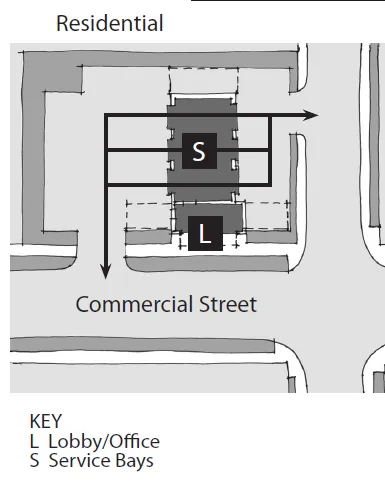
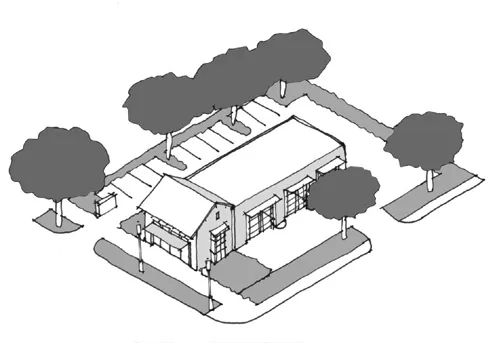
AUTO REPAIR CENTER PROJECT
The illustration shows a site concept plan for an auto service center.
The concept features:
- Street orientation for offices, lobbies and convenience stores;
- Parking and driveways located away from pedestrian sidewalks and pathways; and
- Architecturally interesting and pedestrian-friendly designs facing public streets.
Auto Repair
- Lobby and office facing street
- Service bays in rear of site
- Parking in rear and side portions of site
AUTO SERVICE STATION, AUTO WASH, AND DRIVE-THROUGH BUSINESS DEVELOPMENT
The illustration shows a site concept plan for an auto service station and drive-through business on a shared lot.
The concept features:
- Trees, shrubs, and other vegetation to define the street edge, shade sidewalks and parking areas, and screen automobiles from view, while allowing visibility into the site.
- Buildings and the pump island canopy on the site are architecturally compatible in color, materials, and design.
- Use of walls and landscape buffers to screen and attenuate, noise from facility operations.
- Walkways to connect the automobile service station and drive-through business with adjacent streets.
- Shared driveways with enhanced paving at curb cuts.
KEY
A - Automobile Service Station and Fuel Pumps
B - Automobile Wash
C - Drive-Through Business
Lighting
- On-site lighting should be designed to support the safety and security of the site and be designed so that no source of light is visible off the property, unreasonably disturbs occupants of adjacent properties, or interferes with traffic operations.
- Exterior lighting design should take into account background lighting levels of other sources and the characteristics of the surrounding area.
- Direct and reflected glare should be minimized.
- Light fixtures mounted under pump island canopies should be completely recessed into the canopy, using flat lenses that are flush with the underside or ceiling of the fuel canopy. Lights should not be mounted to the top or sides of the canopy, nor should side fascias of the canopy be illuminated.
- Site and parking lot lighting should utilize full cut-off fixtures, aimed downward and away from the property line.
- Building mounted lighting should be full cut-off fixtures, aimed downward, and shielded so the light source is not visible off the property.
Signage and Corporate Identification
- Business identity, either by awnings, accent bands, paint or other applied color schemes, signage, parapet details, or materials should not be the dominant architectural feature.
- All signage should be architecturally integrated with the building façade or the site’s surroundings, in terms of size, shape and lighting, such that they do not visually compete with the building architecture or design of the site.
- Signs for multiple corporations sharing the same site should be integrated as one unit to create a shared identity for the property or should be located and designed as a package, where signs do not visually compete with each other.
- Ground mounted monument signs are preferred over canopy fascia signs.
- New development should anticipate and provide logical sign areas, allowing flexibility for new uses as the building is reused over time.
- Raceways and transformers should be hidden, when possible.
4.2.7 Integrated Transit
Section titled “4.2.7 Integrated Transit”New commercial development and renovation of existing centers and buildings should be planned and designed to facilitate access to transit.
Design Guidelines
- 🚶 Renovated and new projects should be clearly connected to transit services. Sidewalks should provide direct access to transit stops. Special considerations for patrons should be taken into account, such as shopping cart storage and bike racks.
- 🚶 Transit stops should be conveniently and centrally located in commercial districts. They should be easy to find and collocated with commercial services and amenities. Their location and design should be coordinated with Transit provider.
- 🚶 Transit stops/shelters and connecting pedestrian routes should be well lit, visible and facilitate access by people with disabilities.
- 🚶 The business owner is encouraged to provide a location for convenient route and schedule information.
- 🚶 Bicycle facilities should be designed into the site plan in a way that supports use of bicycles.
4.2.8 Transition to Residential Areas
Section titled “4.2.8 Transition to Residential Areas”Renovated and new projects should be designed to enhance adjacent residential neighborhoods and promote active transportation from these neighborhoods, rather than automobiles for short trips. Projects should be designed to reduce the visual, noise and use impacts on adjacent residential areas.
Design Guidelines
- 🚶 Renovated and new projects should enhance the connections to shopping streets. They should provide streetscape, sidewalks, building setback and storefront design that link residential streets to main commercial and transit streets. Residents should be able to walk a direct route from their homes to commercial center stores without traversing parking lots and having to walk out of their way around perimeter fencing and walls.
- 🚶 Renovated and new projects should provide a landscape plan that supports the design and pedestrian access objectives for contiguous residential streets.
- New projects should acknowledge the scale and proximity of adjacent residential neighborhoods by stepping down in height, increasing setbacks, and providing a more friendly building orientation.
- 🚶 Paseos should be utilized to provide common outdoor spaces and allow for pedestrian access through the development and connection to adjacent developments.
- 🚶 Unnecessary tall concrete block sound walls should not separate commercial uses from residential uses. Where sounds walls exist or are necessary, breaks in the sound walls shall be provided for access from adjacent neighborhoods and designed as “live-ends.”
- Placing loading and service areas adjacent to residential areas is discouraged. Site circulation and placement of loading areas should be incorporated into the project so that it is screened and held back from residential areas. Where screening walls are required, they shall be designed as a natural extension of the architectural and landscaping concepts for the project. Evergreen trees should be used for screening and to help with noise reduction.
- Automotive and service bays should orient away from residential development and public streets. Service bays should not dominate the public street frontage.
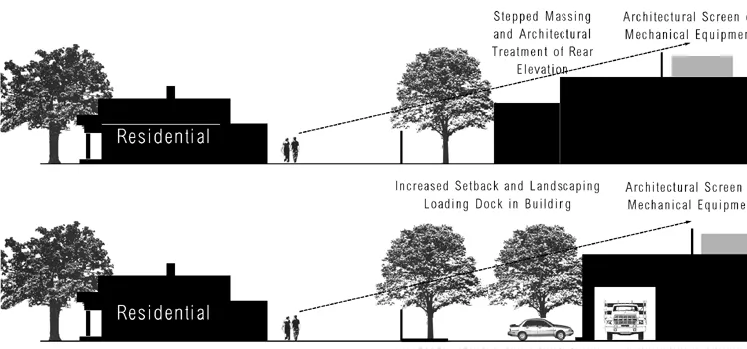
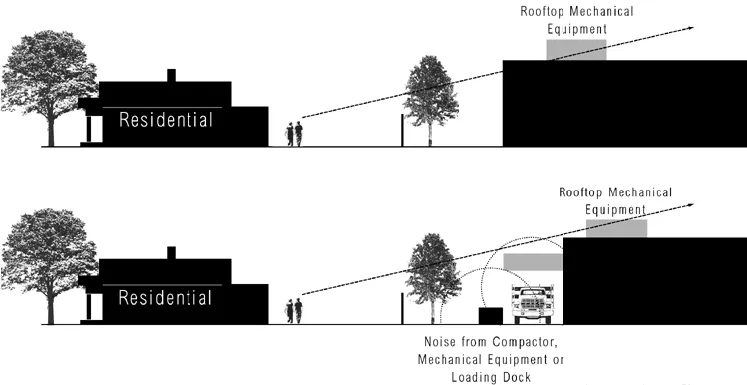
TRANSITION TO RESIDENTIAL AREAS
This diagram indicates the desirable and undesirable site planning approaches in terms of interfacing with an adjacent residential neighborhood.
Desirable
- Sets buildings toward the street corner
- Connects sidewalks to neighborhood street with landscaped storefront edge
- Hides service and loading area within building envelope
- Provides landscaped site border
- Uses low-scale and reflected lighting to direct light away from neighbors
Undesirable
- Sets mass of building along lot line next to houses
- Has curb cuts and no landscaping along residential street
- Has outdoor loading area next to residential property that is visible from street
- Has no landscape buffer at site edges
- Has tall parking lot lighting and security lighting that spills into residential yards
4.3 Landscaping / Site Elements
Section titled “4.3 Landscaping / Site Elements”New and renovated commercial projects should use landscape to reinforce overall site and architectural design concepts for the project and surrounding neighborhood.
Landscape design should be a defining feature for every project that contributes to the community’s health, sustainability, image, and pedestrian activity, safety, access and comfort. Landscaping should promote pedestrian activity and provide for pedestrian safety, access, comfort and connections while contributing to overall placemaking and image objectives for village districts. Landscaping and trees can be used to complement buildings and to make a positive contribution to the aesthetics and function of the specific site and area. These aesthetics contribute to the mental and emotional well-being of customers, and support economic activity. Landscaping helps reduce storm water runoff, filters water and captures carbon and air particulates to improve air and water quality, provides shade during summer months and lowers temperatures reducing heat island impacts.
Design Guidelines
- The design of landscaping for commercial projects should reduce the creation of heat islands and filter harmful greenhouse gas and smog. Landscaping should provide softscape areas in place of paving and create shade. All site areas not covered by structures, walkways, driveways and parking should be landscaped.
- Site landscaping should include stormwater quality treatment features, such as vegetated swales, to attenuate flows and remove pollutants from runoff before it leaves the site, consistent with the County’s stormwater quality control measures.
- New and renovated commercial projects should use landscaping to reinforce overall site and architectural design concepts for the project and surrounding neighborhood. This includes a hierarchy of canopy trees, accent/flowering trees, shrubs and groundcover. Drought tolerant planting should be used consistent with the County Water Conservation Ordinances. Special hardscape, such as pavers, stained concrete, and stone, should be used to identify pathways and gathering places in projects. Ungrouted pavers and permeable pavements are encouraged to reduce runoff.
- Incorporate appropriate landscaping that includes a variety of trees, shrubs, and other plantings. Utilize Sacramento County’s River Friendly Landscape (RFL) Guidelines for plant material selection, placement and maintenance. The sustainable RFL guidelines are water and energy efficient, reduces maintenance, improves air quality and diverts green waste from the landfills.
- Landscaped storm water quality design measures shall provide multiple public benefits and be integrated into open space areas to provide storm water quality benefits and landscaping benefits.
- Provide on-going maintenance to identify and ensure the timely replacement of any dead or diseased vegetation.
- Design landscaping to be compatible with building design. Use trellises, arbors, cascading landscaping, vines and perimeter garden walls wherever suitable.
- 🚶 Consider security issues in the landscape design of the site, including creation of barriers and screening.
- Do not allow landscaping to impede fire access to hydrant connections.
- 🚶 Preserve and incorporate existing and native trees within the project site design to the greatest extent possible.
- 🚶 Retain existing mature trees in landscape and building location plans to the greatest extent possible. Where existing trees must be removed, trees shall be replaced on-site or in another location, acceptable to the Planning Director, to compensate for the loss in canopy and environmental benefits. Participation in the County’s Tree Mitigation program to compensate for canopy loss is also acceptable.
- Provide all landscaped areas with irrigation systems as needed to sustain the landscape. Comply with the County’s Landscape Ordinance.
- Landscaping should be used to enhance and soften screening of loading and parking areas. It should also be used to help frame views and edges.
- The design of any non-building structures such as entry gateways, pavilions, or walkway trellises shall complement their related commercial center or building design and/or theme.
- 🚶 Artwork and other amenities, such as benches, murals, sculptures and fountains, are encouraged in public areas of projects. The landscape plan should identify locations and infrastructure support (i.e., lighting, power, water, etc.). Placement of amenities should not adversely impact people with disabilities by encroaching into walkways.
- Tree plantings used to satisfy the county parking shade requirements should be located in an ordered pattern that enhances the overall site image, reduces the visual impact of large parking areas, and reflects the pedestrian movement from car to buildings and communal open spaces.
- Mature trees, rock outcrops, creeks and other desirable natural site features should be preserved and incorporated into the landscape plan. Projects located adjacent to open space, creeks or wetlands should include a landscape interface that is coordinated and consistent with natural areas. A vegetative buffer should be included to treat runoff before it reaches the natural area.
- 🚶 Use of known high allergen plantings is discouraged.
Drainage/Flood Facilities:
- 🚶 Neighborhood parks are encouraged to be centers of neighborhood activity and could be combined with schools, community recreation centers, libraries and other civic uses.
- 🚶 To encourage sufficient usage, parks and open space should be strategically located in or near residential areas and commercial districts and be accessible via roadways, transit routes, and off-road pedestrian and bicycle trails and paseos (walkways).
- Size, type, and location shall be sized and located as to support the community master plan goals.
- Flood protection and drainage facilities shall be designed to provide multiple public benefits wherever possible. Facilities shall include multi-purpose improvements consisting of recreation, the environment, storm water runoff, water reclamation, infiltration, groundwater recharge, flood control, etc. Attractive joint use basins, such as parks (in addition to Quimby land dedication requirements) or parkways with trails that also convey water to water quality basins or similar facilities and provide some water quality treatment are examples of desired multiple public benefit facilities.
- 🚶 Public safety is a high priority and Crime Prevention Through Environmental Design (CPTED) principles should be applied.
- Open space should be connected to provide habitat corridors through urban environments.
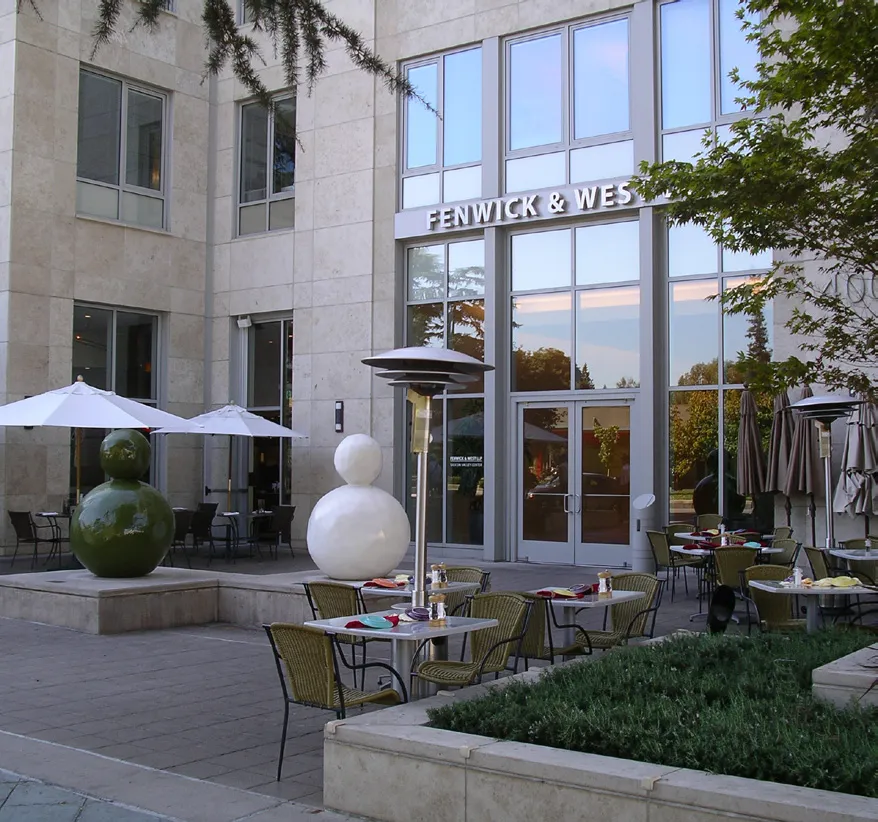
Outdoor sitting and gathering places with public art add to the quality of the shopping experience, create a social focus for the project and adjacent neighborhoods, and add value to tenants that benefit from sharing patrons.
4.4 Commercial Architectural Design: Principles and Guidelines
Section titled “4.4 Commercial Architectural Design: Principles and Guidelines”New projects and renovation of existing buildings should contribute to the design and placemaking objectives for their commercial district and adjacent neighborhoods.
4.4.1 Architectural Design Concepts
Section titled “4.4.1 Architectural Design Concepts”Projects in specific plan or other special planning districts should support existing architectural design policies and concepts. Every renovation and new commercial project should pursue architectural concepts that are compatible and further image and economic goals for the district and adjacent neighborhoods. Consult with the Office of Planning and Environmental Review for projects in these areas.
Design Guidelines
- For freeway and arterial-oriented big box centers, design themes should tie together all the tenants in the center. When multiple centers are located in the same district, they each should provide design concepts that enhance the continuity of the street as a single business address.
- 🚶 In aging strip districts, new and renovated commercial projects should strive to introduce new design themes and concepts emphasizing pedestrian safety, access, comfort and interconnectivity.
- New or renovated freestanding commercial pad buildings should be designed to meet both the merchandising needs of the tenant and image objectives and design themes for the district.
- For renovated or new commercial projects in a residential context, they should reflect the architectural traditions, scale and character of the adjacent neighborhood.
- The use of green and sustainable development standards and practices in planning, design, construction and renovation of new and existing buildings should be used wherever possible. Sustainable green infrastructure should be utilized wherever possible.
4.4.2 Building Form and Massing
Section titled “4.4.2 Building Form and Massing”Building massing and orientation should result in a pleasing and coherent composition of building elements and spaces.
Design Guidelines
- 🚶 The placement and shape of buildings should support placemaking objectives for projects. Buildings should shape, enclose and define pedestrian edges and spaces and streets.
- Freestanding “big box” stores are discouraged. Large stores should be integrated into in-line shops or wrapped in storefront buildings.
- A coherent family of roof forms should support urban design and site concepts. This could include creating gateway elements, reducing the scale of large buildings to better fit a fine-grained commercial or residential context, or support placemaking objectives.
- Roof forms or parapets should be continuous, not superficial forms limited to the most visible areas.
- The massing of a commercial center should result in well-proportioned buildings. Bay spacing, horizontal and vertical rhythms should have a pleasing composition.
- Long, unbroken blank walls are discouraged. Each side of buildings should have an uniform approach to design and detail. Any non-pedestrian focused façade shall have articulation related to the overall building design.
- Corner bay articulations, stepping and varying wall planes, raising and lowering parapet walls, and trellises can be used to reduce the visual monotony of large buildings. Varying building height with one, two or and three-story forms is strongly encouraged as a way to increase visual interest.
- Canopies, arcades and other architectural treatments, such as reveals, recesses, projections and cornices can be added to buildings to give tall walls a pedestrian-friendly scale.
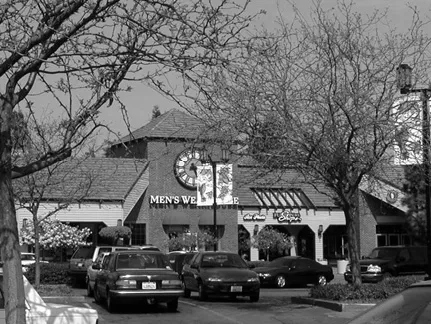
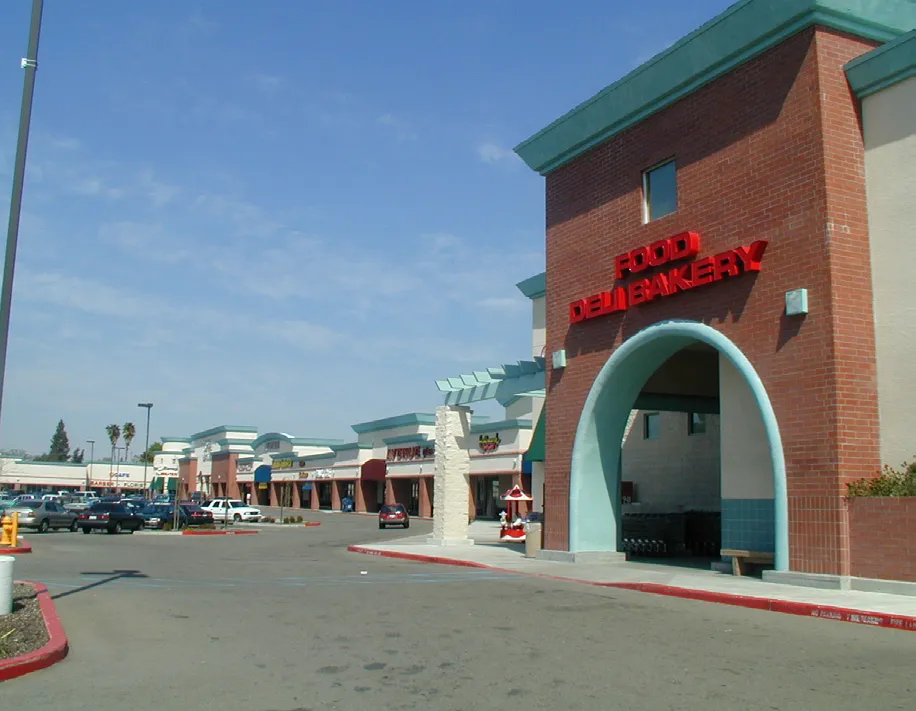
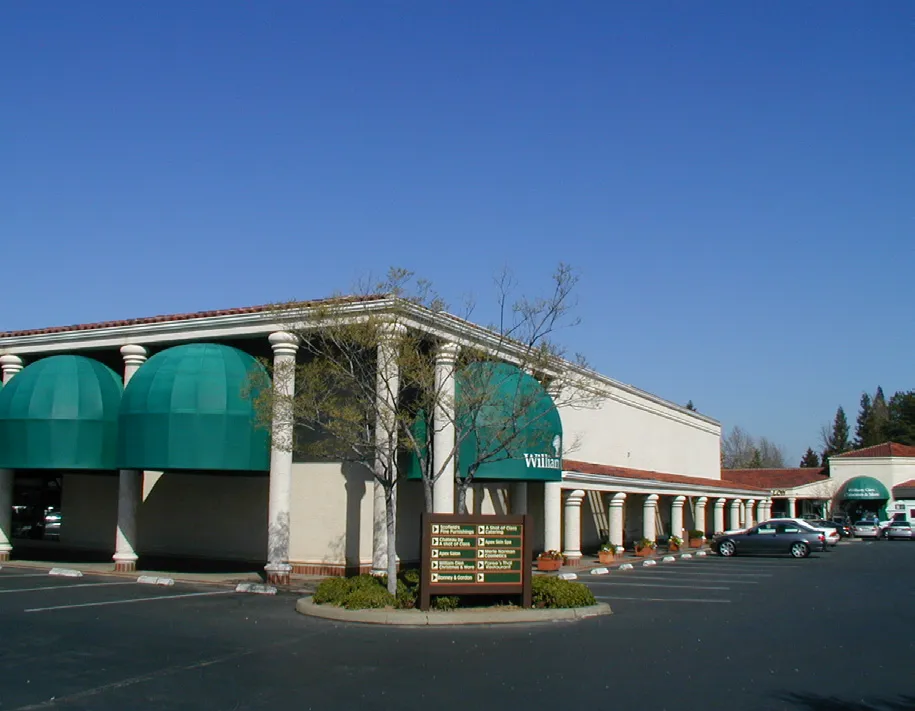
The shopping centers below have unifying design themes. The top example uses a uniform architectural style with variations in scale. The lower example has a variety of styles but emphasizes a strongly defined “main street” image and pedestrian orientation.
MAKING CONNECTED SPACES
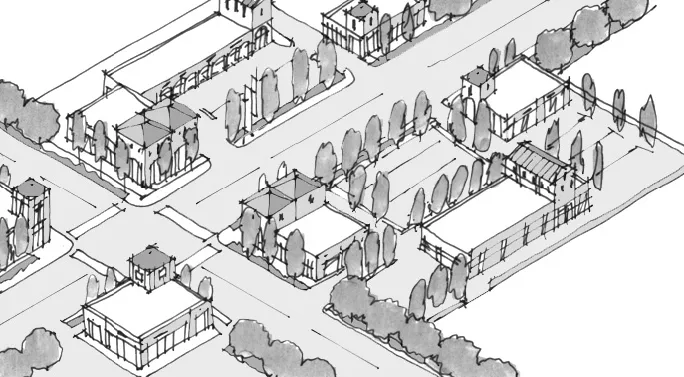
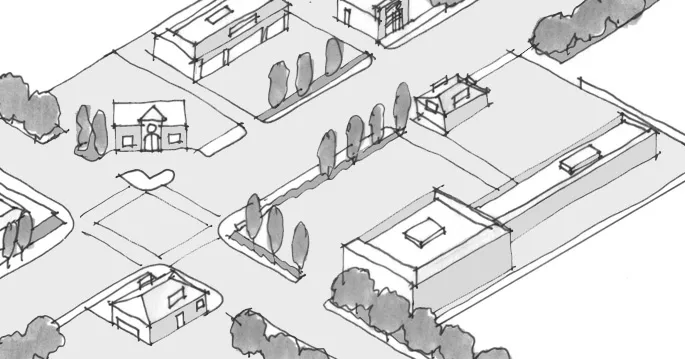
The illustrations below show desirable and undesirable approaches to shaping and site planning commercial buildings.
Desirable
- Responds to urban design objectives for district gateway
- Shapes, connects and activates pedestrian edges and spaces
- Reduces visual size of overall building by articulating building and roof forms
- Pleasing and well proportioned composition of building elements
Undesirable
- Ignores urban design and streetscape objectives for district gateway
- Does not create connected, comfortable or defined pedestrian spaces
- Presents large and unarticulated building and roof forms
- Poorly proportioned building elements
4.4.3 Architectural Design and Features
Section titled “4.4.3 Architectural Design and Features”The architectural design of projects should have a vocabulary of design elements that contributes to overall design and image concepts at a district and pedestrian scale.
Design Guidelines
- Architectural details such as arcades, recessed exterior balconies, changes in façade treatment, window awnings, canopies, setbacks, recesses, reveals, or other building elements should be used to enhance the building and streetscape character.
- Franchise architecture should be minimized and dealt with in the context of the surrounding area. Franchise architecture includes pseudo-historic styles or “trademark” roof shapes, which sacrifice the integrity of a project or district to promote a single tenant.
- The composition of building elevations should elaborate on massing and urban design objectives for commercial projects and their districts.
- The design of renovated and new projects should employ architectural concepts that have a unifying vocabulary of forms, design elements, details and materials. All facades of buildings should draw on the same vocabulary of forms, detail and materials.
- Integrated base wainscoting, cornices, canopies, awnings, brackets and other design features that add a finer grain of detail and design are encouraged.
- Building entrances should be designed as prominent features. Canopies, porticos, recessed entries, added ornamentation and other design elements should enhance the design of entries.
- Refer to Section 5.4.2.E for guidelines on cargo containers used for commercial building structures.
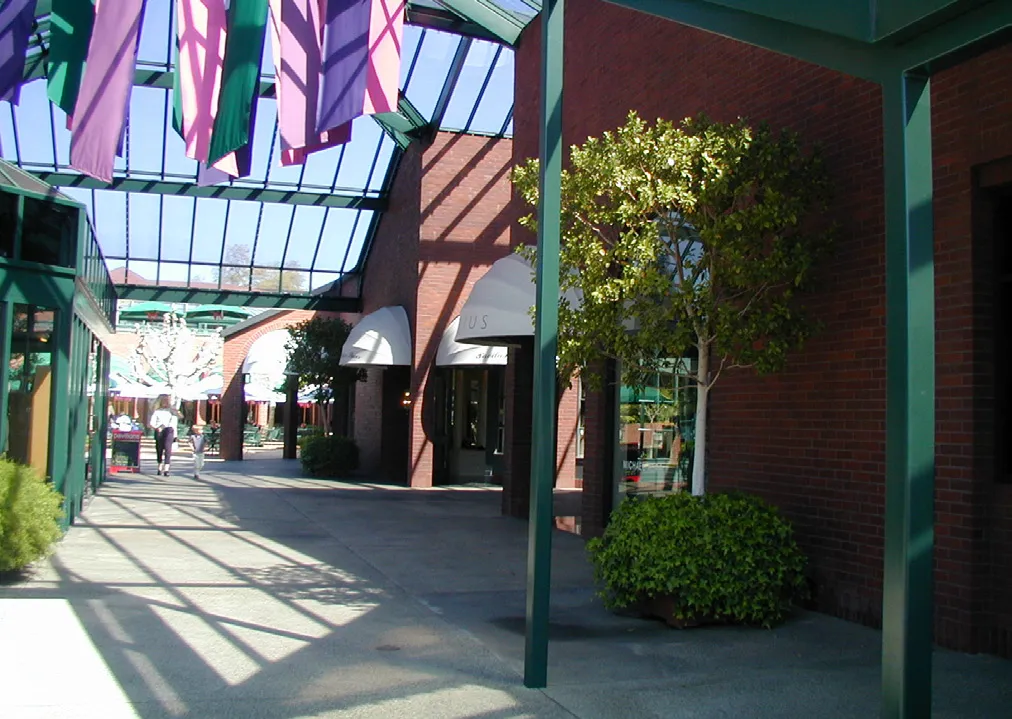
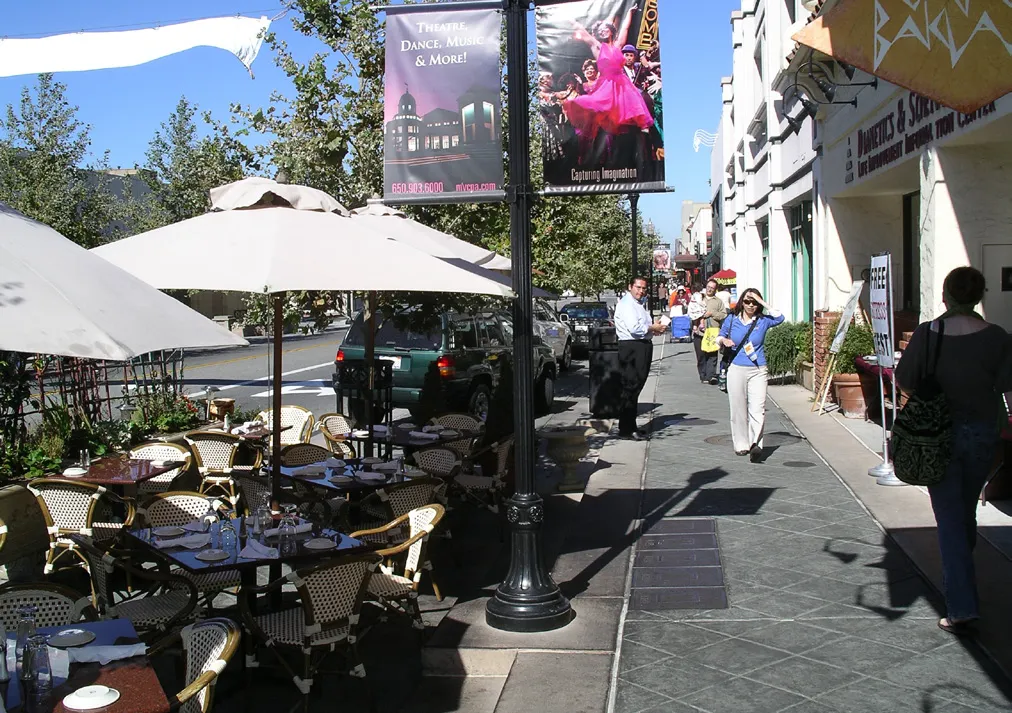
These photos show features that are desirable for creating pedestrian friendly shopping edges. The designs have transparent storefronts, wide sidewalks with areas to sit, and integrated awning and signage concepts.
4.4.4 Materials and Colors
Section titled “4.4.4 Materials and Colors”Selection of materials and finishes for new and renovation projects should be of high quality and reinforce overall image and massing concepts.
Design Guidelines
- Architectural materials should convey an image of quality and durability. Buildings shall be constructed with high quality materials that are durable and enhance building character. Stucco, brick, stone, terra cotta, tile, exterior insulation and finish systems (EIFS), or other solid-facing materials should be used. Certain materials have an inherently inexpensive, insubstantial, or garish quality, and are discouraged. These include:
- Roofs of composite shingles, painted tiles, metal or other sheet material.
- Walls of vinyl, plywood, or other sheet materials.
- Use sustainable building materials that are high quality, durable, provide energy efficiency benefits, require low maintenance, and complement the design of the building. Use of quality recycled products is encouraged.
- Use of “Permanent” and/or cool roof products and materials with reflective surfaces are desirable because of their low maintenance, energy conservation and insulation values.
- Employ Energy Star appliances and energy efficient lighting in construction, to the extent feasible, consistent with the adopted Green Building Policies and requirements.
- Maintain windows free of obstructions and signs to promote maximum visibility of merchandise, and visibility by Sheriff patrols consistent with CPTED strategies.
- Materials and their use should reinforce and enhance architectural concepts.
- Visible roofs should be designed as an integral part of the building design, and clad in clay, concrete tile, or the similar high quality materials.
- Walls should be clad in substantial materials and be well detailed to give walls a pedestrian-friendly scale. Architectural treatments including canopies, awnings, trellises, and other architectural treatments should be included to provide a high quality storefront design.
- A variety of materials should be used on building faces visible to the public. Accent materials shall be of high quality materials that do not appear as an appendage.
- Faux-styles are discouraged. When buildings are designed with obvious references to a period style, materials shall be consistent with that period or style. Honest interpretations of historic styles are acceptable.
- The use of color is encouraged; however, garish colors and materials are discouraged.
- Ground floor storefront display windows should be transparent clear glass. Awnings and canopies should be used for sun protection. Windows on upper floors may be lightly tinted, but should not be reflective.
- Exterior cart storage areas adjacent to buildings shall have an enclosure with a design consistent with that building.
- Any fenced or screened outdoor seating or vending areas next to a building shall have the enclosure designed to be consistent with the building design.
4.4.5 Lighting
Section titled “4.4.5 Lighting”Lighting should be an integral part of the planning and design of commercial projects, anticipating the needs of the shopping experience, businesses and adjacent residential areas.
Design Guidelines
- Lighting in service areas should be the minimum required for operation, and be designed to minimize visibility of those areas.
- 🚶 Low, pedestrian-scaled lighting fixtures are encouraged to help identify and light pedestrian routes.
- 🚶 Lighting should provide for business interest even after hours, when business is closed, to contribute to pedestrian presence and sense of safety.
- 🚶 Provide energy efficient lighting in all common areas and buildings, including pedestrian and vehicular routes. The emphasis should be on personal safety, with lighting landscape or building surfaces secondary.
- Light fixtures should face downward or employ shielding to reduce light sources and visibility from outside the site.
- Lighting in parking areas should be LED lights or other acceptable high energy efficiency light, with automatic controls to dim lights after certain hours or when no one is present. Lighting shall be adequate to provide for a safe environment.
- All lighting fixtures visible to pedestrians shall be designed to minimize glare.
LIGHTING
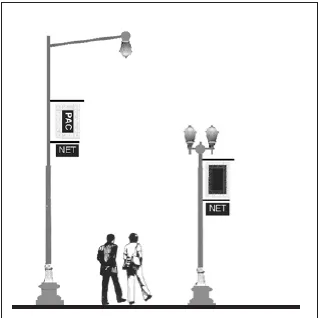
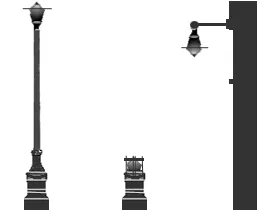
These illustrations demonstrate how lighting concepts should consider general lighting, pedestrian and security needs while adding to the visual interest of commercial centers. They show how lighting is kept focused on the site to reduce glare on adjacent areas.
Light fixtures should face downward or employ shielding to reduce light sources and visibility from outside the site.
Street Lights
- Auto-scale lighting
- Pedestrian lighting
Storefront and Pedestrian Lights
- Streetlamps
- Bollard lighting
- Building-mounted lighting
LOADING AREAS AND TRASH ENCLOSURES
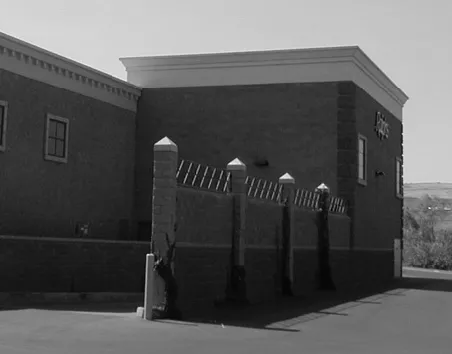
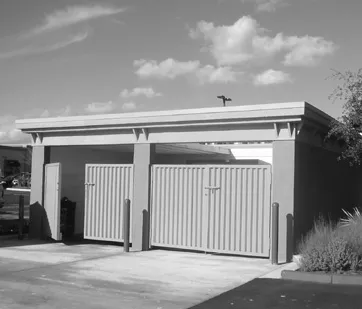
The Guidelines encourage integrating the design of loading and service areas into the overall development. This example provides architectural treatment for a loading dock. Trash enclosures should be architecturally designed to match the retail and commercial buildings.
4.4.6 Service Areas
Section titled “4.4.6 Service Areas”Service facilities should be concealed from public view.
Design Guidelines
- Trash bins and compactors, utility meters, transformers, and other service elements should be enclosed or otherwise completely concealed from view. Service elements, including screening with walls or fences, should be designed as integral elements of the commercial project’s architecture or landscaping.
- Services, utilities, and equipment should be enclosed or buried and should be placed outside of landscape planters at gateway entrances, or otherwise concealed from view.
- Roof-mounted equipment should be concealed by enclosures that are consistent in design with the building design.
- Coordinate with utility companies to encourage the placement of utility fixtures, such as fire backflow preventers and electrical boxes, outside of planter areas and/or to screen such fixtures.
- Provide trash and recycling education information near enclosures. Enclosures shall be in a safe and secure location and shall be kept clean and odor-free.
- Trash enclosure areas shall be designed to the County’s latest storm water quality source control design standards and shall provide trash and recycling education information.
- Radio and television receiving dishes should be located to the side or rear of the lot (or on that portion of the lot most distant from the street). Any dish located within a side yard or corner lot should be located in the back portion of the lot, furthest from the fronting street. Receiving dishes are encouraged to be screened from view from the street with enclosures that are consistent with the building design.
Wireless Communication Facilities:
- Refer to the County Zoning Code for development standards for wireless communication facilities, in addition to the following guidelines.
- The addition of wireless communication equipment on existing structures, including roof-mounting and co-location on existing poles, is preferred.
- Roof-mounted antennas and equipment are required to be constructed, mounted, and painted to blend in with the predominant architecture of the building and/or appear as part of the building.
- New towers and related structures should use materials, colors, textures, screening, and landscaping that best allows them to blend in with the prevalent architecture of the project or with the natural features around the site, as applicable. Neutral grays, blues, greens, browns, and dull metallic colors are recommended. Artistic and stealth designs are also encouraged; however, each structure will be evaluated individually for approval by the County.
- Existing site features, including trees, mature vegetation, and structures should be used as screening, when possible, to allow new facilities to blend in with the background at increased site distances.
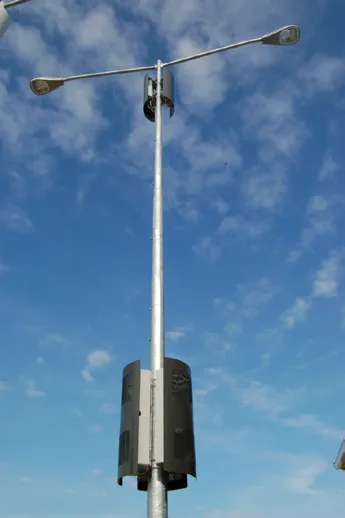
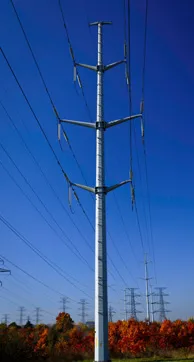
- Use of “stealth by design”2 is encouraged, to disguise and ensure new facilities are compatible with the surrounding environment. Disguising or camouflaging cell towers and cell tower elements helps to preserve the aesthetics of the project site while maintaining purpose and function. Examples of stealth designs include flagpoles, utility poles, street or parking lot lights, bell towers, clock towers, tree-like structures (e.g., monopines or monopalms), public art, and etc.
- Use of pole structures (e.g., street lights, utility poles, and flag poles, as shown in the examples below), compatible with the neighborhood streetscape character, are preferred. Placement of such structures should be coordinated with existing development, so as not to interfere with public access, including Americans with Disabilities Act requirements. The height of pole structures should complement and not exceed the height of existing street lights or utility poles within the neighborhood and shall not exceed the acceptable heights for structures permitted by the County’s Zoning Code.
- Where a new tower is constructed, it should be enclosed with fencing, not less than six feet in height; composed of solid wood, masonry, chain-link fencing with slats, or other approved alternative; and equipped with appropriate anti-climbing devices, to protect against unauthorized climbing. Alternatively, equipment shelters located at the ground level should be raised above a 6 inch curb and screened with landscape materials or enclosed, as appropriate, to protect against potential vandalism; or should otherwise be buried underground.
Examples of stealth wireless communication facilities:
Mounted on a street light pole
Mounted on a utility pole
Designed to appear like a palm tree

4.5 Commercial Signage
Section titled “4.5 Commercial Signage”Signage should contribute to the graphic identity and wayfinding objectives for the commercial district, center, or project while reinforcing the project’s architectural and site planning concepts. New free-standing and monument signs require design review.
4.5.1 District Signage
Section titled “4.5.1 District Signage”Development and public works projects in specific plan or special planning areas should support signage policies and design concepts. Signage identifying shopping and commercial districts should support both wayfinding and graphic identity objectives both day and night. The signage plan should provide consistency throughout the district.
Design Guidelines
- District image themes and design concepts should be reflected in district-wide signage.
- Median, monument, and other district identity and wayfinding signage should be designed and located as part of an overall district signage plan. Signage must comply with ADA requirements.
- Placement and maintenance of district signage must be coordinated with the County Department of Transportation.
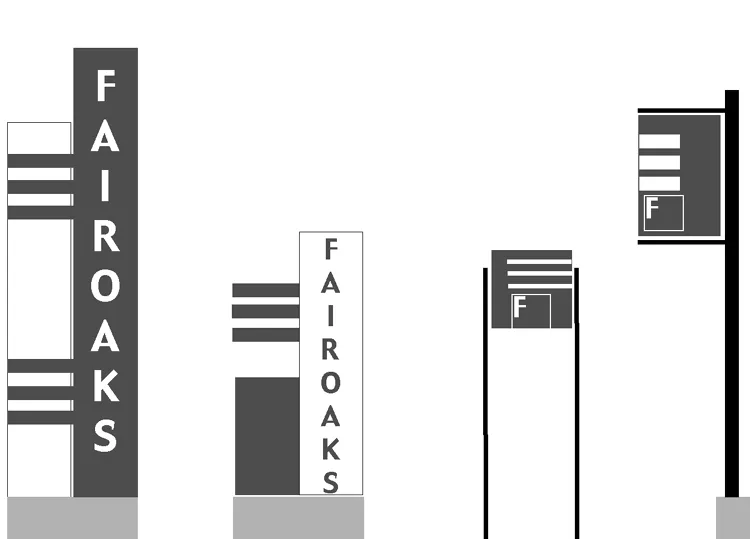
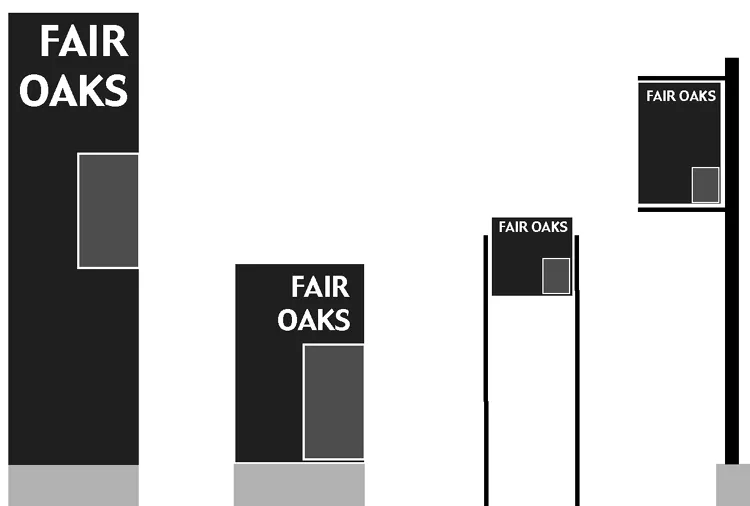
Family of Signage
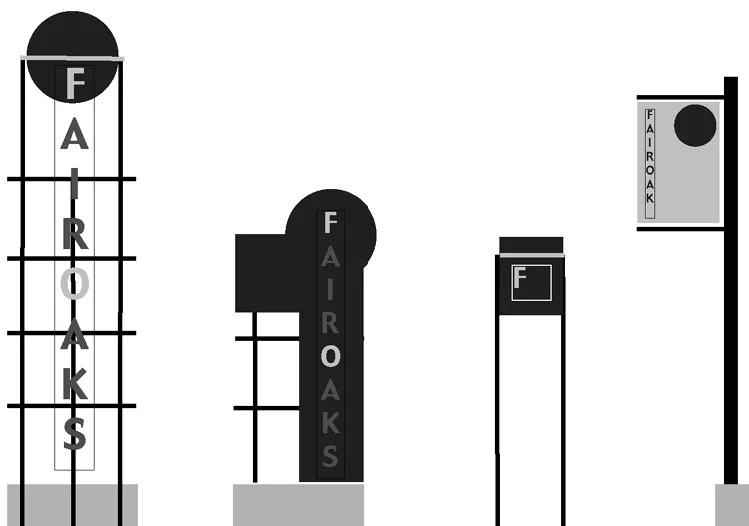
This drawing illustrates the “family” of signage for a commercial district.
The signs include:
- District monument sign
- Site entry signage
- Wayfinding signage
- Banners
4.5.2 Signage for Multi-Tenant Projects
Section titled “4.5.2 Signage for Multi-Tenant Projects”For commercial development with multiple tenants, monument, entry, wayfinding, tenant and other signage should be designed as a “family.”
Design Guidelines
- Commercial centers should have an overall “Master Signage Criteria”. They should express a “family” of signage that supports the merchandising needs of tenants, wayfinding, and graphic identity objectives for the project, district, and adjacent neighborhood. Signage must comply with ADA requirements.
- Commercial projects’ signage plan should have designs for known tenants and future unknown tenants.
- Large garish signs unnecessary to the commercial use of a commercial center are discouraged.
- Monument signs are preferred and encouraged rather than pole signs unless pole signs are authorized within a designated district with specific guidelines and architectural intent.
- Affixed individual characters for signs are encouraged.
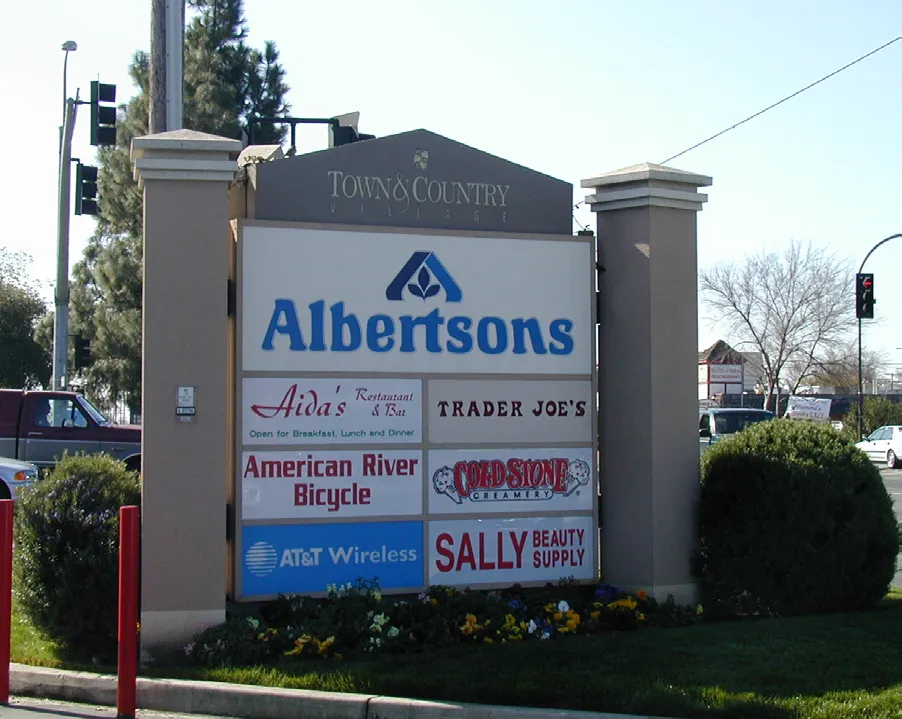
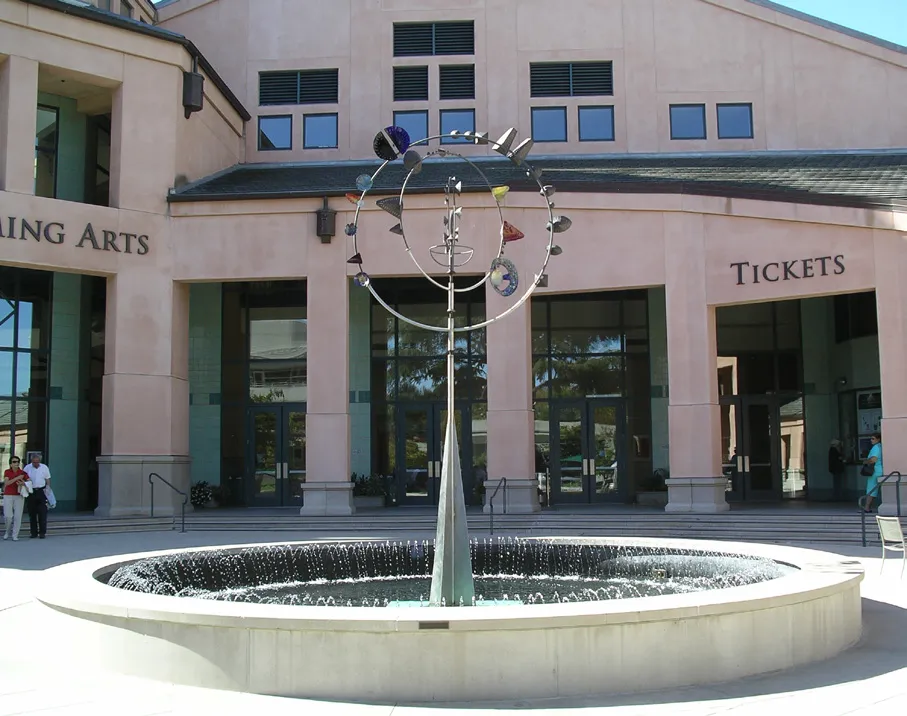
These photographs show signage and public art in a multi-tenant commercial center. They reflect the needs of the individual tenants while providing a unifying graphic identity and amenities.
4.5.3 Signage for Single-Tenant Buildings and Pads
Section titled “4.5.3 Signage for Single-Tenant Buildings and Pads”Design Guidelines
- Signage for single tenant buildings should be developed to reflect landscape and architectural concepts for the project.
- Signage for single tenant commercial buildings and pad buildings should be designed to complement the architectural design. The sign location, shape, letters and lighting should “fit” the building’s facade.
- All the building’s signs should be designed as a one graphic idea. An unrelated and uncoordinated building, window and entry signage is discouraged.
- Monument signs are preferred and encouraged. Cabinet signs (i.e., box signs that are typically mounted on walls) are discouraged.
- Affixed signs with individual characters are encouraged
- Affixed signs should be placed only on vertical surfaces below the eaves or parapet line.
- Signage must comply with ADA requirements.
- These guidelines are intended to apply to a new sign proposed in conjunction with the construction of a new commercial building, remodel, or tenant improvements where a new sign is proposed, and are not intended to apply to the replacement of existing signage.
4.5.4 Water Tanks and Towers
Section titled “4.5.4 Water Tanks and Towers”Design Guidelines
- Tower structures should be designed as site area landmarks and integrated with the existing environment or new site development.
- Logos, murals, or other works of art may be painted or attached to water tanks, towers, or other structures, permitted under the County’s Zoning Code.
- Water tanks and towers should use colors and landscaping that best allows them to blend in with the prevalent architecture of the project or with the natural features around the site, as applicable. Artistic designs or otherwise, neutral color shades are recommended; however each structure will be evaluated individually and approved by the County.
- Signage on water tanks or towers should be used to identify the project, a community or neighborhood, or community services and events on the site, but should not be used to advertise individual businesses, tenants, or products.
- The tower base should be integrated into the surrounding landscape. For example, by allowing safe public access beneath it, enhancing with landscaping (where appropriate), and incorporating plaza or open space that serves as a transition to adjacent ground level uses.
4.5.5 Billboard Signs and Digital Billboards
Section titled “4.5.5 Billboard Signs and Digital Billboards”Design Guidelines
- In accordance with the County’s Zoning Code signage standards, signs shall not create a distraction to drivers, such as moving or rotating signs and signs that include words, phrases, symbols, lights, motion, sound, fumes, mist, or other characteristics that may interfere, mislead, or confuse traffic. The location of signs should not interfere with on-site vehicular circulation or restrict visibility to traffic on adjacent streets or parking areas.
- Signs should be scaled in proportion to site or building elements and use high quality materials, colors, and landscaping that complements the design themes of the site development.
- The size of signs should be scaled to its intended audience, whether scaled to be visible from a moving vehicle or to provide information to pedestrians.
- 🚶 The base of the sign, where accessible to the public, should be designed as part of the pedestrian or commercial shopping experience. It should be designed with a pedestrian-scale and enhanced with landscaping, art, or other pedestrian amenities or features, where appropriate.
4.5.6 Temporary Signage
Section titled “4.5.6 Temporary Signage”Design Guidelines
- Temporary signs permitted by the County for commercial projects should be designed to a similar standard as permanent signage reflecting the same overall objectives.
4.6 Operational Elements
Section titled “4.6 Operational Elements”In many cases, the proposed use of a building or the operational characteristics of the use may influence site design. Public and private spaces often have different screening and safety needs, and the intended hours or anticipated noise levels may influence the entryways, lighting, access, and orientation of the building, particularly when located close to a residential neighborhood.
The following guidelines should be considered in the site design for all new commercial, mixed-use and employment projects, and also incorporated into future business practices.
Design Guidelines
- Business hours should generally be confined to between 6:00 a.m. and 11:00 p.m., and may be further reduced depending on proximity to nearby residential uses.
- Security lighting should be coordinated with the Sheriff, and should be dimmed during late-night hours or equipped with motion detection features. Use of cameras for security is recommended.
- Improve and/or increase access to fresh and healthy foods, such as partnering with the Health Education Council on Healthy Stores and Healthy Restaurants Initiatives. In partnership with the Health Education Council and others: make healthy foods, local fruits and vegetables, and other staple items more visible, accessible, affordable and attractive to neighborhood residents, and increase retailer sales and resident consumption of healthy foods.
- Encourage the use of healthy food menu choices for drive-through and sit down fast food restaurants. Participation with the Health Education Council and Healthy Restaurant Initiative is suggested in order to support business owners in the success of this program.
- 🚶 Promote access to and provide incentives for the use of public transportation.
- 🚶 Promote the use of bicycles, walking, and other healthy alternatives to vehicular travel.
- Noise generating activities, such as loading and unloading, should be confined to normal business hours, and should be minimized during the early and late hours, especially when located near residential uses. Compliance with the County Noise Ordinance is required.
- Provide appropriate setbacks and areas for outdoor use by customers (e.g., outdoor gathering places for smoking, talking or waiting to enter the business) so as not to obstruct the sidewalk or access to other businesses within the commercial center. Provide outdoor seating and shade for customers to socialize as space allows.
- On-site security should be used during special events or sales to control access, parking, and to discourage loitering outside of the business.
- Wheel stops or similar measures should be used to prevent shopping carts or utility carts from leaving the perimeter of the property or commercial center.
- 🚶 Maintain landscaped areas, lighting and security features consistent with CPTED strategies and in a manner to provide a safe environment for customers and employees.
- 🚶 Maintain windows free of obstructions and signs to promote maximum visibility of merchandise, and visibility by Sheriff patrols consistent with CPTED strategies.
- 🚶 Commercial Centers should attract a wide range of commercial and retail businesses. Providing healthy food sources and choices; such as full-service grocery stores, ethnic food markets, farm stands or farmers’ markets, and food establishments that provide fresh food supporting sustainable local food systems is desirable.
- 🚶 Incorporate co-location of other facilities or services that supports the needs of residents (i.e. health care center, recreation center, farmer’s market, drug or corner store, deli, bank, etc.).
- Consider utilizing commercial waste haulers that support food waste to fuel/energy projects and programs and that utilize clean fuels in their waste trucks.
Footnotes
Section titled “Footnotes”-
“Cool pavements” refers to a type of pavement technology that better reflects solar radiation and stays cooler in the sun than traditional pavements. Pavement reflectance is enhanced by using a reflective aggregate, clear binder, or reflective surface coating. While hot pavements aggravate the urban heat island effect by warming the local air and contribute to global warming by radiating heat into the atmosphere, cool pavements store less heat, increase the solar reflectance of roads and lower surface and air temperatures. Thereby, cooling stormwater run-off, to reduce the damage to local watersheds; slowing atmospheric chemical reactions that create smog; offsetting warming caused by greenhouse gases; and saving energy on street lighting and air conditioning that will reduce the emissions of greenhouse gases and other pollutants. ↩
-
“Stealth by Design” is an approach to architecture that disguises buildings or structures to blend with their surroundings, while maintaining purpose and function. ↩