6.0 Village Center / Mixed-Use Design Guidelines
Countywide Design Guidelines
Chapter 6: Village Centers/Mixed-Use Design Guidelines
Section titled “Countywide Design Guidelines Chapter 6: Village Centers/Mixed-Use Design Guidelines”The purpose of this Chapter is to provide design principles and guidelines for mixed-use village centers and projects that provide an integrated mix of uses including residential, office, retail, and civic activities. These centers and projects provide a social, healthy, sustainable and economic focus for Sacramento County’s communities and commercial corridors.
Mixed use may be created as part of New Communities, or may evolve within larger infill sites and redeveloped older commercial sites. Pedestrian and transit-oriented designs are integral within the buildings and include horizontal or vertical mixed use. New mixed use projects are a major element in creating and fostering a sense of place within their segment and the related community.
There are three types of Mixed Use Centers, as outlined in the Zoning Code. These types include: Neighborhood Mixed Use Centers (NMC), Community-Regional Mixed Use Centers (CMC), and Corridor Mixed Use Centers (CMZ).
By planning and developing residential and commercial land uses together, projects can be better connected to the community and provide pedestrian-friendly central places.
6.1 Understanding Context: Village Center Districts
Section titled “6.1 Understanding Context: Village Center Districts”Village center projects provide a social and economic focus for surrounding communities. Each project should contribute to the streetscape, pedestrian and auto access objectives, architectural and signage design objectives for the site and surrounding area. They should establish and reinforce a sense of place for their project area. Project sponsors need to consider the following questions.
- Site connections: How can driveway, sidewalk and other perimeter areas provide connections to increase the connectivity and accessibility to the site from adjacent neighborhoods and development? How can the district attract and benefit from public transportation access?
- Building alignments and orientation: How can building alignments, orientation and transparency contribute to pedestrian attraction and usages? What should be the building and landscape setbacks?
- Building alignments and orientation: How can building alignments orientation and transparency contribute to pedestrian attraction and usages? What should be the building and landscape setbacks along public streets that will support the community objectives to provide a pedestrian usable focus? How are existing and proposed building storefronts, communal open space, and entries oriented?
- Streetscape and landscape design: What type trees exist along the adjoining public streets? Is there a landscape plan for the neighborhood or district? How can the landscape plan help to knit the project together and link it to the surrounding community? What landscaping needs replacement? How can the landscape plan be enhanced to attract pedestrians and promote walking?
- Roadway and parking lot design: How can parking lots and driveways be designed to increase pedestrian comfort, safety and connectivity? How can trees be used to reduce heat generated by parking lots?
- Architectural context: What are the strongest architectural features in the development center area and how can the project complement these themes or ideas?
- Signage design: How can an overall signage concept contribute to the graphic identity of the project and the district?
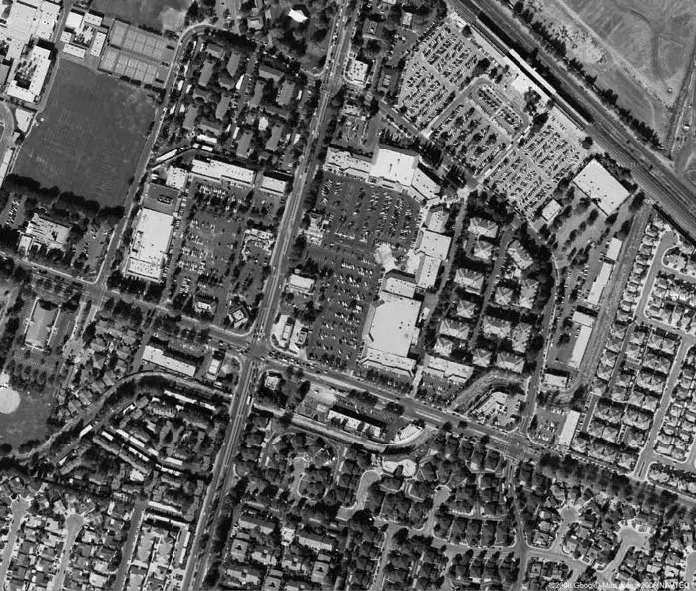
This aerial photo shows a typical commercial strip area with intermingled apartment projects. Some common features include:
USES
- Mix of pre- and post-war commercial uses
- Scattered apartment projects in between and adjacent to commercial centers
ISSUES
- Walled separation between uses and parcels
- Auto-oriented planning and pedestrian isolation
- Lack of social focus for surrounding community
DESIGN OPPORTUNITIES
- Integrating residential and commercial uses with renovated or new development as an economic development catalyst
- Creating better pedestrian connection between neighborhoods and commercial corridors
- Creating transit and pedestrian-friendly options to isolated apartments
6.2 Village Center Design Principles and Guidelines
Section titled “6.2 Village Center Design Principles and Guidelines”Village center districts should provide a community design framework that blends a mix of uses together around well-defined, active communal spaces.
These photos show an example of an integrated and friendly mixed-use suburban district with a grocery store-anchored shopping center and apartments. Storefronts connect the residential and commercial projects that include a small park, outdoor cafes, and public art.
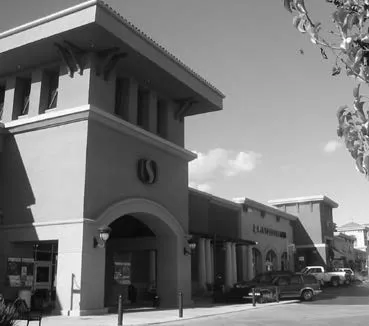
6.2.1 Creating a Sense of Place
Section titled “6.2.1 Creating a Sense of Place”New mixed-use residential and commercial projects should provide a social and economic focus for surrounding neighborhoods by creating a sense of place.
Design Guidelines
- Mixed-use village centers should locate and connect commercial and residential uses to result in a sense of community. Buildings should shape and activate streets and public spaces. Adjacent commercial and multi-family residential uses should be designed to create and share public spaces and streets.
- A unified design concept should be established and be reflected in the architectural style, landscaping, lighting fixtures, signage and other public amenities provided. The use of corporate or franchise architecture is discouraged in the Village Center and shall not be used as compatible theme or style.
- 🚶 New mixed-use developments should use open space, streets and community facilities to provide social and design focal points. Villages should have a central place such as a town square, main street or village plaza. “Parklets” also effectively contribute to providing social spaces. All these public spaces should be linked by an easily recognized pedestrian system.
- New mixed-use village centers should provide common open space as a centrally located and defining feature.
- Communal activities, such as recreation and gathering spaces, should be centrally or purposefully located to contribute to the social interaction of mixed-use projects and surrounding neighborhoods and feel welcoming.
- 🚶 The travel experience for pedestrians and drivers should contribute to the sense of community and “neighborhood belonging” in new village center projects and adjacent neighborhoods. The travel experience should convey that pedestrians and bicyclists are present and that autos are secondary.
- 🚶 New buildings should be designed and oriented to spatially define and activate streets and common open space areas with building entries, storefronts and pedestrian routes. Commercial storefront uses should face public spaces and street edges. These designs promote the sense of safety for those present.
- 🚶 Village Center parking should not dominate any aspect of the centers pedestrian and open space systems and community image.
- 🚶 Village Centers should attract a wide range of commercial and retail businesses. Providing healthy food sources and choices; such as full-service grocery stores, ethnic food markets, farm stands or farmers’ markets, and food establishments that provide fresh food supporting sustainable local food systems is desirable. Drive-through fast food restaurants are not appropriate in Village Centers.
- 🚶 Village Centers should incorporate co-location of other facilities or services that supports the needs of residents (i.e. health care center, recreation center, farmer’s market, drug or corner store, deli, etc.).
6.2.2 Connections to the Community
Section titled “6.2.2 Connections to the Community”Each project should contribute to the streetscape, pedestrian and auto access objectives, and architectural and signage design objectives for the site and surrounding area.
New mixed-use and commercial projects should be planned as an extension of adjacent new or existing neighborhoods.
Design Guidelines
- Gateways and edges of new village development should provide landscape, street improvements and furnishings as common amenities that are shared with adjacent neighborhoods.
- Village Centers should not be socially gated or distinguished as an enclave.
- 🚶 New mixed-use projects should provide for connections of existing and future streets.
- 🚶 Principal access roads into new mixed-use development areas should be of similar scale as streets in adjacent residential neighborhoods. In the event that the adjacent streets are oversized, incorporate designs to reduce street widths and speeds in order to provide a pedestrian dominated environment.
- The street patterns at the edges of a mixed-use village project should be extended into the site.
- 🚶 The design for new villages, and for retrofit of existing shopping or commercial centers, should have emergency and service vehicle access that maintains the pedestrian friendliness of the street.
- 🚶 Unnecessary tall concrete block sound walls should not separate commercial uses from residential uses. Where sounds walls exist or are necessary, provide breaks in the sound walls for access from adjacent neighborhoods and designed as “live-ends.”
- 🚶 When designing sound walls, pedestrian and bicycle connections to adjacent neighborhoods can include “live-end” features. Also used in cul-de-sacs, “live-ends” provide for pedestrian access at the ends to adjoining streets, open spaces, parking lots while permitting the access point to be used as a common outdoor space. “Live-ends” should be landscaped and can include benches, providing nice areas for sitting and socializing.
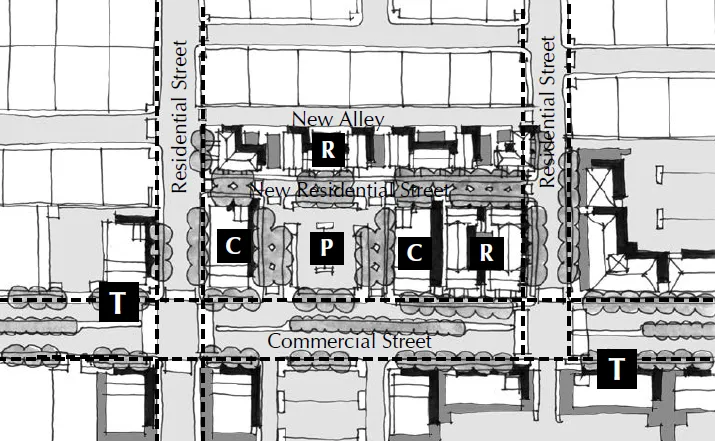
TOWNHOUSE AND STOREFRONT DEVELOPMENT
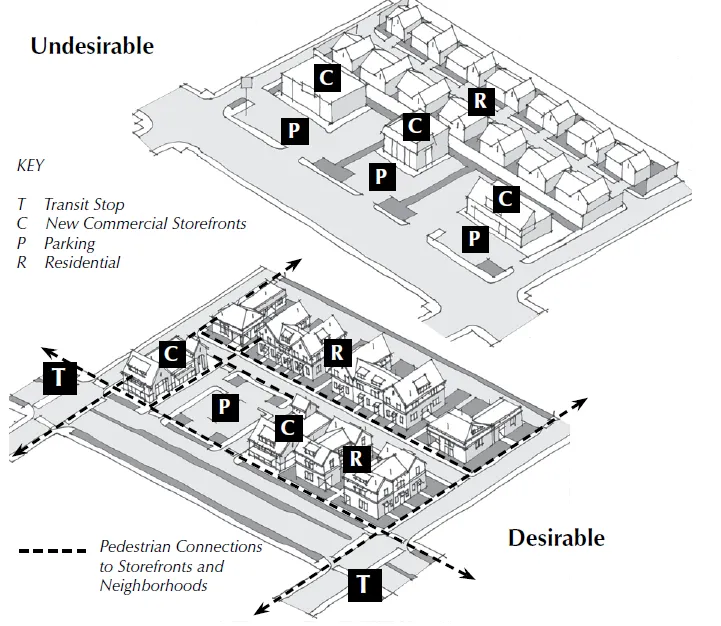
This site diagram illustrates how a mixed-use project can be planned to fit into the surrounding commercial district and neighborhoods. The concept diagram includes townhouses and commercial storefronts on a redeveloped site.
T - Transit stop
C - New Commercial Storefronts
P - Parking
R - Residential
Pedestrian Connections to Storefronts and Neighborhoods
6.2.3 Creating Pedestrian-Friendly Streets
Section titled “6.2.3 Creating Pedestrian-Friendly Streets”Village center projects should be organized around pedestrian-oriented streets rather than driveways and parking lots.
Design Guidelines
- 🚶 Pedestrian connections between commercial and residential developments should be active, friendly, attractive and safe. Large blank walls should not face streets or walkways.
- Public streets must meet the Sacramento County Improvement Standards, including standards for traffic calming. Auto speeds should be between 10-25 mph.
- Mixed-use villages should have a street design that reflects both a functional and design hierarchy that supports a sense of community,
- Primary organizational streets in villages should incorporate planting strips, medians and other design features.
- 🚶 Private drives should be designed as pedestrian-friendly streets that are a natural extension of the surrounding neighborhood.
- 🚶 All village streets should include an interconnected system of separated sidewalks and crosswalks.
- 🚶 Minimize the number and width of driveways and curb cuts.
- 🚶 Quality paving treatment in areas such as parking lots, common areas, and pedestrian walkways can enhance the visual appearance of a project; promote walkability and activity that contributes to healthy residents, while also providing environmental benefits.
- Use accent paving such as textured paving and paving blocks in driveways. Use of permeable concrete, cool pavements and pavers is desirable.
- 🚶 Paseos should be utilized to provide common outdoor spaces and allow for pedestrian access through the development, and connection to adjacent developments.
6.2.4 Block Sizes, Lot Patterns and Building Orientation
Section titled “6.2.4 Block Sizes, Lot Patterns and Building Orientation”New village center projects should use a block, lot and building pattern that provides an overall organizational structure and results in a pedestrian-scaled environment.
Design Guidelines
- Traditional residential-scaled blocks should be used as a reference for the pattern and scale that organize mixed-use village areas. A grid or modified grid block pattern is preferred.
- 🚶 Block patterns should result in a pedestrian-scaled neighborhood that is comfortable for pedestrians and increases access options for the village and surrounding areas.
- Design concepts for mixed-use villages should consider the scale and character of residential streets. The sizes of lots, scale of buildings, and width of streets should be planned to support the design concept.
- Lots and parcels should be planned to promote friendly residential and commercial building orientation towards neighborhood streets. Lot and parcel patterns should orient storefronts, porches, and yards to enhance the social role of village streets. Residential entries and lobbies should face streets and common open spaces.
- Service areas for commercial uses should be located at the edge of the site and screened to reduce impacts on residents.
- Special siting and building design strategies that protect residential livability near service areas should be incorporated into project design. Avoid trash enclosures, loading docks or other noise-generating areas in close proximity to residential uses. If proximity is unavoidable, establish operational requirements for noise or odors to residents.
6.2.5 Parking
Section titled “6.2.5 Parking”Parking in village center projects should support commercial and residential requirements but with less visual prominence than auto-oriented strip commercial centers.
Design Guidelines
- Solutions that minimize the visual impact of residential and commercial driveways should be used, including sharing driveways, using alleys, or other innovative design approaches.
- Parking for commercial uses in villages should be located next to or behind buildings. These parking areas should be divided up into smaller, landscaped lots with defined pedestrian connections.
- Parking lots on corner sites should not be located near the intersection and occupy space for streetfront buildings or open space features.
- Residential parking for mixed-use village developments should be located in courts that are not visible from public streets; broken up with shade trees and landscaping; and use a variety of paving materials. For residential uses, a maximum of four garage doors (spaces) should be allowed without a five-foot break between groups of doors.
- Mixed-use village projects involving a planned development process should consider alternative parking solutions including tandem parking, remote parking, single car garages and other methods of reducing the visual presence of parking and cars from the street.
- Parking areas should incorporate designs that include: trees, lighting, landscaped storm water features, cool and pervious pavement and pavers. Plant trees and shrubs to soften the overall impact of parking areas and to provide shade and noise reduction, heat island cooling and improved air quality.
- Flexible use of parking areas provides opportunities for additional social interaction between businesses, customers, and residents by providing space for large special events and festivals.
- Lighting in parking areas should be LED lights or other acceptable high energy efficiency light, with automatic controls to dim lights after certain hours or when no one is present. Lighting shall be adequate to provide for a safe environment.
- Create textures, patterns, and colors in the design of paved parking areas or entries to create visual interest and to distinguish them from other paved areas. Do not design large monolithic areas of single color untextured paving.
- Use accent paving such as textured paving and paving blocks in driveways. Use of permeable concrete, cool pavements and pavers is desirable.
- Incorporate storm water quality measures into the parking areas to treat the storm runoff and enhance the parking areas by providing shade and reducing the amount of paving.
- Residential parking garages should be located behind the front building elevation.
- 🚶 Multi-story garages serving mixed use villages should have an exterior design that is consistent with the village design theme and image. When garages are located along major pedestrian circulation routes, the ground floor frontage should be considered for commercial or public focused use.
- Provide for electric vehicle fast-charging stations, car and bike share locations, and other alternatives such as zip car.
- 🚶 Bike racks shall be designed with the most current designs that provide secure locking features and are attractive. Many bike racks double as public art to add interest.
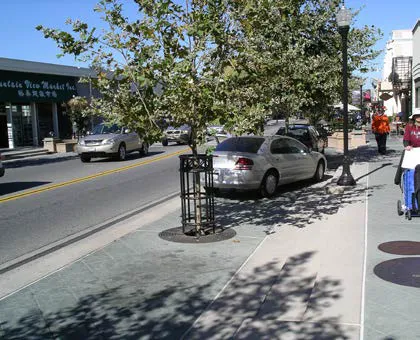
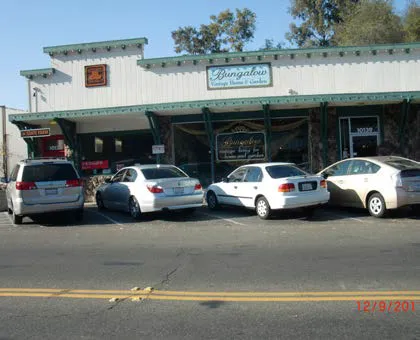
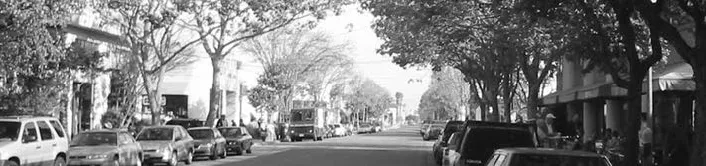
These photos show desirable ways to treat onstreet parking. The top photo shows parallel on-street parking with street trees, sidewalks and lighting. The bottom photo shows angled on-street parking.
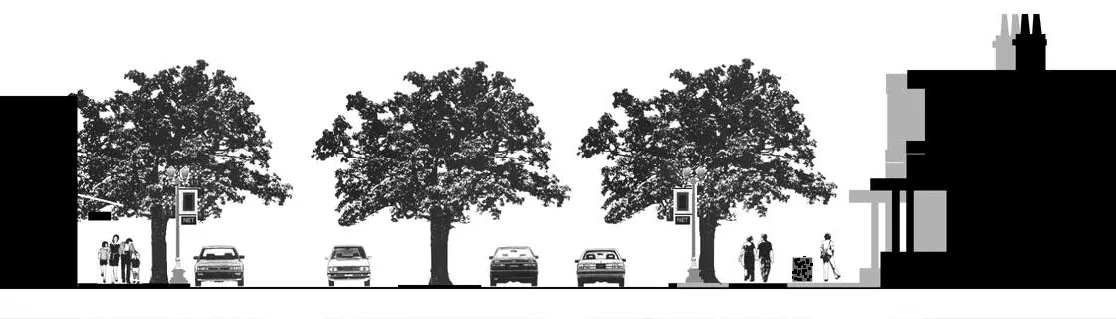
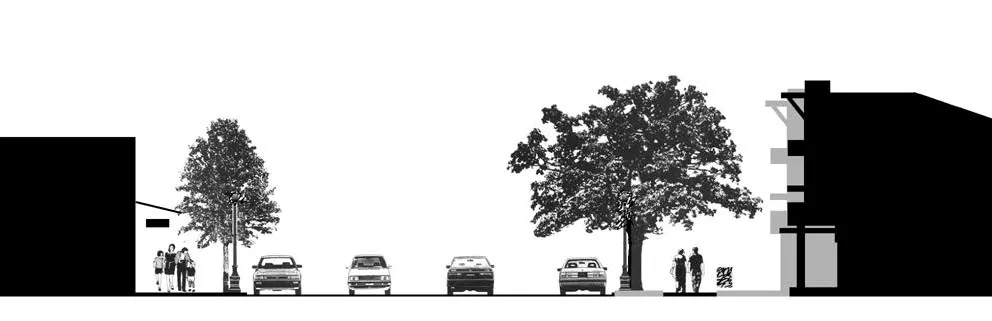
These sections show how streets can be designed to accommodate commercial and residential frontage. The illustrations include a “community street” that is wider and has community-serving commercial uses, and a “main street” that has neighborhood-serving retail.
Community Street
Main Street
6.2.6 Streetscape and Landscaping
Section titled “6.2.6 Streetscape and Landscaping”Streetscape and landscaping should promote pedestrian activity and provide for pedestrian safety, access, comfort and connections while contributing to overall placemaking and image objectives for village districts. Landscaping and trees can be used to complement buildings and to make a positive contribution to the aesthetics and function of the specific site and area. These aesthetics contribute to the mental and emotional well-being of customers, and support economic activity. Landscaping helps reduce storm water runoff, filters water and captures carbon and air particulates to improve air and water quality, provides shade during summer months and lowers temperatures reducing heat island impacts.
Design Guidelines
- Landscape concepts should enhance the linkages between residential and commercial uses.
- All streetscape improvements must meet the Sacramento County Improvement Standards. Larger trees will require wider planting strips.
- 🚶 Mixed-use village developments should provide a comprehensive streetscape plan. The plan should satisfy street design; pedestrian safety, access and comfort; and visual amenity objectives for the village. Signage, lighting and landscaping should provide a thematic identity for mixed-use sites. The use of green and sustainable development standards and practices in planning, design, construction and renovation of new and existing buildings should be used wherever possible.
- Streetscape should enhance the identity of the village center by employing a variety of trees and other plant material that contributes to each street’s identity and character.
- 🚶 Along streets with greater than 50,000 vehicles ADT, plant trees conducive to absorbing particulates including deodar cedar, valley oak, and redwoods. Utilize canopy trees for pedestrian areas to increase shading, cool the pavement and support walking.
- 🚶 In residential areas, projects should include at least one street tree per lot or 30’ of lot frontage, whichever is smaller. Trees should be placed in planting strips, sidewalk tree wells or front yards in a manner that supports the village comprehensive streetscape plan.
- 🚶 Sidewalks adjacent to storefronts should be wide enough to accommodate outdoor sitting areas and landscape. This should include a combination of at least four feet for planting, eight feet for sitting, and six feet clear for walking.
- 🚶 Street trees with large canopies are required for sidewalk areas. Trees should be spaced 25-30 feet on center and be coordinated with the bay spacing and storefront design of the project.
- 🚶 Include street furniture and pedestrian-scale lighting in planning and development of mixed-use projects.
- Landscaped storm water quality design measures provide multiple public benefits and should be integrated into open space areas to provide storm water quality benefits and landscaping benefits.
- Incorporate appropriate landscaping that includes a variety of trees, shrubs, and other plantings. Utilize Sacramento County’s River Friendly Landscape (RFL) Guidelines for plant material selection, placement and maintenance. The sustainable RFL guidelines are water and energy efficient, reduces maintenance, improves air quality and diverts green waste from the landfills.
- Provide on-going maintenance to identify and ensure the timely replacement of any dead or diseased vegetation.
- Design landscaping to be compatible with building design. Use trellises, arbors, cascading landscaping, vines and perimeter garden walls wherever suitable.
- 🚶 Consider security issues in the landscape design of the site, including creation of barriers and screening.
- Do not allow landscaping to impede fire access to hydrant connections.
- 🚶 Preserve and incorporate existing and native trees within the project site design to the greatest extent possible.
- 🚶 Retain existing mature trees in landscape and building location plans to the greatest extent possible. Where existing trees must be removed, trees shall be replaced on-site or in another location, acceptable to the Planning Director, to compensate for the loss in canopy and environmental benefits. Participation in the County’s Tree Mitigation program to compensate for canopy loss is also acceptable.
- Provide all landscaped areas with irrigation systems as needed to sustain the landscape. Comply with the County’s Water Conservation Ordinance. Utility services and equipment should be enclosed or buried, or otherwise concealed from view.
- 🚶 Use of known high allergen plantings is discouraged.
Streetscaping should enhance the identity of the village center by employing a variety of trees and other plant material that contribute to each street’s identity and character.
Drainage/Flood Facilities
- Size, type, and location should be sized and located as to support the community master plan goals.
- 🚶 To encourage sufficient usage, parks and open space should be strategically located in or near residential areas and commercial districts and be accessible via roadways, transit routes, and off-road pedestrian and bicycle trails and paseos (walkways).
- 🚶 Neighborhood parks are encouraged to be centers of neighborhood activity and could be combined with schools, community recreation centers, libraries and other civic uses.
- 🚶 Public safety is a high priority and Crime Prevention Through Environmental Design (CPTED) principles should be applied.
- Flood protection and drainage facilities should be designed to provide multiple public benefits wherever possible. Facilities should include multi-purpose improvements consisting of recreation, the environment, storm water runoff, water reclamation, infiltration, groundwater recharge, flood control, etc. Attractive joint use basins, such as parks (in addition to Quimby land dedication requirements) or parkways with trails that also convey water to water quality basins or similar facilities and provide some water quality treatment are examples of desired multiple public benefit facilities.
6.2.7 Integrating Transit
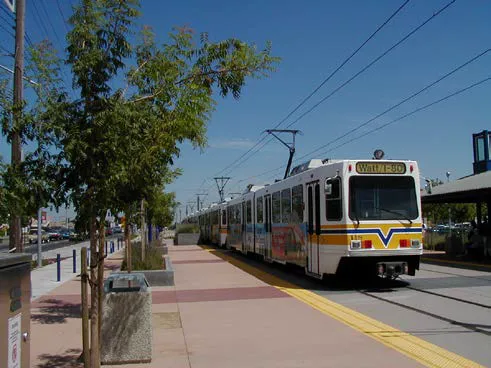
Section titled “6.2.7 Integrating Transit”Transit access is of particular importance for village center districts. Bus and transit stops should be safe, social and centrally located places that help energize and focus village districts.
Design Guidelines
- 🚶 Transit facilities should be centrally located in the village district. They should be visible and socially integrated into the planning of new and redeveloped village centers.
- 🚶 Pedestrian connections to transit facilities should be easy to understand, safe, comfortable and friendly.
- The business owner is encouraged to provide a location for convenient route and schedule information.
- 🚶 Shelters and lighting should be provided. The design of shelters should anticipate the number of transit patrons and their physical comfort. Shade, and screening from wind and rain should be a design consideration for transit shelter design.
- 🚶 Bike facilities should be designed into every village.
6.3 Village Center Architectural Principles and Guidelines
Section titled “6.3 Village Center Architectural Principles and Guidelines”Each project in a village should contribute to placemaking objectives for the community.
6.3.1 Building Form and Massing
Section titled “6.3.1 Building Form and Massing”Massing and orientation for residential, commercial and mixed-use buildings in village districts should have a pleasing composition while reinforcing placemaking, economic and social objectives.
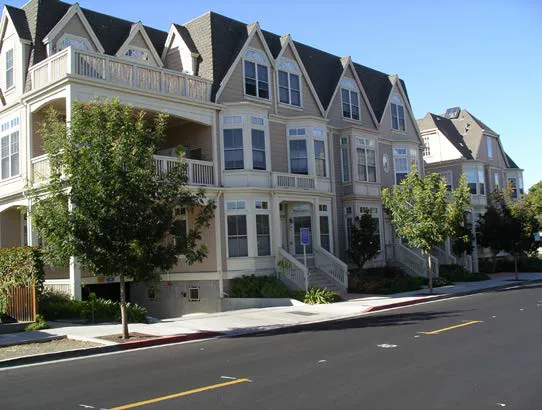
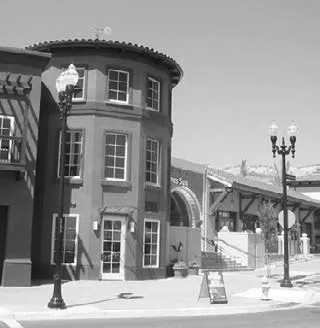
This photo shows a residential building with expressive design features giving the building a rhythm and reinforcing placemaking objectives.
Design Guidelines
- Building form and design should have a deliberate street and street corner orientation in village districts.
- Upper levels should have expressive design features, such as balconies and bay windows, that give the building a rhythm and residential scale.
- Roof forms should reflect the project’s architectural context. In a commercial context, the roof may be flat or have a strong horizontal cornice element. In a residential neighborhood edge or village context, roof forms should include hip or gable elements.
- For vertical mixed use, the uses should be an identifiable design element.
- Roof-mounted equipment shall be concealed by enclosures that are consistent in design with the building roof.
- The massing concepts of multi-story development should transition in scale between commercial streets and single-family residential streets.
- Building design concepts should include stepping down the scale and mass and increasing side or rear yard setbacks of taller buildings where they are adjacent to existing single-family areas.
- Units should be oriented toward public streets and commons rather than neighboring backyards.
- Parking for commercial or mixed use buildings should be designed and located to mitigate noise and visual impact on adjoining residential neighborhoods.
- Residential and commercial development should be interfaced with streets or open spaces rather than sharing a property line.
MAKING MIXED-USE SOCIAL
These two site diagrams illustrate two ways to develop a site with a mix of residential and commercial uses.
The design concept on the top is undesirable because it:
- Has disconnected commercial development;
- Creates multiple curb cuts and several disconnected parking lots;
- Creates an isolated walled subdivision; and
- Results in unsafe and uncomfortable pedestrian experience.
The bottom example is a desirable design concept. The concept is desirable because it:
- Has connected commercial buildings that share parking and access;
- Creates good pedestrian edges that are connected and interesting;
- Creates a variety of public and private spaces;
- Has a variety of housing designs; and
- Enhances access to adjacent neighborhoods.
6.3.2 Architectural Design
Section titled “6.3.2 Architectural Design”Architectural features should reinforce massing, place-making concepts and express the mixed-use nature of village centers.
Design Guidelines
- Commercial and residential buildings in mixed-use villages should contribute to overall planning and place-making objectives, while providing architectural variety. They shall conform in design to the relevant provisions of the Multi-Family Guidelines (Chapter 3.0), the Commercial Design Guidelines (Chapter 4.00) and the Employment Center Design Guidelines (Chapter 5.0).
- 🚶 Residential and commercial buildings should express their function and purpose. Commercial storefront buildings should be designed to create a successful shopping experience. Transparent storefronts, bay spacing and details should reflect the pedestrian scale and pace of storefront retailing.
- Storefronts should maximize openness and transparency.
- Residential design features should enhance the expression of individual units and houses. This includes balconies, bay window elements, roof design, entries, porches, and window patterns.
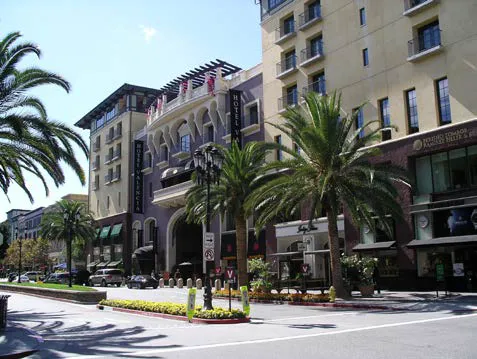
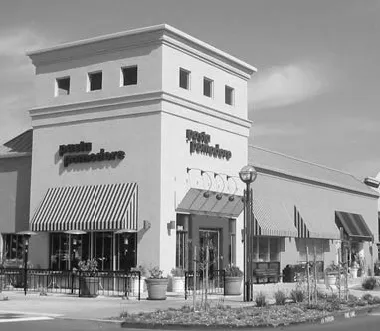
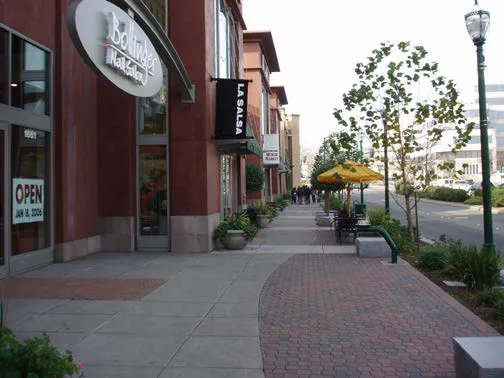
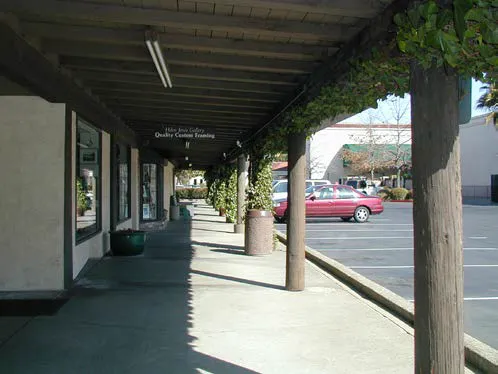
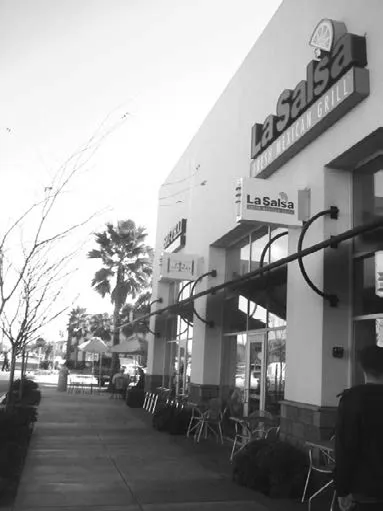
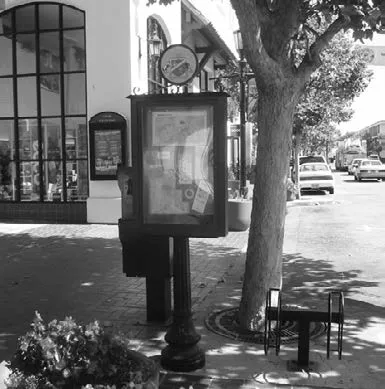
These photos show examples on how to design shopfronts for good pedestrian connections in a suburban setting. The sidewalks have connections to adjacent residential blocks.
6.3.3 Materials and Colors
Section titled “6.3.3 Materials and Colors”Architecture within each mixed-use project should use a palette of materials that convey an image of quality and durability.
Selection of materials and finishes should support architectural and massing concepts for village centers.
Design Guidelines
- Commercial frontage portions of mixed-use projects should utilize materials and colors that support retailing and image objectives for shopping environments.
- Use sustainable building materials that are high quality, durable, provide energy efficiency benefits, require low maintenance, and complement the design of the building. Use of quality recycled products is encouraged.
- Use of “Permanent” and/or cool roof products and materials with reflective surfaces are desirable because of their low maintenance, energy conservation and insulation values.
- Employ Energy Star appliances and energy efficient lighting in construction, to the extent feasible, consistent with the adopted Green Building Policies and requirements.
- Portions of mixed-use projects with residential frontage should use colors and materials that enhance the project’s architectural concepts and are compatible with adjacent residential streets.
- Architecture within each mixed-use project should use a palette of materials that convey an image of quality and durability. Certain materials have an inherently inexpensive, insubstantial or garish quality. These materials should not be used in new construction or renovation. Examples include:
- Roofs: glazed or painted tiles, highly reflective metal or sheet materials, fake shingles made from metal or plastic materials
- Walls: vinyl, metal, plywood, T-111 siding, masonite or other sheet materials
- Wood or hardboard siding, if used, should be shiplap or board-and-batten.
- Shiplap should be installed so there are no visible joints. Board-and-batten should be installed so there are no visible joints in the underlying “board” material.
- Painted surfaces should use colors that reinforce architectural concepts and are compatible with natural materials, such as brick or stone.
6.3.4 Lighting
Section titled “6.3.4 Lighting”Lighting concepts should be an integral part of the overall village design concepts anticipating the needs of pedestrian and automobile circulation, open spaces, storefront shopping, and residents.
Design Guidelines
- Lighting on commercial elevations of mixed-use village projects should support overall objectives for the street and storefront design.
- Elevations with residential front porches should have individual lights that illuminate entries and walkways.
- Lighting in service or common areas should be shielded from adjacent residential units.
- 🚶 Lighting should provide for business interest even after hours, when business is closed, to contribute to pedestrian presence and sense of safety.
- 🚶 Provide energy efficient lighting in all common areas and buildings, including pedestrian and vehicular routes. The emphasis should be on personal safety, with lighting landscape or building surfaces secondary.
LIGHTING A PEDESTRIAN DISTRICT
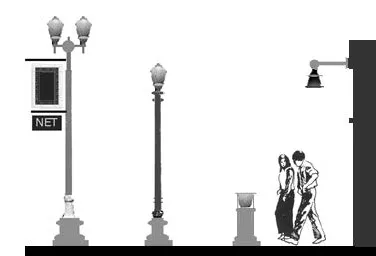
These sketches illustrate a family of lighting elements that provide for the safety and functional requirements for mixed-use villages.
- Parking and Street Lighting
- Street Lamps
- Pedestrian-scale Light Bollards
- Wall-mounted Sidewalk Lighting
These sketches illustrate the selection of street trees for a mixed-use neighborhood. Tree selection should reflect County Improvement Standards and the district’s urban design objectives.
-
Street Canopy Trees
Where: Wide streets, residential frontage
Require: 6-7’ planting strips -
Vertical Street Trees
Where: Medians, near intersections
Require: 5-6’ planting strips -
Smaller Upright Street Trees
Where: Storefront edges
Require: 4-5’ tree-cuts

6.3.5 Walls and Fences
Section titled “6.3.5 Walls and Fences”Screen walls are generally regarded as mitigation for poor site planning. However, when walls or fences are required, they should be designed as an extension of village architectural and landscape design concepts.
6.3.6 Service Areas
Section titled “6.3.6 Service Areas”Service and loading dock areas in village centers should be placed in locations that are not visually prominent and screened from view.
Design Guidelines
- Loading areas should be located to rear or inside side yards. Loading areas should not be visible from public streets or adjacent buildings.
- Trash bins and compactors, utility meters, transformers, and other service elements should be enclosed or otherwise completely concealed from view. Service elements should be designed as an integral element of the project’s architecture.
- Provide sound-attenuation features around noise-generating areas such as trash enclosures and loading docks. Such features may include fully enclosed loading docks and higher dock walls.
- Locate noise generating services so that vehicular service drives have a minimized noise impact on any adjacent residential uses.
- Provide trash and recycling education information near enclosures. Provide enclosures in a safe and secure location kept clean and odor-free.
- Design trash enclosure areas to the County’s latest storm water quality source control design standards, and provide trash and recycling education information.
- Refer to the commercial Section 4.4.6 for guidelines on wireless communication facilities.
6.4 Village District Signage
Section titled “6.4 Village District Signage”Village district signage should help define the district’s identity and address a pedestrian’s pace and scale.
6.4.1 District Image and Wayfinding Signage
Section titled “6.4.1 District Image and Wayfinding Signage”Village centers should have overall signage and graphic identity concepts that guide district, site and building signage design day and night.
Design Guidelines
- Village image and design themes should be reflected in a district-wide signage plan. The plan should include a “family” of signage that supports the merchandising needs of tenants, wayfinding, and graphic identity objectives for the village and adjacent neighborhood.
- District identity and wayfinding signage should be designed and located as part of an overall district signage plan.
- Placement and maintenance of village district signage must be coordinated with the County Department of Transportation and comply with ADA requirements.
- Refer to the commercial Sections 4.5.4 and 4.5.5 for guidelines addressing water tanks and towers and billboard signs and digital billboards.
6.4.2 Multi-Tenant Project Signage
Section titled “6.4.2 Multi-Tenant Project Signage”Village center buildings should have graphic standards and schedule for building, tenant and wayfinding signage that reinforce pedestrian scale and pace of the district.
Design Guidelines
- Multi-tenant buildings in village districts should have an overall signage concept plan.
- A project’s signage plan should be designed for known tenants and future unknown tenants.
- Large, garish signs unnecessary to the commercial use of a village center are discouraged.
- Affixed signs should be composed of individual characters; cabinet signs are discouraged.
- Affixed signs should be placed only on vertical surfaces below the eaves or parapet line. Rooftop signs are discouraged.
6.4.3 Storefront Signage
Section titled “6.4.3 Storefront Signage”Storefront signage should reinforce the pedestrian orientation of village centers.
- Awning signs are allowed with graphics and signage limited to vertical surfaces. Awning signs should count against cumulative areas for affixed signs.
- Suspended blade signs are allowed under awnings or canopies.
- Maintain windows free of obstructions and signs to promote maximum visibility of merchandise, and visibility by Sheriff patrol consistent with CPTED strategies.
6.5 Project Operational Elements
Section titled “6.5 Project Operational Elements”The operational elements design guidelines for mixed-use mirror those of the commercial district section. Please refer back to Section 4.6 for this information and details.
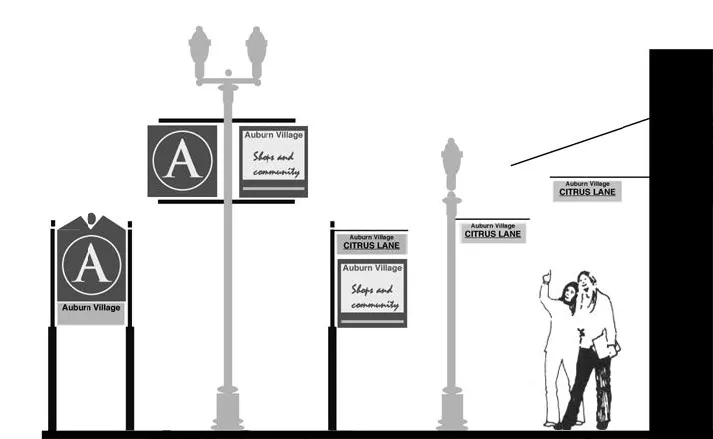
This sketch shows a family of signage that would be appropriate in a mixeduse village district.
- District Signage
- District Banner Signage
- Wayfinding Signage
- Street Signage
- Blade Signs