

Appendix B: Special Standards
Countywide Design Guidelines
Appendix B: Special Standards
Section titled “Countywide Design Guidelines Appendix B: Special Standards”B.1 ADA Transitional Pedestrian Guidelines
Section titled “B.1 ADA Transitional Pedestrian Guidelines”The County is in the process of updating pedestrian facilities to respond to the American Disabilities Act (ADA). All new sidewalks, crosswalks, and buildings located in public rights-of-way need to comply with the Federal laws regarding accommodating persons with disabilities. The County has prepared guidelines that demonstrate how to design sidewalks and other facilities that support accessibility requirements.
B.2 Disabled Access
Section titled “B.2 Disabled Access”Title 24 and ADA
Section titled “Title 24 and ADA”Disabled access for new and renovated development is governed by California’s Title 24 (provides standards for disabled access, energy efficiency and seismic design) and the Americans with Disabilities Act (ADA) and the Americans with Disabilities Act’s Accessibility Guidelines (ADAAG). Every project is required to be designed to provide access. This includes public infrastructure projects, site planning for private development, and building design.
B.3 Universal Design
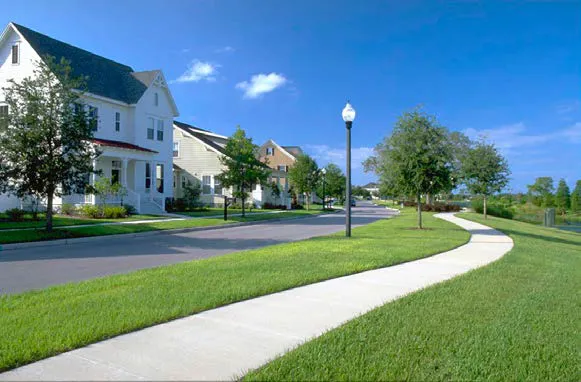
Section titled “B.3 Universal Design”The Design Guidelines encourage design solutions for persons of all abilities through universal design concepts. Universal design is the process of ensuring that the built environment is accessible, understandable, and navigable to people with a wide range of abilities and conditions affecting one or more of the senses, motor skill, reach, range of motion, and/or general mobility. Universal design accommodates a wide range of individual preferences and abilities; communicates necessary information effectively (regardless of ambient conditions or the user’s sensory abilities); and can be approached, reached, manipulated, and used regardless of the individual’s body size, posture, or mobility.
Universal access and design is encouraged in multifamily housing to benefit people of all ages and abilities by making all components of the built environment more usable and readily accessible by as many people as possible at little or no extra cost. Moreover, universal design must be aesthetically pleasing and functional for people with mobility, visual, hearing, and other impairments as well as those who have no significant disability.
Universal design is a higher standard than the standard required by the Americans with Disabilities Act. Universal design may exceed the minimum program requirements of the building codes. Universal design is best achieved through innovative design of building and spaces, rather than through prescriptive measures and should be considered from the earliest design stages.
B.4 Stormwater Quality Design Principles
Section titled “B.4 Stormwater Quality Design Principles”The County’s Department of Water Resources has prepared development standards for new and redevelopment projects which require the use of stormwater quality control measures on most projects. The County has published the Guidance Manual for Onsite Stormwater Quality Control Measures that contain design criteria and guidelines for these measures, which are intended to reduce pollutants in urban runoff and attenuate the volume and rate of runoff discharged to the local stormwater drainage system and creeks and rivers. Since many of the measures will affect site grading, drainage and parking lot layout, project applicants should strive to integrate stormwater quality measures into their projects at the earliest possible phase of design. Early consideration allows for more effective and economical options possibly requiring less long-term maintenance. Also, many of the stormwater quality measures fulfill other ordinances.
B.5 Crime Prevention Through Environmental Design
Section titled “B.5 Crime Prevention Through Environmental Design”In recent years designers and architects have begun to recognize crime as a man-made hazard that can be resisted through quality design. The new design approach to crime prevention is known as “Crime Prevention Through Environmental Design” (CPTED). It is more far-reaching than dead-bolts on doors or locks on windows; it is the use of design to eliminate or reduce criminal behavior while at the same time encouraging people to “keep an eye out” for each other.
The following CPTED strategies can be applied through design guidelines to residential, commercial, industrial and mixed-use developments to help create safer, more livable communities.
Natural Surveillance
Section titled “Natural Surveillance”The placement of physical features, activities, and people in a way that maximizes visibility is one concept directed toward keeping intruders easily observable, and therefore less likely to commit criminal acts. Features that maximize the visibility of people, parking areas, and building entrances are: unobstructed doors and windows, pedestrian-friendly sidewalks and streets, front porches, and appropriate nighttime lighting.
Territorial Reinforcement
Section titled “Territorial Reinforcement”Physical design can also create or extend a sphere of influence. Users are encouraged to develop a sense of territorial control while potential offenders, perceiving this control, are discouraged. This concept includes features that define property lines and distinguish private spaces from public spaces using landscape plantings, pavement designs, gateway treatments, signage, and open (“CPTED”) fences.
Natural Access Control
Section titled “Natural Access Control”Natural access control is another design concept directed primarily at decreasing crime opportunity by denying access to crime targets and creating a perception of risk for offenders. People are physically guided through a space by the strategic design of streets, sidewalks, building entrances, landscaping, and neighborhood gateways. Design elements are very useful tools to clearly indicate public routes and discourage access to private areas and structural elements.
Maintenance
Section titled “Maintenance”Care and maintenance allow for the continued use of a space for its intended purpose. Deterioration and blight indicate less concern and control by the intended users of a site and indicate a greater tolerance of disorder. Proper maintenance prevents reduced visibility due to plant overgrowth and obstructed or inoperative lighting, while serving as an additional expression of territoriality and ownership. Inappropriate maintenance, such as over pruning shrubs, can prevent landscape elements from achieving desired CPTED effects. Communication of design intent to maintenance staff is especially important for CPTED related ideas to be effective.
B.6 Sample HOA Conditions
Section titled “B.6 Sample HOA Conditions”The following condition is a recommended standard condition to be applied to small lot and townhome residential projects. The intent is to ensure that a HOA is formed in all cases, and that Covenants, Conditions and Restrictions (CC&Rs) be recorded that outline the respective duties of the HOA and individual property owners. There are many different product types, and this condition may be modified for individual circumstances. Any provisions of State Law pertaining to HOAs would supersede any portion of this condition. For small lot detached products, this condition does require that the HOA maintain the residences; it would require that there be “step-in” provisions for enforcement by the HOA if individual property owners do not meet the CC&R standard.
- Establish a Homeowners’ Association and record Declaration of CC&Rs that clearly establishes the respective maintenance and repair responsibilities of the Association and the individual residence owners, including, but not limited to:
- Front yard landscape maintenance by the Association for all residential lots;
- Maintenance by the Association of all private streets and alleys;
- Landscaping and general maintenance by the Association of project common areas and paseos;
- Maintenance, paint, repair, and eventual replacement of all other residential dwelling improvements including exterior surfaces by the residence owners in accordance with the maintenance manual provided by the developer to initial purchasers;
- Provisions relating to the storage and disposal of trash including provisions requiring trash containers to be maintained in garages or in the residence except when the container is at the curb on refuse collection days and provisions relating to the placement of materials during the Neighborhood Cleanup Program;
- Provisions prohibiting the conversion of garage bays to uses such as workshops or storage that prevent the parking of vehicles in the garage.
The following condition is intended to address situations where the primary make-up of property owners are investors who may not be completely engaged in property maintenance and long-term stability. This condition does not require that units be owner-occupied over the life of the unit.
- The Board of Directors of the HOA shall be comprised of owner occupants. Initial sale of homes for ownership by investors/absentee owners of the entire subdivision shall be limited to no more than ten percent (10%) of the residential units in the subdivision.
The following condition is intended to more specifically address placement of garbage containers, especially in cases where there are dead-end private streets.
- Garbage containers will be serviced on the street of a resident’s address. On a private street that is not a through street, all containers must be placed on one side of the street as designated by the County in order for service to be performed. It will be necessary to have CC&Rs that prohibit parking on service day for these streets. During Neighborhood Clean-up Programs, all materials will need to be placed on the main street that crosses the street which is not a through street. No material will be serviced on a private street which is not a through street. All owners on private streets and the HOA will need to sign a Release of Liability for any damage that may occur while the County provides service to those private streets.