

Noise Element
Sacramento County General Plan
Noise Element
Section titled “Sacramento County General Plan Noise Element”Adopted December 15, 1993
Amended November 9, 2011 & December 13, 2017 & December 13, 2022
SECTION I: INTRODUCTION
Section titled “SECTION I: INTRODUCTION”Purpose of the Noise Element
Section titled “Purpose of the Noise Element”The Noise Element of the Sacramento County General Plan provides a basis for comprehensive local policies to control and abate environmental noise and to protect the citizens of Sacramento County from excessive noise exposure. The fundamental goals of the Noise Element are as follows:
- To provide sufficient information concerning the community noise environment so that noise may be effectively considered in the land use planning process.
- To develop strategies for abating excessive noise exposure through cost-effective mitigation measures in combination with appropriate zoning to avoid incompatible land uses.
- To protect those existing regions of the planning area whose noise environments are deemed acceptable and also those locations throughout the community deemed ‘noise sensitive’.
- To protect existing noise-producing commercial and industrial uses in Sacramento County from encroachment by noise-sensitive land uses.
Noise Element Requirements
Section titled “Noise Element Requirements”The noise element requirements contained in California Government Code Section 65302(f) are summarized as follows:
-
A noise element shall identify and appraise noise problems in the community. The noise element shall recognize the guidelines established by the Office of Noise Control in the State Department of Health Services and shall analyze and quantify, to the extent practicable, as determined by the legislative body, current and projected noise levels for all major sources of noise within the County.
-
Noise contours shall be shown for major noise sources and stated in terms of the day/night average level (Ldn) or other appropriate noise descriptors. The noise contours shall be prepared on the basis of noise monitoring or following generally accepted noise modeling techniques for the various sources identified above.
-
The noise contours shall be used as a guide for establishing a pattern of land uses in the land use element that minimizes the exposure of community residents to excessive noise. The noise element shall include policies, implementation measures and possible solutions that address existing and foreseeable noise problems, if any.
Acoustical Terminology
Section titled “Acoustical Terminology”Acoustics
Section titled “Acoustics”The science of sound.
Ambient Noise
Section titled “Ambient Noise”The distinctive acoustical characteristics of a given area consisting of all noise sources audible at that location. In many cases, the term ambient is used to describe an existing or pre-project condition such as the setting in an environmental noise study.
Attenuation
Section titled “Attenuation”The reduction of noise.
A-Weighting
Section titled “A-Weighting”A frequency-response adjustment of a sound level meter that conditions the output signal to approximate human response. All noise level measurements and noise standards associated with this Noise Element are provided in terms of A-weighted sound levels.
Capacity Enhancing
Section titled “Capacity Enhancing”A roadway project which would increase roadway capacity. Examples include new roadway construction projects or widening projects. Projects which only re-stripe or otherwise alter roadway configuration without increasing capacity are not included in this definition
Community Noise Equivalent Level. Defined as the 24-hour average noise level with noise occurring during evening hours (7 - 10 p.m.) weighted by a factor of three and nighttime hours weighted by a factor of 10 prior to averaging.
Decibel or dB
Section titled “Decibel or dB”Fundamental unit of sound, defined as ten times the logarithm of the ratio of the sound pressure squared over the reference pressure squared.
Frequency
Section titled “Frequency”The measure of the rapidity of alterations of a periodic acoustic signal, expressed in cycles per second or Hertz.
Infill Project
Section titled “Infill Project”A project which is consistent with the General Plan Land Use Map designations, zoning, and community plan for the property in which at least 50% of the project site is bounded by similar uses and a project which would not expand the perimeter of the development area.
Day/Night Average Sound Level. Similar to CNEL but with no evening weighting.
Equivalent or energy-averaged sound level.
Median noise level, or level exceeded 50% of time.
The highest root-mean-square (RMS) sound level measured over a given period of time.
Loudness
Section titled “Loudness”A subjective term for the sensation of the magnitude of sound.
Unwanted sound.
Noise Reducing Pavement
Section titled “Noise Reducing Pavement”Pavement types for which local studies have identified noise-reducing benefits.
Sensitive Outdoor Areas
Section titled “Sensitive Outdoor Areas”The primary outdoor activity area associated with any given land use at which noise-sensitivity exists and the location at which the County’s exterior noise level standards are applied.
Single-Family Residential Uses:
Section titled “Single-Family Residential Uses:”Normally considered to be back yard spaces, or distinct rear patio/deck areas of single-family residential uses. Front yard spaces, elevated balconies front courtyards, front decks, side yards, etc., are not commonly considered to be sensitive outdoor activity areas. Where the location of outdoor activity areas for large lot residential properties cannot be determined, the County’s exterior noise level standards shall be applied within 50 feet of the rear of the residence.
Multi-family Residential Uses:
Section titled “Multi-family Residential Uses:”Common outdoor recreation areas, such as pools, tot-lots, tennis courts, etc., of multi-family uses are considered to be the sensitive outdoor area. Individual patios and balconies of multi-family developments are not considered to be sensitive outdoor areas.
Residential Component of Mixed-Use Developments:
Section titled “Residential Component of Mixed-Use Developments:”Mixed use developments will commonly consist of residential units on elevated floors above office or commercial uses. As a result, such uses may not include a clearly delineated sensitive outdoor area, in which case satisfaction with the County’s interior noise level standards will be considered adequate.
Small Lot Detached Single Family Developments:
Section titled “Small Lot Detached Single Family Developments:”In higher density detached single family residential developments (RD-10 or greater density), outdoor activity areas may be small patios or courtyards, or the development may not propose outdoor areas. If small lot developments provide a common outdoor recreation area for the residents of the community (much like an apartment complex), the standards of the Noise Element shall be applied at that location. Otherwise, the standards shall be applied at individual patio/courtyard areas of these developments.
Fundamentals of Noise
Section titled “Fundamentals of Noise”Noise is often described as unwanted sound. Sound is defined as any pressure variation in air that the human ear can detect. If the pressure variations occur frequently enough (at least 20 times per second) they can be heard and hence are called sound. The number of pressure variations per second is called the frequency of sound, and is expressed as cycles per second, called Hertz (Hz).
Measuring sound directly in terms of pressure would require a very large and awkward range of numbers. To avoid this, the decibel scale was devised. The decibel scale uses the hearing threshold (20 micropascals), as a point of reference, defined as 0 dB. Other sound pressures are then compared to the reference pressure, and the logarithm is taken to keep the numbers in a practical range. The decibel scale allows a million-fold increase in pressure to be expressed as 120 dB. Another useful aspect of the decibel scale is that changes in levels (dB) correspond closely to human perception of relative loudness. Figure 1 shows examples of noise levels for several common noise sources and environments.
The perceived loudness of sounds is dependent upon many factors, including sound pressure level and frequency content. However, within the usual range of environmental noise levels, perception of loudness is relatively predictable, and can be approximated by weighing the frequency response of a sound level meter by means of the standardized A-weighing network. There is a strong correlation between A-weighted sound levels (expressed as dBA) and community response to noise. For this reason, the A-weighted sound level has become the standard tool of environmental noise assessment. All noise levels reported in this document are in terms of A-weighted levels.
Community noise is commonly described in terms of the ‘ambient’ noise level, which is defined as the all-encompassing noise level associated with a given noise environment. A common statistical tool to measure the ambient noise level is the average, or equivalent, sound level (Leq), which corresponds to a steady-state A-weighted sound level containing the same total energy as a time-varying signal over a given time period (usually one hour). The Leq is the foundation of the composite noise descriptor, Ldn, and shows very good correlation with community response to noise.
The Day-Night Average Level (Ldn) is based upon the average noise level over a 24-hour day, with a +10 decibel weighing applied to noise occurring during nighttime (10:00 p.m. to 7:00 a.m.) hours. The nighttime penalty is based upon the assumption that people react to nighttime noise exposures as though they were twice as loud as daytime exposures. Because Ldn represents a 24-hour average, it tends to disguise short-term variations in the noise environment.
TABLE 1
Section titled “TABLE 1”TYPICAL A-WEIGHTED SOUND LEVELS OF COMMON NOISE SOURCES
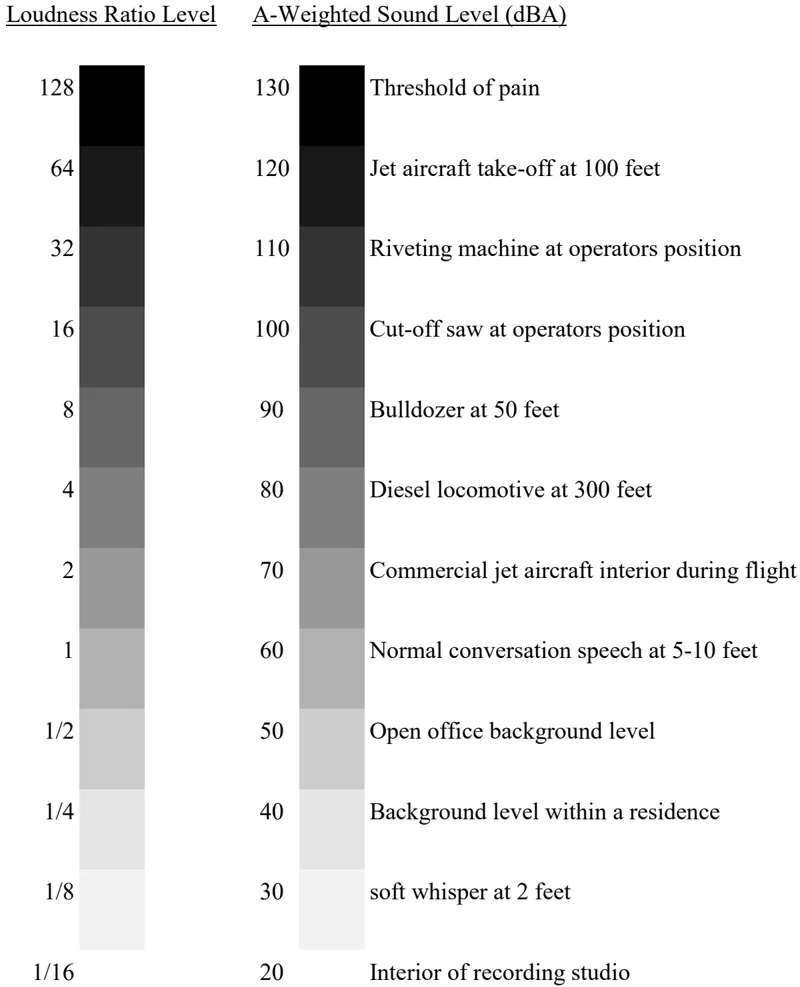
| Loudness Ratio Level | A-Weighted Sound Level (dBA) | Context |
|---|---|---|
| 128 | 130 | Threshold of pain |
| 64 | 120 | Jet aircraft take-off at 100 feet |
| 32 | 110 | Riveting machine at operators position |
| 16 | 100 | Cut-off saw at operators position |
| 8 | 90 | Bulldozer at 50 feet |
| 4 | 80 | Diesel locomotive at 300 feet |
| 2 | 70 | Commercial jet aircraft interior during flight |
| 1 | 60 | Normal conversation speech at 5-10 feet |
| 1/2 | 50 | Open office background level |
| 1/4 | 40 | Background level within a residence |
| 1/8 | 30 | soft whisper at 2 feet |
| 1/16 | 20 | Interior of recording studio |
Noise in the community has been characterized as a health problem, not in terms of actual physiological damages such as hearing impairment, but in terms of inhibiting general well-being and contributing to undue stress and annoyance. The health effects of noise in the community arise from interference with human activities such as sleep, speech, recreation and tasks demanding concentration or coordination. When community noise interferes with human activities or contributes to stress, public annoyance with the noise source increases, the acceptability of the environment for people decreases. This decrease in acceptability and the threat to public well-being are the bases for land use planning policies preventing exposures to excessive community noise levels.
To control noise from fixed sources which have developed from processes other than zoning or land use planning, many jurisdictions have adopted community noise control ordinances. Such ordinances are intended to abate noise nuisances and to control noise from existing sources. They may also be used as performance standards to judge the creation of a potential nuisance, or potential encroachment of sensitive uses upon noise-producing facilities. Community noise control ordinances are generally designed to resolve noise problems on a short-term basis (usually by means of hourly noise level criteria), rather than on the basis of 24-hour or annual cumulative noise exposures.
In addition to the A-weighted noise level, other factors should be considered in establishing criteria for noise sensitive land uses. For example, sounds with noticeable tonal content such as whistles, horns, droning or high-pitched sounds may be more annoying than the A-weighted sound level alone suggests. Many noise standards apply a penalty, or correction, of 5 dBA to such sounds. The effects of unusual tonal content are generally more of a concern at nighttime, when residents may notice the sound in contrast to low levels of background noise.
Because many rural residential areas experience very low noise levels, residents may express concern about the loss of “peace and quiet” due to the introduction of a sound which was not audible previously. In very quiet environments, the introduction of virtually any change in local activities will cause an increase in noise levels. A change in noise level and the loss of “peace and quiet” is the inevitable result of land use or activity changes in such areas. Audibility of a new noise source and/or increases in noise levels within recognized acceptable limits are not usually considered to be significant noise impacts, but these concerns should be addressed and considered in the planning and environmental review processes.
Background on Criteria for Acceptable Noise Exposure
Section titled “Background on Criteria for Acceptable Noise Exposure”The State Office of Planning and Research (OPR) Noise Element Guidelines include recommended exterior and interior noise level standards for local jurisdictions to identify and prevent the creation of incompatible land uses due to noise. The OPR guidelines contain a land use compatibility table which describes the compatibility of different land uses with a range of environmental noise levels in terms of Ldn. A noise environment of 60 dB Ldn or less is considered to be normally acceptable for residential uses according to those guidelines.
The U.S. Environmental Protection Agency (EPA) also offers guidelines for community noise exposure in the publication ‘Information on the Levels of Environmental Noise Requisite to Protect Public Health and Welfare with an Adequate Margin of Safety’. These guidelines consider occupational noise exposure as well as noise exposure in the home. The ‘Levels Document’ recognizes an exterior noise level of 55 dB Ldn as a goal to protect the public from hearing loss, activity interference, sleep disturbance and annoyance. The EPA notes, however, that this level is not a regulatory goal, but is a level defined by a negotiated scientific consensus without concern for economic and technological feasibility or the needs and desires of any particular community. The EPA and other Federal agencies have suggested land use compatibility guidelines which indicate that residential noise exposures of 55 to 65 dB Ldn are acceptable.
The U.S. Environmental Protection Agency has also prepared a Model Community Noise Control Ordinance, using Leq as the means of defining allowable residential noise level limits. The EPA model contains no specific recommendations for local noise level standards, but reports a range of Leq values as adopted by various local jurisdictions. The mean daytime residential noise standard reported by the EPA is 57 dBA (Leq); the mean nighttime residential noise standard is 52 dBA (Leq). Other state laws and regulations regarding noise control are directed towards aircraft, motor vehicles and noise in general.
The California Vehicle Code sets noise emission standards for new vehicles including autos, trucks, motorcycles and off-road vehicles. Performance standards also apply to all vehicles operated on public streets and roadways. Section 216 of the Streets and Highways Code regulates traffic noise received at schools near freeways.
SECTION II: GOALS AND POLICIES
Section titled “SECTION II: GOALS AND POLICIES”GOAL 1
Section titled “GOAL 1”To protect the existing and future citizens of Sacramento County from the harmful effects of exposure to excessive noise. More specifically, to protect existing noise-sensitive land uses from new uses that would generate noise levels which are incompatible with those uses, and to discourage new noise sensitive land uses from being developed near sources of high noise levels.
GOAL 2
Section titled “GOAL 2”To protect the economic base of Sacramento County by preventing the encroachment of noise-sensitive land uses into areas affected by existing noise-producing uses. More specifically, to recognize that noise is an inherent by-product of many land uses and to prevent new noise-sensitive land uses from being developed in areas affected by existing noise-producing uses.
GOAL 3
Section titled “GOAL 3”To provide the County with flexibility in the development of infill properties which may be located in elevated noise environments.
GOAL 4
Section titled “GOAL 4”To provide sufficient noise exposure information so that existing and potential future noise impacts may be effectively addressed in the land use planning and project review processes.
Traffic And Railroad Noise Sources
Section titled “Traffic And Railroad Noise Sources”The noise level standards for noise-sensitive areas of new uses affected by traffic or railroad noise sources in Sacramento County are shown by Table 1. Where the noise level standards of Table 1 are predicted to be exceeded at new uses proposed within Sacramento County which are affected by traffic or railroad noise, appropriate noise mitigation measures shall be included in the project design to reduce projected noise levels to a state of compliance with the Table 1 standards.
Aircraft Noise Sources
Section titled “Aircraft Noise Sources”Proposals for new development within Sacramento County which may be affected by aircraft noise shall be evaluated relative to Table 4: Land Use Compatibility for Aircraft Noise , except in the following cases. Development proposals which may be affected by aircraft noise from Sacramento International Airport shall be evaluated relative to the Land Use Compatibility Plan prepared for Sacramento International Airport dated December 12, 2013, adopted herein by reference. Development proposals which may be affected by aircraft noise from Mather Airport shall be evaluated relative to the Land Use Compatibility Plan prepared for Mather airport dated February 2021, adopted herein reference, as well as applicable footnotes in Table 4.
New residential development within the 60 CNEL noise contours adopted by the County for land use planning purposes at any airport or Helipad within Sacramento County shall be prohibited unless exceptions set forth in Table 4 below are found to be applicable. This policy is not applicable to Executive Airport.
New residential development within adopted Airport Policy Area boundaries, but outside the 60 CNEL, shall be subject to the following conditions:
- Provide minimum noise insulation to 45 dB CNEL within new residential dwellings, including detached single family dwellings, with windows closed in any habitable room.
- Notification in the Public Report prepared by the California Department of Real Estate disclosing the fact to prospective buyers that the parcel is located within an Airport Policy Area.
- An Avigation Easement prepared by the Sacramento County Counsel's Office granted to the County of Sacramento, recorded with the Sacramento County Recorder, and filed with Department of Airports. Such Avigation Easement shall acknowledge the property location within an Airport Planning Policy Area and shall grant the right of flight and unobstructed passage of all aircraft into and out of the subject Airport.
Exceptions: New accessory residential dwellings on parcels zoned Agricultural, Agricultural-Residential, Interim Agricultural, Interim General Agricultural, or Interim Limited Agricultural and between the 60 and 65 CNEL contours, shall be permitted within adopted Airport Policy Area boundaries, but would be subject to the conditions listed above.
Non-Transportation Noise Sources
Section titled “Non-Transportation Noise Sources”The interior and exterior noise level standards for noise-sensitive areas of new uses affected by existing non-transportation noise sources in Sacramento County are shown by Table 2. Where the noise level standards of Table 2 are predicted to be exceeded at a proposed noise-sensitive area due to existing non-transportation noise sources, appropriate noise mitigation measures shall be included in the project design to reduce projected noise levels to a state of compliance with the Table 2 standards within sensitive areas.
Where a project would consist of or include non-transportation noise sources, the noise generation of those sources shall be mitigated so as not exceed the interior and exterior noise level standards of Table 2 at existing noise-sensitive areas in the project vicinity.
The ‘last use there’ shall be responsible for noise mitigation. However, if a noise-generating use is proposed adjacent to lands zoned for uses which may have sensitivity to noise, then the noise generating use shall be responsible for mitigating its noise generation to a state of compliance with the Table 2 standards at the property line of the generating use in anticipation of the future neighboring development.
Construction Noise
Section titled “Construction Noise”Noise associated with construction activities shall adhere to the County Code requirements. Specifically, Section 6.68.090(e) addresses construction noise within the County.
Transportation Projects
Section titled “Transportation Projects”For capacity enhancing roadway or rail projects, or the construction of new roadways or railways, a noise analysis shall be prepared in accordance with the Table 3 requirements. If projected post-project traffic noise levels at existing uses exceed the noise standards of Table 1, then feasible methods of reducing noise to levels consistent with the Table 1 standards shall be analyzed as part of the noise analysis. In the case of existing residential uses, sensitive outdoor areas shall be mitigated to 60 dB, when possible, through the application of feasible methods to reduce noise. If 60 dB cannot be achieved after the application of all feasible methods of reducing noise, then noise levels up to 65 dB are allowed.
If pre-project traffic noise levels for existing uses already exceed the noise standards of Table 1 and the increase is significant as defined below, feasible methods of reducing noise to levels consistent with the Table 1 standards should be applied. In no case shall the long-term noise exposure for non-industrial uses be greater than 75 dB; long-term noise exposure above this level has the potential to result in hearing loss.
A significant increase is defined as follows:
| Pre-Project Noise Environment (Ldn) | Significant Increase |
|---|---|
| Less than 60 dB | 5+ dB |
| 60 - 65 dB | 3+ dB |
| Greater than 65 dB | 1.5+ dB |
NO-10.
Section titled “NO-10.”For interim capacity enhancing roadway or rail projects, or the construction of new interim roadways or railways, it may not be practical or feasible to provide mitigation if the ultimate roadway or railway design would render the interim improvements ineffective or obsolete. An example would be a noise barrier constructed for an interim project which would need to be removed to accommodate the ultimate project. The following factors should be considered in determining whether or not noise mitigation will be implemented for interim projects, but in general, noise mitigation for interim projects would not be provided:
- The severity of the impact
- The cost and effectiveness of the mitigation.
- The number of properties which would benefit from the mitigation.
- The foreseeable duration between interim and ultimate improvements.
- Aesthetic, safety and engineering considerations.
NO-11.
Section titled “NO-11.”If noise-reducing pavement is to be utilized in conjunction with a roadway improvement project, of if such paving existing adjacent to a proposed new noise-sensitive land use, the acoustical benefits of such pavement shall be included in the noise analysis prepared for the project.
General Noise Policy
Section titled “General Noise Policy”NO-12.
Section titled “NO-12.”All noise analyses prepared to determine compliance with the noise level standards contained within this Noise Element shall be prepared in accordance with Table 3.
NO-13.
Section titled “NO-13.”Where noise mitigation measures are required to satisfy the noise level standards of this Noise Element, emphasis shall be placed on the use of setbacks and site design to the extent feasible, prior to consideration of the use of noise barriers.
NO-14.
Section titled “NO-14.”Noise analyses prepared for multi-family residential projects, town homes, mixed use, condominiums, or other residential projects where floor ceiling assemblies or party-walls shall be common to different owners/occupants, shall be consistent with the State of California Noise Insulation standards.
NO-15.
Section titled “NO-15.”The County shall have the flexibility to consider the application of 5 dB less restrictive exterior noise standards than those prescribed in Tables 1 and 2 in cases where it is impractical or infeasible to reduce exterior noise levels within infill projects to a state of compliance with the Table 1 or 2 standards. In such cases, the rational for such consideration shall be clearly presented and disclosure statements and noise easements should be included as conditions of project approval. The interior noise level standards of Tables 1 and 2 would still apply. The maximum allowable long-term noise exposure permissible for non-industrial uses is 75 dB.
Exemptions
Section titled “Exemptions”NO-16.
Section titled “NO-16.”The following sources of noise shall be exempt from the provisions of this Noise Element:
- Emergency warning devices and equipment operated in conjunction with emergency situations, such as sirens and generators which are activated during power outages. The routine testing of such warning devices and equipment shall also be exempt provided such testing occurs during daytime hours.
- Activities associated with events for which a permit has been obtained from the County.
Table 1
Section titled “Table 1”Noise Standards for New Uses Affected by Traffic and Railroad Noise Sacramento County Noise Element
| New Land Use | Sensitive [1] Outdoor Area - Ldn | Sensitive Interior [2] Area - Ldn | Notes |
|---|---|---|---|
| All Residential | 65 | 45 | 5 |
| Transient Lodging | 65 | 45 | 3,5 |
| Hospitals & Nursing Homes | 65 | 45 | 3, 4, 5 |
| Theaters & Auditoriums | --- | 35 | 3 |
| Churches, Meeting Halls | 65 | 40 | 3 |
| Schools, Libraries, etc. | 65 | 40 | 3 |
| Office Buildings | 65 | 45 | 3 |
| Commercial Buildings | --- | 50 | 3 |
| Playgrounds, Parks, etc. | 70 | --- | |
| Industry | 65 | 50 | 3 |
Notes:
Section titled “Notes:”- Sensitive areas are defined in acoustic terminology section.
- Interior noise level standards are applied within noise-sensitive areas of the various land uses, with windows and doors in the closed positions.
- Where there are no sensitive exterior spaces proposed for these uses, only the interior noise level standard shall apply.
- Hospitals are often noise-generating uses. The exterior noise level standards for hospitals are applicable only at clearly identified areas designated for outdoor relaxation by either hospital staff or patients.
- If this use is affected by railroad noise, a maximum (Lmax) noise level standard of 70 dB shall be applied to all sleeping rooms to reduce the potential for sleep disturbance during nighttime train passages.
Table 2
Section titled “Table 2”Non-Transportation Noise Standards Sacramento County Noise Element
Median (L50) / Maximum (Lmax) [1]
| Receiving Land Use | Outdoor Area at Daytime[2] | Outdoor Area at Nighttime [2] | Interior Day & Night [3] | Notes |
|---|---|---|---|---|
| All Residential | 55 / 75 | 50 / 70 | 35 / 55 | |
| Transient Lodging | 55 / 75 | --- | 35 / 55 | 4 |
| Hospitals & Nursing Homes | 55 / 75 | --- | 35 / 55 | 5, 6 |
| Theaters & Auditoriums | --- | --- | 30 / 50 | 6 |
| Churches, Meeting Halls, Schools, Libraries, etc. | 55 / 75 | --- | 35 / 60 | 6 |
| Office Buildings | 60 / 75 | --- | 45 / 65 | 6 |
| Commercial Buildings | --- | --- | 45 / 65 | 6 |
| Playgrounds, Parks, etc. | 65 / 75 | --- | --- | 6 |
| Industry | 60 / 80 | --- | 50 / 70 | 6 |
Notes:
Section titled “Notes:”- The Table 2 standards shall be reduced by 5 dB for sounds consisting primarily of speech or music, and for recurring impulsive sounds. If the existing ambient noise level exceeds the standards of Table 2, then the noise level standards shall be increased at 5 dB increments to encompass the ambient.
- Sensitive areas are defined acoustic terminology section.
- Interior noise level standards are applied within noise-sensitive areas of the various land uses, with windows and doors in the closed positions.
- Outdoor activity areas of transient lodging facilities are not commonly used during nighttime hours.
- Hospitals are often noise-generating uses. The exterior noise level standards for hospitals are applicable only at clearly identified areas designated for outdoor relaxation by either hospital staff or patients.
- The outdoor activity areas of these uses (if any), are not typically utilized during nighttime hours.
- Where median (L50) noise level data is not available for a particular noise source, average (Leq) values may be substituted for the standards of this table provided the noise source in question operates for at least 30 minutes of an hour. If the source in question operates less than 30 minutes per hour, then the maximum noise level standards shown would apply.
Table 3
Section titled “Table 3”Requirements for Acoustical Analyses Prepared in Sacramento County
An acoustical analysis prepared pursuant to the Noise Element shall:
- Be the responsibility of the applicant.
- Be prepared by qualified persons experienced in the fields of environmental noise assessment and architectural acoustics.
- Include representative noise level measurements with sufficient sampling periods and locations to adequately describe local conditions.
- Estimate projected future (20 year) noise levels in terms of the Standards of Tables 1 and 2, and compare those levels to the adopted policies of the Noise Element.
- Recommend appropriate mitigation to achieve compliance with the adopted policies and standards of the Noise Element.
- Estimate interior and exterior noise exposure after the prescribed mitigation measures have been implemented.
Table 4
Section titled “Table 4”Land Use Compatibility for Airport Noise for all public use airports except for Sacramento International Airport. In the case of Sacramento International Airport, use the Land Use Compatibility Plan prepared for Sacramento International Airport dated December 12, 2013, adopted herein by reference. In the case of Mather Airport, use the Land Use Compatibility Plan prepared for Mather Airport dated February 2021, adopted herein by reference, and applicable footnotes below.
| Land Use Type | Land Use Designation | 60-65 CNEL | 65-70 CNEL | 70-75 CNEL | 75-80 CNEL | 80-85 CNEL |
|---|---|---|---|---|---|---|
| RESIDENTIAL [1],[7] | Single-family detached [2] | No[6] | No | No | No | No |
| RESIDENTIAL [1],[7] | Two-family dwelling | No[6] | No | No | No | No |
| RESIDENTIAL [1],[7] | Multi-family dwelling (3+ families) | No[6] | No | No | No | No |
| RESIDENTIAL [1],[7] | Group Quarters & Rooming Houses | No[6] | No | No | No | No |
| RESIDENTIAL [1],[7] | Mobile Home Parks or Courts | No[6] | No | No | No | No |
| RESIDENTIAL [1],[7] | Agricultural/Residential (min. 2ac parcel size) | Yes [6],[8] | Yes [6],[8] | No | No | No |
| INDUSTRIAL MANUFACTURING | Food and kindred products | Yes | Yes | Yes [3] | Yes [3] | Yes [3] |
| INDUSTRIAL MANUFACTURING | Textiles and apparel | Yes | Yes | Yes [3] | Yes [3] | Yes [3] |
| INDUSTRIAL MANUFACTURING | Transportation equipment | Yes | Yes | Yes [3] | Yes [3] | Yes [3] |
| INDUSTRIAL MANUFACTURING | Lumber and wood products | Yes | Yes | Yes [3] | Yes [3] | Yes [3] |
| INDUSTRIAL MANUFACTURING | Furniture and fixtures | Yes | Yes | Yes [3] | Yes [3] | Yes [3] |
| INDUSTRIAL MANUFACTURING | Paper and allied products | Yes | Yes | Yes [3] | Yes [3] | Yes [3] |
| INDUSTRIAL MANUFACTURING | Printing and publishing | Yes | Yes | Yes [3] | Yes [3] | Yes [3] |
| INDUSTRIAL MANUFACTURING | Chemicals and allied products | Yes | Yes | Yes [3] | Yes [3] | Yes [3] |
| INDUSTRIAL MANUFACTURING | Asphalt paving and miscellaneous petroleum | Yes | Yes | Yes [3] | Yes [3] | Yes [3] |
| INDUSTRIAL MANUFACTURING | Petroleum refining | Yes | Yes | Yes [3] | Yes [3] | Yes [3] |
| INDUSTRIAL MANUFACTURING | Rubber and plastics | Yes | Yes | Yes [3] | Yes [3] | Yes [3] |
| INDUSTRIAL MANUFACTURING | Stone, glass, clay, and concrete products | Yes | Yes | Yes [3] | Yes [3] | Yes [3] |
| INDUSTRIAL MANUFACTURING | Primary and fabricated metals | Yes | Yes | Yes [3] | Yes [3] | Yes [3] |
| INDUSTRIAL MANUFACTURING | Electrical and electronic equipment | Yes | Yes | Yes [3] | Yes [3] | Yes [3] |
| INDUSTRIAL MANUFACTURING | Leather products | Yes | Yes | Yes [3] | Yes [3] | Yes [3] |
| INDUSTRIAL MANUFACTURING | Industrial, commercial, & computer equipment | Yes | Yes | Yes [3] | Yes [3] | Yes [3] |
| INDUSTRIAL MANUFACTURING | Photo, optical and medical equipment | Yes | Yes | Yes [3] | Yes [3] | Yes [3] |
| INDUSTRIAL MANUFACTURING | Miscellaneous manufacturing | Yes | Yes | Yes [3] | Yes [3] | Yes [3] |
| TRANSPORTATION, COMMUNICATIONS, & UTILITIES | Streets, roads, and highways | Yes | Yes | Yes | Yes | Yes |
| TRANSPORTATION, COMMUNICATIONS, & UTILITIES | Heavy rail lines: freight and passenger | Yes | Yes | Yes [3] | Yes [3] | Yes [3] |
| TRANSPORTATION, COMMUNICATIONS, & UTILITIES | Light rail lines: passenger | Yes | Yes | Yes [3] | Yes [3] | Yes [3] |
| TRANSPORTATION, COMMUNICATIONS, & UTILITIES | Trucking and rail freight terminals | Yes | Yes | Yes [3] | Yes [3] | Yes [3] |
| TRANSPORTATION, COMMUNICATIONS, & UTILITIES | Warehousing and storage | Yes | Yes | Yes [3] | Yes [3] | Yes [3] |
| TRANSPORTATION, COMMUNICATIONS, & UTILITIES | Passenger terminals and stations | Yes | Yes | Yes [3] | Yes [3] | No |
| TRANSPORTATION, COMMUNICATIONS, & UTILITIES | Water transportation: freight and passenger | Yes | Yes | Yes [3] | Yes [3] | No |
| TRANSPORTATION, COMMUNICATIONS, & UTILITIES | Parking lots | Yes | Yes | Yes [3] | Yes [3] | Yes [3] |
| TRANSPORTATION, COMMUNICATIONS, & UTILITIES | Transportation services | Yes | Yes | Yes [3] | Yes [3] | No |
| TRANSPORTATION, COMMUNICATIONS, & UTILITIES | Radio, television, and telephone | Yes | Yes | Yes [3] | Yes [3] | No |
| TRANSPORTATION, COMMUNICATIONS, & UTILITIES | Cellular radio transmission antenna | Yes | Yes | Yes [3] | Yes [3] | Yes [3] |
| TRANSPORTATION, COMMUNICATIONS, & UTILITIES | Courier service | Yes | Yes | Yes [3] | Yes [3] | No |
| TRANSPORTATION, COMMUNICATIONS, & UTILITIES | Electrical and natural gas generation and switching | Yes | Yes | Yes [3] | Yes [3] | Yes [3], [7] |
| TRANSPORTATION, COMMUNICATIONS, & UTILITIES | Natural gas and petroleum pipelines and storage | Yes | Yes | Yes [3] | Yes [3] | Yes [3] |
| TRANSPORTATION, COMMUNICATIONS, & UTILITIES | Water treatment plants | Yes | Yes | Yes [3] | Yes [3] | Yes [3] |
| TRANSPORTATION, COMMUNICATIONS, & UTILITIES | Sewer treatment plants | Yes | Yes | Yes [3] | Yes [3] | Yes [3] |
| TRANSPORTATION, COMMUNICATIONS, & UTILITIES | Sanitary landfills | Yes | Yes | Yes [3] | Yes [3] | Yes [3] |
| TRANSPORTATION, COMMUNICATIONS, & UTILITIES | Recycling and transfer facilities | Yes | Yes | Yes [3] | Yes [3] | Yes [3] |
| TRANSPORTATION, COMMUNICATIONS, & UTILITIES | Hazardous material facilities | Yes | Yes | Yes [3] | Yes [3] | Yes [3] |
| WHOLESALE TRADE | Paints, varnishes, and supplies | Yes | Yes | Yes [3] | Yes [3] | Yes [3] |
| WHOLESALE TRADE | Chemicals and allied products | Yes | Yes | Yes [3] | Yes [3] | Yes [3] |
| WHOLESALE TRADE | Petroleum terminals and wholesalers | Yes | Yes | Yes [3] | Yes [3] | Yes [3] |
| WHOLESALE TRADE | Miscellaneous wholesale trade | Yes | Yes | Yes [3] | Yes [3] | Yes [3] |
| RETAIL TRADE | Department and variety stores (single) | Yes | Yes | Yes [3] | Yes [3] | No |
| RETAIL TRADE | Lumber, building materials, and nurseries | Yes | Yes | Yes [3] | Yes [3] | No |
| RETAIL TRADE | Grocery and drug stores | Yes | Yes | Yes [3] | Yes [3] | No |
| RETAIL TRADE | Paint, glass, wallpaper, and hardware | Yes | Yes | Yes [3] | Yes [3] | No |
| RETAIL TRADE | Auto, truck, boat, & recreational vehicle dealers | Yes | Yes | Yes [3] | Yes [3] | No |
| RETAIL TRADE | Mobile home dealers | Yes | Yes | Yes [3] | Yes [3] | No |
| RETAIL TRADE | Auto and truck service stations | Yes | Yes | Yes [3] | Yes [3] | No |
| RETAIL TRADE | Fuel dealers | Yes | Yes | Yes [3] | Yes [3] | No |
| RETAIL TRADE | Apparel and shoes | Yes | Yes | Yes [3] | Yes [3] | No |
| RETAIL TRADE | Home furnishings | Yes | Yes | Yes [3] | Yes [3] | No |
| RETAIL TRADE | Eating and drinking | Yes | Yes | Yes [3] | Yes [3] | No |
| RETAIL TRADE | Miscellaneous retail trade | Yes | Yes | Yes [3] | Yes [3] | No |
| BUSINESS AND PERSONAL SERVICES | Auto, truck, boat, RV, and miscellaneous repair | Yes | Yes | Yes [3] | Yes [3] | No |
| BUSINESS AND PERSONAL SERVICES | Mobile home repair | Yes | Yes | Yes [3] | Yes [3] | No |
| BUSINESS AND PERSONAL SERVICES | Commercial laundries and cleaning | Yes | Yes | Yes [3] | Yes [3] | No |
| BUSINESS AND PERSONAL SERVICES | Coin operated laundries | Yes | Yes | Yes [3] | Yes [3] | No |
| BUSINESS AND PERSONAL SERVICES | Photographers, beauty and barber, shoe repair | Yes | Yes | Yes [3] | Yes [3] | No |
| BUSINESS AND PERSONAL SERVICES | Funeral services | Yes | Yes | Yes [3] | Yes [3] | No |
| BUSINESS AND PERSONAL SERVICES | Business Services | Yes | Yes | Yes [3] | Yes [3] | No |
| BUSINESS AND PERSONAL SERVICES | Computer programming and data processing | Yes | Yes | Yes [3] | Yes [3] | No |
| BUSINESS AND PERSONAL SERVICES | Travel agencies | Yes | Yes | Yes [3] | Yes [3] | No |
| BUSINESS AND PERSONAL SERVICES | Legal and engineering | Yes | Yes | Yes [3] | Yes [3] | No |
| BUSINESS AND PERSONAL SERVICES | Banks, credit unions, and financial | Yes | Yes | Yes [3] | Yes [3] | No |
| BUSINESS AND PERSONAL SERVICES | Hotels, motels, inns, bed and breakfast | Yes | Yes | Yes [3] | Yes [3],[4] | No |
| BUSINESS AND PERSONAL SERVICES | Business parks and industrial clusters | Yes | Yes | Yes [3] | Yes [3] | No |
| BUSINESS AND PERSONAL SERVICES | Office (for rent or lease) | Yes | Yes | Yes [3] | Yes [3] | No |
| BUSINESS AND PERSONAL SERVICES | Business and vocational schools | Yes | Yes | Yes [3] | Yes [3] | No |
| BUSINESS AND PERSONAL SERVICES | Construction businesses | Yes | Yes | Yes [3] | Yes [3] | No |
| BUSINESS AND PERSONAL SERVICES | Miscellaneous personal services | Yes | Yes | Yes [3] | Yes [3] | No |
| SHOPPING DISTRICTS | Neighborhood shopping centers | Yes | Yes | Yes [3] | Yes [3] | Yes [3] |
| SHOPPING DISTRICTS | Community shopping centers | Yes | Yes | Yes [3] | Yes [3] | Yes [3] |
| SHOPPING DISTRICTS | Regional shopping centers | Yes | Yes | Yes [3] | Yes [3] | Yes [3] |
| PUBLIC AND QUASI-PUBLIC SERVICES | Post offices | Yes | Yes | Yes [3] | Yes [3],[4] | No |
| PUBLIC AND QUASI-PUBLIC SERVICES | Government offices | Yes | Yes | Yes [3] | Yes [3],[4] | No |
| PUBLIC AND QUASI-PUBLIC SERVICES | Government social services | Yes | Yes | Yes [3] | Yes [3],[4] | No |
| PUBLIC AND QUASI-PUBLIC SERVICES | Elementary and Secondary schools | Yes | Yes [3],[4] | No | No | No |
| PUBLIC AND QUASI-PUBLIC SERVICES | College and universities | Yes | Yes [3],[4] | No | No | No |
| PUBLIC AND QUASI-PUBLIC SERVICES | Hospitals | Yes | Yes [3],[4] | Yes [3],[4] | No | No |
| PUBLIC AND QUASI-PUBLIC SERVICES | Medical and dental laboratories | Yes | Yes | Yes [3] | Yes [3] | No |
| PUBLIC AND QUASI-PUBLIC SERVICES | Doctor and dentist offices | Yes | Yes | Yes [3] | Yes [3] | No |
| PUBLIC AND QUASI-PUBLIC SERVICES | Museum and art galleries | Yes | Yes [3],[4] | No | No | No |
| PUBLIC AND QUASI-PUBLIC SERVICES | Libraries | Yes | Yes [3],[4] | No | No | No |
| PUBLIC AND QUASI-PUBLIC SERVICES | Churches | Yes | Yes [3],[4] | No | No | No |
| PUBLIC AND QUASI-PUBLIC SERVICES | Cemeteries | Yes | Yes | Yes [3] | Yes [3] | No |
| PUBLIC AND QUASI-PUBLIC SERVICES | Jails and detention centers | Yes | Yes | Yes [3] | No | No |
| PUBLIC AND QUASI-PUBLIC SERVICES | Child care programs (six or more children) | Yes | Yes [3],[4] | No | No | No |
| PUBLIC AND QUASI-PUBLIC SERVICES | Nursing care facilities | Yes | Yes [3],[4] | No | No | No |
| RECREATION | Neighborhood parks | Yes | Yes | Yes [3] | No | No |
| RECREATION | Community-wide and regional parks | Yes | Yes | Yes [3] | No | No |
| RECREATION | Riding stables | Yes | Yes | Yes [3] | No | No |
| RECREATION | Golf courses | Yes | Yes | Yes [3] | No | No |
| RECREATION | Open space and natural areas | Yes | Yes | Yes [3] | Yes [3] | Yes [3] |
| RECREATION | Natural water areas | Yes | Yes | Yes [3] | Yes [3] | Yes [3] |
| RECREATION | Recreation and amusement centers | Yes | Yes | Yes [3] | Yes [3] | No |
| RECREATION | Physical fitness and gyms | Yes | Yes | Yes [3] | Yes [3] | No |
| RECREATION | Camps, campgrounds, & recreational vehicle parks | Yes | Yes | No | No | No |
| RECREATION | Dance halls, studios, and schools | Yes | Yes | Yes [3] | Yes [3] | No |
| RECREATION | Theaters - live performance | Yes | Yes [3],[5] | Yes [3],[5] | Yes [3] | No |
| RECREATION | Motion picture theater - single or double | Yes | Yes [3] | Yes [3] | Yes [3] | No |
| RECREATION | Motion picture theater complex - three or more | Yes | Yes [3] | Yes [3] | Yes [3] | No |
| RECREATION | Professional sports | Yes | Yes [3] | No | No | No |
| RECREATION | Stadiums and arenas | Yes | No | Yes | No | No |
| RECREATION | Auditoriums, concert halls, and amphitheaters | Yes | Yes [3],[5] | Yes [3],[5] | No | No |
| RECREATION | Fairgrounds and expositions | Yes | Yes | Yes | No | No |
| RECREATION | Racetracks | Yes | Yes | Yes | No | No |
| RECREATION | Theme parks | Yes | Yes | Yes | No | No |
| AGRICULTURAL AND MINING | Row and field crops | Yes | Yes | Yes [3] | Yes [3] | Yes [3] |
| AGRICULTURAL AND MINING | Tree crop | Yes | Yes | Yes [3] | Yes [3] | Yes [3] |
| AGRICULTURAL AND MINING | Intensive livestock | Yes | Yes | Yes [3] | No | No |
| AGRICULTURAL AND MINING | Nursery products | Yes | Yes | Yes [3] | Yes [3] | Yes [3] |
| AGRICULTURAL AND MINING | Poultry | Yes | Yes | Yes [3] | No | No |
| AGRICULTURAL AND MINING | Pasture and grazing | Yes | Yes | Yes [3] | Yes [3] | Yes [3] |
| AGRICULTURAL AND MINING | Agricultural services | Yes | Yes | Yes [3] | Yes [3] | Yes [3] |
| AGRICULTURAL AND MINING | Mining and quarrying | Yes | Yes | Yes [3] | Yes [3] | Yes [3] |
| AGRICULTURAL AND MINING | Oil and gas extraction | Yes | Yes | Yes [3] | Yes [3] | Yes [3] |
Footnotes to Land Use Compatibility Table for Airport Noise:
Section titled “Footnotes to Land Use Compatibility Table for Airport Noise:”- This compatibility table does not apply to Borges-Clarksburg Airport, as no noise contours exist there. Also, it does not apply to Executive Airport, as the noise contours do not extend into the unincorporated area of Sacramento County.
- These guidelines define only compatible land uses within noise contours. Where proposed land uses fall within the established Safety Areas or may penetrate any of the imaginary height surfaces, additional restrictions do apply, which can be found in the safety and height policy sections of this Plan.
-
Caretaker residences are a compatible use within all CNEL ranges, provided that they are ancillary to the primary use of a property, intended for the purpose of property protection or maintenance, and subject to the condition that all residential units be designed to limit intruding noise such that interior levels do not exceed 45 CNEL, with windows closed, in any habitable room.
-
Single family detached residential units within the 60-65 dB CNEL noise contours of the Mather Airport Policy Area may be considered a compatible use if: (a) approved by the Board of Supervisors upon completion of Sacramento County’s master plan process, including demonstration of compliance with LU-119 and LU-120; (b) an evaluation of potential noise and safety impacts pursuant to CEQA has occurred and appropriate noise mitigation measures to reduce interior noise levels to 45 dB have been included in the environmental document and adopted as conditions of approval; and (c) all of the requirements in Footnote 7 below are met. Second residential units are a compatible use within all CNEL ranges, subject to the condition that the proposed second unit be consistent with the provisions of Section 65852.1 and 65852.2 of the California Government Code.
-
Measures to achieve an interior noise level of 50 CNEL must be incorporated into the design and construction of portions where the public is received, office areas, and other areas where people work or congregate.
-
Measures to achieve an interior noise level of 45 CNEL must be incorporated into the design and construction of all noise sensitive areas including, but not limited to, rooms designed for the purpose of sleep, libraries, churches, and areas intended for indoor entertainment events.
-
Only indoor uses permitted.
-
Compatible at Sacramento International Airport and Franklin Field only if the residential use is directly related to agricultural uses, such as dwelling units for the land owner, the owner’s immediate family, or for employees may be compatible at Mather Airport if approved by the Board of Supervisors as a component of a master plan and all criteria set forth in Footnote 2 above are satisfied. All residential units shall be designed to limit intruding noise such that interior noise levels do not exceed 45 CNEL, with windows closed, in any habitable room.
-
New residential uses within 60 CNEL are not compatible, with the exception of accessory residential dwellings on parcels zoned Agricultural, Agricultural-Residential, Interim Agricultural, Interim General Agricultural, or Interim Limited Agricultural, or single family dwelling as set forth in Footnote 2 above. Except as provided in Footnotes 2 and 6 above, new residential development within the Mather Airport Policy Area boundaries but outside the 60 CNEL shall be subject to the following conditions:
- Provide minimum noise insulation to provide 45dB within new residential dwellings, including detached single family dwellings, with windows closed, in any habitable room.
- Notification in the Public Report prepared by the California Department of Real Estate disclosing the fact to prospective buyers that the parcel is located within the Mather Airport Policy Area.
- An Avigation Easement prepared by the Sacramento County Counsel's Office granted to the County of Sacramento and recorded with the Sacramento County Recorder and filed with Department of Airports. Such Avigation Easement shall acknowledge the property location within the Mather Airport Policy Area and shall grant the right of flight and unobstructed passage of all aircraft into and out of Mather Airport.
New residential development within the Mather Airport Policy Area outside the 65dB CNEL but inside the 60dB CNEL shall be subject to Conditions A through C above and a County-approved noise analysis and mitigation to reduce interior noise impacts to 45 dB with windows closed, in any habitable room.
-
Compatible with McClellan Park and Mather Airfield only up to 70dB CNEL.