Rollingwood Commons Condominiums PDC
Sacramento County Zoning Code
Rollingwood Commons Condominiums County-Initiated Planned Development Ordinance
Section titled “Sacramento County Zoning Code Rollingwood Commons Condominiums County-Initiated Planned Development Ordinance”Adopted March 10, 1976
76-PD-3
SECTION 1. PROPERTY REZONED
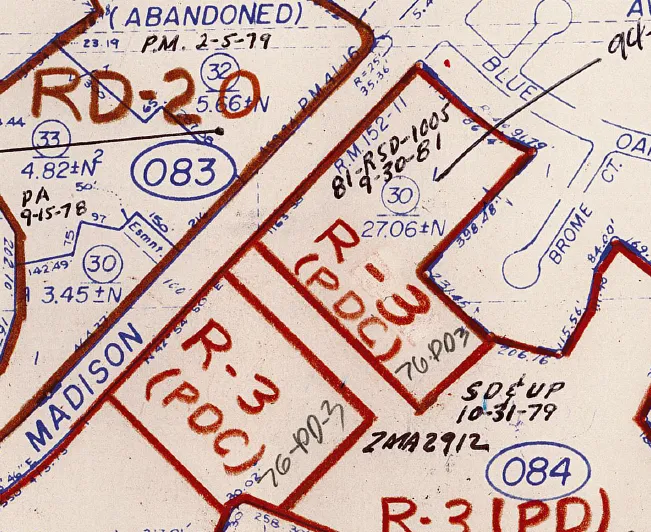
Section titled “SECTION 1. PROPERTY REZONED”Section 23.01.190 of the Zoning Code of Sacramento County which incorporates Comprehensive Zoning Plan is amended to change the real property shown on Exhibit “A” to the R-3 (PDC) Multiple Family Residential Planned Development Combining Zone. Said Exhibit “A” is attached hereto and made part of this ordinance.
SECTION 2. INCORPORATED WITHIN ZONING CODE
Section titled “SECTION 2. INCORPORATED WITHIN ZONING CODE”Chapter 1, Article 3 of the Zoning Code of Sacramento County, Ordinance No. 1111, as amended, is hereby amended by adding thereto Section 23.01.352, which shall read as follows:
Section 23.01.352 – Planned Development – County Initiated; Ordinance 76-PD-3
SECTION 3. PURPOSE OF ORDINANCE
Section titled “SECTION 3. PURPOSE OF ORDINANCE”The property described in Exhibit “A” is in the same ownership and is contiguous to property commonly known as the Rollingwood Planned Development regulated pursuant to Section 23.01.344 of the Zoning Code. It is the purpose of this ordinance to prescribe substantially similar provisions in the regulation of the land described in Exhibit “A” as for the land regulated in the Rollingwood Planned Development. To carry out the purpose, this ordinance provides for a development plan review procedure so as to consider lot design and configuration, grading, the extent of removal of native vegetation, and other design considerations.
SECTION 4. PERMITTED USES
Section titled “SECTION 4. PERMITTED USES”All uses authorized as permitted uses or conditional uses in the R-3 zone of the Zoning Code are authorized on the property herein regulated, subject to the provisions of Section 5 of this ordinance.
SECTION 5. DEVELOPMENT PLAN
Section titled “SECTION 5. DEVELOPMENT PLAN”A development plan shall be submitted for review and approval by the Project Planning Commission for the herein regulated property before the property is developed. The plan shall be in substantial conformance with the standards set forth in Section 6 of this ordinance. The plan as more specifically set forth in Section 6, shall show the location of proposed improvements, trees to be retained and removed, parking, traffic circulation, landscaping, grading plans, floor plans, elevations and perspectives sufficient to illustrate the full design character of the project. Said review and approval shall not render the property undevelopable for the uses and densities authorized in the R-3 zone.
SECTION 6. STANDARDS
Section titled “SECTION 6. STANDARDS”- Parking. Parking areas providing at least two parking stalls for each dwelling unit shall be provided. The dimensions of the parking areas shall conform to the parking standards set forth in Chapter 15 of this Zoning Code, Ordinance No. 1111, as amended.
- Landscaping. There shall be a minimum of twenty-five (25) feet of landscaping adjacent to any public streets and a minimum of fifteen (15) feet of landscaped area adjacent to any private drive or parking areas.
- Private Roads. Private roads shall be sufficiently maintained so as to allow passage for fire trucks and other emergency vehicles and to the satisfaction of the fire district having jurisdiction over said property. All private roads are to be named and dwelling units are to be identified by signs showing unit numbers and such names and unit numbers shall be placed in a location visible to emergency vehicles.
- Grading. The design, layout and configuration of the improvements shall minimize the extent and amount of grading. The following techniques shall be considered and utilized where feasible to accomplish the reduction in the extent and amount of grading:
- The use of split-level building design and foundation systems to accomplish elevation transitions as close to existing grades as possible.
- Grading for streets shall be reduced as much as possible consistent with the minimum requirements for utility service drainage requirements,and street design and improvement requirements.
- No grading shall be done on the property described in Exhibit "A" until a grading permit is obtained from the Public Works Department.
The Public Works Department shall not approve any grading plans or issue any grading permit unless said plans are consistent with the site plans approved by the Planning Commission and with the policies as set forth in this section. No grading permit shall be issued for work to be conducted from November 1, through March 15 unless measures to prevent erosion are provided to the satisfaction of the Public Works Department
- Tree Removal. The design, layout and configuration of the improvements shall be accomplished so as to minimize the removal of trees. No trees shall be damaged or removed unless:
- The trees are located within the right-of-way of an approved public street, private street, or;
- The trees are specifically approved for removal by the Planning Commission as part of the site plan approval
- Noise Reduction. The configuration and layout of the improvements shall be designed, and where necessary the developer shall provide noise attenuation devices, so that the interior community noise equivalent level (CNEL) with windows closed, attributable to exterior sounds shall not exceed an annual CNEL of 45 dB in any habitable room. Methods to be considered shall include the orientation of the buildings, earth berms, solid fences, and building design features. The design of attenuation devices shall be subject to the advice of an acoustical engineer and the approval of the County Health Agency.
- Subsequent Improvements. The Board of Supervisors recognizes that after development of the project has taken place, property owners and residents thereof may desire to make certain improvements, alterations, and additions to their property. The Board of Supervisors, having considered this possibility, has determined that certain deviations such as, but not limited to, fireplaces, window and patio awnings, Bar-B-Ques and other normal ancillary landscaping features are insubstantial deviations from the requirements of this ordinance and do not constitute an amendment to the plan; and that such changes shall be permitted upon the issuance of any building permit issued pursuant to the provisions of Title 16, of the Sacramento County Code. The Board of Supervisors has further determined that certain deviations such as the erection of or addition to improvements such as ancillary buildings, swimming pools and fences and walls are not substantial deviations from the requirements of this ordinance provided such deviations are not inconsistent with the character of the plan nor decrease the amount of open space shown on the approved site plan by more than 5%. The Board hereby delegates to the Zoning Administrator the authority to approve any such changes.
SECTION 7. VARIANCES
Section titled “SECTION 7. VARIANCES”The variance provision of Article 1, Chapter 18, of the Sacramento County Zoning Code, Ordinance No. 1111, as amended, shall not apply to this ordinance.
SECTION 8. VIOLATIONS
Section titled “SECTION 8. VIOLATIONS”Violation of the provisions of this ordinance or exhibits made part of this ordinance shall be deemed a violation of the Sacramento County Zoning Code, Ordinance No. 1111, as amended.
EXHIBIT “A”
Section titled “EXHIBIT “A””The original Exhibit A is missing, however, based on historical County zoning maps, it encompasses the area zoned as (PDC) as shown below.