Walnut Grove SPA
Sacramento County Zoning Code
Walnut Grove Special Planning Area
Section titled “Sacramento County Zoning Code Walnut Grove Special Planning Area”“Third Edition”
Adopted January 12, 2005
Amended March 1, 2017
81-SPA-2
Adopted by 2004-ZOB-0320
Amended by SZC-2017-0003 / PLNP2013-00092First Edition: Adopted 1981
Second Edition: Joint Walnut Grove & Locke SPA adopted December 3, 1997 (1995-ZOB-0250)
INTRODUCTION AND INTENT
Section titled “INTRODUCTION AND INTENT”504.20. INTENT:
Section titled “504.20. INTENT:”It is the intent of the Board of Supervisors in adopting the Special Planning Area (SPA) Ordinance to recognize the existing uses in this community and to encourage rehabilitation of existing structures and construction of new structures which will be consistent with the fabric of the area with a minimal disruption in the lifestyle of the residents. This SPA Ordinance recognizes the unique design and environment of Walnut Grove and promotes the retention of viable commercial centers in the Historical Preservation Areas as well as preservation of the cultural aspects of this community. The SPA requires review of projects measured against these unique standards.
The further purpose of this Ordinance is to recognize the established ownership pattern in Walnut Grove and provide for and encourage the division of property for individual ownership.
504-21. PROCESS GUIDELINES FOR APPLICANTS:
Section titled “504-21. PROCESS GUIDELINES FOR APPLICANTS:”Applicants should refer to the following sections to attain information for their projects (Note: These process guidelines are not applicable to all projects):
- To determine if proposed use is allowed in project area - See Sections 504-29 PROHIBITED USES, 504-30 PERMITTED USES.
- To determine review process for project - See 504-25 REVIEW PROCEDURES FOR PERMITTED USES NOT REQUIRING A USE PERMIT.
- To determine development standards for residential project - See Sections 504-31 DEVELOPMENT STANDARDS, 504-32 RESIDENTIAL DENSITY, 504-33 LANDSCAPING
- To determine development standards for non-residential projects - See Sections 504-31 DEVELOPMENT STANDARDS, 504-33 LANDSCAPING, 504-34 PARKING, 504-35 SIGNS
504.22. DEFINITIONS:
Section titled “504.22. DEFINITIONS:”Except as provided herein, the definitions in Chapter 7 of the Sacramento County Zoning Code shall apply.
- CEQA. California Environmental Quality Act.
- DCMAC. Delta Citizens Municipal Advisory Council.
- SRDHS. Sacramento River Delta Historical Society.
- WGHMA. Walnut Grove Homeowners and Merchants Association.
- Accessory Building or Structure. A detached subordinate building or structure located on the same premises as the primary building or buildings, the use of which is incidental to that of the primary building or to the use of the land.
- Breweries. An establishment where malt beverages are manufactured on the premises. Breweries are classified as any use that manufactures more than 15,000 barrels of beverage (all beverages combined) annually. A brewery may have a tap room as part of the principal use as long as the floor area utilized for the tap room is less than or equal to 25 percent of the total floor area of the facility.
- Comments, Statements and/or opinions by the Primary Review Body or the Secondary Review Body about a particular proposed project. These could include statements/opinions about the appearance of a proposed project, impacts to the surrounding neighborhood, and appropriateness for the community. Suggested ways to improve a project could also be included in a review body's comments. A vote or a quorum is not required to provide project comments.
- Dangerous Building. For the purpose of the Ordinance, a dangerous building shall be as defined in Chapter 16.22 of the Sacramento County Code.
- Historical Preservation Area. The areas or buildings which are on the National Register of Historic Places and/or the California Register of Historic Resources, including, but not limited to, those districts and/or structures shown on Exhibit 504-38.
- Interior Remodeling. Any work on the interior of the buildings such as new walls, and upgrading of electrical, mechanical, and plumbing.
- Mixed-Use Building. Building with residential uses and non-residential uses (office, retail, institutional, etc.).
- New Construction. New building or structure not existing on-site on the date of adoption of this Ordinance.
- Primary Review Body. A project review body that reviews a project through a formal meeting with the applicant present and provides written recommendations and/or comments to the Planning Director (The DCMAC always provides written recommendations). The Primary Review Body receives written recommendations and/or comments from the Secondary Review Body.
- Recommendations. Advisory statements by the Primary Review Body or the Secondary Review Body to approve or deny a project. Recommended conditions could also be included. A vote and a quorum are required to provide project recommendations.
- Remodeling. Change, addition or modification of the size, style and/or construction of a structure. The goal is to maintain or improve a structure's value.
- Repair. Reconstruction or restoration of an existing structure for the purposes of preserving or retaining the characteristics or operation of the structure.
- Residential Dwelling Units. Units developed for residential purposes including and limited to apartments, rooming or boarding houses, townhouses, condominiums, halfplexes, duplexes and single-family dwellings.
- Secondary Review Body. Project review body where formal meeting with the applicant present is not required to review projects. Provides written recommendations and/or comments to the Primary Review Body.
- Specialty and Craft Brewery. A small-scale brewery that produces a maximum of 15,000 barrels of malt beverages annually. May also be known as a "micro-brewery". The brewery may include a tap room as part of the principal use as long as the floor area utilized for the tap room is less than or equal to 25 percent of the total floor area of the facility.
- Tasting Room - Off Site (Primary Use). A business open to the public and primarily used for the retail marketing, sales, education, and sampling of a brewery's or winery's products (single source or multiple source) that is off site from a brewery or winery. Beer or wine tasting does not include quantities greater than a tasting-sized pour (1 to 2 ounces). Tastings may include food and beer or wine pairings as an accessory use where the food is ancillary to the beer or wine tasting, food is not prepared onsite, and approval is received from Sacramento County Environmental Management for the facility. Food pairings may not involve menu options or meal service so that the beer or wine tasting room functions as a restaurant.
- Tasting Room - Off Site (Accessory Use). A business open to the public and primarily used for the retail marketing, sales, education, and sampling of a brewery's or winery's produces (single source or multiple source) that is offsite from a brewery or winery and is an accessory use to a primary use such as a restaurant or retail store. Beer or wine tasting does not include quantities greater than a tasting-sized pour (1 to 2 ounces). The tasting area cannot exceed more than 33 percent of the combined area of the primary use and the tasting area.
- Vacation Rental. A property with a single-family home, duplex or guest house intended for permanent occupancy that is occupied by any person other than the primary owner for transient use; or is otherwise occupied or utilized on a transient basis. Vacation rental does not include a bed and breakfast inn, or occasional home exchanges that are not otherwise subject to Transient Occupancy Taxes.
- Winery. A bonded winery facility consisting of the building or buildings used to convert fruit juices into wine, and to age, bottle, store, distribute, and sell. A winery shall include any or all of the following activities and facilities; crushing, fermenting, bottling, blending, bulk and bottle storage, aging, shipping, receiving, tasting room, laboratory equipment, maintenance facilities, conference room space, sales and administrative offices. A bonded winery is entitled to all privileges afforded to ABC Type 02 winegrowers, unless specifically restricted by this ordinance.
- Large Winery. A winery with more than 15,000 cases annual production or a tasting room facility of more than 1,500 square feet.
- Small Winery. A winery with up to 15,000 cases annual production and a maximum size tasting room facility of 1,500 square feet.
504.23. EXHIBITS
Section titled “504.23. EXHIBITS”Walnut Grove Special Planning Area Map - Section 504-38
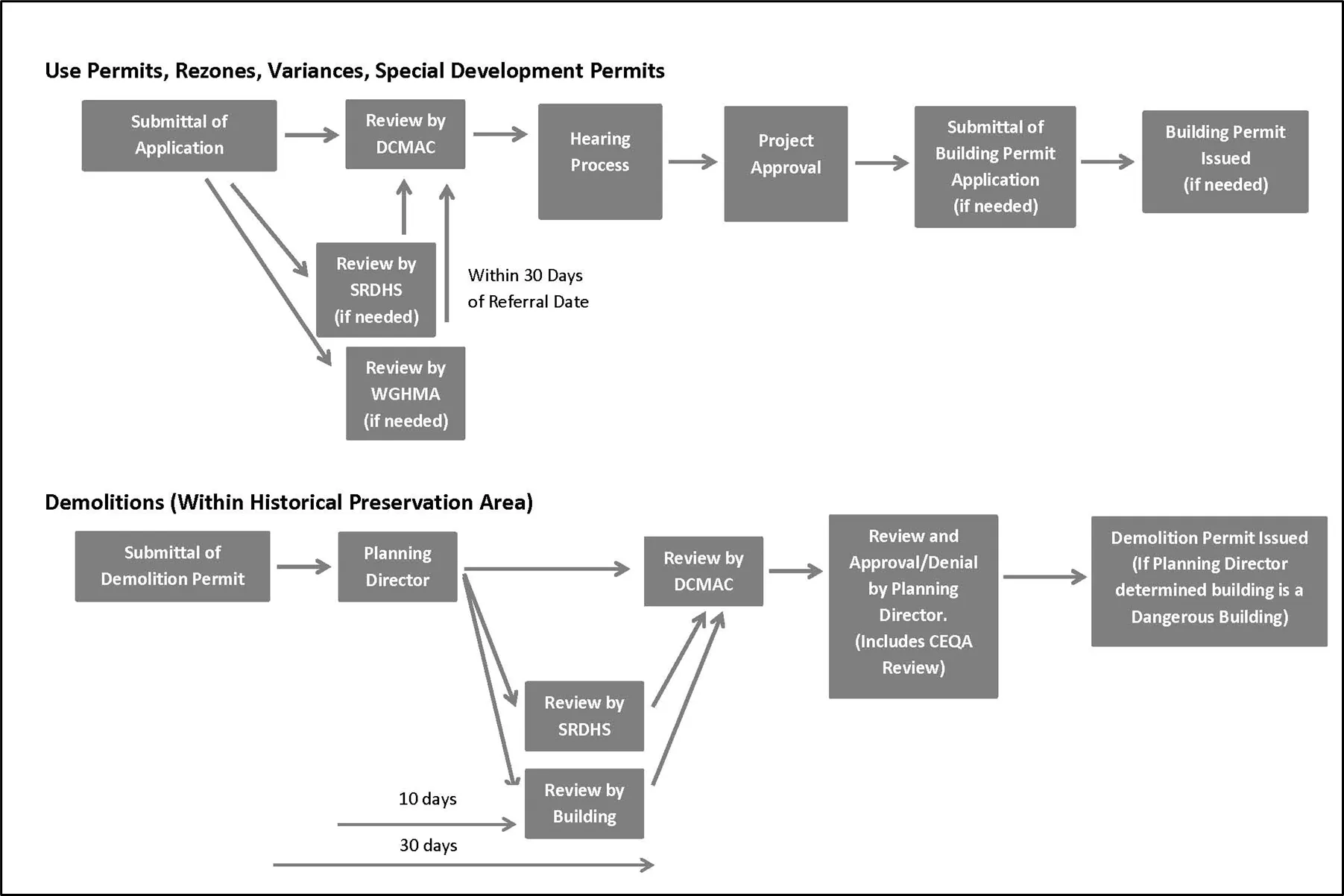
Walnut Grove Project Review Processes Charts - Section 504-39
ADMINISTRATION
Section titled “ADMINISTRATION”504-24. PROJECT REVIEW PROCESS:
Section titled “504-24. PROJECT REVIEW PROCESS:”For construction and uses, the following review processes apply within the SPA.
(a) Building Permit Review Process (Planning Director).
Section titled “(a) Building Permit Review Process (Planning Director).”- Building permits of projects subject to this process are reviewed for compliance with the Zoning Code and this SPA. No further review, beyond a building permit, is required when all standards and use requirements of the Zoning Code and this SPA are met.
(b) Plan Check Review Process.
Section titled “(b) Plan Check Review Process.”Note: It is recommended that the applicant have his/her plans initially reviewed by the WGHMA before submittal of building permit application if the project is within the WGHMA membership area. This may prevent problems later in the building permit process.
-
The Planning Director shall review the project for compliance with this SPA, the County Zoning Code and the Secretary of Interior Standards for the Treatment of Historic Properties (if project is in Historical Preservation Area). For projects within the Historical Preservation Area, the application package should include the following (in addition to items required for building permit application):
- Provide electronic and hard copies of application. Two (2) Arch D (24” x 36”) hard copies of the building permit application shall be submitted to the County. An electronic copy of the package in PDF format must also be submitted, via email or on a CD.
- Context photographs. The application shall include a drawing sheet with full-scale or enlarged photographs to provide an overview of the subject property and adjacent buildings and common areas.
- Photographs of existing conditions. Clear, full-scale or enlarged photographs of all building facades shall be included. If the existing conditions of the elevations are not clear in the photographs, drawings must be provided.
- Elevations of the proposed project. Drawings that show all of the building facades of the new building, existing building with new addition, or remodel shall be included.
- Plot plan with property lines. Show property lines on site plan to clearly show their relationship to the proposed project. This is required even if the building footprint is not changing.
-
The Building Permit application shall be referred to the SRDHS (if project is within a Historical Preservation Area) and the WGHMA (if project is within the WGHMA project review area) by the Planning Director. The WGHMA will be the Primary Review Body while the SRDHS will be the Secondary Review Body. The SRDHS shall forward its recommendations and/or comments to the WGHMA within 30 days of the referral date. If the project is not within the WGHMA project review area, the SRDHS will forward its recommendations and/or comments to the Planning Director. If project is not within the WGHMA project review area or within a Historical Preservation Area, then the Planning Director will approve or deny the Building Permit within 10 days after the Design Review Administrator recommends approval of the project (if Design Review is required).
-
The WGHMA shall forward its recommendations and/or comments to the Planning Director within 60 days of the referral date. If SRDHS review is not required, then the WGHMA shall forward its recommendations and/or comments to the Planning Director within 45 days of the referral date.
-
If the project requires Design Review, a formal application for a Design Review (available at the Sacramento County Planning and Environmental Review Division) is required, in addition to a building permit. The maps and drawings necessary to describe the project, as well as review of potential impacts to adjoining properties are required. The design, compatibility of the uses, parking, landscaping and lighting will be considered.
-
The Planning Director shall approve the Building Permit for the Planning and Environmental Review Division within 10 days after:
- The Planning Director receives recommendations and/or comments from the Primary and Secondary Review Bodies (if needed); and
- The Design Review Administrator recommends approval of the project (if Design Review is required); and
- The project is in compliance with all applicable zoning codes.
-
The Building Permits and Inspection Division (BPI) issues building permit after BPI review of building permit plans is completed, required corrections are made, and approvals are attained from relevant agencies.
(c) Use Permits.
Section titled “(c) Use Permits.”Use Permits shall be required for those uses as indicated in the Use Tables in the Zoning Code, or as specified in this SPA. The Use Permit Process shall be in accordance with Section 6.4.3 of the Zoning Code. In addition to those requirements, the application review distribution shall include DCMAC, the WGHMA (if project is within the WGHMA project review area) and the SRDHS (if the project is within a Historical Preservation Area), and the intent of this SPA shall be considered. The DCMAC will be the Primary Review Body and the WGHMA and SRDHS will be the Secondary Review Bodies. The WGHMA and SRDHS shall forward their recommendations and/or comments to DCMAC through the Planning Director within 30 days of referral.
(d) Rezones.
Section titled “(d) Rezones.”Land Use categories may be changed by rezone as provided for in Section 6.2.1 of the Zoning Code. In addition to those requirements, the application review distribution shall include DCMAC, the WGHMA (if project is within the WGHMA project review area) and the SRDHS (if the project is within a Historical Preservation Area), and the intent of this SPA shall be considered. The DCMAC will be the Primary Review Body and the WGHMA and SRDHS will be the Secondary Review Bodies. The WGHMA and SRDHS shall forward their recommendations and/or comments to DCMAC through the Planning Director within 30 days of referral.
(e) Variances.
Section titled “(e) Variances.”Variances from the standards in the Zoning Code or this SPA may be considered through a variance process as provided for in Section 6.5.1 of the Zoning Code. The application review distribution shall include DCMAC, the WGHMA (if project is within the WGHMA project review area) and the SRDHS (if the project is within a Historical Preservation Area), and the intent of this SPA shall be considered. The DCMAC will be the Primary Review Body and the WGHMA and SRDHS will be the Secondary Review Bodies. The WGHMA and SRDHS shall forward their recommendations and/or comments to DCMAC through the Planning Director within 30 days of referral.
(f) Special Development Permits.
Section titled “(f) Special Development Permits.”Projects within the SPA that are designated to achieve the purposes set forth in Section 6.4.6 of the Zoning Code may be considered through the Special Development Permit process. In addition to those requirements, the application review distribution shall include DCMAC, WGHMA (if project is within the WGHMA project review area) and SRDHS (if within a Historical Preservation Area) and the intent of this SPA shall be considered. The DCMAC will be the Primary Review Body and the WGHMA and SRDHS will be the Secondary Review Bodies. The WGHMA and SRDHS shall forward their recommendations and/or comments to DCMAC through the Planning Director within 30 days of referral.
(g) Uses Not Otherwise Provided For.
Section titled “(g) Uses Not Otherwise Provided For.”Uses not provided for in this SPA may be considered by the Planning Director as set forth in Section 6.4.5 of the Zoning Code.
504-25. REVIEW PROCEDURES FOR PERMITTED USES NOT REQUIRING A USE PERMIT:
Section titled “504-25. REVIEW PROCEDURES FOR PERMITTED USES NOT REQUIRING A USE PERMIT:”Unless otherwise specified, all construction projects indicated as permitted uses in Section 504-30 shall be reviewed as follows:
| Project in All Areas | Building Permit Review (Planning Director) | Plan Check Review (Needs Local Review) |
|---|---|---|
| Interior Remodeling or Exterior Repair | X | |
| New Signs [1] | X | |
| Existing Signs [Repairing or Replacing] [2] | X | |
| Parking Lots Not Associated with an Application [3] | X |
| Project in Historical Preservation Area | Building Permit Review (Planning Director) | Plan Check Review (Needs Local Review) |
|---|---|---|
| Non-Residential, or Mixed-Use Buildings: New Construction, Exterior Remodeling and Additions [3] | X | |
| Single-Family Residential Dwellings or Duplex [10 Units/Acre or Less on Existing Lots]: Exterior Remodeling and Additions, New Construction [4] | X | |
| Multifamily Dwellings: New Construction [3][5] | Planning Entitlement – Design Review or Use Permit | Planning Entitlement – Design Review or Use Permit |
| Multifamily Dwellings: Exterior Remodeling and Additions [3] | X | |
| New Accessory Structure Construction – Visible From Roadway [Street, Alley] | X | |
| New Accessory Structure Construction – Not Visible from Roadway [Street, Alley] | X |
| Project Outside Historical Preservation Area | Building Permit Review (Planning Director) | Plan Check Review (Needs Local Review) |
|---|---|---|
| Non-Residential, or Mixed-Use Buildings: New Construction [3] | X | |
| Non-Residential or Mixed-Use Buildings: Exterior Remodeling and Additions [3] | X | |
| Single-Family Residential Dwellings or Duplex [10 Units/Acre or Less on Existing Lots]: New Construction, Exterior Remodeling and Additions [4] | X | |
| Multifamily Dwellings: New Construction [3][5] | Planning Entitlement – Design Review or Use Permit | Planning Entitlement – Design Review or Use Permit |
| Multifamily Dwellings: Exterior Remodeling and Additions [3] | X | |
| New Accessory Structure Construction | X |
Footnotes for 504-25
Section titled “Footnotes for 504-25”- Signs that meet the standards in 504-35. Signs that do not meet the standards in 504-35, monument signs, directory signs and off-site signs may be considered through a Use Permit request reviewed by DCMAC, WGHMA (if within WGHMA project review area) and SRDHS (if within a Historical Preservation Area) and heard by the Zoning Administrator.
- If repaired sign or sign replacing old sign is different in appearance or size from original sign, Plan Check Review will be required.
- Design Review is required. Design Review is required for all new multifamily projects with 150 units or less in the Commercial-Residential sub-area.
- Special Development Permit for new single-family or duplex projects exceeding 10 units per acre.
- All new multifamily projects requiring Design Review or Use Permits shall be reviewed by the Primary Review Body (DCMAC) and the Secondary Review Bodies – WGHMA (if within WGHMA project review area, SRDHS (If within a Historical Preservation Area).
504-26. FINDINGS:
Section titled “504-26. FINDINGS:”For a granting authority to approve a project subject to any of the PROJECT REVIEW PROCESSES set forth within, the follow findings shall be made:
- The intent of the SPA has been met.
- The design of the project is compatible with the surrounding character, cultural, and historical aspects.
- The standards of development required by this SPA have been met.
If these findings cannot be made, the project shall be denied. The hearing authority on the appeal of such a denial, shall list the special and extenuating circumstances that make it difficult to conform to the findings before granting an appeal.
504-27. DEMOLITION AND DANGEROUS BUILDINGS:
Section titled “504-27. DEMOLITION AND DANGEROUS BUILDINGS:”Any Demolition permits for structures proposed to be completely removed from a site that is located within a Historic Preservation Area as shown on Exhibit 504-38 shall be subject to approval by the Planning Director. The Planning Director shall refer the proposal within 10 days to DCMAC, SRDHS and the Building Permits and Inspections Division for a coordinated review and recommendations.
The DCMAC shall consider the request within 30 days after receipt of the demolition application. Representatives of the Building Permits and Inspections Division and SRDHS shall be invited by DCMAC.
Within 10 days after receipt of the DCMAC’s recommendation, the Planning Director shall initiate CEQA review or deny the requested Demolition Permit. The demolition permit may be denied when it is found that the Chief Building Inspector has determined that the building is not in danger of collapsing or when the Planning Director, after consultation with the Chief Building Inspector, SRDHS and DCMAC, determines that feasible alternatives to demolition are available. Feasible alternatives may include but are limited to: securing, stabilizing, supporting or otherwise preventing the building from collapsing. The Planning Director’s determination is final unless appealed to the Board of Zoning Appeals pursuant to Section 6.1.3 of the Zoning Code.
When a building is determined to be a DANGEROUS BUILDING by the Planning Director, it may be removed immediately in accordance with the procedures set forth in Chapter 16.22 of the County Code.
After obtaining approval from the Planning Director, but prior to the issuance of a demolition permit, the application must provide documentation of the structure for the historical record. At minimum, the documentation must include clear photographs of all sides of the structure, details of unique or representative construction features, and any history of the structure known to, or reasonably obtainable by the applicant. No demolition permit shall be issued until this information is received. Historical materials such as doorknobs, hinges, light fixtures, tubs and the like should be salvaged for re-use, preferable on the same site. If the Owner does not wish to salvage such items, a reasonable opportunity to salvage should be offered to local or other organizations, for the benefit of historic preservation.
If the building is demolished and a new replacement structure is proposed, the new structure will be subject to the Plan Check Review process. The new structure shall be compatible with the architectural style, and materials of the buildings common to the area.
LAND USES
Section titled “LAND USES”504-28. EXISTING LAND USES AND BUILDINGS:
Section titled “504-28. EXISTING LAND USES AND BUILDINGS:”Each use and principal building in existence on the effective date of the original Ordinance (March 10, 1983) is deemed to be a conforming use and a conforming building. However, if such use is discontinued for a period of time exceeding twelve (12) months, it may be reestablished as provided in the Use Tables as a permitted use or by a use permit.
If the use is not permitted in the use category, but is listed elsewhere in the Zoning Code or this SPA, it may be considered a re-establishment through a request for a Use Permit to be heard by the Zoning Administrator. Uses not listed in the Zoning Code or this SPA shall be subject to the process set forth in Section 6.4.5 of the Zoning Code.
- Existing Lots. Existing lots as of the date of the original Ordinance (March 10, 1983) are deemed to be conforming in lot size and shape and shall retain building rights for any use permitted by this SPA.
504-29. PROHIBITED USES:
Section titled “504-29. PROHIBITED USES:”Psychiatric Facility, Sanitarium, Social Rehabilitation Center, Massage Parlor, Tattoo Shop, Live Theater - Adult, Motion Picture Theater - Adult, and Bookstore - Adult.
504-30. PERMITTED USES:
Section titled “504-30. PERMITTED USES:”Unless prohibited in Section 504-29 above, allowed land uses in the Sub-Areas shown on map in Section 504-38 shall be determined by using the following table:
Key for Section 504-30
Section titled “Key for Section 504-30”CZ = Conditional Use Permit by the Zoning Administrator
VRP = Vacation Rental Permit
P = Permitted Primary Use
Permitted Uses, by Sub-Area
Section titled “Permitted Uses, by Sub-Area”| Uses | Residential | Commercial-Residential | Industrial | Office-Warehouse |
|---|---|---|---|---|
| All RD-10 Uses | P (1) | P (1) | P (1) | |
| All GC Uses | P (1) | P (1) | ||
| All MP Uses | P (1) | P (1) | ||
| All M-1 Uses | P (1) | P (1) | ||
| Neighborhood Parks | P | P | P | |
| Community Gardens | P | P | P | |
| Cabinet Shop | P (2) | P | P | |
| Building Trades Service Yard and Workshop (including electricians and plumbers) | P (2) | P | P | |
| Petroleum Storage | P (3) | |||
| Fertilizer and Agricultural Chemicals (storage, sales, service and blending) | P (3) | P (3) | ||
| Tourism-Related Uses | ||||
| Bed and Breakfast Inn | CZ | P | ||
| Vacation Rental: Single-Family or Duplex (One or Both Units) Only | VRP | VRP | ||
| Small Wineries/Specialty and Craft Breweries | CZ (2)(4) | P (4) | P (4) | |
| Large Wineries/Breweries | P (5) | P (5) | ||
| Tasting Rooms – Off Site (Primary Use) | P (6)(7)(8) | |||
| Tasting Rooms – Off Site (Accessory Use) | P (6)(7)(8)(9) |
Footnotes for 504-30
Section titled “Footnotes for 504-30”- By right or with Use Permit. See Zoning Code Section 3.2.5.
- Permitted if the entire operation is conducted within a completely enclosed building or screened from view behind a fence or wall as set forth in Section 5.2.5 in the Zoning Code. For small wineries/specialty craft breweries, processing activities shall be conducted within a completely enclosed building and storage activities shall either be within a completely enclosed building or screened from view behind a fence or wall as set forth in Section 5.2.5 in the Zoning Code.
- Permitted provided the entire operation, including the parking and storage of vehicles used in connection with the operation, is conducted within a completely enclosed building or screened from view within a fenced-in area as set forth in Section 5.2.5 in the Zoning Code.
- Comply with all provisions set forth in Section 3.4.8 in the Zoning Code.
- Use is allowed if in compliance with use standards in Section 3.4.9 in the Zoning Code.
- The tasting room facility must be affiliated with a minimum of one brewery/winery in order to meet the requirements of the Alcoholic Beverage Control (ABC) Type 2 Winegrower license or Type 23 Microbrewery license.
- The retail sales area within the beer or wine tasting room shall not exceed thirty percent (30%) of the tasting room structure or the area designated for tasting within a multipurpose building.
- There are no restrictions on the size and frequency of events provided that:
- Outdoor activities are limited to Sunday through Thursday 8:00 a.m. to 7:00 p.m.; and Friday, Saturday, and holidays 8:00 a.m. to 11:00 p.m. Indoor activities are permitted without restrictions as to day and time.
- All events and the use of outdoor amplified sound are subject to the Sacramento County Noise Ordinance.
- The tasting area cannot exceed more than 33 percent of the combined area of the primary use and the tasting area.
DEVELOPMENT STANDARDS AND DESIGN CRITERIA
Section titled “DEVELOPMENT STANDARDS AND DESIGN CRITERIA”504-31. DEVELOPMENT STANDARDS
Section titled “504-31. DEVELOPMENT STANDARDS”(a) Setbacks and Height:
Section titled “(a) Setbacks and Height:”-
New structures and/or additions within the Historic Preservation Areas must be consistent with setbacks and heights of the existing structures in the area.
-
New structures and/or additions outside the Historical Preservation Areas shall meet setbacks and height standards required for the use in the Zoning Code, unless there are existing setbacks and heights in the immediate area.
-
Multifamily structures or additions shall meet the setbacks and height standards in the Multi-Family Design Guidelines that are based on the project’s community context, unless there are existing setbacks and heights in the immediate area.
-
Greater height or reduced setbacks may be considered through a Special Development Permit process.
(b) Lot Size:
Section titled “(b) Lot Size:”Lot area, width and depth shall be determined by Section 504-37 of this SPA.
504-32. RESIDENTIAL DENSITY
Section titled “504-32. RESIDENTIAL DENSITY”(a) Historical Preservation Area.
Section titled “(a) Historical Preservation Area.”Existing and new buildings shall not exceed two units per 20 feet of building frontage on one street. Building frontage shall be considered the narrowest dimension when the building fronts on more than one street. When a Use Permit is required to reestablish an existing use pursuant to Section 504-28, a greater density than two units per 20 feet of building frontage may be considered based on the original density existing on March 10, 1983, subject to a review of the impacts that density may have under present conditions. An increase in density for other circumstances may be considered through a Special Development Permit.
(b) Undeveloped Areas Outside The Historical Preservation Area.
Section titled “(b) Undeveloped Areas Outside The Historical Preservation Area.”The density in undeveloped areas outside the Historical Preservation Area shall not exceed 10 units per acre. Up to 15 units per acre may be considered through a Special Development Permit.
(c) Existing Lots.
Section titled “(c) Existing Lots.”All existing lots may have one single-family residence, one two-family residence, or two single-family residences as a permitted use notwithstanding the density requirements set forth herein.
504-33. LANDSCAPING:
Section titled “504-33. LANDSCAPING:”Specific landscaping requirements are not described in this Section; however, the review authority may require landscaping in areas where on-site and off-site parking is provided and where buildings are set back from the sidewalk. This landscaping requirement may be accomplished by provision of street trees, window boxes, hanging baskets, sidewalk planters, planter strips, shrubs or a combination of the items listed. Areas which may be required to be landscaped include slopes too steep for construction, side yards, back yards, or other open areas. Conditions of design review or use permit may require planting of these areas to retard erosion or to provide further visual amenities. If street trees are provided by the project proponent, they may be planted directly into the ground or in appropriate tubs. In all cases, landscaping required shall be designed to enhance the overall appearance of the area. Drought-resistant landscaping is encouraged.
504-34. PARKING
Section titled “504-34. PARKING”- Off-street parking shall be provided, using standards of the Zoning Code as a basic guide for each use; however, lesser standards may be applied if deemed by the Department of Community Development to be adequate for the proposed use considering the existing uses and the parking demand of the proposed use, the availability of vacant land for off-site and on-site parking, availability of on-street parking, parking agreements and any other solutions the applicant may propose. Parking may be provided at locations other than the applicant’s project site, with evidence of recorded and irrevocable agreements and easements.
- Property owners and commercial users of property are encouraged to form an association, assessment district, or community area with the purpose of acquisition, construction and maintenance of parking facilities.
- Development plans for parking facilities, not associated with an application requiring other review, shall be submitted to the Department of Community Development for Plan Check Review and Design Review. Review and approval of the plans shall be relative to design, internal circulation, landscaping and parking standards in the Zoning Code, Section 5.9 ”Off-Street Parking”. Varied surfaces such as turf block, terrazzo, and planting areas will be encouraged around trees and within parking areas.
- Parking facilities for other means of transportation are also encouraged.
504-35. SIGNS
Section titled “504-35. SIGNS”- Existing permitted signs on or before the effective date of the Original Ordinance (March 10, 1983) shall be considered conforming and may be repaired or replaced after Building Permit Review if the size and design of the sign is not changing. Otherwise the repaired or new sign shall be subject to the Plan Check Review process. This also applies to all signs that were permitted after the effective date of the Original SPA Ordinance.
- All new signs, displays and logos are permitted subject to Plan Check Review according to the following standards:
- Pole signs are prohibited.
- Signs shall be placed flat against the building, or projected at right angles from the building and shall not project above the roof line of the building.
- Signs shall not have flashing, moving, or animated illumination. Lighting of signs shall be arranged so as to not produce a glare on other properties in the vicinity, and the source of light shall not be visible from adjacent property, or a public street.
- All signs shall reflect the historical character of the area through the design, color, material, and lighting used. Materials may be wood, metal, or other historically appropriate combinations of materials.
- A business name or logo and address number may be permanently applied or lettered directly onto window glass or glass in doors or may be a sign placed in the window. Sign materials and lettering style must be appropriate to the historic context. Painted lettering or wooden signs are acceptable.
The aggregate of all window signage is limited to a maximum coverage of 25% of the total storefront window display area or six square feet, whichever is greater. This signage is in addition to the maximum allowed per building. - Total area of all advertising devices shall not exceed the following:
- For the Historical Preservation Area - 20 square feet per building
- For the Commercial-Residential, Office/Warehouse, and Industrial Sub-Areas - two (2) square feet per foot of building frontage.
- Only one side of the sign is considered in determining the allowable sign area.
- Buildings that have frontage on two streets, other than corner buildings, may use the allowable sign area on both streets.
- Sign meeting the above standards shall be reviewed through the Plan Check Review process. Signs that do not meet the above standards, monument signs, directory signs and off-site signs may be considered through a Use Permit request heard by the Zoning Administrator.
504-36. DESIGN CRITERIA:
Section titled “504-36. DESIGN CRITERIA:”This Section does not prescribe style or scheme for development of the town of Walnut Grove. Rather, it attempts to regulate rehabilitation activities which are sensitive to the cultural/historical nature of the area, which will relate to the existing construction and development of the town, and which will promote the existing feeling within the town area. Different parts of the Section specify regulations which should preserve the existing amenities of the town and are of benefit to the entire community. However, there are other elements involved in design which will set the real atmosphere of an area. These augmentative features listed below will be considered in review of development plans by the SRDHS, WGHMA, DCMAC, Design Review Administrator, the Planning Director, Planning Commission, and Board of Supervisors.
- Architectural motif and style
- Height, bulk, mass, shape and proportion of structures and their various sub-elements such as roof pitches, porches, windows and doors
- Color and building materials
- Relationship to adjacent structures and to overall community identity
- Street furniture, including benches, light fixtures, trash receptacles, and other furnishings customarily located between the business establishment and the street right-of-way
- Paving and sidewalk materials
- Painting and finish work. Painting will generally conform to the colors historically used in Walnut Grove, including natural wood, ivory, off-white, light brown and tan. Other colors are permissible if documented by historic evidence. Other colors are permissible if documented by historical evidence.
- This DESIGN CRITERIA is intended to apply specifically to the Old Town Historical Preservation areas; however, any new development should be sensitive to the historical architectural style of the area. All development within the SPA will be reviewed based on the design criteria and the design of any structure should be compatible with the overall character of the area to the extent practical.
- The design should be based on standards set forth in "REHAB RIGHT" and the "SECRETARY OF INTERIOR'S STANDARDS FOR HISTORICAL PRESERVATION." The documents are on file in the Sacramento County Department of Community Development.
PARCEL MAPS AND SUBDIVISIONS
Section titled “PARCEL MAPS AND SUBDIVISIONS”504-37. PARCEL MAPS AND SUBDIVISIONS
Section titled “504-37. PARCEL MAPS AND SUBDIVISIONS”- Existing Developed Areas. Parcels created for existing development or new parcels created from existing parcels that are less than one acre and located within a developed area are exempt from Zoning Code requirements such as lot area, frontage, setbacks, parking and density, and the design standards of Title 22, Chapter 22.110 of the County Code. Newly created parcels on vacant land within the developed areas shall be similar in size and shape to the existing parcels in the area. Construction on these parcels shall be in conformance with the standards set forth in Section 504-31 (a).
- Undeveloped Areas. Parcels created on undeveloped land are subject to all the standards of the SPA and the relevant standards of the Zoning Code and the requirements of Title 22 of the County Code unless otherwise authorized by a Special Development Permit.
504-38. WALNUT GROVE SPECIAL PLANNING AREA
Section titled “504-38. WALNUT GROVE SPECIAL PLANNING AREA”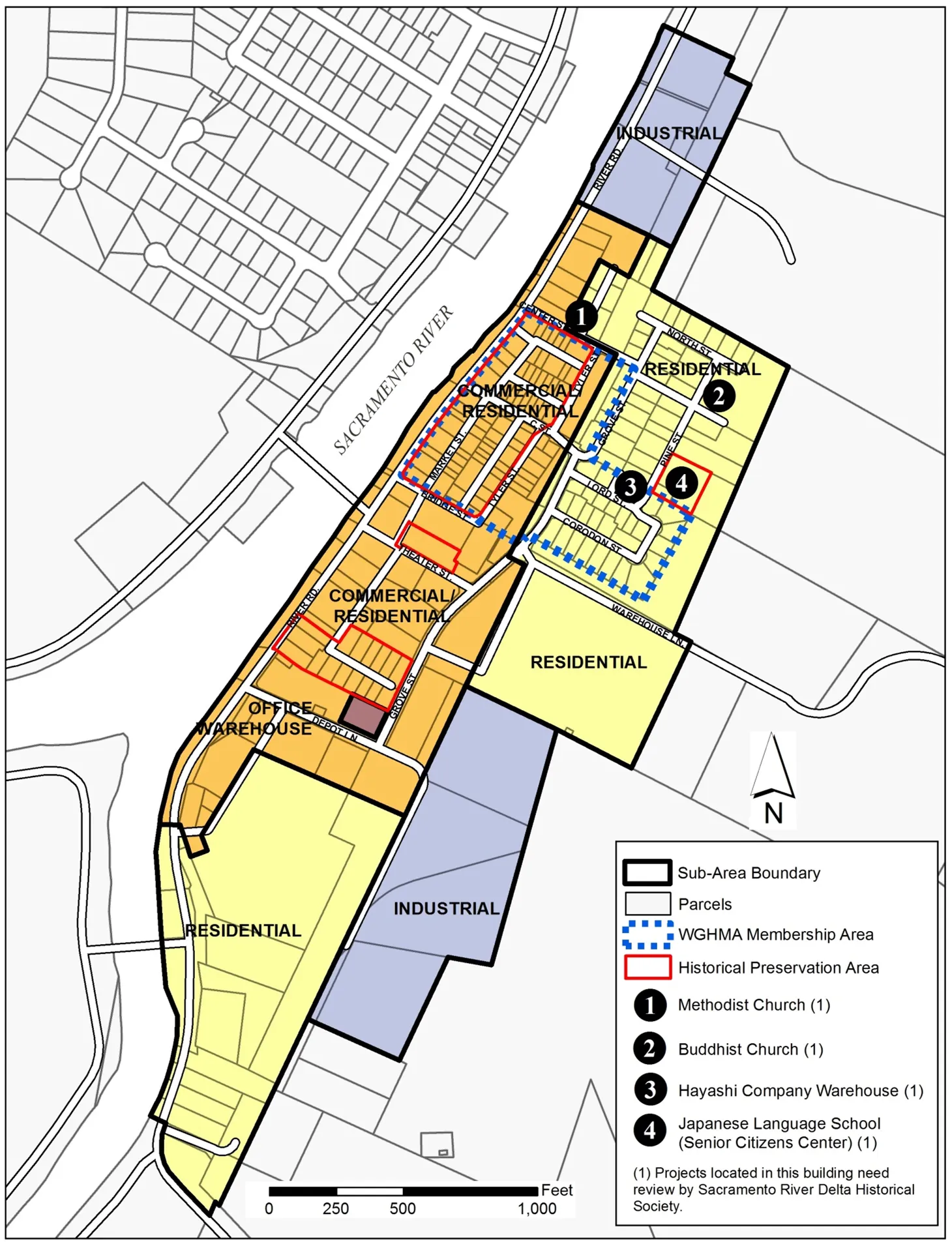
504-39. WALNUT GROVE PROJECT REVIEW PROCESS CHARTS
Section titled “504-39. WALNUT GROVE PROJECT REVIEW PROCESS CHARTS”CHART A
Section titled “CHART A”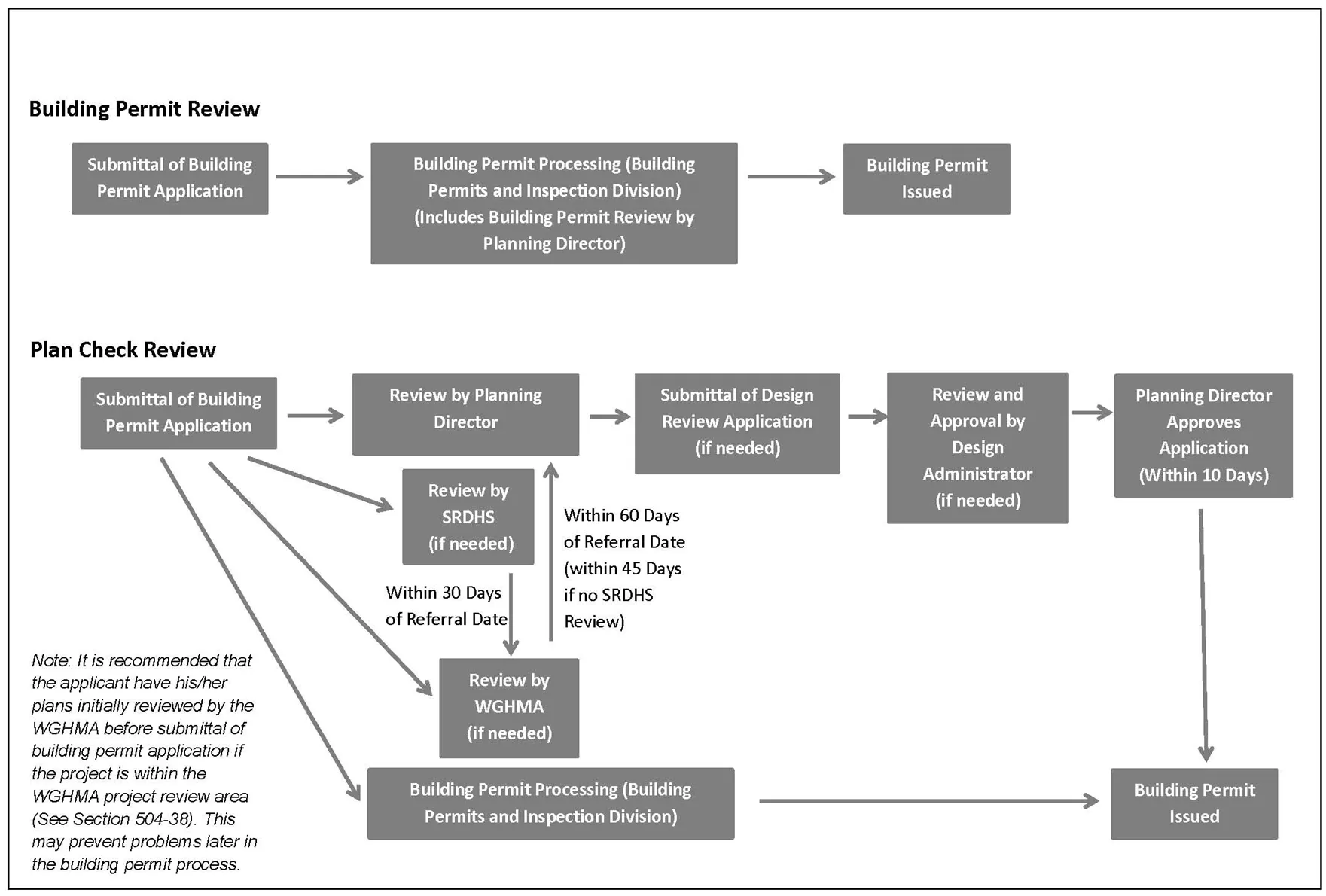
CHART B
Section titled “CHART B”