

Chapter 7: Definitions and Acronyms
Sacramento County Zoning Code
Chapter 7: Definitions and Acronyms
Section titled “Sacramento County Zoning Code Chapter 7: Definitions and Acronyms”Amended July 11, 2024
This section clarifies interpretation of common wording and language issues that may occur in this Code.
7.1. WORD USAGE AND CONSTRUCTION OF LANGUAGE
Section titled “7.1. WORD USAGE AND CONSTRUCTION OF LANGUAGE”7.1.1. Meanings and Intent
Section titled “7.1.1. Meanings and Intent”All terms, phrases, and expressions in this Code shall be construed according to the general purpose and intent set out in Section 1.3., Purpose of this Code, and the additional specific purpose statements contained throughout this Code.
7.1.2. Headings, Illustrations, and Text
Section titled “7.1.2. Headings, Illustrations, and Text”In case of any difference of meaning or implication between the text of this Code and any heading, drawing, table, figure, commentary block or illustration, the text shall control.
7.1.3. Lists and Examples
Section titled “7.1.3. Lists and Examples”Unless otherwise specifically indicated, lists of items or examples that use terms such as “including” and “such as,” or similar language, are intended to provide examples, not to be exhaustive lists of all possibilities.
7.1.4. Computation of Time
Section titled “7.1.4. Computation of Time”References to days are calendar days unless otherwise stated. The time in which an act is to be done shall be computed by excluding the first day and including the last day. If the last day is a Saturday, Sunday or holiday observed by the County, that day shall be excluded.
7.1.5. Reference
Section titled “7.1.5. Reference”Whenever reference is made to any portion of this Code, the reference applies to this Code as adopted and any amendments or additions hereafter made.
7.1.6. References to Other Regulations, Publications, and Documents
Section titled “7.1.6. References to Other Regulations, Publications, and Documents”Whenever reference is made to a resolution, ordinance, statute, regulation, or document, such reference shall be construed as a reference to the most recent edition of such regulation (as amended), resolution, ordinance, statute, regulation, or document, unless otherwise specifically stated.
7.1.7. Technical and Nontechnical Terms
Section titled “7.1.7. Technical and Nontechnical Terms”Words and phrases shall be construed according to the common and approved usage of the language, but technical words and phrases that may have acquired a peculiar and appropriate meaning in law shall be construed and understood according to such meaning.
7.1.8. Public Officials and Agencies
Section titled “7.1.8. Public Officials and Agencies”All public officials, bodies, and agencies to which references are made are those of Sacramento County, unless otherwise indicated.
7.1.9. Mandatory and Discretionary Terms
Section titled “7.1.9. Mandatory and Discretionary Terms”The words “shall,” “will,” and “must” are always mandatory. The words “may” and “should” are advisory and discretionary terms.
7.1.10. Conjunctions
Section titled “7.1.10. Conjunctions”Unless the context clearly suggests the contrary, conjunctions shall be interpreted as follows:
7.1.10.A.
Section titled “7.1.10.A.”“And” indicates that all connected items, conditions, provisions or events apply.
7.1.10.B.
Section titled “7.1.10.B.”“Or” indicates that one or more of the connected items, conditions, provisions, or events applies.
7.1.11. Tenses and Plurals
Section titled “7.1.11. Tenses and Plurals”Words used in one tense (past, present or future) include all other tenses, unless the context clearly indicates the contrary. The singular includes the plural, and the plural includes the singular.
7.1.12. Calculations and Rounding
Section titled “7.1.12. Calculations and Rounding”[ADDED 07-16-2020]
Where any provision of this Code requires calculation to determine applicable requirements, any fractional/decimal results of the calculation shall be rounded to the nearest whole number, (0.5 or more shall be rounded up and less than 0.5 shall be rounded down). This rule does not apply to density calculations for residential projects (see Section 7.1.13).
7.1.13. Number of Residential Units
Section titled “7.1.13. Number of Residential Units”[ADDED 07-16-2020]
The number of residential units shall not exceed the maximum allowable density per acre for the zone district within which the project is located and which has a specified density maximum. Therefore, any fractional dwelling count shall be rounded down to the nearest whole number to ensure compliance with maximum density, except as follows:
7.1.13.A.
Section titled “7.1.13.A.”For projects eligible for a State density bonus pursuant to CA GOV §65915 or any successor statute, or Section 6.5.4 (Affordable Housing Incentive Program), any fractional number of permitted bonus density units shall be rounded up to the next whole number.
7.1.13.B.
Section titled “7.1.13.B.”For land division projects in RD zoning districts resulting in four or fewer residential lots the maximum allowable density per acre for the zone district shall not apply, so long as all of the resulting lots meet the minimum lot area, width, and frontage requirements for the zone district. A Special Development Permit to deviate from these standards does not constitute compliance with this provision.
7.2. INTERPRETATIONS
Section titled “7.2. INTERPRETATIONS”The Planning Commission has the authority to determine the interpretation or usage of terms used in this Code, according to the provisions of Section 6.5.3, Interpretations.
7.3. CODE TERMS AND USE DEFINITIONS
Section titled “7.3. CODE TERMS AND USE DEFINITIONS”This Section defines the terms used in this Code and the uses contained in Chapter Three, Use Regulations.
Accessory Structure
Section titled “Accessory Structure”[DELETED 06-22-2017]
See Structure, Accessory
Accessory Use
Section titled “Accessory Use”A use customarily incidental, related, and clearly subordinate to the main use of the lot or building that does not alter the principal use of the subject lot or adversely affect other properties in the zoning district.
Active Design
Section titled “Active Design”
Active Design is a way to encourage and accommodate physical activity and healthy living through the way buildings and neighborhoods are designed and built. Active Design utilizes the look, feel, and functioning of sidewalks, streets, neighborhoods, landscaping, parks, and buildings to make it safe, easy and desirable to walk or bicycle. Active Design has public health benefits. By making it safe, easy and desirable to walk or bicycle to work, school, and run errands; physical activity occurs as a natural part of our daily life. Obesity and chronic disease is reduced and individual and community health is improved. Active Design also overlaps with safety - Crime Prevention through Environmental Design (CPTED); universal design, and sustainable design because of the way it promotes accessibility and care of the environment. Active Designs are identified by the above icon and are discussed further in the County’s Design Guidelines.
Active Transportation
Section titled “Active Transportation”Active transportation relates to physical activity undertaken as a means of transport. It includes travel by foot, bicycle and by other non-motorized vehicles. Use of public transportation is also included in the definition as it often involves some walking or bicycling to pick-up and from drop-off points. People are more active when they ride a bike, walk or take public transportation.
Adult Day Care Center
Section titled “Adult Day Care Center”A licensed facility that provides an organized day program of personal care, daytime supervision, and social and support activities and services but excluding health care, to persons 55 years or older or other adults.
Adult-Related Establishment
Section titled “Adult-Related Establishment”An adult-related establishment is a bathhouse, escort bureau, modeling studio, or sexual encounter center, as such terms are defined in Chapter 4.34 of the SCC. “Adult-related establishment” does not include an adult bookstore, adult video tape store, adult motion picture theater, adult live theater, adult mini-motion picture theater, adult hotel or motel, or cabaret, and does not include other adult-related establishments regulated by Chapter 4.34 of the SCC.
Adult Novelty
Section titled “Adult Novelty”Establishment that, as one of its principal business purposes, offers for sale or rental for any form of consideration Instruments, devices or paraphernalia that are designed or marketed as useful primarily for the stimulation of human genital organs for anything of pecuniary value.
Adult Uses
Section titled “Adult Uses”Adult uses are sexually-oriented businesses or adult-related establishments, defined as follows.
Sexually-Oriented Business
Section titled “Sexually-Oriented Business”Sexually-oriented business, include but are not limited to any of the following:
Adult Bookstore
Section titled “Adult Bookstore”An establishment that devotes 25 percent or more of the total floor area open to the public or 25 percent or more of the total stock on hand, to the sale or rental of books, magazines, periodicals or other printed matter, photographs, motion pictures, films, video tapes, or video disks that are distinguished or characterized by an emphasis upon the depiction or description of “Specified Anatomical Areas” or “Specified Sexual Activities” as defined in Chapter 4.34 of the SCC.
Adult Motion Picture Theater
Section titled “Adult Motion Picture Theater”A building, a portion of a building, or an open or enclosed area that regularly features motion pictures distinguished or characterized by an emphasis on matters depicting, describing or relating to “Specified Sexual Activities” or “Specified Anatomical Areas,” as defined in Chapter 4.34 of the SCC.
Adult Live Theater
Section titled “Adult Live Theater”A building, a portion of a building, or an open or enclosed area that regularly features persons who appear in a state of nudity or state of semi-nudity, or live performances that are characterized by specified sexual activities. For purposes of this definition, the term “regularly features” means that the adult live theater features nudity, semi-nudity or specified sexual activities as a permanent focus of its business and gives special prominence to such content on a permanent basis.
Advisory Body
Section titled “Advisory Body”An officer, board, or commission responsible for reviewing an application and preparing a recommendation to the decision body whether to approve, approve with conditions, or deny the application, as provided in Chapter Six, Administration of this Code.
A person authorized by a property owner to act on his behalf relating to matters arising out of this Code.
Agricultural Conservation Easements
Section titled “Agricultural Conservation Easements”A deed restriction landowners voluntarily place on their property to protect agricultural land. The landowner either sells or donates the development rights (some or all) of the property to a qualified conservation organization or public agency to protect the agricultural use of the land in perpetuity.
Agricultural Equipment Repair and Maintenance
Section titled “Agricultural Equipment Repair and Maintenance”Repair or maintenance of vehicles and equipment for agricultural uses as defined in this Chapter.
Agricultural Research Institution
Section titled “Agricultural Research Institution”[ADDED 02-25-2021]
Has the same meaning as that term defined in CA FAC §81000 and may be modified from time to time therein. Currently defined as:
- A public or private institution or organization that maintains land or facilities for agricultural research, including colleges, universities, agricultural research centers, and conservation research centers.
- An institution of higher education that grows, cultivates or manufactures industrial hemp for purposes of research conducted under an agricultural pilot program or other agricultural or academic research.
Agricultural Supplies and Services
Section titled “Agricultural Supplies and Services”Retail sales of agricultural chemicals, fertilizer, feed, grain, and farm supplies, not including trucks, tractors, combines, and similar heavy equipment; and rental and incidental storage of farming equipment, not including trucks, tractors, combines, and similar heavy equipment.
Agricultural Uses, General
Section titled “Agricultural Uses, General”[AMENDED 03-09-2016]
The primary use of the premises for agriculture, including the cultivation of the soil for the production and harvesting of crops, the care and breeding of livestock, poultry, pastureland, horticulture, dairying, viticulture, aquaculture, silviculture (timber management), floriculture, apiaries (beekeeping), and the storage and minor repair of agricultural vehicle and equipment used for the processing and transportation of the products grown on the premises.
Agricultural Uses, Urban
Section titled “Agricultural Uses, Urban”[AMENDED 07-16-2020][AMENDED 02-25-2021]
The growing of fruits, herbs, and/or vegetables and/or the raising of animals in an urban area for food or other purposes. Urban agriculture includes, but is not limited to, private gardens, market gardens and community gardens. Urban agriculture does not include the cultivation of cannabis or industrial hemp.
Airport, Public or Private
Section titled “Airport, Public or Private”An area of land or water used or intended for use for the landing and takeoff of aircraft, airport buildings, or other appurtenant facilities. Includes private landing strips, but does not include any area located in a permanent agricultural zoning district that is used exclusively as a landing or takeoff area by a crop duster or by the landowner.
Alcohol, On-Sale
Section titled “Alcohol, On-Sale”[ADDED 06-07-2018]
The sale of alcoholic beverages including beer, wine and distilled spirits for consumption on the premises where beverages are sold and the incidental sale of beer and wine for consumption off of the premises.
A public thoroughfare less than 30 feet in width, which affords only a secondary means of access to an abutting property.
Alteration
Section titled “Alteration”Any change, addition, or modification in construction or occupancy.
Animal Grooming Service, Short-term boarding
Section titled “Animal Grooming Service, Short-term boarding”The provision of bathing and trimming services for small animals on a commercial basis. These uses include boarding of domestic animals for a maximum period of five days.
Apartment
Section titled “Apartment”A room or suite of rooms which is occupied or which is intended or designed to be occupied by one family for living and sleeping purposes.
Appeal Body
Section titled “Appeal Body”A board or commission responsible for hearing an appeal to a final decision of a decision body on an application, as provided in Chapter Six, Administration of this Code.
Applicant
Section titled “Applicant”A person who submits an application for review and processing pursuant to this Code.
Appropriate Authority
Section titled “Appropriate Authority”An officer, board, or commission responsible for advisory or decision hearing, as provided in Chapter Six, Administration of this Code.
Arcade, Electronic, Mechanical, or Video Games
Section titled “Arcade, Electronic, Mechanical, or Video Games”A single-use facility that provides three or more electronic, mechanical, or video game machines for use of patrons. “Electronic, mechanical, or video game machines” means any machine, apparatus, contrivance, appliance, or device that may be operated by placing or depositing a coin, check, token, slug, ball, or other article or device or by other means of payment, and involves in its use either skill or chance; including, but not limited to a tape machine, card machine, pinball machine, bowling game machine, shuffleboard machine, marble game machine, horse racing machine, basketball game machine, baseball game machine, football game machine, electronic video game, or any other similar machine or device. This does not include computer or electronic devices that are sample or “demonstrator” machines in a retail sales, rental, or service facility.
Areas of Moderate Flood Hazard
Section titled “Areas of Moderate Flood Hazard”[ADDED 02-2017]
Moderate risk flood hazard zones are shown by the letter “X” on the FEMA Flood Insurance Rate Maps. (Older maps use the letters “B” or “C”.)
Art Gallery, Art Studio
Section titled “Art Gallery, Art Studio”Spaces used principally for art activities.
Arterial, Major
Section titled “Arterial, Major”A major arterial is a street having a right-of-way of 80 feet or more as shown on the major streets and highways plan of the circulation element of the General Plan, adopted by the Board of Supervisors.
Assembly, Manufacturing, and Processing, Heavy - Indoor
Section titled “Assembly, Manufacturing, and Processing, Heavy - Indoor”[AMENDED 07-16-2020]
Allows manufacturing within a fully enclosed building that can be expected to have some off-property impacts or that may involve quantities of hazardous materials, including, but not limited to: ore reduction; metal foundries, forges, smelters, and casting; paper and pulp manufacture; manufacturing or processing of paint, varnish, adhesive, or resin; chemical, or sodium compound manufacture; newspaper printing; animal rendering or reduction; processing of odorous food products; and leather tanning or curing.
Assembly, Manufacturing, and Processing, Light - Indoor
Section titled “Assembly, Manufacturing, and Processing, Light - Indoor”[AMENDED 07-16-2020]
Allows manufacturing uses within a fully enclosed building that will have limited impacts (i.e., no smoke, noxious odors, vibration, dust, electromagnetic interference, excessive noise, etc. beyond the property line or outside of daytime hours) similar to purpose statement for M-1, including but not limited to: cabinet, blacksmith, machine, fabrication or welding shop; printing plant; photographic processing plant; honey extraction; and manufacturing of ice, candy, toiletries, cosmetics, or pharmaceuticals.
Assembly, Manufacturing, and Processing, Outdoor
Section titled “Assembly, Manufacturing, and Processing, Outdoor”[AMENDED 07-16-2020]
Allows manufacturing and assembly activities that are not fully enclosed within a building or where more than 20 percent of the lot area is devoted to outdoor storage of material, feedstock or finished product, including but not limited to: Quarry or stone mill; lumber mill, brick yard, stockyard, or railroad repair shops; and tire reconditioning and rebuilding.
Assembly Uses
Section titled “Assembly Uses”A location, auditorium, hall, or similar facility that is publicly or privately owned and is developed for the principal purpose of accommodating groups of persons for meetings, exhibitions, shows, and other public-interest events.
Attached/Attachment
Section titled “Attached/Attachment”[ADDED 05-11-2018][AMENDED 01-15-2021]
A structure that shares a common wall with another structure that is at least 30 percent of the secondary structure wall.
Automobile Service Station
Section titled “Automobile Service Station”[AMENDED 07-16-2020]
A retail commercial establishment devoted primarily to the retail sales of gasoline and similar motor fuels to the public, or as an incidental use to another commercial establishment, and which may also include retail sales of motor oils, lubricants, travel aides, minor automobile accessories, and minor automobile servicing, repairs, and maintenance. An automobile service station does not include any commercial, business, or governmental establishment having on the premises a gas pump or pumps from which gasoline or other motor fuels are not sold at retail to the public on a regular basis.
Automobile Service Station, Secondary
Section titled “Automobile Service Station, Secondary”[DELETED 07-16-2020]
Automobile Repair, Major
Section titled “Automobile Repair, Major”Major body and engine work and repairs to automobiles, other passenger vehicles, or boats. Examples include but are not limited to: rebuilding of radiator, transmission, and other major machine shops, body rebuilding, and painting.
Automobile Repair, Minor
Section titled “Automobile Repair, Minor”Minor adjustments, service, and repairs to automobiles or other passenger vehicles. Examples include but are not limited to: radiator, transmission, muffler, and brake repair, lubricant shops, diagnosis and tune-up, smog inspection, auto glass repair and installation, automotive seat covers and re-upholstery, tire sales and service, and car washes. Shall not include body and engine work as defined in “Auto Repair, Major.”
Automobile Wash Facility
Section titled “Automobile Wash Facility”A facility designed for the purpose of either self-service or automatic washing of automobiles.
A bar is any premises used or intended to be used for selling or serving alcoholic beverages to the public for consumption on the premises that does not qualify as or is not part of a “bona fide public eating place” as defined in CA BPC §2303.
[ADDED 05-11-2018]
A structure designed and constructed for use in housing farm machinery, animals, supplies or products that are harvested from or utilized to support agricultural production on a parcel of land.
Basement
Section titled “Basement”The portion of a building included between the upper surface of any floor and the upper surface of the next floor above which is partly below grade, but so located that the vertical distance from grade to the floor below is less than the vertical distance from grade to the floor above.
Beauty/Barber Shop, Spa
Section titled “Beauty/Barber Shop, Spa”A place of business providing hairdressing or other cosmetic treatment services, including manicures, facials and similar services. Massage and the application of permanent cosmetics are allowed as incidental uses.
Bed and Breakfast Inn
Section titled “Bed and Breakfast Inn”A dwelling containing a single living unit that serves as the residence for the owner or manager and not more than five guest rooms that, for compensation, provide temporary night to night lodging with or without meals.
Bedroom
Section titled “Bedroom”Any room in a dwelling unit used or intended or designed to be used for sleeping purposes with no less than 70 square feet of floor area and no dimension less than seven feet other than bathroom(s), kitchen, living, dining, family or any other room that meets the definition of a den.
Beekeeping, Commercial
Section titled “Beekeeping, Commercial”[AMENDED 02-24-2017]
Beekeeping in order to collect honey and other products (including beeswax, propolis, pollen, and royal jelly), to pollinate crops, or to produce bees for sale to other beekeepers or for rent.
Beekeeping, Non-Commercial
Section titled “Beekeeping, Non-Commercial”[ADDED 02-24-2017]
Beekeeping whereby any monies derived from the bees or the hive products is incidental to a permitted residential or non-residential use and not a significant source of the beekeeper’s income nor the beekeeper’s primary reason for practicing apiculture.
Behavioral Health Center
Section titled “Behavioral Health Center”[ADDED 06-06-2024]
An institution that provides behavioral health services, including, but not limited to, psychiatric and mental health care, substance use treatment, and rehabilitation, on a long-term (more than 90 days per stay), inpatient basis.
The Board of Supervisors of Sacramento County.
Board of Zoning Appeals
Section titled “Board of Zoning Appeals”The Board of Zoning Appeals of Sacramento County, established pursuant to Chapter 2.38 of the SCC.
Boarding House
Section titled “Boarding House”[AMENDED 06-06-2024]
A building wherein two or more, but not more than five, legally permitted bedrooms with no more than two adults per bedroom are independently rented for 30 or more consecutive days with separate written or oral agreements, leases, or subleases or a combination thereof, regardless of whether or not the owner, agent or rental manager resides within the residence or dwelling units, where lodging is provided with or without compensation. Shall not include a Residential Care Home or Scattered Shelter, as defined in this Section. Further, the term does not include a residential dwelling being shared by individuals residing together in a single household under a single lease (see Family/Single Household, as defined in this Section). Rental periods of less than 30 consecutive days are considered lodging uses, such as Short-Term Rental, Bed and Breakfast Inn, and Hotel, Motel.
Boat Dock, Private
Section titled “Boat Dock, Private”A pier or small structure at the edge of the water, where boats for personal or neighborhood use can tie up; not intended for public or commercial use.
Borrow Mining Operations, Short-Term
Section titled “Borrow Mining Operations, Short-Term”All, or any part of, the process involved in the removal of dirt, soil, sand, gravel, or other material from below grade of surrounding land for any purpose other than that necessary and incidental to site grading and building construction.
Brew Pub
Section titled “Brew Pub”A brew pub is an establishment that brews malt beverages on site for sale and consumption on the premises and that qualifies as a “bona fide public eating place” as defined in CA BPC §2303, limited in production to a maximum of 6,000 barrels of malt beverages annually. A brew pub does not include wholesale or off-site sales of alcohol unless such alcohol sales are allowed as a primary use in the underlying zoning district.
Breweries
Section titled “Breweries”An establishment where malt beverages are manufactured on the premises. Breweries are classified as any use that manufactures more than 15,000 barrels of beverage (all beverages combined) annually. A brewery may include a tap room as part of the principal use as long as the floor area utilized for the tap room is less than or equal to 25 percent of the total floor area of the facility.
Breweries, Specialty and Craft
Section titled “Breweries, Specialty and Craft”A small-scale brewery that produces a maximum of 15,000 barrels of malt beverages annually. May also be known as a “micro-brewery”. The brewery may include a tap room as part of the principal use as long as the floor area utilized for the tap room is less than or equal to 25 percent of the total floor area of the facility. May include a restaurant (see definition of brew pub).
Buildable Area
Section titled “Buildable Area”The portion of the lot remaining after allowing for all required yard areas and required open spaces.
Building, Height of
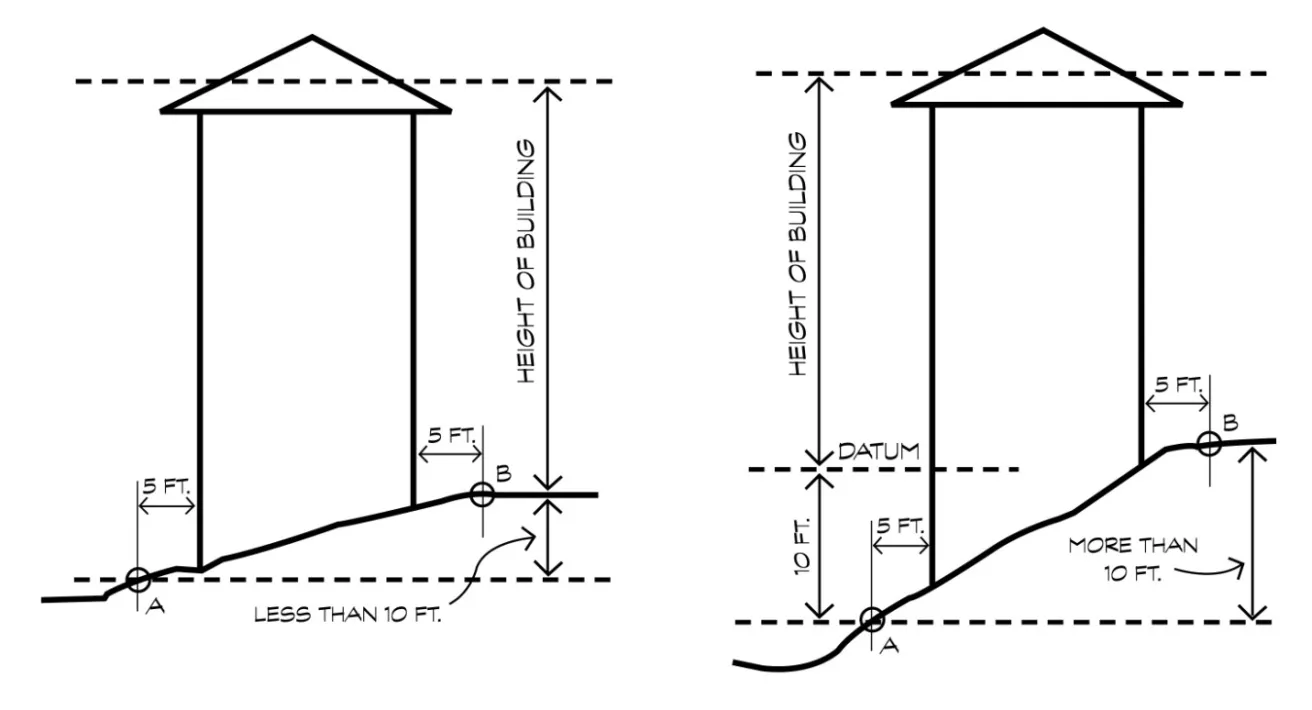
Section titled “Building, Height of”The height of a building shall be the vertical distance above a reference datum measured to the highest point of the coping of a flat roof or to the deck line of a mansard roof or to the average height of the highest gable of a pitched or hipped roof. The reference datum shall be selected by either of the following, whichever yields a greater height of building:
A. The elevation of the highest adjoining sidewalk or ground surface within a five-foot horizontal distance of the exterior wall of the building when such sidewalk or ground surface is not more than 10 feet above the lowest grade of the lot. B. An elevation 10 feet higher than the lowest grade when the sidewalk or ground surface is more than 10 feet above the lowest grade of the lot.
The height of a stepped or terraced building is the maximum height of any segment of the building.
Building Height Measurement Diagram
Section titled “Building Height Measurement Diagram”Case A on left; Case B on right
Building Line
Section titled “Building Line”A line located within a property at the minimum distance prescribed by this Code from any street, highway, canal, lake, river, park, stream, slough, parkway, floodplain, or portion thereof.
Building Size Equivalent
Section titled “Building Size Equivalent”The size of a building or group of buildings at a common work location measured in square feet, which is equivalent to a specified level of employment based on trip generation studies conducted by the California Department of Transportation.
Bus Depot
Section titled “Bus Depot”A passenger station for publicly or privately operated bus lines. A bus depot is generally a major destination point and characterized as a transfer point between local bus lines or other modes of transportation and intercity and interstate bus operations. A bus depot may or may not include indoor operational facilities. A bus stop is not a bus depot.
Bus Shelter
Section titled “Bus Shelter”A partially enclosed shelter for bus or other transit passengers located within or immediately adjacent to a public right-of-way.
Business Services, General
Section titled “Business Services, General”Service establishments primarily within buildings, providing other businesses with services including maintenance, repair and service, testing, rental, etc. Examples include but are not limited to addressing and mailing services; advertising business; computer programming, software, and systems; design; blueprinting-photocopying service; computer sales, rental, and lease; computer service and training; data processing service; mail or delivery service pickup station; locksmith/key and lock shop; mail order business; messenger service; office machines and equipment sales and minor repair; delivery service; drafting service; furniture rental agency; photocopy service; print shop; stenographic service; radio, television, or recording studio; telegraph office; telephone answering service; equipment rental agency, office related uses only.
Business Services, Intensive
Section titled “Business Services, Intensive”Service establishments primarily within buildings, providing other businesses with services that have more intense operational impacts, requiring the separation or mitigation from sensitive receptors. Examples include but are not limited to disinfecting-fumigating service; janitorial service; pest control service; alarm or warning system sales and service; upholstery/furniture cleaning, locksmith; and safe repair shop.
Bundling
Section titled “Bundling”The concurrent processing of two or more applications that pertain to the same development proposal.
Campground
Section titled “Campground”An area or tract of land on which accommodations for temporary occupancy are located or may be placed, including cabins, tents, and major recreational equipment, without the need for on-site infrastructure or individual sewer hookups, and which is primarily used for recreational purposes and retains an open air or natural character.
Cannabis
Section titled “Cannabis”[ADDED 07-16-2020]
Shall have the same meaning as set forth in CA HSC §11018 as defined in CA BPC §26001.
Cannabis, Commercial Activities
Section titled “Cannabis, Commercial Activities”[ADDED 05-11-2017][AMENDED 07-16-2020]
Includes all commercial activities as set forth in CA BPC §19300.5 and §26001, including, but not limited to the cultivation, possession, manufacture, processing, storing, laboratory testing, labeling, transporting, distribution, delivery or sale of cannabis or cannabis products.
Cannabis, Personal Cultivation
Section titled “Cannabis, Personal Cultivation”[ADDED 05-11-2017][AMENDED 07-16-2020]
The cultivation of cannabis for personal use is subject to the definitions and restrictions contained in Chapter 6.88, Title 6, of the SCC.
Canneries
Section titled “Canneries”Any establishment where food is received in raw or partly processed form for the purpose of canning in hermetically sealed containers and where sterilization by heat is used, or where preservation of vegetable products is accomplished by the use of approved chemical preservatives, sugar, salt, or acidity factors introduced as ingredients or additives, or by freezing foods for sale as and for food in any other type of vessel, bottle, can, bag, container, or other type or form of package, and the products placed on the market for general consumption as food. The use shall not include the packing or preservation of products for private use or a food establishment that processes meat or poultry products under the supervision of the U.S. Department of Agriculture.
Card Room
Section titled “Card Room”Any place where gambling is conducted and to which the public is invited to participate.
Cargo Container
Section titled “Cargo Container”A container made of steel or other similar material which is designed for securing and protecting items for transport or temporary storage. Cargo containers include, but are not limited to: containers commonly used as shipping containers on ships and railroad, and/or tractor trailer, Portable On Demand Storage (PODS), and other similar containers.
Carpool
Section titled “Carpool”A group of two to six persons traveling together in a light or medium-duty passenger vehicle.
Catering Service
Section titled “Catering Service”A place of business established to provide food service for parties, events, and institutions at off-site locations.
Cemetery
Section titled “Cemetery”Land used or intended to be used for the burial of the dead and dedicated for cemetery purposes including columbaria, mausoleums, and funeral establishments when incidental to and operated in conjunction with and within the boundary of the cemetery.
California Environmental Quality Act. CEQA requires environmental review prior to approval of a private or public project that may adversely affect the environment. CEQA works to ensure that governmental agencies consider possible significant impacts of proposed projects.
Child Day Care Center
Section titled “Child Day Care Center”[AMENDED 06-07-2018]
A facility providing a program for social development, pre-academic, or group training for children under 18 years of age; a facility, other than a family day care home, providing care and supervision of children on less than a 24-hour basis, with or without compensation or on a cooperative basis. Included within the definition are the following types of facilities: day nursery, nursery schools, group day care facilities, and day centers for persons with mental disabilities. Such facilities shall include those child care facilities operated in conjunction with a school or place of worship.
Church - See Place of Worship
Section titled “Church - See Place of Worship”Clerk of the Sacramento County Board of Supervisors.
Cluster Development
Section titled “Cluster Development”A development in which dwelling units are arranged in one or more dwelling groups, separated by each other by intervening open space giving visual definition to each group. Dwelling groups shall consist of two or more buildings, each containing one or more dwelling units arranged around a court.
Coin Operated Dispenser or Amusement
Section titled “Coin Operated Dispenser or Amusement”Any machine, apparatus or device which may be operated by depositing a coin, token, or similar device, which is used for amusement purposes such as a juke box, children’s rides, or other equipment, where no competition, score, skill, or chance is involved.
College, University
Section titled “College, University”An educational institution offering advanced instruction beyond the secondary level in any academic field, but not including business, trade, or vocational schools.
Community Garden
Section titled “Community Garden”[AMENDED 02-24-2017]
A garden established by an organization for the cultivation of fruit, vegetables, herbs and other produce on a vacant lot and maintained by any group of persons for the primary purpose of providing food for personal consumption.
Community Plan
Section titled “Community Plan”A Community Plan reflects the goals and policies of each individual community. Community Plan policies are intended to guide the physical development of a community on a more detailed basis than the General Plan.
Community Planning Advisory Council
Section titled “Community Planning Advisory Council”Community Planning Advisory Council, established pursuant to Chapter 2.36 of the SCC to review and recommend on applications for land use or development proposed within a specific geographic area of the County. Commonly referred to as “CPAC”.
Community Stand
Section titled “Community Stand”A retail stand operated by a nonprofit organization, which sells shell eggs, locally grown crops, a limited amount of non-potentially hazardous prepackaged food and food preparation related items.
Compost
Section titled “Compost”[ADDED 02-24-2017]
Relatively stable decomposed organic matter for use in agricultural and other growing practices usually consisting of materials such as grass, leaves, yard waste, worms, and also including raw and uncooked kitchen food wastes, but specifically excluding bones, meat, fat, grease, oil, raw manure, and milk products.
Computer Gaming Center
Section titled “Computer Gaming Center”Facilities where players challenge others by networked computers or on the internet. Also see the definition of Internet Café.
Concrete Batch Plant
Section titled “Concrete Batch Plant”A facility that combines various ingredients in order to produce concrete. The final product is transported to job sites by trucks that may or may not be part of the establishment.
Conditional Use Permit (CUP)
Section titled “Conditional Use Permit (CUP)”Also known as special use permit or Use Permit, the CUP allows specific land uses in zones not normally allowed for a particular site to ensure that the proposed use is compatible with the surrounding neighborhood.
Condominium
Section titled “Condominium”A condominium is a residential dwelling unit, the title or ownership of that consists of an undivided interest (sometimes referred to as air space) in common in a portion of a parcel of real property together with a separate interest in space in a building located on such real property.
Condominium Conversion
Section titled “Condominium Conversion”A change in ownership of a parcel or parcels of property, together with structures thereon, whereby the parcel or parcels and structures previously used as rental units are changed to ownership.
Congregate Care Facility
Section titled “Congregate Care Facility”[AMENDED 06-06-2024]
A residential facility or portion of a larger phased-living complex, offering independent living accommodations oriented to the particular needs of a segment of the population, (usually senior citizens) and including a variety of common facilities, equipment, or services available to the tenants. As a minimum requirement, a congregate care facility must maintain congregate cooking and dining programs, and may include a variety of congregate recreation, social, transportation, health maintenance, or counseling programs. Congregate care facilities shall be developed subject to institutional development standards. If the facility offers only independent cooking facilities in private residential units or if common support services are optional, then the facility is defined as a Multifamily Project. If the facility also offers any amount of more intensive medical care licensed by the State of California, including but not limited to extensive skilled nursing services, memory care, or medically assisted withdrawal (detoxification) services, then the facility is defined as a Convalescent Hospital or Rehabilitation Center or if residential in character, a Residential Care Home. If the proposed facility is best described by the definition of Transitional Housing or Supportive Housing, as defined in this Section, the project shall instead be subject to the requirements of that use.
Corridor Plan
Section titled “Corridor Plan”A land use plan for a segment of a major thoroughfare within Sacramento County.
Cottage Food Operations
Section titled “Cottage Food Operations”An enterprise that produces non-potentially hazardous food products in a non-commercial kitchen within a dwelling that the operator resides. These food products may be sold directly or indirectly to consumers, restaurants or markets.
County
Section titled “County”The County of Sacramento, California.
Crematory
Section titled “Crematory”A crematory is a furnace where human remains are burned and reduced to ashes.
Crime Prevention Through Environmental Design (CPTED)
Section titled “Crime Prevention Through Environmental Design (CPTED)”Crime Prevention Through Environmental Design (CPTED) utilizes strategies to deter criminal behavior and increase people’s sense of safety through the design of the built environment. Incorporating CPTED strategies into a project design can help to reduce crime and create safer communities.
Any whole edible portion of a plant in its raw and natural state and non-edible crops, such as flowers.
Locally Grown Crops
Section titled “Locally Grown Crops”Crops grown within the Sacramento, Yolo, Solano, Contra Costa, San Joaquin, Amador, El Dorado, Placer, Sutter, and Yuba Counties.
Non-Locally Grown Crops
Section titled “Non-Locally Grown Crops”Crops grown outside of the 10 counties described above.
Cultivation of Miscellaneous Illegal Crops
Section titled “Cultivation of Miscellaneous Illegal Crops”The cultivation of any crop that contravenes either state or federal law is prohibited.
Crop Dusting Service
Section titled “Crop Dusting Service”Application of fertilizers, pesticides, and fungicides onto crops (often from a low-flying aircraft).
Crops, Raising and Harvesting
Section titled “Crops, Raising and Harvesting”[AMENDED 02-24-2017]
The commercial raising and harvesting of agricultural and horticultural uses, including but not limited to production of grains, field crops, vegetables, fruits, nut trees, herbs, flowers and seed production, nursery stock and ornamental plant production (including plants, trees, shrubs and ground covers grown in containers or green houses). Does not include the use intended for personal consumption (e.g., gardening).
Crowing Fowl
Section titled “Crowing Fowl”Any rooster, peacock, goose, quacking duck, or guinea fowl.
Cumulative Impacts
Section titled “Cumulative Impacts”Cumulative impacts refer to two or more individual effects which, when considered together, are considerable or which compound or increase other environmental impacts. Cumulative impacts can result from individually minor but collectively significant projects taking place over a period of time.
Damaged Vehicle
Section titled “Damaged Vehicle”Any vehicle containing one or more integral or component parts that are damaged but, nevertheless, remain attached to the vehicle.
Dance Club/Hall
Section titled “Dance Club/Hall”A place where dancing is conducted, whether for profit or not for profit, and at which the public is allowed to dance, with or without charge. Also includes any club or association of persons which conducts dancing for its members or bona fide guests more often than once a month, and to which the public is not admitted.
Dancing in a Bar or Restaurant, Incidental
Section titled “Dancing in a Bar or Restaurant, Incidental”The gathering of persons, where dancing is permitted as a secondary use, at a bar or restaurant and that does not emphasize “Specified Sexual Activities.”
Decision Body
Section titled “Decision Body”An officer, board, or commission responsible for hearing and final decision on an application, as provided in Chapter Six, Administration of this Code.
Den (family room, sewing room, study, loft studio or similar rooms)
Section titled “Den (family room, sewing room, study, loft studio or similar rooms)”[AMENDED 05-11-2018]
A room which is open (has no door and has one wall that is at least 50 percent open to the interior portion of the dwelling) or at least one side, does not contain a wardrobe, closet or similar facility, and which is not designed or used for sleeping purposes. A room which does not adhere to the above open wall requirement can also be considered a den if it opens directly into a garage area and is designated for common living space.
Density
Section titled “Density”[AMENDED 01-15-2021]
The number of dwelling units per gross or net acre, not including Accessory Dwelling Units.
Design Review Administrator’s Committee or DRAC
Section titled “Design Review Administrator’s Committee or DRAC”The Design Review Administrator’s Committee, established and appointed pursuant to Section 6.4.2 of the SCC that recommends on conformance of development plans and permits with applicable design standards.
Development
Section titled “Development”Construction, erection, reconstruction, remodeling, alteration, maintenance, expansion, movement or similar.
Development Agreement
Section titled “Development Agreement”A development agreement shall be an agreement adopted pursuant to CA GOV §65865.
Development Standard
Section titled “Development Standard”[ADDED 09-09-2022]
Site or construction conditions, including, but not limited to, height limits, required setbacks, maximum floor area ratio, and/or onsite open-space that apply to a development pursuant to any ordinance, general plan element, specific plan, or other County condition, law, policy, resolution or regulation.
Dish Antennae
Section titled “Dish Antennae”A device incorporating a reflective surface in the shape of a parabolic dish, cone, horn, or cornucopia, used to transmit and/or receive television, radio, and/or microwave, or other similar signals.
Dismantled Vehicle
Section titled “Dismantled Vehicle”Any vehicle that lacks one or more integral or component parts.
Distilleries
Section titled “Distilleries”Any establishment where spirituous liquors are manufactured. A distillery may include a tasting room as part of an accessory use as long as the floor area utilized for the tasting room is less than or equal to 25 percent of the total floor area of the facility.
Drive Through
Section titled “Drive Through”[AMENDED 12-01-2017]
A commercial facility that provides or dispenses products or services, through an attendant or an automated machine, to persons remaining in vehicles that are in designated stacking lanes. A drive-through facility may be in combination with other uses, such as a financial institution, personal service shop, retail store, eating establishment or gas stations. In these guidelines, a drive-through facility does not include gas pump islands or vacuum cleaning stations. Features associated with drive-throughs, include, but are not limited to: designated stacking lane(s), intercom systems, menu/order boards, service window(s), kiosk(s), or other related mechanical devices.
Driveway, Private
Section titled “Driveway, Private”A private way for vehicular travel which provides access from an off-street parking area to a public or private street.
Driving Instruction
Section titled “Driving Instruction”A place of business that provides instruction for driving an automobile.
Dwelling, Accessory Unit (ADU)
Section titled “Dwelling, Accessory Unit (ADU)”[ADDED 09-09-2022]
An attached or a detached residential dwelling unit that provides complete independent living facilities for one or more persons and is located on a lot with a proposed or existing primary residence. It shall include permanent provisions for living, sleeping, eating, cooking, and sanitation on the same parcel as the single-family or multifamily dwelling is or will be situated.
Dwelling, Agricultural Accessory
Section titled “Dwelling, Agricultural Accessory”Single-family detached accessory structure that provides living quarters for an on-site agricultural employee receiving a major portion of their income from such employment. “Major portion” shall mean, for the purposes of this definition, greater than 50 percent of all income for the family residing in the accessory dwelling. This does not include farm worker housing. In addition, evidence of agricultural production or receipts may be required to verify necessity for such dwellings.
Dwelling, Duplex
Section titled “Dwelling, Duplex”[AMENDED 07-16-2020] [AMENDED 09-09-2022]
A duplex is a building designed for occupancy by two households living independently of each other, each in a separate dwelling unit, on one lot.
Dwelling, Efficiency Unit
Section titled “Dwelling, Efficiency Unit”[ADDED 07-16-2020]
Residential unit occupied by no more than two persons and which has a minimum floor area of 150 square feet and may have a full or efficiency kitchen or bathroom facility.
Dwelling, Halfplex
Section titled “Dwelling, Halfplex”[ADDED 07-16-2020]
A halfplex is a building designed for occupancy by two families living independently of each other, where each dwelling unit is located on a lot that may be separately owned or conveyed.
Dwelling, Junior Accessory Unit
Section titled “Dwelling, Junior Accessory Unit”[ADDED 01-15-2021]
A residential dwelling unit that is no more than 500 square feet in size and contained entirely within the habitable area of a single-family residence. A Junior Accessory Dwelling Unit (JADU) shall include an efficiency kitchen and may include separate sanitation facilities, or may share sanitation facilities with the existing structure. JADUs may not be used for Short-Term Rentals.
Dwelling, Multiple Family
Section titled “Dwelling, Multiple Family”[AMENDED 07-16-2020][AMENDED 09-09-2022]
A building on a single lot that is designed and intended for occupancy by three or more households living independently of each other, each in a separate dwelling unit, including apartments for rent (including apartments designated for transitional and/or supportive living) and condominiums. Note: If a project includes three or more dwelling units of any type on one lot, it may be considered a Multifamily Project and shall utilize applicable development standards. This does not include Accessory Dwelling Units.
Dwelling, Primary
Section titled “Dwelling, Primary”[ADDED 09-09-2022]
A single-family residential structure with provisions for living, sleeping, eating, a single kitchen for cooking, and sanitation facilities occupied and intended for one household. On properties with more than one dwelling unit, the larger unit is considered the Primary Dwelling and the smaller unit the Accessory Dwelling Unit or Second Primary Dwelling Unit. For duplexes of equal size, either of the two units may be considered the Primary Dwelling Unit for purposes of calculating allowable accessory structures. This definition does not apply to multifamily dwellings or projects.
Dwelling, Second Unit (SDU)
Section titled “Dwelling, Second Unit (SDU)”[ADDED 09-09-2022]
An attached or detached building (dwelling) designed exclusively for occupancy by one household. The dwelling may be constructed as a conventional site-built product or as a factory-built (or modular home, as defined in the CA HSC §19971) building. This definition shall apply to an additional dwelling unit developed under California SB-9 provisions. Also known as a Second Primary Dwelling Unit.
Dwelling, Single-family Attached
Section titled “Dwelling, Single-family Attached”[AMENDED 07-16-2020][AMENDED 09-09-2022]
An attached dwelling unit entirely within a separate, privately owned lot. Examples include rowhomes, townhomes, or cluster developments. The lot may be located within a common lot owned by the project homeowners association. The property line describing the townhouse lot must follow the common wall of adjoining units and the outer edge of the unit’s exterior walls, but may extend outward to include patios, detached garages, entry areas, parking spaces, and similar features.
Dwelling, Single-Family Detached
Section titled “Dwelling, Single-Family Detached”[AMENDED 09-09-2022]
A detached building designed exclusively for occupancy by one household. Includes a residential care home or facility that serves six or fewer persons, not including the operator of the facility, members of the operator’s family/household, or persons employed as facility staff. A single-family dwelling may be constructed as a conventional site-built product or as a factory-built (or modular home, as defined in CA HSC §19971) building.
Dwelling Unit
Section titled “Dwelling Unit”[AMENDED 09-09-2022]
A dwelling unit shall mean one or more rooms in a dwelling, apartment house or apartment hotel designed for or occupied by persons residing together in a single household for living or sleeping purposes and having only one kitchen and separate toilet facilities. A single household means that the occupants of a dwelling unit reside together as a family and have established ties and familiarity with each other, jointly use common areas, interact with each other, share meals, household activities and responsibilities (see family definition).
Earth Tones
Section titled “Earth Tones”Earth Tones are muted shades of gray and muted shades and medium to dark tones of the following colors: burnt umber, raw umber, raw sienna, burnt sienna, Indian red, English red, yellow ochre, chrome green and terra vert.
Efficiency Kitchen
Section titled “Efficiency Kitchen”[ADDED 01-15-2021]
A cooking facility with appliances, a food preparation counter, and storage units.
Emergency Shelter
Section titled “Emergency Shelter”A public or private facility that provides immediate, short-term shelter (up to 120 days) for homeless individuals or families and that may involve supplemental services. An emergency shelter may consist of one or more buildings. An “emergency shelter program” includes all buildings that are on the same or adjacent parcels and operated by the same entity.
Employee Projections
Section titled “Employee Projections”An estimate of the number of persons expected to be employed in a development project, employment facility, or other common work location, based on either a) the known practices and operating procedures of the occupant/employer, or b) the building size equivalent for the type of use.
Entrance, Primary
Section titled “Entrance, Primary”The main entrance to a building or structure.
Environment
Section titled “Environment”The physical conditions that exist within an area which will be affected by a proposed project including land, air, water, minerals, plants, animals, noise, and objects of historical or aesthetic significance.
Environmental Coordinator
Section titled “Environmental Coordinator”The individual appointed to make environmental determinations for the Lead Agency. In Sacramento County, the County Executive appoints the Environmental Coordinator.
Environmental Impact Report (EIR)
Section titled “Environmental Impact Report (EIR)”A detailed review of a proposed development project pursuant to the California Environmental Quality Act; analyzing significant effects on the environment, reasonable alternatives, and mitigation measures to the project.
Environmental Impact Statement (EIS)
Section titled “Environmental Impact Statement (EIS)”A federal agency review, pursuant to the National Environmental Policy Act, of a project that is expected to cause significant environmental damage. It is the federal equivalent of an EIR.
Event Center/Reception Hall
Section titled “Event Center/Reception Hall”[ADDED 12-01-2017]
A facility operated by a private entity that is open to the general public for the purpose of hosting meetings, training seminars, conventions, parties, banquets, concerts, weddings, and other similar social functions.
Exemption
Section titled “Exemption”An environmental document exempting a proposed development project from the California Environmental Quality Act based on a finding that the project does not have any significant effects on the environment.
Family / Single Household
Section titled “Family / Single Household”[ADDED 09-09-2022][AMENDED 06-06-2024]
An individual or group of two or more persons who have established ties and familiarity with one another (regardless of whether related or not by blood, marriage or adoption) that live together as a single household on a continuous non-transient basis. Each member of the family has access to all parts of the dwelling; interact with each other; share meals; and, household activities. If the dwelling unit is rented, all adult residents have chosen to jointly occupy the entire premises of the dwelling unit, under a single written lease with joint use and responsibility for the premises. Further, the makeup of the household occupying the rental is determined by the residents of the dwelling unit rather than the landlord, property manager, or agency. The term “family” shall not include institutional group living situations such as dormitories, fraternities, sororities, monasteries, convents or similar group living arrangements whose association is temporary or of limited duration (i.e. school term, completion of a program, rehabilitation, etc.); nor does it include group living arrangements such as boarding houses, hotels or motels. Indications that a household may not be operating as a “family” may include but are not limited to: members of the household have separate, private entrances; each member of the household has locks on their bedroom door; members of the household have separate food storage facilities; members have restricted access to certain portions of the dwelling; and/or lease a specific room or portion of the dwelling.
Family Contractor’s Business
Section titled “Family Contractor’s Business”A business operated at or from a residence that employs only members of the resident’s family and that complies with the provisions of Section 3.9.3.E, Family Contractor’s Business, including provisions related to incidental storage of vehicles.
Family Day Care Home
Section titled “Family Day Care Home”[AMENDED 07-11-2024]
As defined by CA HSC §1596.78, a home that regularly provides care, protection, and supervision for 14 or fewer children, in the provider’s own home, for periods of less than 24 hours per day, while the parents or guardians are away, and is either a large family day care home or a small family day care home. A Family Day Care Home includes a detached single-family dwelling, a townhouse, a dwelling unit within a dwelling, or a dwelling unit within a covered multifamily dwelling in which the underlying zoning allows for residential uses.
A place where agricultural production is the primary use.
Farm Stay
Section titled “Farm Stay”A working farm on which bedrooms are made available for rent in a farmhouse or in a detached structure, and where lodging and overnight sleeping accommodations are provided for a stay of no more than 14 days, either with or without meals.
Farmworker
Section titled “Farmworker”[ADDED 06-06-2024]
A person who works full or part-time (24 hours or more per week on average, during a calendar year) in the service of a bona fide commercial agricultural operation(s), as determined by the Agricultural Commissioner, in any of the branches of farming, which includes, but is not limited to the agricultural activities described in the definition of “Agricultural Uses, General” of this Section.
Farmworker Dwelling Unit
Section titled “Farmworker Dwelling Unit”[AMENDED 06-06-2024]
Structures used or occupied by up to six agricultural (farm) employees or one agricultural (farm) employee and the worker’s household. The accommodations may consist of any single-family-style living quarters, including a stick-built dwelling, boarding house, mobilehome or manufactured home for long-term occupancy, or a recreational vehicle for seasonal occupancy.
Farmworker Housing
Section titled “Farmworker Housing”Living quarters for agricultural (farm) employees and their families consisting of up to 45 beds in group quarters or up to 16 farmworker dwelling units or spaces designed for a single-family or household. The units may be of an alternative housing type that meets state and federal standards for livability and durability, including manufactured housing, factory-built housing, other forms of prefabricated housing, and dormitory- and barracks-style housing in which residents share common cooking and bathroom facilities. Farm worker housing does not include a hotel, motel, bed and breakfast lodging, or recreational vehicle park.
Farmer’s Market, Certified
Section titled “Farmer’s Market, Certified”A public marketplace for fruits, vegetables, and other products (primarily agricultural-related products), either indoors or out-of-doors that has been issued a direct marketing certificate by the County Agricultural Commissioner indicating that the marketplace is a certified farmers’ market.
Feedlot
Section titled “Feedlot”“Feedlot” shall mean any premises used principally for the raising or keeping of animals in a confined feeding area. “Feedlot” is not intended to otherwise preclude the raising of animals as part of a general farming or livestock operation or as an FFA, 4-H, or other student project in an agricultural zoning district.
Confined Feeding Area
Section titled “Confined Feeding Area”“Confined feeding area” shall mean any livestock feeding, handling, or holding operation or feed yard where animals are concentrated in an area that is not normally used for pasture or for growing crops and in which animal wastes may accumulate and where the area per animal unit is less than 600 square feet.
General Farming or Livestock Operation
Section titled “General Farming or Livestock Operation”“General farming or livestock operation” shall mean one in which the confined feeding of animals is an incidental part of the total livestock operation.
[AMENDED 06-07-2018]
As used by this Code, a fence is a uniform barrier made of cohesive, durable material to establish a boundary, as a means of protection or to provide confinement. A fence is considered to be from 18 inches high to seven feet high, as measured vertically from the established lot grade. For purposes of definition, fences over seven feet in height are considered structures.
Fence, Open
Section titled “Fence, Open”[ADDED 06-07-2018][AMENDED 01-12-2019]
An open fence shall mean a barrier which permits direct vision through at least 75 percent of any one square foot segment of fence surface when viewed perpendicular to the fence length. Open fencing includes wrought iron, chain link, tubular steel, aluminum, expanded metal or other similar type of material approved by the Planning Director.
Fence, Screen
Section titled “Fence, Screen”[ADDED 06-07-2018]
When solid screen fencing is required, screen fencing shall mean a barrier made of durable material and shall be either solid decorative masonry, solid wood, or chain link fencing with opaque vinyl slats.
Fence, Semi Open
Section titled “Fence, Semi Open”[ADDED 01-12-2019]
A semi-open fence shall mean a barrier made of durable material which permits direct vision through 50 to 75 percent of any one square foot segment of fence surface when viewed perpendicular to the fence length.
Fence, Solid
Section titled “Fence, Solid”[AMENDED 04-07-2016][AMENDED 06-07-2018][AMENDED 01-12-2019]
A solid fence shall mean a barrier made of durable material such as wood or masonry which is designed to obstruct visibility through at least 50 percent of any one square foot segment of fence surface when viewed perpendicular to the fence length.
Financial Institution
Section titled “Financial Institution”A public or private institution such as a bank or savings and loan that collects funds from the public or other institutions and invests them in financial assets.
Flood Hazard Zone
Section titled “Flood Hazard Zone”[ADDED 02-2017]
An area subject to flooding that is delineated as either a Special Flood Hazard Area or an area of moderate hazard on an official Flood Insurance Rate Map (FIRM) issued by the Federal Emergency Management Agency (FEMA). The identification of flood hazard zones does not imply that areas outside the flood hazard zones, or uses permitted within flood hazard zones, will be free from flooding or flood damage.
Floor Area, Gross
Section titled “Floor Area, Gross”The area within surrounding walls of a building (or portion thereof) exclusive of vent shafts and courts.
Floor Area, Net
Section titled “Floor Area, Net”The gross floor area of a building less public areas such as hallways, stairs, lobbies, and storage or service areas.
Food Processing Industry
Section titled “Food Processing Industry”Any activity involving the storage, primary processing, or primary manufacturing of raw agricultural products or by products, and the secondary reprocessing, conversion, or compounding of previously processed bulk agricultural products so long as it occurs on the same site and in conjunction with an operation also involved in the primary process, except canneries, distilleries, wineries, and breweries.
Food Production and Wholesales
Section titled “Food Production and Wholesales”Includes the farming, production, and processing of food to sell to a retail food establishment such as a restaurant or grocery store; food manufacturers; or warehouse for food distribution. Examples include, but are not limited to, a wholesale baker or butcher.
Fortune Teller
Section titled “Fortune Teller”Any person who professes to foretell events in other people’s lives. Any person who purports to be able to describe events both past, present, and future, by reading palms or through the use of any instrument such as cards, bones, glass ball, or other device.
Foundation System
Section titled “Foundation System”An assembly of materials constructed below, or partially below grade, not intended to be removed from its installation site, which is designed to support the structure and engineered to resist the imposition of external natural forces, as defined by CA HSC §18551.
Fraternity House/Sorority House
Section titled “Fraternity House/Sorority House”A building or structure housing a group of persons associated for their common interest, including eating, sleeping, and other such facilities.
Freeway
Section titled “Freeway”A highway where the owners of abutting properties have no right or easement of access between the abutting lands and the highway or in which such owners have only limited or restricted right or easement of access to the highway. A County designated freeway is designated as such on the major streets and highway plan of the circulation element of the General Plan, adopted by the Board of Supervisors.
Freight Depot
Section titled “Freight Depot”See definition for “Truck, Freight, or Draying Terminal”.
Frontage, Block
Section titled “Frontage, Block”The portion of a property that abuts one side of a public street which allows primary access to the property.
Frontage, Lot or Parcel
Section titled “Frontage, Lot or Parcel”The portion of a property that abuts one side of a public street which allows primary access to the property. The public street frontage for lots fronting on a curved street, or on the curved portion of a cul-de-sac street, shall be measured along an arc located within the front 50 feet of the lot, and based on a center point coincidental with the center point of the street curve. If such arc is further than 20 feet from the right-of-way line of the street, that arc will be considered the front yard setback line of the lot.
For Right-of-Ways with PUPFs: The portion of a property that abuts one side of a public street which allows primary access to the property. The public street frontage for lots fronting on a curved street, or on the curved portion of a cul-de-sac street, shall be measured along an arc located within the front 50 feet of the lot, and based on a center point coincidental with the center point of the street curve. If such arc is further than 24 feet (for single-family residential) or 26 feet (for non-single-family residential) from the right-of-way line of the street, that arc will be considered the front yard setback line of the lot.
Parcel Frontage Measurement Diagram
Section titled “Parcel Frontage Measurement Diagram”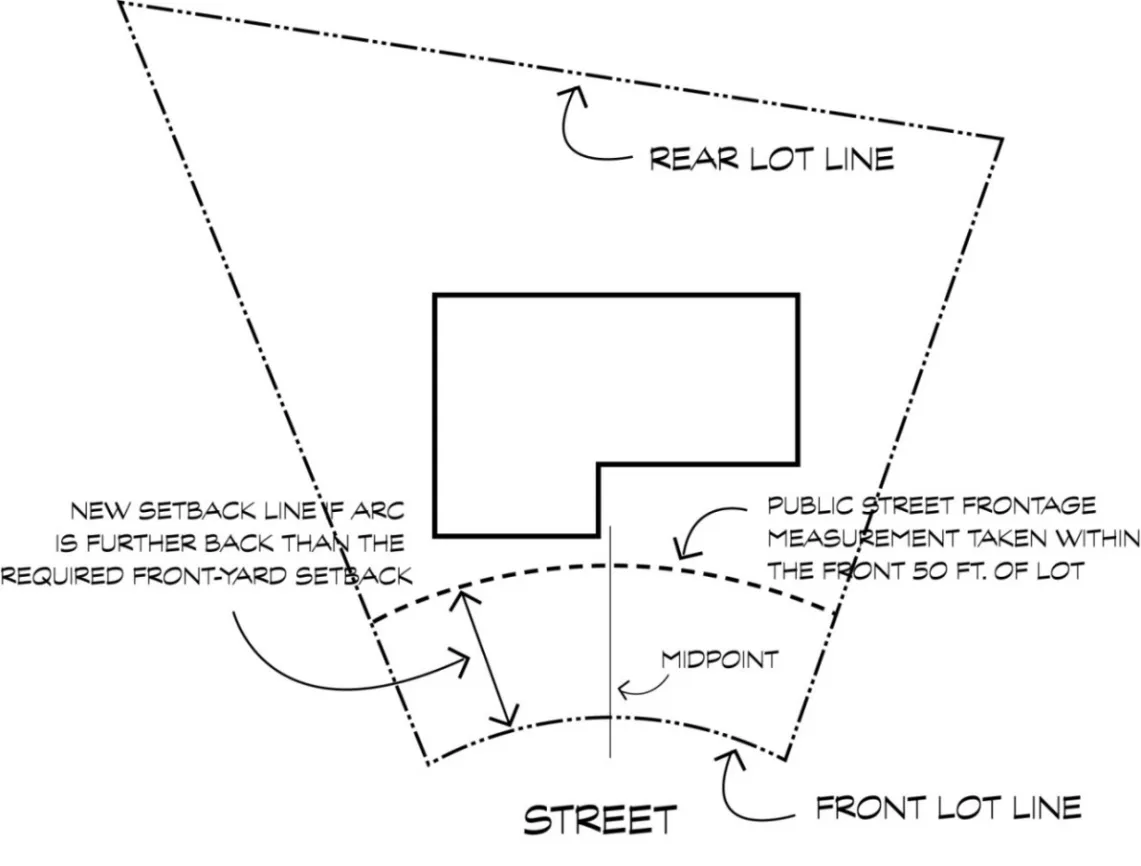
Funeral Establishment
Section titled “Funeral Establishment”A place of business devoted exclusively to activities related to the preparation and arrangements for the funeral, transportation, burial, or other disposition of human dead bodies and including but not limited to:
- A chapel in which memorial, funeral, or religious services may be conducted.
- A preparation room equipped for the preparations and embalming of human dead bodies for burial or transportation.
A funeral establishment does not include a crematory.
Garage, Private
Section titled “Garage, Private”A detached accessory building on the same lot as a dwelling, a portion of a main building, or a carport, for the housing of noncommercial vehicles of the occupants of the dwelling.
Garage, Public
Section titled “Garage, Public”A public garage is any garage other than a private garage.
Garage Sales
Section titled “Garage Sales”The temporary sale of used or unwanted household items that is held in the garage, driveway, or front yard area of a seller’s home.
Garbage
Section titled “Garbage”Garbage includes, but is not limited to, the following: waste resulting from the handling of edible foodstuffs or resulting from decay, and solid or semisolid putrescible wastes, and all other mixed nonrecyclable wastes which are generated in the day-to-day operation of any business, residential, governmental, public or private activity, and may include tin cans, bottles and paper, or plastic food or beverage containers.
General Plan
Section titled “General Plan”The Sacramento County General Plan adopted by the Board of Supervisors on November 9, 2011, and all revisions and amendments thereto.
General Retail Sales (Up to 49,999 square feet)
Section titled “General Retail Sales (Up to 49,999 square feet)”A large retail store or several stores, service facilities, and related uses predominantly commercial, with a maximum gross floor area not to exceed 50,000 square feet and using common facilities such as parking, landscaping, signing, and loading areas, where applicable.
General Retail Sales (50,000 - 350,000 square feet)
Section titled “General Retail Sales (50,000 - 350,000 square feet)”A store, group of stores, service facilities, and related uses predominantly commercial possibly utilizing common facilities such as parking, landscaping, signing, and loading areas. Separate buildings and parcels of land may be considered a part of the shopping center if they are served by mutual parking agreements.
General Retail Sales (> 350,000 square feet)
Section titled “General Retail Sales (> 350,000 square feet)”A shopping center where the gross floor area exceeds 350,000 square feet.
Government and Local Agency Buildings and Uses
Section titled “Government and Local Agency Buildings and Uses”All buildings and uses owned and operated by a public entity, including but not limited to libraries, museums, and community centers.
Grade (Adjacent Ground Elevations) is the lowest point of elevation of the finished surface of the ground between the exterior wall of a building and a point five feet distant from said wall, or the lowest point of elevation on the finished surface of the ground between the exterior wall of a building and the property line if it is less than five feet distant from said wall. In case walls are parallel to and within five feet of a public sidewalk, alley or other public way, the grade shall be the elevation of the sidewalk, alley or public way. In the case of signs, grade is the lowest point of elevation of the finished surface of the ground at the base of the sign, or in the case of a double support, the lowest point of elevation of the finished surface of the ground at the supports. In the case of fences within five feet of a public right-of-way or right-of-way with PUPF, grade is measured from the grade of the right-of-way or right-of-way with the PUPF. Beyond five feet and for fences on interior property lines, grade is measured at the highest point on either side of the fence.
Grade, Existing
Section titled “Grade, Existing”Existing grade shall mean the natural grade in place prior to the preparation of property for development. For individual recorded lots, existing grade shall mean natural grade or the grade established as a part of the development of the subdivision.
Grade Measurement Diagram
Section titled “Grade Measurement Diagram”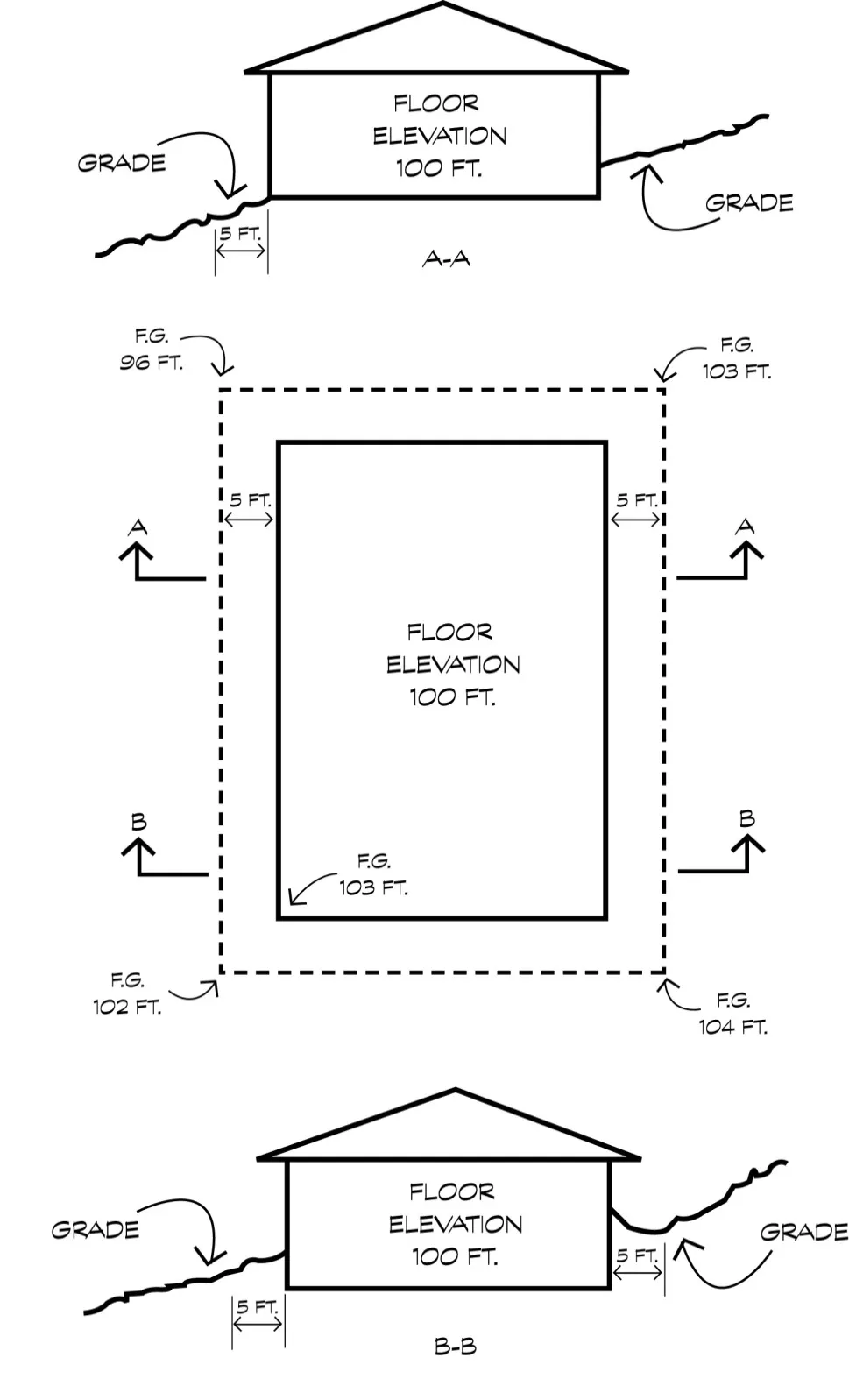
Greenwaste
Section titled “Greenwaste”Organic waste generated by landscape garden or agricultural operations consisting of lawn clippings, tree and shrub prunings, wood, and miscellaneous soil material. This is categorized as material which can be used to process into compost or wood chips for reuse.
Greenwaste Facility
Section titled “Greenwaste Facility”Facility that accepts garden, wood, and other organic waste to reprocess into compost, wood chips, or other products, including the use of power-driven processing equipment. Facilities which receive greenwaste (garden, wood, or other organic waste) for shipment to another facility for reprocessing or composting are included in this type of facility. A greenwaste facility does not include the chipping and grinding of construction and demolition debris.
Guest House
Section titled “Guest House”[ADDED 01-15-2021]
A detached accessory structure that includes conditioned space that is intended for occasional overnight use but does not contain cooking facilities. Occasional overnight use means not more than 10 nights in any calendar month. Guest houses may not be used for short- or long-term rentals and are not considered an independent dwelling unit. Can also be called casitas, pool houses, or studios. Does not include Accessory Dwelling Units or Junior Accessory Dwelling Units.
Gunsmith, Gun Sales/Ammunition Sales
Section titled “Gunsmith, Gun Sales/Ammunition Sales”A place of business that makes, sells, and repairs small firearms, and sells ammunition.
Habitable Area
Section titled “Habitable Area”[ADDED 05-11-2018][AMENDED 01-12-2019]
Areas within a structure, typically a residential occupancy, used for living, sleeping, eating or cooking purposes.
Hazardous Material
Section titled “Hazardous Material”For the purposes of this Code, a hazardous material is any substance, material, or waste for which the filing of a Hazardous Material Disclosure form would be required pursuant to Section 6.96.040, Chapter 6.96, Title 6 of the SCC.
Heavy Equipment
Section titled “Heavy Equipment”Equipment normally utilized in heavy construction projects and includes, but is not limited to: earthmoving equipment, road work and paving equipment, motor graders, bulldozers, rollers, scrapers, earthmovers, cable and hydraulic shovels, trenchers, standing and truck cranes, dump trucks, large tractors, water trucks, cement trucks, front loaders, back hoes, excavators, drilling equipment, pile drivers, compactors, zoom booms, telehandlers, forklifts, platform lifts, generators, conveyors, and any other piece of equipment determined by the Planning Director as belonging to the heavy equipment category. Factors that may affect the Planning Director’s determination may include, but is not limited to: equipment typically move on metal self-laying tracks, machinery primarily designed for excavation or equipment that produces 125 decibels or more when simply operating as designed, and has an operating weight of 15,000 pounds or more.
[ADDED 02-25-2021]
Shall have the same meaning as “Industrial Hemp”.
Hog Farm
Section titled “Hog Farm”Any place where two or more head of swine are maintained, raised, fed, or fattened.
Home Occupation
Section titled “Home Occupation”A use conducted in a dwelling unit that is clearly incidental and subordinate to the use of the dwelling for residential purposes. Such use shall not be considered to be incidental and subordinate unless all of the criteria outlined in the accessory use standard of Section 3.9.3.F, Home Occupation, are met.
Hookah/Smoke/Vape Lounge
Section titled “Hookah/Smoke/Vape Lounge”A place of business that offers smoking from a communal pipe device known as a “hookah” that is typically located at each table, and is used to smoke flavored tobacco or herbal products. Also, includes businesses known as “vape lounges” for the smoking of e-cigarettes.
Hospital
Section titled “Hospital”[AMENDED 06-07-2018]
A health facility other than a facility for persons with mental disabilities having a duly constituted governing body with overall administrative and professional responsibility and having an organized medical staff that provides 24-hour inpatient care including the following basic services: medical, nursing, surgical, anesthesia, laboratory, radiology, pharmacy, dietary services, or psychiatric care and treatment. Hospital shall not include the use of land devoted exclusively to house personnel or private activities not related to hospital patients, such as classrooms, or private physicians’ and other professional offices.
Hospital, Convalescent
Section titled “Hospital, Convalescent”[AMENDED 06-07-2018][AMENDED 06-06-2024]
An institution providing skilled care for the recently hospitalized, or a facility providing skilled nursing care to persons needing care and attention on a 24-hour basis. Included within the definition are the following types of facilities:
-
Nursing or other care for non-ambulatory patients or persons with disabilities requiring nursing services
-
Skilled nursing care facility
-
Nursing home
-
Convalescent home
-
Long-term respite care facility
-
Long-term treatment center for persons with disabilities
-
Group care facility
-
Medically assisted withdrawal (detoxification) facility
Ancillary uses are permitted if subordinate to the primary use of the property and occupying not more than 25 percent of the gross floor area. Ancillary uses include but are not limited to: adult day health care centers, intermediate care facilities, and day treatment centers for persons with disabilities. The term shall not include a Family Day Care Home or Residential Care Home, as defined in this Section.
Hotel, Motel
Section titled “Hotel, Motel”A building designed for occupancy as the more or less temporary place of abode for individuals who are lodged with or without meals, in which there are six or more guest rooms, and in which no provision is made for cooking in the individual rooms or suites provided that an owner or manager may reside in the hotel in an apartment or penthouse with cooking facilities. Swimming pools, fitness centers, business centers, convention facilities, and food service are allowed as ancillary uses when intended to serve guests of the hotel. When such facilities are intended for or marketed to the general public, they shall be ancillary to an allowed primary hotel use.
Housing for Special Needs Groups
Section titled “Housing for Special Needs Groups”[ADDED 09-09-2022]
Housing that is targeted to meet the needs of large households (particularly lower income households) and people with disabilities as may be further defined in the County Housing Element.
Hydrogen Fueling Station
Section titled “Hydrogen Fueling Station”[ADDED 07-11-2024]
The equipment used to store and dispense hydrogen fuel to vehicles according to industry codes and standards that is open to the public, pursuant to CA GOV §65850.7(i)(4). The term shall not include any other structures or uses associated with the development. This definition shall expire on January 1, 2030, unless further extended by CA State statute.
Incidental Agricultural Uses
Section titled “Incidental Agricultural Uses”[AMENDED 02-24-2017]
Row crop cultivation and animal husbandry other than kennels, hog farms, feedlots, and the keeping of pets, provided the activity is conducted on a hobby-type basis for personal use or consumption or for urban agricultural purposes and further provided that such activity is not a primary use of the premises.
Incidental Keeping of Animals
Section titled “Incidental Keeping of Animals”[AMENDED 02-24-2017]
Any animal husbandry activity conducted on a hobby-type basis for personal use or consumption or for urban agricultural purposes other than kennels, hog farms, feedlots, and the keeping of pets; and which is not the primary use of the premises. The keeping of crowing fowl is not included as incidental keeping of animals.
Incidental Retail Sales
Section titled “Incidental Retail Sales”The public sale of goods and services incidental to a permitted primary use. For example, in the case of a permitted industrial use, up to 25 percent of the sales and stockroom area may be devoted to parts sales to the general public.
Incidental Use
Section titled “Incidental Use”A use which is subordinate and of minor consequence to the primary use on the same site and occupies not more than 25 percent of the gross floor area and less than 25 percent of the outdoor storage area.
Industrial Hemp
Section titled “Industrial Hemp”[ADDED 02-25-2021]
Has the same meaning as that term defined in CA FAC §81000.
Industrial-Hemp Cultivation
Section titled “Industrial-Hemp Cultivation”[ADDED 02-25-2021]
Includes any activity involving the propagation, planting, growing, breeding, harvesting, grading, trimming, or other development of industrial hemp plants or propagative plant material. Drying, curing, pressing and other similar post-harvest activities are considered primary processing of agricultural products.
Initial Study
Section titled “Initial Study”A Lead Agency’s preliminary project analysis which is used to: 1) serve as an informational document to be used by the public and by decision makers when making choices about projects; 2) determine whether a project has the potential to cause significant environmental impacts; 3) decide whether an EIR is required; 4) ensure that all potential areas of environmental damage are identified; 5) identify possible appropriate mitigation measures; and 6) assist in the preparation of EIRs by identifying the potential environmental damages upon which an EIR should focus.
Internet Café
Section titled “Internet Café”A place of business that offers a large number of computers with high-speed Internet access to the public, usually for a fee. The business may provide snacks and drinks, and the fee for using a computer is usually charged as a time-based rate. The business may be geared towards multi-player gaming, but generally customers use the computers for access to the Internet or email. May also be known as a “Wi-Fi Café”.
Intersection
Section titled “Intersection”An intersection is the area embraced within the prolongation of the lateral curb lines, or if no curbs, within the prolongation of the boundary lines of two or more streets where any street joins another at an angle regardless of whether the streets cross one another. An intersection may be in the form of an “X”, “T”, “L”, “Y”, or in any other form produced by the joining of one street with another at an angle as set forth herein.
Any worn out, cast off, or discarded article or material which is ready for destruction or has been collected or stored for salvage or conversion to some use. Any article or material which unaltered or unchanged and without further reconditioning, can be used for its original purpose as readily as when new shall not be considered junk.
Junk Tire Handling
Section titled “Junk Tire Handling”The receiving of junk tires with or without a fee for the purpose of storing, shredding, cutting, or splitting them.
Junk Yard, Vehicle/Equipment Wrecking Yard, Scrap or Used Materials Yard
Section titled “Junk Yard, Vehicle/Equipment Wrecking Yard, Scrap or Used Materials Yard”[AMENDED 06-22-2017]
Any lot or portion of a lot used for the wrecking or dismantling of machinery, automobiles or other motor vehicles, or for the storage or keeping for sale of parts and equipment resulting from such dismantling or wrecking, or for the storage or keeping of junk, including scrap metals or other scrap materials, with no burning permitted.
Kennel, Cattery, Small Animal Boarding and Training
Section titled “Kennel, Cattery, Small Animal Boarding and Training”Any lot, building, structure, enclosure, or premises where five or more dogs of four months of age or older are kept for more than five days per year. Any lot, building, structure, enclosure or premises where five or more cats of six months of age or older are kept for more than five days per year. The provision of shelter and care for small animals on a commercial basis including activities (e.g., feeding, exercising, grooming, and incidental medical care).
Kill Floor
Section titled “Kill Floor”A small-scale, customer-oriented operation that provides facilities to persons for the purpose of slaughtering their own animals. Customers may bring their animals to the facility, but more often will purchase an animal at the facility. The animal is killed by trained and licensed personnel and immediately turned over to the customer. Kill floors are licensed and inspected by the State Department of Food and Agriculture under strict performance standards.
Kitchen
Section titled “Kitchen”[ADDED 07-16-2020][AMENDED 01-15-2021]
An area within a dwelling that has noncommercial appliances to cook food, a sink, and sufficient cabinetry and counter space to store and prepare food. Includes Efficiency Kitchen.
Laboratory
Section titled “Laboratory”A facility that provides controlled conditions in which scientific research, experiments, and measurements may be performed.
Landlocked Lot
Section titled “Landlocked Lot”[ADDED 12-01-2017]
A lot that has no direct access to a public street and no deeded access rights across adjacent properties to obtain such access.
Landscaped Area
Section titled “Landscaped Area”An area devoted to soft live landscaping such as lawn, ground cover, trees or shrubs, the area of which is at least the minimum width specified in the applicable zoning district, excluding any perimeter curbing that may be necessary or desired.
Lead Agency
Section titled “Lead Agency”The public agency that has the principle authority for carrying out or approving a development project.
Liquor Store
Section titled “Liquor Store”Any retail business where 50 percent or more of shelf space is dedicated to alcoholic beverages.
Live Theater/Motion Picture Theater
Section titled “Live Theater/Motion Picture Theater”An establishment primarily engaged in providing live theatrical productions or exhibiting motion picture productions that are intended for persons of all ages and that does not emphasize “Specified Sexual Activities.”
Live Work Unit
Section titled “Live Work Unit”A residential occupancy, by a single housekeeping unit, or one or more rooms or floors in a building that includes: 1) cooking space and sanitary facilities in conformance with County building standards; and 2) adequate working space accessible from the living area, reserved for, and regularly used by, one or more persons residing therein.
Loading Docks
Section titled “Loading Docks”A designated loading area with either an elevated platform or recessed driveway area for delivering or pick-up of goods.
Local Agency
Section titled “Local Agency”An agency of the State for the local performance of governmental or proprietary functions within limited boundaries as defined in CA GOV §53090. In the event “Local Agency” as defined in CA GOV §53090 is changed, the definition of Local Agency as used in this Code shall be deemed changed accordingly.
A parcel of land shown on a subdivision map, parcel map, certificate of compliance, or a record of survey map or described by metes and bounds and recorded in the office of the County Recorder of Sacramento County, or a site in one ownership having an area for each main building or use as required in the applicable zoning district and having a frontage upon or access by adequate public easement to a public street, road, or highway.
Lot, Corner
Section titled “Lot, Corner”A lot situated at the intersection of two or more public streets having an angle of intersection of not more than 135 degrees.
Lot, Interior
Section titled “Lot, Interior”A lot other than a corner lot.
Lot, Through
Section titled “Lot, Through”A lot having a frontage on two parallel or approximately parallel streets.
Lot Area, Gross
Section titled “Lot Area, Gross”A gross lot area is the horizontal area within the lines of a lot or parcel including streets, highways, roads, and alleys.
Lot Area, Net
Section titled “Lot Area, Net”[AMENDED 07-16-2020]
Net lot area is the total horizontal net area within the lot lines of a lot or parcel exclusive of existing public and private streets, highways, roads and alleys, or proposed streets and highways as shown on the Circulation Plan, General Plan, or community plan. Private streets do not include access easements (i.e., private drive easements).
Lot Depth
Section titled “Lot Depth”The horizontal distance between the front and rear lot lines measured on the longitudinal center line.
Lot Line, Front
Section titled “Lot Line, Front”In the case of an interior lot, a line separating the lot from the street or place; in the case of a corner lot, a line separating the narrowest street frontage of the lot from the street. In the case of a square, or nearly square shaped corner lot, the owner may choose which street to designate as the front of the lot. Once the choice of frontage has been made, it cannot be changed unless all requirements for yard space are met.
Lot Line, Rear
Section titled “Lot Line, Rear”A lot line which is opposite and most distant from the front lot line and, in case of an irregular, triangular or gore-shaped lot, a line 10 feet in length within the lot, parallel to and at the maximum distance from the front lot line.
Lot Line, Side
Section titled “Lot Line, Side”A lot line that is not a front or rear lot line.
Lot, Width
Section titled “Lot, Width”The horizontal distance between the side lot lines, measured at right angles to the lot depth at a point midway between the front and rear lot lines.
General Yard Area Example
Section titled “General Yard Area Example”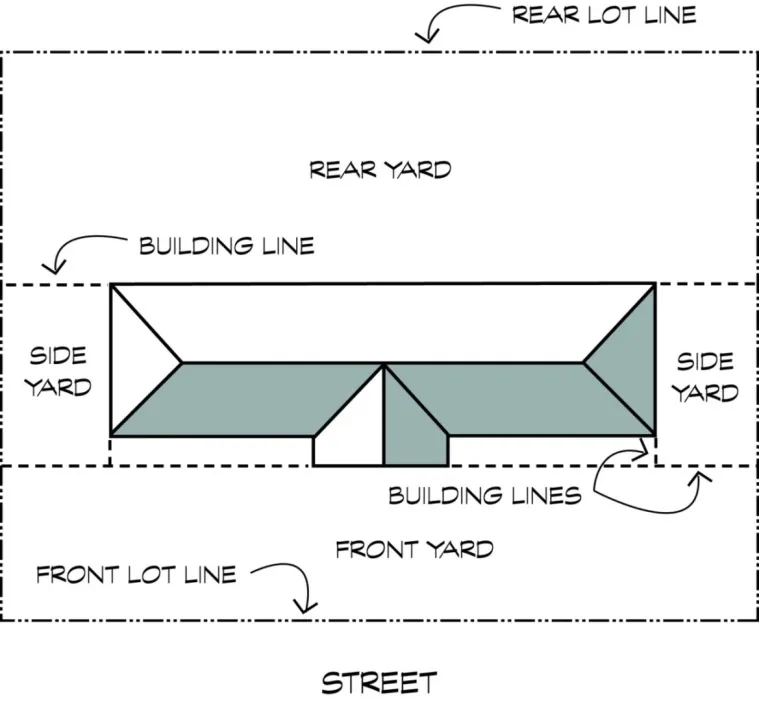
Front Lot Line Example, Corner Lot
Section titled “Front Lot Line Example, Corner Lot”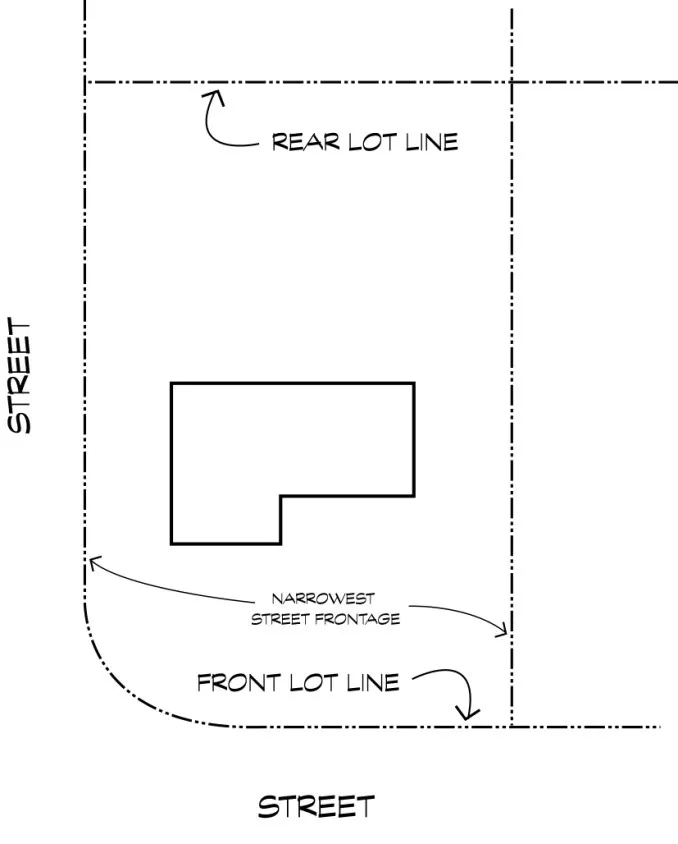
Rear Lot Line Example
Section titled “Rear Lot Line Example”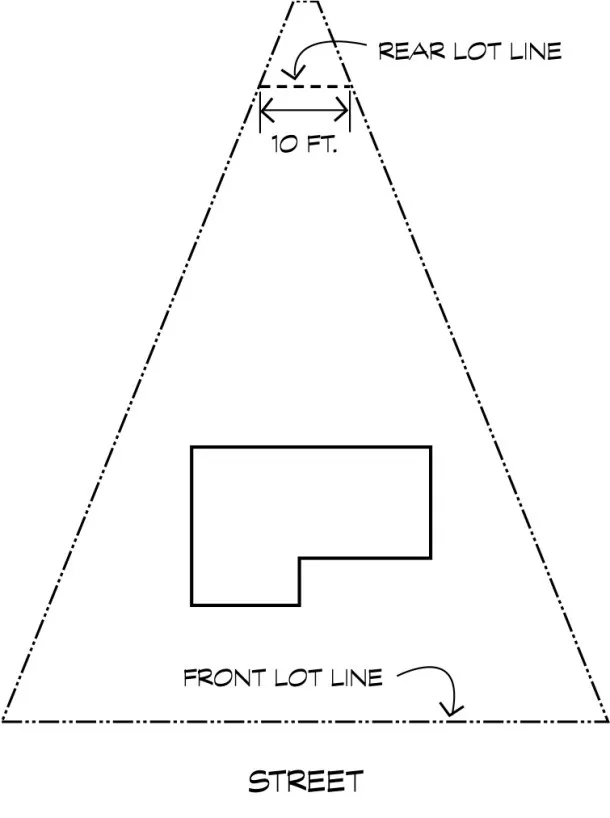
Lot Width Example
Section titled “Lot Width Example”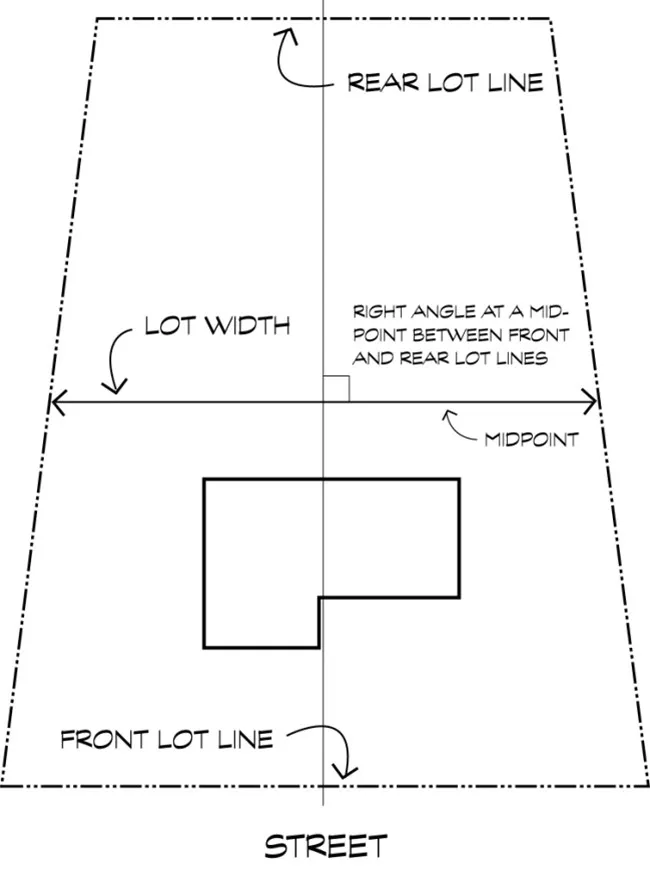
Through Lot Example
Section titled “Through Lot Example”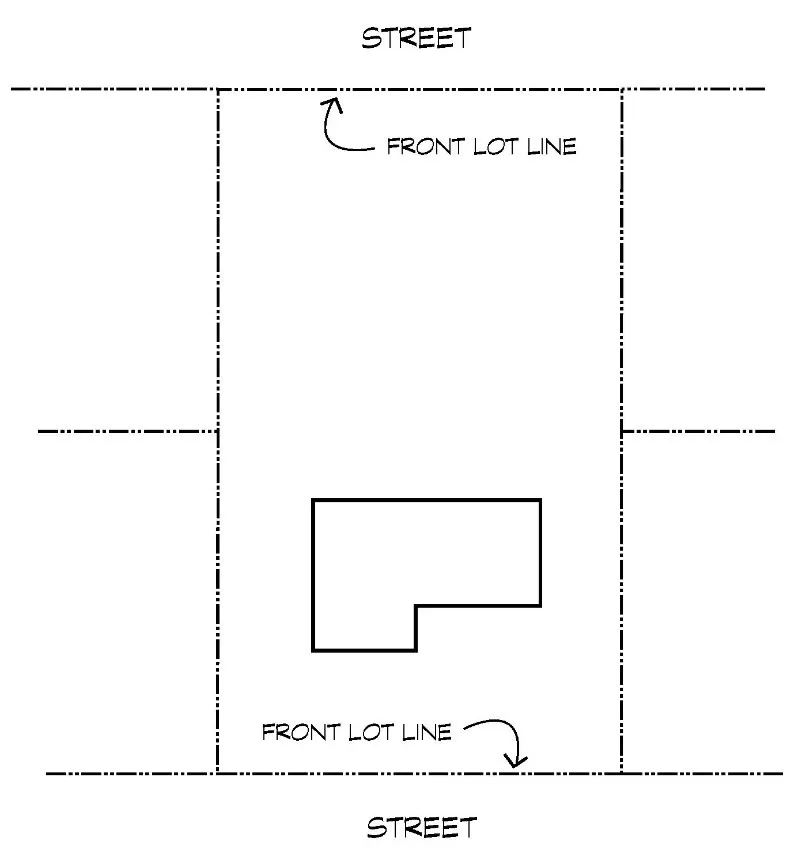
Low Barrier Navigation Center
Section titled “Low Barrier Navigation Center”[ADDED 09-09-2022]
A housing first, low-barrier, service-enriched emergency shelter focused on moving people into permanent housing that provides temporary living facilities while case managers connect individuals experiencing homelessness to income, public benefits, health services, shelter, and housing. “Low Barrier” means best practices to reduce barriers to entry, and may include, but is not limited to, the following: (1) The presence of partners if it is not a population-specific site, such as for survivors of domestic violence or sexual assault, women or youth. (2) Pets. (3) The storage of possessions. (4) Privacy, such as partitions around beds in a dormitory setting or in larger rooms containing more than two beds, or private rooms.
Map, Final Subdivision
Section titled “Map, Final Subdivision”A map prepared by a registered civil engineer or a licensed land surveyor and presented for recording, which conforms to an approved application for a tentative subdivision map and the Subdivision Map Act.
Map, Tentative Parcel
Section titled “Map, Tentative Parcel”A map presented to the advisory agency for approval of land divisions that require a parcel map.
Map, Tentative Subdivision
Section titled “Map, Tentative Subdivision”A map presented to the advisory agency for approval of land divisions that require a final subdivision map.
Map, Tentative Vesting
Section titled “Map, Tentative Vesting”A form of tentative map that, when approved, confers a vested right to proceed for a limited period of time, with development in substantial compliance with the ordinances, policies, and standards that were in effect at the time the application for a vesting map was determined to be complete, or at the time the application was approved.
Marina, Boat Dock, or Launch
Section titled “Marina, Boat Dock, or Launch”A location for boats or other water vessels to be moored or launched for private, public or commercial use.
Market Garden
Section titled “Market Garden”[ADDED 02-24-2017]
A garden established by an individual or group as the primary use of a site for the cultivation of fruit, vegetables, herbs and other produce for sale or donation to the public.
Massage Enterprise
Section titled “Massage Enterprise”[ADDED 07-08-2016]
Any enterprise that offers massage, whether or not at a fixed location. Massage enterprises include, but are not limited to, massage establishments, out-call massage services, home occupations, and independent contractors offering massage services for pecuniary compensation, consideration, hire or reward.
Massage Establishments
Section titled “Massage Establishments”[AMENDED 07-08-2016]
Any enterprise at a fixed location that offers massage, except for home occupations.
Ministerial Action
Section titled “Ministerial Action”Approvals which involve the use of fixed standards or objective measures without requiring the use of personal or professional judgment; e.g. issuance of building permits and licenses, approval of final subdivision or parcel maps, and individual utility service connection sign-offs.
Minor Use Permit
Section titled “Minor Use Permit”Minor Use Permits typically have less impact on adjacent properties than a Conditional Use Permit, require less intensive review, and may be approved by planning staff, upon compliance with staff recommendations and conditions for approval. Unlike a Conditional Use Permit, Minor Use Permits do not require a public hearing.
Mitigation Measures
Section titled “Mitigation Measures”Measures included in a proposed development project’s Environmental Impact Report that reduce or eliminate that project’s significant environmental effects.
Mitigation Monitoring and Reporting Program (MMRP)
Section titled “Mitigation Monitoring and Reporting Program (MMRP)”A program designed to ensure that the adopted environmental mitigation measures are actually completed.
Mixed Use
Section titled “Mixed Use”A variety of residential, commercial, and office uses typically associated with or along a transit corridor. Mixed-use development specifically calls for higher intensity uses along transit lines and to be consistent with Transit-Oriented Design Guidelines for Sacramento County.
Mobile/Manufactured Home
Section titled “Mobile/Manufactured Home”-
A structure, constructed on or after June 15, 1976, transportable in one or more sections, that in the traveling mode is eight or more feet in body width or 40 feet in body length, or that when erected is 320 or more square feet in area and is built on a permanent chassis and is designed to be used as a dwelling with or without a foundation system when connected to the required utilities, and that contains required plumbing, heating, air conditioning, and electrical systems. This structure is known as a “Manufactured Home.”
-
A structure that was built prior to June 15, 1976 that meets all other provisions listed in the first bullet is known as a “Mobilehome.” The terms “mobilehome” and “manufactured home” are synonymous as they relate to land use and differ by the year in which they were built (i.e. pre- or post-June 15, 1976) and the type of permanent HUD label (United States Department of Housing and Urban Development) required.
-
A “Manufactured Home” or “Mobilehome” does not include commercial modulars, factory-built housing (or modular housing), or recreational vehicles.
-
A “doublewide” mobile home is a mobile home that is built and transported in two or more sections on separate chassis and is designed to be joined together at the point of use to form a single dwelling.
Mobile Home Park
Section titled “Mobile Home Park”A subdivision of plots designed for siting of mobile homes. Plots are generally rented or leased to mobile home owners and include water hookups and sewage disposal for each home. Mobile home parks typically contain all utilities, streets, parking and amenities such as swimming pools and clubhouses. Mobile-home parks may also be called trailer parks.
Multifamily Project
Section titled “Multifamily Project”[ADDED 07-16-2020]
A development that includes three or more dwelling units of any type on one lot.
Natural Amenities
Section titled “Natural Amenities”Naturally occurring features such as native oaks, rock outcroppings, ponds, marshes, and other riparian vegetation.
Negative Declaration
Section titled “Negative Declaration”An environmental document that states that after an initial study, a proposed development project shows no significant environmental effects or, in light of potential substantial effects, the project has been revised to mitigate substantial effects and that the new revised project does not substantially affect the environment. A negative declaration entails that an Environmental Impact Report is not required.
Neighborhood Convenience Store
Section titled “Neighborhood Convenience Store”A market with a sales area of up to 6,000 square feet, frequently located near residential development, that offers a limited variety of food, household, and sundry items and that is operated primarily for the convenience of the walk-in shopper or someone purchasing just a few items, perhaps during the hours before or after larger facilities are open for business.
Nightclub
Section titled “Nightclub”An establishment typically open late at night, offering live music, dancing, alcohol, and sometimes serving food.
Nonconformance
Section titled “Nonconformance”Failure of a use, structure, lot, sign, or similar, which may have conformed to existing regulations when established, created, or developed, to conform to the current provisions and regulations of the Code.
Non-Profit Organization
Section titled “Non-Profit Organization”[ADDED 06-22-2017]
Any organization, unincorporated association or other entity created for charitable, philanthropic, educational, character building, political, social or other similar purposes, the net proceeds from operations of which are committed to promotion of the objects or purposes of the organization and not to private gain, together with any person charge with the responsibility of controlling conduct in behalf of the organization upon any premises regulated by the provisions of this chapter.
Notice of Completion
Section titled “Notice of Completion”A notice filed with the State Office of Planning and Research which states that a Draft EIR has been issued and that copies were being distributed for public review.
Notice of Determination (NOD)
Section titled “Notice of Determination (NOD)”A notice filed with the County Clerk (and the State Clearinghouse when appropriate) which: 1) describes a project; 2) identifies expected environmental impacts, if any; 3) states the type of environmental determination which was made; 4) indicates if Department of Fish and Game fees are required (“de minimis” finding) and 5) includes copies of Findings of Fact and a Statement of Overriding Considerations where appropriate. Filing of the Notice of Determination starts a 30-day period for legal challenge.
Notice of Exemption (NOE)
Section titled “Notice of Exemption (NOE)”A brief notice, filed at the County Clerk’s office, which states the Lead Agency has approved or will carry out a project that is exempt from the requirements of CEQA.
Notice of Intent (NOI)
Section titled “Notice of Intent (NOI)”The method for informing the public that an agency intends to adopt a Negative Declaration or Mitigated Negative Declaration for a project, and that such Negative Declaration or Mitigated Negative Declaration is available for public review and comment.
Notice of Preparation (NOP)
Section titled “Notice of Preparation (NOP)”A notice sent to public agencies and interested parties which informs them of the intent to: 1) prepare an EIR; 2) solicit comments and advice regarding what they believe the future EIR should address.
Nursery (horticulture)
Section titled “Nursery (horticulture)”[ADDED 02-25-2021]
An establishment for the growth, display, and/or sale of plants, shrubs, trees, and accessory items used in indoor or outdoor planting, conducted within an enclosed building or outdoors. Includes establishments for the development and production of seeds. Industrial hemp nurseries are restricted to wholesale establishments.
Nursery Stock
Section titled “Nursery Stock”[ADDED 02-25-2021]
Any plant for planting, propagation, or ornamentation and as defined by CA FAC§5005.
Office Uses, General
Section titled “Office Uses, General”Includes but is not limited to such office-based business uses as accountants, bookkeepers, collection, computer programing, counseling, personnel, insurance, public relations, advertising, real estate, dating services, interior decorator, building trades contractors office, travel or ticket agency, or other business or professional offices having the same general characteristics. Also includes medical, dental, or optical offices or clinics. These are facilities under the supervision of one or more licensed medical professionals providing diagnosis and treatment of outpatients. Examples include but are not limited to: acupuncture clinic or office, orthopedic appliance sales and service, optician, corrective eyewear sales and service, hearing aids sales and service, counseling clinic, diet clinic, kidney dialysis clinic, physical therapy clinic, dental appliance laboratory, physician, dentist, orthodontist, etc.
Outdoor Merchandise Display
Section titled “Outdoor Merchandise Display”[AMENDED 01-12-2019]
An outdoor arrangement of objects, items, products or other materials, typically not in a fixed position and capable of rearrangement, for the purpose of advertising products available for sale on site.
Parcel
Section titled “Parcel”An area or tract of land assigned a separate parcel number and shown as a separate unit of property on the Assessment Roll of Sacramento County.
Parking Area, Off-Street
Section titled “Parking Area, Off-Street”An area, building, or space exclusive of street or alley rights-of-way, used for the parking of automobiles.
Parking Area, Public
Section titled “Parking Area, Public”An off-street parking area, publicly or privately owned, for public use whether free, for compensation, or as an accommodation for clients or customers.
Parking Garage or Lot
Section titled “Parking Garage or Lot”A building or surface area lot used to comply with minimum off-street parking requirements, including spaces, aisles, and driveways but, where automotive vehicles may be stored whether free, for compensation, or as an accommodation for clients or customers for the purposes of temporary, daily, or overnight off-street parking.
Parking Space
Section titled “Parking Space”Space in the open or within a structure designed for the parking of one automobile.
Pawn Shop
Section titled “Pawn Shop”An establishment wherein the business of a pawnbroker is conducted. A pawnbroker shall be any person who lends or advances money or other things for profit on the pledge and possession of personal property, or other valuable things, other than securities or written or printed evidences of indebtedness; or, who deals in the purchasing of personal property or other valuable things on condition of selling the same back to the seller at a stipulated price.
Payday Loan, Check Cashing
Section titled “Payday Loan, Check Cashing”A place of business that offers deferred deposit transaction services (short-term loans intended to cover a borrower’s expenses until their next payday) and check cashing services that charge a percentage fee for cashing a check.
Personal Services, General
Section titled “Personal Services, General”A place of business providing non-medical, personal care to individuals as a primary use. Examples include but are not limited to electrolysis; dressmaker; wig sales and service; laundromat, self-service; laundry or cleaning agency, retail (on-site cleaning permitted); laundry or cleaning pickup station; tailor; shoe shine parlor; photography studio, including incidental processing; picture framing shop; art studios; and jewelry repair. The use may also include accessory retail sales of products related to the services provided.
Any domesticated animal which is kept for pleasure, rather than utility or sale, in a cage, terrarium, aquarium, or other confinement within a primary dwelling; or, any fish or amphibian which is kept in a pond for pleasure, rather than utility or sale; or, any domestic dog (canis familiaris) or domestic cat (felis catus) kept or generally housed on property.
Place of Worship or other Religious Institution
Section titled “Place of Worship or other Religious Institution”A permanently located building, commonly used for religious worship and associated activities, excluding daily private schools, and includes incidental retail uses not to exceed 20 percent of the square footage devoted to the primary use. Includes short-term shelters as incidental use.
Planning Commission
Section titled “Planning Commission”As used in this Code, the term Planning Commission shall mean the Sacramento County Planning Commission.
Planning Director
Section titled “Planning Director”[AMENDED 12-01-2017]
Planning Director shall mean the Director of Planning and Environmental Review of Sacramento County or their designee.
Primary Processing of Agricultural Products
Section titled “Primary Processing of Agricultural Products”[AMENDED 02-25-2021]
The act of changing or preparing an agricultural commodity, subsequent to its harvest or in its natural mature state to the initial stage of processing in order to prepare it for market or further processing at an off-site location. Examples of primary processing include drying, curing, pressing, crushing, extracting, sorting, nut hulling and shelling, grading of livestock or agricultural products, primary processing of fruits to juice and initial storage of the juice without fermentation, and cleaning and packing of agricultural products for shipment. Primary processing does not include smoking of fish or meat, canneries, mills, food processing, light or heavy processing into non-food commodities (see assembly, manufacturing, and processing), refineries, feedlots, kill floors, or other similar uses.
Private Garden
Section titled “Private Garden”[ADDED 02-24-2017]
A garden established for the cultivation of produce and/or the incidental keeping of animals, on an occupied parcel, accessory to a permitted residential or commercial use.
Private Social Center, Social Club, Fraternal Hall/Lodge
Section titled “Private Social Center, Social Club, Fraternal Hall/Lodge”[AMENDED 12-01-2017]
Facilities used for individuals to meet and socialize for mutual aid or benefit, those individuals being members of a common social, service, or fraternal organization. Examples include but are not limited to: labor union hall, Elks lodge, and social center.
Processor
Section titled “Processor”[ADDED 02-25-2021]
The business of processing or manufacturing hemp, that solicits, buys, contracts to buy, or otherwise takes title to, or possession or control of, any hemp from its cultivator for the purpose of processing or manufacturing it and selling, reselling, or redelivering it in any dried, canned, extracted, fermented, distilled, frozen, eviscerated, or other preserved or processed form.
Produce
Section titled “Produce”[ADDED 02-24-2017]
Any food in its raw or natural state which is in such form as to indicate that is intended for consumer use with or without any or further processing.
Project Review Committee or PRC
Section titled “Project Review Committee or PRC”A committee composed of representatives of various departments and public services providers that reviews and approves development proposals, tentative parcel boundary line adjustment, and development and entitlement applications for completeness.
Promotional Sales and Display
Section titled “Promotional Sales and Display”The temporary display of merchandise and products, or any activity that is intended to promote the permitted primary use, including outdoor tent sales, amusement rides, street dances, concerts, and live entertainment.
Property Owner
Section titled “Property Owner”A person or persons with a possessory interest in the property, other than a periodic tenancy, estate at will, or sufferance, or a person with a contractual right that will ripen into a possessory interest in the property.
Proximity to Transit
Section titled “Proximity to Transit”[ADDED 09-09-2022]
Transit-supportive projects or uses located within a one-quarter mile of a transit station or stop along a light rail line, bus rapid transit line, or other trunk line providing high frequency bus service with 20-minute or better headways, which is either in existing service, under construction, or planned for service as identified in Regional Transit’s Short-Range Transit Plan Ten Year Capital Program of Projects.
Psychiatric Facility, Social Rehabilitation Center
Section titled “Psychiatric Facility, Social Rehabilitation Center”[DELETED 06-06-2024]
See Behavioral Health Center
Public Auction, Flea Market
Section titled “Public Auction, Flea Market”A public sale in which property or items of merchandise are sold to the highest bidder; or an open air area not enclosed in a building where space is rented, leased to, or used by one or more vendors of new or used merchandise.
Public Hearing
Section titled “Public Hearing”A meeting called by a public body for which public notice has been given and that is held in a place at which the public may attend to hear issues and to express opinions.
Public Utility, Public Service Facility, Major
Section titled “Public Utility, Public Service Facility, Major”Generating plants, electrical substations, above ground electrical transmission lines, refuse collection or disposal facilities, water reservoirs, water or wastewater treatment plants, and similar facilities of public agencies or public utilities.
Public Utility, Public Service Facility, Minor
Section titled “Public Utility, Public Service Facility, Minor”A utility facility that is necessary to support a legally established use and involves only minor structures (e.g., electrical distribution lines).
Public Utilities and Public Facilities Easement or PUPF
Section titled “Public Utilities and Public Facilities Easement or PUPF”The easement for Public Utilities and Public Facilities (PUPF) combines the landscape buffer (adjacent to curb), sidewalk, and utility easement, outside of the street right-of-way. Refer to the County Street Improvement Standards for additional criteria.
Race Track
Section titled “Race Track”A public or private recreation facility constructed for the racing of animals, vehicles or athletes, and which may contain grandstands, concourses or other support facilities.
Recreation Facility, Indoor
Section titled “Recreation Facility, Indoor”A facility that is open to the general public for recreation activities, including but not limited to: bingo, schools and training facilities for self-defense, judo, boxing, and swimming; soccer; laser tag; physical fitness and body reducing or building studios; dance ballrooms; studios for dance, voice, music, gymnastics, aerobics; and charm or culture schools.
Recreation Facility, Outdoor
Section titled “Recreation Facility, Outdoor”A facility that is open to members of the public, including groups, clubs, leagues, and organizations, that may or may not involve admission charges or compensation. The facility normally has boundaries and structures and is designed to comply with guidelines for a recreational activity. This use includes outdoor concerts, paint ball facilities and golf courses.
-
An outdoor recreation facility includes activities that may generate excessive noise, dust, traffic, and parking not normally associated with the permitted uses in the zoning district. Included are soccer, baseball, football, and similar activities when conducted as set forth above.
-
Any use of constructed facilities for private or public motorized sports, such as water-skiing, motor cross, and go carts, is considered an outdoor recreation facility. Motorized vehicles used strictly for agricultural purposes are not considered an outdoor recreation facility.
-
Personal recreational uses, clearly incidental to a residential use, such as one basketball stand, one volleyball court, one tennis court, one badminton net, and similar uses are not considered outdoor recreation facilities as defined in this Section.
Recreational Vehicle Park, Travel Trailer Park
Section titled “Recreational Vehicle Park, Travel Trailer Park”Any parcel, tract, or area of land that is rented, leased, or offered for rent or lease to owners or users of recreational vehicles for temporary occupancy. The presence of any one vehicle in the park shall be limited to a period not to exceed 180 days in any one-year period. In general, these types of parks provide more intensive infrastructure such as sewer hookups.
Recycling Facility
Section titled “Recycling Facility”A business that accepts by donation or purchase, recyclable materials from the general public, other recycling facilities, local government agencies, and other business enterprises. The facility is used for the collection, sorting, short-term storage, cleansing, treating, and reconstitution of recyclable materials that would otherwise become solid waste, and returning them to the economic mainstream in the form of raw material for new, reused, or reconstituted products which meet the quality standards necessary to be used in the marketplace. A recycling facility includes “Recycling Center” activities as defined in CA PRC §40180 and Title 14 CCR, Article 5.9 and 6.0 that are excluded from regulation as solid waste facilities, with the exception of Construction and Demolition wood chipping and grinding operations. A recycling facility is not a greenwaste or solid waste facility and does not accept material that is not source separated and separated for reuse, or contains more than 10 percent residual material or one percent putrescible material.
Recycling Facility, Convenience
Section titled “Recycling Facility, Convenience”A convenience recycling facility is a recycling facility located in a convenience zone as defined and certified by the California Department of Conservation under the California Beverage Container Recycling and Litter Reduction Act (CA PRC §14500 et seq.). Only cans, bottles, and plastic containers and other containers and material identified or adopted under the CA PRC §14500 et seq. are accepted at a convenience recycling facility.
Recycling Facility, Major
Section titled “Recycling Facility, Major”A major recycling facility is a facility with an operation receiving/processing 50 tons or more of material per day; or that stores on-site stockpiled material of 5,000 tons or more; or that receives more than 50 truck trips per day; or with a site area that exceeds three acres. A major facility does not include operations that are completely indoors. A major facility is not a greenwaste facility or a solid waste facility.
Recycling Facility, Minor
Section titled “Recycling Facility, Minor”A minor recycling facility is a recycling facility that is conducted completely indoors or involving outdoor operations with materials stored in containers located in a fenced yard, and that is otherwise not a major recycling facility, is not a convenience recycling facility, a greenwaste facility, a solid waste facility or a wood chipping and grinding operation.
Recyclable Material
Section titled “Recyclable Material”Recyclable material means reusable material, including without limitation metals, glass, plastic, paper, concrete and organic material which is intended for reuse, remanufacture, or reconstitution for the purpose of using the altered form. Recyclable material does not include refuse or hazardous material.
Rehabilitation Center
Section titled “Rehabilitation Center”[AMENDED 12-01-2017][AMENDED 06-06-2024]
An institution that provides services or training, often in a group setting, to persons with disabilities who temporarily need assistance, guidance, or counseling for physical, emotional, social, and vocational rehabilitation, whether on a short-term (90 days or less) inpatient or an outpatient basis. Included within the definition are facilities that provide one or more of the following services:
-
Short-term rehabilitation for people with disabilities
-
Day Programs (training and activity centers) - clients are typically on-site for several hours at a time, a variety of activities are provided, and a mix of group and individual activities occur to assist clients in their rehabilitation.
-
Short-term Respite Care
-
Short-term Inpatient and/or Outpatient Medically Assisted Withdrawal (Detoxification) Center
-
Short-term Inpatient Psychiatric and/or Substance Use Treatment Services
For long-term care services, see Behavioral Health Center and Hospital, Convalescent.
Remote Teller
Section titled “Remote Teller”A facility separated from the main structure but located on the same or a separate parcel of property, where one can conduct financial or other business transactions through the use of computer or other electronic or similar transmission means. The remote teller may be oriented for either pedestrian or auto access.
Repair Services, General
Section titled “Repair Services, General”A place of business providing repair or maintenance services. This use does not include the maintenance and repair of vehicles.
Residential Care Home
Section titled “Residential Care Home”[AMENDED 12-01-2017][AMENDED 09-09-2022][AMENDED 06-06-2024]
A dwelling that is residential in character, as defined in this Section, and that provides 24-hour, non-medical care for up to 20 individuals where permitted, in need of personal services, supervision, or assistance that is essential for sustaining the activities of daily living or for the protection of the individual. Includes the following types of facilities, unless by nature of the facilities or services provided and as determined by the Planning Director, the use more closely meets the definition of a Congregate Care Facility, Convalescent Hospital, or other social care use:
-
Foster Family Homes
-
Group Homes
-
Adult Residential Facilities for adults who are unable to provide for their own needs, including those with disabilities.
-
Care homes for the chronically ill
-
Care homes for the elderly
-
Sober-living facilities where 24-hour on-site supervision is provided and sobriety/recovery is a requirement. The residents participate in recovery services (on or off-site) as necessary to maintain sobriety/recovery, such as, but not limited to, group counseling sessions, individual counseling sessions, and/or recovery/treatment planning.
-
Any other facility that is residential in character and is licensed by the State of California with the following exception: facilities with over six residents that provide any amount of more intensive medical care, including but not limited to extensive skilled nursing services, memory care, or medically assisted withdrawal (detoxification) services, are defined as Convalescent Hospitals or Rehabilitation Centers.
Residential In Character
Section titled “Residential In Character”[ADDED 06-06-2024]
When located in the AG, AR, and low-density single-family (RD-1 through RD-10) zoning districts, residential character is comprised of the following use and scale/intensity:
-
Use: The site shall be developed with a primary dwelling, as defined in this Section, and may also include permitted residential accessory structures and uses. These uses shall not generate vehicular traffic beyond what is normal in a residential district (10 vehicle trips per day and in no case exceed 16 trips per day, including residents, employees, and visitors). Use of the property shall be private and not open to the public.
-
Scale and Intensity: The primary dwelling is similar in scale to other dwellings within 500 feet of the site. The number of residents and caregivers does not require more than five parking spaces consistent with residential paving and parking standards.
Resort
Section titled “Resort”A place providing recreation and entertainment for vacationers.
Responsible Agency
Section titled “Responsible Agency”A public agency which proposes to carry out or approve a project for which a Lead Agency has prepared an EIR or Negative Declaration. The term refers to any agency that has discretionary approval authority over any portion of a project not governed by the Lead Agency.
Restaurant, Carry-out/Sit-down
Section titled “Restaurant, Carry-out/Sit-down”An establishment where food and drink are prepared, served, and consumed primarily within the principal building. A restaurant use may or may not have within its premises a bar for the sale of alcoholic beverages for on-site consumption. Reference “bona fide public eating place,” as defined in CA BPC §2303. Does not include industrial or wholesale food production. Types of sit-down restaurants include but are not limited to coffee shop, café, cafeteria, delicatessen, ice cream parlor, pastry shop, soda fountain. A carry-out or drive-through restaurant is any establishment where ready-to-eat food, primarily intended for immediate consumption, is available upon a short waiting time and packaged or presented so that it can be readily eaten outside or inside the premises, including but not limited to fast food restaurants and donut shops. A drive-thru window to serve customers in motor vehicles or while parked may be a part of the restaurant operation.
Rezone
Section titled “Rezone”A change of zoning.
Riding Stable, Corral
Section titled “Riding Stable, Corral”A building, structure, or parcel occupied or used for the keeping, training, or pasturing of six or more horses not belonging to the owner, or where six or more horses are kept for hire or sale or kept as a business with the intention of gain or profit; or a riding stable or academy.
Right-of-Way Line
Section titled “Right-of-Way Line”The right-of-way line of any highway or streets as shown on the current Master Plan for Streets and Highways, or Street Improvement Standards (see also “Right-of-Way, Public”), as adopted by the Board of Supervisors.
Right-of-Way, Public
Section titled “Right-of-Way, Public”That portion of real property granted to the County to utilize said property for public street purposes. This grant includes the right for use by public utilities. The right-of-way is administered by Sacramento County Department of Transportation.
Right-of-Way, Public with Public Utilities and Public Facilities
Section titled “Right-of-Way, Public with Public Utilities and Public Facilities”A public right-of-way that includes Public Utilities and Public Facilities (PUPF). The easement for PUPF combines the landscape buffer (adjacent to curb), sidewalk, and utility easement, outside of the street right-of-way. Refer to the County Street Improvement Standards for additional criteria.
Roadside Crop Sales
Section titled “Roadside Crop Sales”Roadside sale of fresh vegetables, fruits, nuts, and other agricultural crops grown on the premises or off site.
Agricultural Market
Section titled “Agricultural Market”A market located within a permanent building, which sells eggs, locally grown crops, a limited amount of non-potentially hazardous prepackaged food, and agricultural and food preparation related items.
Community Event (Field Retail Stand, Farm Stand, Produce Stand, and Agricultural Market)
Section titled “Community Event (Field Retail Stand, Farm Stand, Produce Stand, and Agricultural Market)”A community event that is of a civic, political, public, or educational nature that is held on the premises of a field retail stand, farm stand, produce stand, or agricultural market and that may include additional booths.
Farm Stand
Section titled “Farm Stand”A field retail stand that sells eggs, crops grown by the producer on premises controlled by the producer, a limited amount of non-potentially hazardous prepackaged food, and food preparation related items.
Field Retail Stand
Section titled “Field Retail Stand”A retail stand that sells only shell eggs, crops grown by the producer on premises controlled by the producer and food preparation related items.
Non-Potentially Hazardous Food
Section titled “Non-Potentially Hazardous Food”A food that does not require time or temperature control to limit pathogenic micro-organism growth or toxin formation.
Prepackaged Food
Section titled “Prepackaged Food”Any properly labeled processed food, prepackaged to prevent any direct human contact with the food product under distribution from the manufacturer, food facility, or other approved source.
Produce Stand
Section titled “Produce Stand”A retail stand, located within a permanent building, which sells eggs, locally grown crops and food preparation related items.
Rubbish
Section titled “Rubbish”Rubbish includes, but is not limited to, all non-putrescible wastes such as paper, cardboard, grass clippings, tree or shrub trimmings, wood, bedding, crockery, construction waste, and similar waste materials.
Sanitary Sewer Facility, Public
Section titled “Sanitary Sewer Facility, Public”A sanitary sewerage facility provided by a government agency.
Scattered Shelter
Section titled “Scattered Shelter”[ADDED 06-06-2024]
Small-scale temporary shelter for individuals and their families that is residential in character, as defined in this Section, and operated by a shelter program. Clients of the shelter are assigned through a placement process, are provided on- or off-site supportive services, have regular contact with and receive oversight from program staff, and have 24-hour support available to them. Clients do not have leases or gain tenancy while participating in the program. Scattered shelters typically exist as an alternative to large-scale emergency shelters.
Scenic Corridor
Section titled “Scenic Corridor”A strip of land on each side of a stream or roadway which is generally visible to the public traveling on such route. The scenic corridor for a freeway shall include a horizontal distance of 1,000 feet from the center of the freeway. The scenic corridor for a scenic highway or scenic country route shall include a horizontal distance of 500 feet on each side of the center line with a minimum distance of 300 feet beyond the right-of-way or the edge of the stream. A Scenic Corridor is the same as a Special Sign Corridor.
Scenic County Route
Section titled “Scenic County Route”A County road, State highway, or navigable river which is part of a scenic travel system within Sacramento County and so designated by the Board of Supervisors.
Scenic Highway
Section titled “Scenic Highway”A highway so designated by the State of California, pursuant to provisions of the CA SHC.
School, K-12, Public
Section titled “School, K-12, Public”An educational institution serving the public and comprised of the following divisions:
Elementary School
Section titled “Elementary School”A school, providing instruction for kindergarten through eighth grade.
Junior High School
Section titled “Junior High School”Any public or private school, other than a trade school, where instruction is given in the sixth through the ninth grades, inclusive, or in any one of grades seven, eight, or nine.
High School
Section titled “High School”Any public or private school, other than a trade school, in which instruction is given in the ninth through twelfth grades, inclusive, or in any one of such grades.
School, Private
Section titled “School, Private”A privately operated educational institution for instruction of business, trade, or vocational school for adults offering instruction in business skills such as clerical, bookkeeping, stenographic, office, and data processing machine or computer skills, including a college or university offering instruction beyond the secondary level when instruction focuses on business, management, administration, and similar fields and where instruction is provided in an office like setting; or a school offering instruction in technical, commercial, or trade skills, such as electronic, automotive, and aircraft technician schools; or a school offering instruction in vocations including, but not limited to, medical, dental, and animal health technicians, barbers, and beauty operators.
Seasonal Sales and Display
Section titled “Seasonal Sales and Display”Any temporary business of selling, displaying and/or delivering goods, merchandise, or service upon any street, sidewalk, or private ground, conducted for seasonal purposes for, or in advance of specific holidays, including the seasonal display of flowers, pumpkins, and Christmas trees at permitted primary retail uses.
Secretary
Section titled “Secretary”Secretary shall mean the Secretary of the Sacramento County Planning Commission.
Self-Service Laundromat
Section titled “Self-Service Laundromat”A business establishment with washing and drying machines operated by coins, where articles of clothing may be washed and dried by the customer, and which may include accessory uses by the operator.
Sensitive Receptor
Section titled “Sensitive Receptor”[ADDED 02-25-2021]
A facility or land use that serves or attracts members of a population who are particularly sensitive to the effects of air pollutants or strong odors, such as children, the elderly, and people with illnesses. Sensitive receptors include, but are not limited to, hospitals, convalescent facilities providing 24-hour care, senior living facilities (excluding small residential care homes), places of worship, child daycare centers, private and public K-12 schools, youth-oriented facilities, afterschool programs, parks, sports complexes, etc.
Separated for Reuse
Section titled “Separated for Reuse”Materials including commingled recyclables that have been separated or kept separate from the solid waste stream for the purpose of additional sorting or processing those materials for recycling or reuse in order to return them to the economic mainstream in the form of raw material for new, reused, or reconstituted products which meet the quality standards necessary to be used in the marketplace, and includes materials that have been source separated.
Service Yard, Workshop
Section titled “Service Yard, Workshop”Any building or premises used for the office, storage yard, or maintenance shop or garage for a service use, including but not limited to, service yards for contractor or building trades, gardening or landscaping business, billboard sign agency, and similar.
Setback, Applicability
Section titled “Setback, Applicability”The minimum required distance between any structure and a specified line such as a lot, public or private right-of-way, easement, future street right-of-way as identified through an official control or buffer line that is required to remain free of structures unless otherwise provided herein.
Setback, Building
Section titled “Setback, Building”The minimum required distance between any structure and a specified line such as a lot, public or private right-of-way, easement, future street right-of-way as identified through an official control or buffer line that is required to remain free of structures unless otherwise provided herein.
Short-Term Rental
Section titled “Short-Term Rental”[ADDED 06-20-2019][AMENDED 07-11-2024]
Rental of all or a portion of a primary dwelling or of an accessory dwelling unit (that was legally permitted prior to January 1, 2020) for transient occupancy. Transient Occupancy is defined as the use of any room or rooms for lodging or sleeping purposes for a period of time not to exceed 29 consecutive days per stay. Short-term rentals may occur year-round, but are limited to no more than 29 total days per rental party per year. Short-term rental differs from a bed and breakfast inn in that the short-term rental is limited to one rental party at a time.
Side Street Frontage, Public
Section titled “Side Street Frontage, Public”[ADDED 09-09-2022]
The portion of a lot or parcel frontage on a public street other than a freeway or expressway, which allows for means of access but is not the principal means of access i.e. a corner lot.
Any structure, part thereof, or device or inscription which is located upon, attached to, or painted or represented on any land, or on the outside of any building or structure, or on an awning, canopy, marquee or similar appendage, or permanently affixed to the glass on the outside or inside of a window so as to be seen from the outside of the building, and which displays or includes any numeral, letter, word, model, banner, emblem, insignia, symbol, device, light, trademark, or other representation used as, or in the nature of, an announcement, advertisement, attention-arrester, direction, warning, or designation of any person, firm, group, organization, place, commodity, product, service, business, profession, enterprise or industry. This definition shall include empty sign frames and sign panels and exclude official notices issued by a court or public body or officer or directional, warning or information sign or structures required by or authorized by law or by Federal, State, County or City authority.
Sign, Area of
Section titled “Sign, Area of”The area of a sign or other advertising device as determined by measurements to the outside of a simple boundary perimeter including any voids within such perimeter. Where a sign has more than one face, the area shall be calculated as equal to the maximum projected area.
Sign, Billboard
Section titled “Sign, Billboard”A sign which directs attention to a business, profession, commodity, service or entertainment conducted, sold, or offered elsewhere than upon the same lot or parcel on which said sign is located. May also include some advertisement for a business, profession, commodity, service or entertainment conducted, sold, or offered on the premises, in the case of a “Digital Billboard” or by design of the sign.
Sign, Digital Billboard
Section titled “Sign, Digital Billboard”A Digital Billboard Sign is a billboard sign utilizing digital message technology, capable of changing the static message or copy on the sign electronically.
Sign, Directional
Section titled “Sign, Directional”Signs informing the motoring public of the location of or direction to commercial or recreational establishments.
Sign, Directory Pole
Section titled “Sign, Directory Pole”An on-site or off-site sign supported by a sign structure from the ground which directs attention to three or more businesses, professions, services, or entertainments located on the same or an adjacent parcel on which the sign is located, except as provided for in Section 5.10.1A.10.
Sign Group, Directional
Section titled “Sign Group, Directional”A group of directional signs placed at a location within a scenic corridor.
Sign, Height of
Section titled “Sign, Height of”Height of a sign is the vertical distance from the “Grade” to the highest point of the structure.
Sign, Monument
Section titled “Sign, Monument”A sign constructed upon a solid appearing base or pedestal, the total width of which is at least 50 percent of the overall width of the sign.
Sign, Nonconforming
Section titled “Sign, Nonconforming”A sign which was lawful when erected, but which does not conform to currently established zoning district regulations.
Sign, Non-directory Pole
Section titled “Sign, Non-directory Pole”An on-site supported sign, supported by a sign structure from the ground which directs attention to not more than two businesses professions, services or entertainments located on the same parcel on which the sign is located or an adjacent parcel as provided in Section 5.10.2.A. 2.d and Section 5.10.3.A.2.e.
Sign, Off-site
Section titled “Sign, Off-site”A sign which directs attention to a business, profession, commodity, service or entertainment conducted, sold, or offered elsewhere than upon the same lot or parcel on which said sign is located. This definition may include billboards, subdivision signs, identification signs, community interest group signs, mass transit signs, gateway signs, posters, panels, painted bulletins, and similar advertising displays.
Sign, On-site
Section titled “Sign, On-site”A sign which directs attention to a business, profession, commodity, service or entertainment conducted, sold, or offered upon the lot or parcel on which the sign is placed.
Sign, Portable
Section titled “Sign, Portable”Any on-site or off-site advertising device, as described under the definition for sign, which is not permanently attached to a building or to the ground.
Sign, Real Estate
Section titled “Sign, Real Estate”A sign, advertising the property, its use, owner or tenant, the sale or lease of the property, or agents representing the owner or tenant.
Sign, Roof
Section titled “Sign, Roof”A sign erected, constructed, painted or placed upon or over a roof or parapet wall of a building, and which is wholly or partly supported by the building or roof structure. Roof signs may include a sign support framework on top of the building.
Sign, Subdivision
Section titled “Sign, Subdivision”A sign pertaining exclusively to the development and sale of land subdivisions and located within the same recorded subdivision.
Sign, Subdivision Directional
Section titled “Sign, Subdivision Directional”A sign located outside the subdivision for the purpose of providing direction to a subdivision. Signs that are off site but within 1,000 feet of the point on the property at which sales are conducted, or within 1,000 feet of the entrance to the site, are considered as on-site signs under the Outdoor Advertising Act, Section 5272(c).
Sign, Subdivision Permanent Identification
Section titled “Sign, Subdivision Permanent Identification”A sign located at the entrance to the subdivision for the purpose of a permanent identification of the subdivision.
Significant Environmental Effect (Impact)
Section titled “Significant Environmental Effect (Impact)”A substantial, or potentially substantial, adverse change within the area affected by a project including changes to land, air, water, minerals, plants, wildlife, ambient noise, and objects of historic or aesthetic significance. A social or economic change that causes a physical change may also be considered when determining whether the project’s harmful physical changes are significant.
Single Room Occupancy Residential Units (SRO)
Section titled “Single Room Occupancy Residential Units (SRO)”A habitable room, suitable for living space and separate from common cooking, bathroom, or other areas, that typically houses one or two individuals. SRO units may have separate bathrooms or separate kitchens, but not both.
Smoke Shop
Section titled “Smoke Shop”Establishment selling smoking, drug, and/or traditional or electronic tobacco paraphernalia or products where 15 percent or more of the shelf space is devoted to selling tobacco or any smoking-related paraphernalia and products. Limited sales of tobacco products that commonly occur within convenience stores or service stations are not included in this definition.
Solar Facilities
Section titled “Solar Facilities”Solar energy facilities include solar panels (photovoltaic systems), solar thermal systems that convert solar energy to electricity by heating a working fluid to power a generator, and solar hot water systems designed to heat water for either domestic or commercial uses.
Solar Facilities, Accessory
Section titled “Solar Facilities, Accessory”[AMENDED 01-12-2019][AMENDED 07-16-2020]
Solar facilities that are designed to produce no more than what is necessary to meet on-site energy demand. There are two types of accessory solar facilities:
Accessory I
Section titled “Accessory I”Rooftop or ground-mounted solar panels or solar hot water systems accessory to a permitted residence where ground-mounted systems do not exceed one-half acre.
Accessory II
Section titled “Accessory II”Rooftop and ground-mounted solar panels or solar hot water systems that are accessory to a permitted non-residential use.
Solar Facilities, Commercial
Section titled “Solar Facilities, Commercial”[ADDED 01-12-2019]
Solar facilities that produce energy for off-site use. There are two levels of commercial solar facilities:
Commercial I
Section titled “Commercial I”Photovoltaic technologies (solar panels) or solar thermal technologies producing energy for off-site use, covering 10 acres or less.
Commercial II
Section titled “Commercial II”Photovoltaic technologies (solar panels) or solar thermal technologies producing energy for off-site use, covering more than 10 acres.
Solar Facilities, Grid-Intertied
Section titled “Solar Facilities, Grid-Intertied”Solar energy systems that connect to the electric company’s power distribution grid.
Solar Hot Water Systems
Section titled “Solar Hot Water Systems”Solar energy systems that circulate fluids heated by solar energy, typically for use in domestic hot water systems, swimming pool/hot tubs, space heating or a combination of these uses.
Solar Thermal Technology Facilities
Section titled “Solar Thermal Technology Facilities”Solar thermal facilities generate electricity by concentrating solar energy to heat a fluid that produces steam to power a generator.
Sole or Dual Owner Massage Establishment
Section titled “Sole or Dual Owner Massage Establishment”[ADDED 07-08-2016]
A massage business where one or two persons owns 100 percent of the business, and a maximum of two persons provide massage services for compensation for that business, and has no other employees or independent contractors.
Solid Waste Facilities
Section titled “Solid Waste Facilities”A facility that is a solid waste transfer or processing station, a disposal facility or other waste conversion facility, and also includes any solid waste operation that may be carried out pursuant to an enforcement agency notification, including a construction debris chip and grind facility that does not involve greenwaste.
Source Separated
Section titled “Source Separated”Materials including commingled recyclables that have been separate or kept separate from the solid waste stream, at the point of generation, for the purpose of additional sorting or processing those materials for recycling or reuse in order to return them to the economic mainstream in the form of raw material for new, reused, or reconstituted products which meet the quality standards necessary to be used in the marketplace.
Special Flood Hazard Area (SFHA)
Section titled “Special Flood Hazard Area (SFHA)”[ADDED 01-12-2017]
An area shown on the FEMA Flood Insurance Study and the FIRM as Zone A, AO, A1-30, AE, A99, AH or AR. These zones are lands covered by the floodwaters of the base flood (100-year) where the National Flood Insurance Program’s floodplain management regulations apply.
Specific Plan
Section titled “Specific Plan”A detailed policy plan that identifies allowable land uses and infrastructure needs for a specific geographic area. Zoning, subdivision, and public works decisions must be in compliance with specific plans.
Stable, Commercial or Public
Section titled “Stable, Commercial or Public”A building, structure, or parcel occupied or used for the keeping, training, or pasturing of six or more horses not belonging to the owner, or where six or more horses are kept for hire or sale or kept as a business with the intention of gain or profit; or a riding stable or academy.
Stadium
Section titled “Stadium”A structure that is open or enclosed and used for games, concerts, and major events and is partly or completely surrounded by tiers of seats for spectators.
Stock Cooperative
Section titled “Stock Cooperative”A stock cooperative is a corporation owned by residents through shares, the corporation in turn owns the housing complex. The shareholder-owners have the right to exclusive long-term leases on specific individual units of the complex, instead of direct ownership of the units. The common property adjacent to the units is also owned by the corporation, with the shareholder-owners enjoying the right to use the area.
Storage, Mini
Section titled “Storage, Mini”A building or group of buildings consisting of individual, small, self-contained units that are leased or owned for the storage of business and household goods or contractor supplies.
Storage, Towed or Damaged Vehicles
Section titled “Storage, Towed or Damaged Vehicles”[AMENDED 06-22-2017]
An area providing storage of towed or damaged vehicles and boats.
Story is that portion of a building included between the upper surface of any floor and the upper surface of the floor next above. Also, the topmost story shall be that portion of a building included between the upper surface of the topmost floor and the ceiling, or roof, above, except where the distance between floor and ceiling, or roof, is less than five feet, in which case the area shall not constitute a story. Building setbacks shall be measured from that portion which constitutes the “story” as shown in the Story Measurement diagram.
If the finished floor level directly above a basement, cellar, or unused under-floor space is more than six feet above grade, as defined herein, for more than 50 percent of the total perimeter, or is more than 12 feet above grade, as defined herein, at any point, such basement, cellar, or unused under-floor space shall be considered as a story.
Story Measurement Diagram
Section titled “Story Measurement Diagram”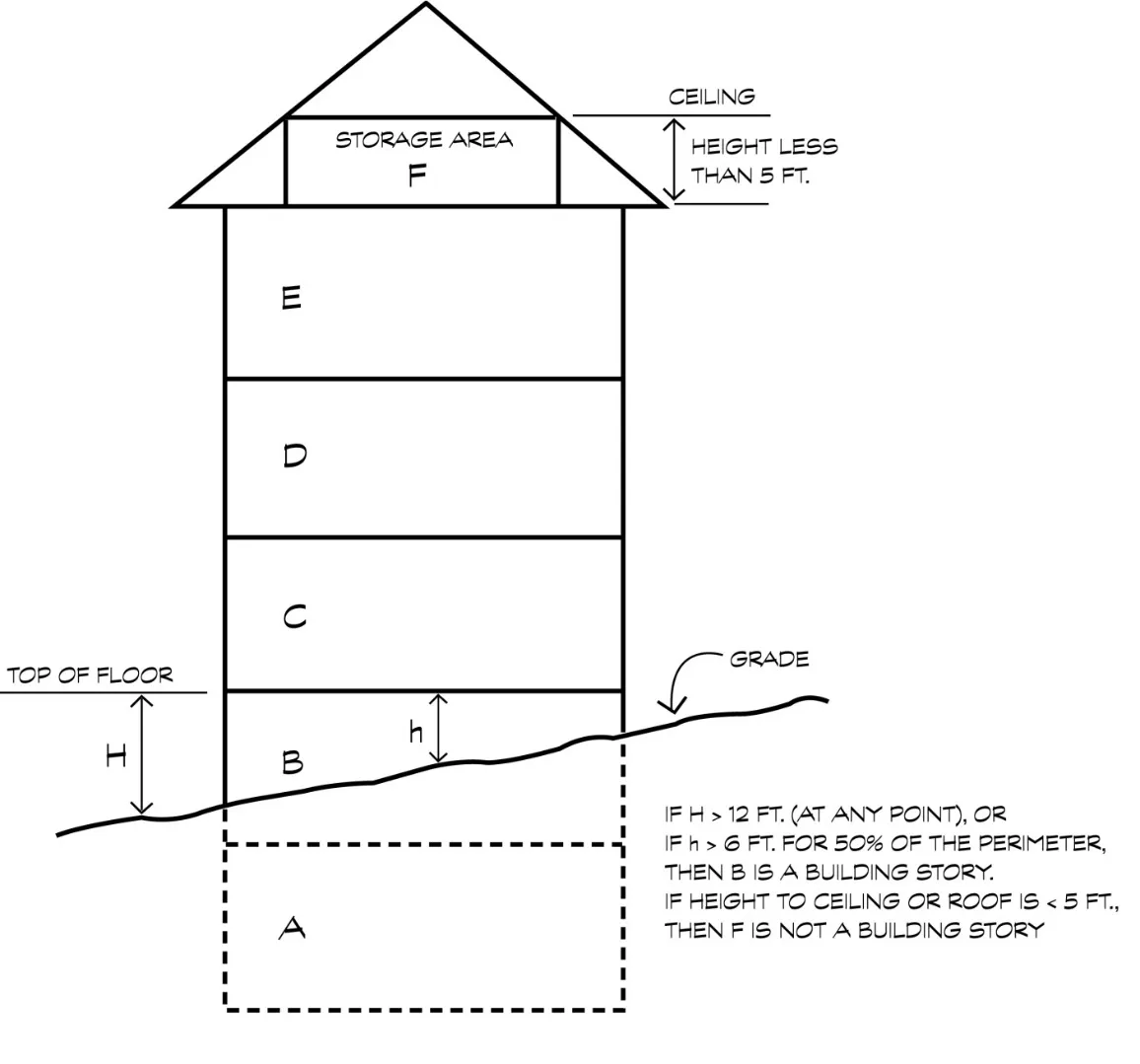
Street
Section titled “Street”A public thoroughfare including public roads or highways 30 feet or more in width, which affords a principal means of access to abutting property.
Street Frontage, Public
Section titled “Street Frontage, Public”The portion of a lot or parcel frontage on a public street other than a freeway or expressway, affording the principal means of access.
Street, Private
Section titled “Street, Private”A street owned and maintained by the abutting property owners, or by an association of property owners, excluding off-street parking areas, driveways, and driveways to off-street parking areas.
Street, Public
Section titled “Street, Public”A street or road shall not be a public street until and unless the said street or road shall have been accepted into a street or road system maintained by a city, county, or the State. Streets and roads in public parks, public airports, public schools and similar public grounds shall not be construed to be public streets for the purposes of this Code.
Structure
Section titled “Structure”Anything constructed or erected which requires location on the ground or attached to something having location on the ground, but not including fences or walls used as fences that are seven feet or less in height.
Structure, General Agricultural
Section titled “Structure, General Agricultural”[ADDED 07-16-2020]
A structure designed, constructed, and used to house farm implements, livestock, or agricultural produce or products grown or raised on the premises. Controlled atmosphere and cold storage warehouses are not agricultural buildings.
Structure, Incidental Agricultural Accessory
Section titled “Structure, Incidental Agricultural Accessory”[ADDED 05-11-2018]
A structure that supports agricultural activity or animal husbandry conducted on a hobby-type basis for personal use or consumption, or for urban agricultural purposes and further provided that such activity is not a primary use of the premises. Incidental Agricultural Accessory Structures are limited to private stables and corrals, barns used primarily for agricultural purposes, and aviaries/chicken coops.
Structure, Nonconforming
Section titled “Structure, Nonconforming”A structure which was never lawful or was lawful when erected, but which does not conform to currently established zoning district regulations.
Structure, Residential Accessory
Section titled “Structure, Residential Accessory”[AMENDED 05-11-2018][AMENDED 01-15-2021][AMENDED 09-09-2022]
A structure that is accessory to a permitted primary dwelling and that does not include independent living facilities. Examples include detached garages, guest houses, workshops, sheds, and gazebos. See Section 3.9.3.CC - Residential Accessory Structures for further examples. Does not include Accessory Dwelling Units or Junior Accessory Dwelling Units.
Subdivision
Section titled “Subdivision”The division, by any subdivider, of any unit or units of improved or unimproved land, or any portion thereof, shown on the latest equalized county assessment roll as a unit or as contiguous units, for the purpose of sale, lease or financing, whether immediate or future except for leases of agricultural land for agricultural purposes. Property shall be considered as contiguous units, even if it is separated by roads, streets, utility easement or railroad rights-of-way. “Subdivision” includes a condominium project, as defined in CA CIV §1350, a community apartment project, as defined in CA BPC§11004, or the conversion of five or more existing dwelling units to a stock cooperative, as defined in CA BPC §11003.2. Any conveyance of land to a governmental agency, public entity, public utility, or subsidiary of a public utility for conveyance to such public utility for rights-of-way, shall not be considered a division of land for purposes of computing the number of parcels.
Subdivision Map Act
Section titled “Subdivision Map Act”The Subdivision Map Act of the State of California and all amendments or additions thereto (CA GOV §66410).
Subdivision Review Committee
Section titled “Subdivision Review Committee”The Sacramento County Subdivision Review Committee appointed pursuant to the provisions of the Subdivision Ordinance (Title 22, Land Development of the SCC).
Supportive Housing
Section titled “Supportive Housing”[ADDED 09-09-2022][AMENDED 06-06-2024]
Housing with no limit on length of stay, that is occupied by the target population as defined in CA GOV §65582, and that is linked to an onsite or offsite service that assists the supportive housing resident in retaining the housing, improving their health status, and maximizing their ability to live and, when possible, work in the community (CA GOV §65582, subdivision (g).). Supportive services include, but are not limited to, a combination of subsidized, permanent housing, intensive case management, medical and mental health care, substance abuse treatment, employment services, and benefits advocacy. Supportive housing is considered a residential use and is subject to the same restrictions that apply to other residential dwellings of the same housing type and zone district.
Surface Mining Operations
Section titled “Surface Mining Operations”All, or any part of, the process involved in the mining of minerals on mined lands by removing overburden and mining directly from the mineral deposits, open-pit mining of minerals naturally exposed, mining by the auger method, dredging and quarrying, borrow pitting, streambed skimming, segregation and stockpiling of mined materials and recovery of the same or surface work incident to an underground mine. Surface mining operations shall include, but are not limited to in-place distillation, retorting or leaching, the production and disposal of mining waste, prospecting and exploratory activities, borrow pitting, streambed skimming, and segregation and stockpiling of mined materials and recovery of same.
Sustainability
Section titled “Sustainability”The U.S. Environmental Protection Agency (EPA) describes sustainability as: “A simple principle that everything we need for our survival and well-being depends, either directly or indirectly, on our natural environment”. Sustainability creates and maintains the conditions under which humans and nature can exist in productive harmony, that permit fulfilling the social, economic and other requirements of present and future generations. Sustainability is important to making sure that we have and will continue to have, the water, materials, and resources to protect human health and our environment. Use of smart growth strategies creates sustainable communities.
A low-lying depression that collects water and has an indistinct drainage course.
Tattoo Shop
Section titled “Tattoo Shop”A place of business whose principal activity is placing designs, letters, figures, symbols or other marks upon or under the skin of any person, using ink or other substances that result in the permanent coloration of skin by means of the use of needles or other instrument designed to contact or puncture the skin.
Temporary Concession
Section titled “Temporary Concession”[AMENDED 06-22-2017][AMENDED 07-11-2024]
Any individual retail sales operation from a location not involving a permanent building for the purpose of housing or conducting sales, distributions or transactions, to make goods or services available to the general public using a temporary table, stand, cart, or similar equipment; but not including a mobile vending vehicle licensed and operated pursuant to the provisions of the SCC.
Threshold of Significance
Section titled “Threshold of Significance”An identifiable quantitative, qualitative or performance level of a particular environmental effect.
Thrift Store
Section titled “Thrift Store”Thrift store means a retail establishment selling donated secondhand goods, either donated to the organization or obtained in bulk from an organization collecting donations, and does not include an antique or consignment store that sells secondhand items either on behalf of the original owner, who receives a percentage of the selling price, or that have been purchased elsewhere.
Tool Repair, Sharpening, and Reconditioning
Section titled “Tool Repair, Sharpening, and Reconditioning”A place of business providing repair or maintenance services for tools including, but not limited to: appliances; electronic equipment; televisions, radios, and shoe repair. This use does not include the maintenance and repair of vehicles.
Transient Use or Transient Occupancy
Section titled “Transient Use or Transient Occupancy”Occupancy of a lodging facility or residence by any person other than the primary owner by concession, permit, right of access, license, gift or other agreement for a period of 30 consecutive calendar days or less, counting portions of calendar days as full days.
Transitional Housing
Section titled “Transitional Housing”[ADDED 09-09-2022][AMENDED 06-06-2024]
Buildings configured as rental housing developments, but operate under program requirements that require the termination of assistance and recirculating of the assisted unit to another eligible program recipient at a predetermined future point in time that shall be no less than six months from the beginning of the assistance (CA GOV §65582, subdivision (j).) Transitional housing is considered a residential use and is subject to the same restrictions that apply to other residential dwellings of the same housing type and zone district.
Transit-Oriented Development (TOD)
Section titled “Transit-Oriented Development (TOD)”A mixed-use community within an average one-quarter mile walking distance of a transit stop and commercial core area. The design, configuration, and mix of uses within the TOD emphasize a pedestrian-oriented environment and reinforce the use of public transportation. A TOD’s mix of residential, retail, office, open space, and public uses are all located within comfortable walking distance, and it is convenient for residents and employees to travel by transit, bicycle or foot, as well as by car.
Truck, Freight, or Draying Terminal
Section titled “Truck, Freight, or Draying Terminal”A building or area in which freight brought by air, rail, or truck is assembled or stored for routing or refreshment; and in which semitrailers used for the business, including tractor/trailer units and other trucks, are parked or stored.
Truck and Large Vehicle Lease, Rent, Repair, Sales, Storage or Service
Section titled “Truck and Large Vehicle Lease, Rent, Repair, Sales, Storage or Service”[AMENDED 07-16-2020]
A commercial establishment primarily engaged in the lease, rent, repair, sales, storage, or service of vehicles with a manufacturer’s gross vehicle rating of 10,000 pounds or more.
Urban Level of Flood Protection (ULOP)
Section titled “Urban Level of Flood Protection (ULOP)”[ADDED 02-2017]
The level of flood protection that is necessary for new development to withstand a 200-year event in accordance with Urban Level of Flood Protection criteria developed by the State of California Department of Water Resources. The ULOP is required for a development project and/or new construction located within an “applicability area” as show in Appendix D of the Floodplain Management Ordinance: “ULOP Applicability in Unincorporated Areas of Sacramento County”, indicating locations where all the following criteria apply:
- The project is in a Floor Hazard Zone.
- The project site is in an urban area with 10,000 or more residents, or is in an urbanizing area in which 10,000 or more residents are anticipated within 10 years; and
- The project site is in a watershed with a contributing area greater than 10 square miles; and
- The project site has potential flood depths greater than three feet in the 200-year flood.
Urban Agricultural Stand
Section titled “Urban Agricultural Stand”[ADDED 02-24-2017]
A retail stand accessory to a private, market or community garden that sells fresh vegetables, fruits, nuts, and other agricultural crops, eggs, honey and products produced on site when processed and sold consistent with a cottage food permit and any other applicable permits and/or requirements.
Urban Lot Split
Section titled “Urban Lot Split”[ADDED 09-09-2022]
The subdivision of one existing single-family residential parcel into no more than two resultant lots in a single-family residential zone (RD-1 through RD-10) consistent with the California Housing Opportunity and More Efficiency (HOME) Act (SB 9) as further defined in SCC Section 22.05.035 and the Sacramento County Zoning Code User Guide.
Urban Policy Area
Section titled “Urban Policy Area”Defines the area expected to receive urban levels of public infrastructure and services within the 20-year planning period.
Urban Services Boundary
Section titled “Urban Services Boundary”The ultimate growth boundary of the urban area in unincorporated areas of the County. The boundary is based upon natural and environmental constraints and the purpose is to control urban growth while protecting the County’s natural resources.
The purpose for which land or a building is arranged, designed, or intended, or for which either land or a building is or may be occupied or maintained.
Used for
Section titled “Used for”The phrase “used for” includes “arranged for”, “designed for”, “intended for”, “maintained for” or “occupied for”.
Use, Nonconforming
Section titled “Use, Nonconforming”A use which was never lawful or was lawful when established but which does not conform to currently established zoning district regulations.
Vacation Rentals
Section titled “Vacation Rentals”[DELETED 06-20-2019]
Vanpool
Section titled “Vanpool”A group of between seven and 15 persons travelling together in a van or similar motor vehicle.
Variance
Section titled “Variance”A grant of relief from the requirements, or a relaxation of the strict application, of the terms of this Code that permits construction in a manner that would otherwise be prohibited by this Code, as granted pursuant to Section 6.5.1.
Vehicle Auction
Section titled “Vehicle Auction”The sale of new or used vehicles offered to bidders by an auctioneer for money or other consideration. A vehicle is defined as any self-propelled or towable (trailer) unit designed primarily for transportation of persons or goods on land, water, or air.
Vehicle Storage
Section titled “Vehicle Storage”Service establishments in the business of storing cars, buses, and other motor vehicles for clients. The definition includes sites where vehicles are stored for rental or leasing. The definition does not include wrecking yards or farm equipment storage.
Veterinarian, Animal Hospital
Section titled “Veterinarian, Animal Hospital”Establishments where small animals receive medical and surgical treatment.
Warehousing
Section titled “Warehousing”A business engaged primarily in storage, wholesale, and distribution of manufactured products, supplies, and equipment.
Water Supply, Public
Section titled “Water Supply, Public”A water supply provided by a local agency, publicly owned corporation, or approved utility company.
Water Surface Elevation
Section titled “Water Surface Elevation”The elevation in feet above mean sea level of the surface of a body of water or watercourse.
Watershed
Section titled “Watershed”A region or area bounded peripherally by a water parting and draining ultimately to a particular watercourse or body of water.
Wet Bar
Section titled “Wet Bar”[ADDED 01-15-2021]
An area that may include a sink, counter, and storage for food and drinks, but no cooking appliances. Does not include Efficiency Kitchen.
Wholesale Store
Section titled “Wholesale Store”An outlet for the sale of commodities and goods for further resale, not including large retail establishments. In some cases, incidental retail sales may be permitted.
Wildlife Preserve
Section titled “Wildlife Preserve”Wildlife preserves are those areas designated by a public agency and owned by a private or public entity for the purposes of protecting, maintaining, and studying important vegetative, water, fish and wildlife resources.
Williamson Act Contracts
Section titled “Williamson Act Contracts”Voluntary contracts between landowners and a city or county in which they agree to retain their lands in agriculture for a minimum of 10 years, renewable up to an additional 10 years. In return for entering into this contract, the landowners receive property tax relief on the lands under contract.
Wind Turbine Facilities
Section titled “Wind Turbine Facilities”Wind turbine facilities convert wind energy to electricity, and include two types:
- Small Wind Turbines
Section titled “- Small Wind Turbines”Wind turbines rated 20KW or less, and designed to produce no more than what is necessary to meet on-site energy demand.
- Large Wind Turbines
Section titled “- Large Wind Turbines”Wind turbines not classified as small wind turbines.
Winery
Section titled “Winery”A bonded winery facility consisting of the building or buildings used to convert fruit juices into wine, and to age, bottle, store, distribute, and sell. A winery shall include any or all of the following activities and facilities; crushing, fermenting, bottling, blending, bulk and bottle storage, aging, shipping, receiving, tasting room, laboratory equipment, maintenance facilities, conference room space, sales and administrative offices. A bonded winery is entitled to all privileges afforded to ABC Type 02 winegrowers unless specifically restricted by this ordinance.
Winery Tours
Section titled “Winery Tours”Guided tours conducted by representatives of a winery to members of the public.
Large Winery
Section titled “Large Winery”A winery with more than 15,000 cases annual production.
Small Winery
Section titled “Small Winery”A winery with up to 15,000 cases annual production, and a maximum size tasting room facility of 1,500 square feet.
Tasting Room
Section titled “Tasting Room”A room where the general public can sample wine and where wine and grape products produced on site are for sale. A tasting room may not be used as an office or for wine production.
Wireless Communication Facility
Section titled “Wireless Communication Facility”[ADDED 12-20-2019]
Means a commercial facility that transmits and/or receives electromagnetic or radio frequency waves, including, but not limited to towers, façade-mounted antennas, roof-top mounted towers, distributed antenna systems, support or accessory structures and related equipment. Amateur radio operators are not included in this definition. Includes related equipment, which is all equipment ancillary to the transmission and reception of a wireless telecommunications facility. Such equipment may include, but is not limited to, cable, conduit and connectors, electrical meters, and enclosed electrical equipment.
Wireless Communications Facility - Eligible Facilities Request
Section titled “Wireless Communications Facility - Eligible Facilities Request”[ADDED 12-20-2019]
A modification that falls within the guidelines of 47 C.F.R. Subsection 1.6100(b), and as modified from time to time. Current guidelines are as follows:
-
Any request for modification of an existing tower or base station that does not substantially change the physical dimensions of such tower or base station, involving:
-
Collocation of new transmission equipment;
-
Removal of transmission equipment; or
-
Replacement of transmission equipment.
-
-
Substantial change. A modification substantially changes the physical dimensions of an eligible support structure if it meets any of the following criteria:
-
For towers other than towers in the public rights-of-way, it increases the height of the tower by more than 10 percent or by the height of one additional antenna array with separation from the nearest existing antenna not to exceed 20 feet, whichever is greater; for other eligible support structures, it increases the height of the structure by more than 10 percent or more than 10 feet, whichever is greater;
- Changes in height should be measured from the original support structure in cases where deployments are or will be separated horizontally, such as on buildings’ rooftops; in other circumstances, changes in height should be measured from the dimensions of the tower or base station, inclusive of originally approved appurtenances and any modification that were approved prior to the passage of the Spectrum Act.
-
For towers other than towers in the public rights-of-way, it involves adding an appurtenance to the body of the tower that would protrude from the edge of the tower more than 20 feet, or more than the width of the tower structure at the level of the appurtenance, whichever is greater; for other eligible support structures, it involves adding an appurtenance to the body of the structure that would protrude from the edge of the structure by more than six feet;
-
For any eligible support structure, it involves installation of more than the standard number of new equipment cabinets for the technology involved, but not to exceed four cabinets; or, for towers in the public rights-of-way and base stations, it involves installation of any new equipment cabinets on the ground if there are no pre-existing ground cabinets associated with the structure, or else involves installation of ground cabinets that are more than 10 percent larger in height or overall volume than any other ground cabinets associated with the structure;
-
It entails any excavation or deployment outside the current site;
-
It would defeat the concealment elements of the eligible support structure; or
-
It does not comply with conditions associated with the siting approval of the construction or modification of the eligible support structure or base station equipment, provided however that this limitation does not apply to any modification that is non-compliant only in a manner that would not exceed the thresholds identified in §1.40001(b)(7)(i) through (iv) of the C.F.R.
-
Wireless Communication Facility - Small Cell
Section titled “Wireless Communication Facility - Small Cell”[ADDED 12-20-2019]
WCFs mounted on structures 50 feet or less in height or on structures no more than 10 percent taller than adjacent structures with an antenna array of no more than three cubic feet and total wireless equipment no more than 28 cubic feet. Structures in this case shall mean light and utility poles, either within or outside the PROW.
An open space other than a court, on a lot, unoccupied and unobstructed from the ground upward, except as otherwise provided in this Code.
Yard, Front
Section titled “Yard, Front”A yard extending from the full width of the lot between the front of the main building and the front lot line. The depth of the required front yard shall be measured horizontally between the nearest part of the closest building and the nearest point of the front lot line.
Yard, Rear
Section titled “Yard, Rear”A yard extended across the full width of the lot between the most rear main building and the rear lot line. The depth of the required rear yard shall be measured horizontally between the nearest part of a main building toward the nearest point of the rear lot line.
Yard, Side
Section titled “Yard, Side”A yard, between a building and the side lot line, extending from the front yard to the rear yard. The width of the required side yard shall be measured horizontally from the nearest point of the side lot line toward the nearest part of the closest building.
Yard, Side Street
Section titled “Yard, Side Street”A yard, between a building and the side lot line adjacent to the street right-of-way, extending from the front yard to the rear yard. The depth of the required side street yard shall be measured horizontally between the nearest part of the closest building and the nearest point of the side lot line adjacent to the street.
Zero Lot Line
Section titled “Zero Lot Line”A design which allows a residential structure to be constructed up to one of the interior side property lines of a parcel.
Zero Lot Line Example Diagram
Section titled “Zero Lot Line Example Diagram”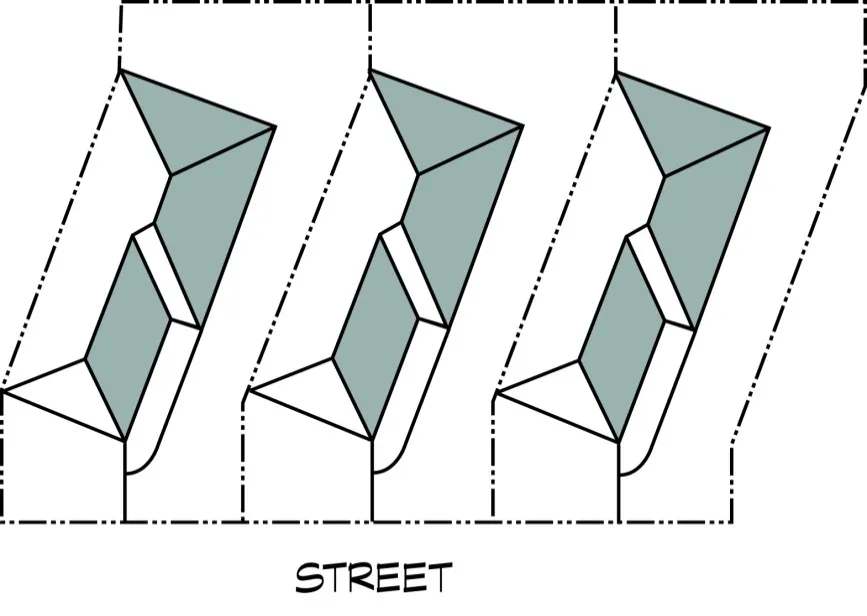
Zoning
Section titled “Zoning”Specific immediate use for land, which is adopted by ordinance and carries the weight as local law. It is the primary instrument for general plan implementation.
Zoning District
Section titled “Zoning District”Any of the land use zoning districts specified in Chapter Three of this Code.
Zoning Verification Letter
Section titled “Zoning Verification Letter”[ADDED 03-27-2019]
Document issued by the Planning Director or Designee, that provides information on zoning laws related to a particular property, based on this Code. A Zoning Verification Letter may provide any or all of the following: a general description of the zoning district, references to any applicable zoning and development standards, legal land uses, zoning history of the property, current entitlements.
7.4. ACRONYMS
Section titled “7.4. ACRONYMS”General Abbreviations
Section titled “General Abbreviations”ABC - Department of Alcoholic Beverage Control
ADA - American with Disabilities Act [AMENDED 12-01-2017]
ADU - Accessory Dwelling Unit [ADDED 05-11-2018]
ALUCP - Airport Land Use Compatibility Plan
ANSI - American National Standards Institute
AWEA - American Wind Energy Association
BOD - Biological Oxygen Demand
BRT - Bus Rapid Transit
Cal OSHA - California Office of Safety Hazard Administration
CCTV - Closed Circuit Television
CEQA - California Environmental Quality Act
EIR - Environmental Impact Report
EIS - Environmental Impact Statement
NOD - Notice of Determination
NOE - Notice of Exemption
NOI - Notice of Intent
NOP - Notice of Preparation
CDFA - California Department Food and Agriculture
CLUP - Airport Comprehensive Land Use Plan
CPAC - Community Planning Advisory Council
CPTED - Crime Prevention through Environmental Design
CZP - Comprehensive Zoning Plan
EMD - Environmental Management Department
FAR - Floor Area Ratio
D - Duplex
DRA - Design Review Administrator
DRAC - Design Review Advisory Committee
HIP - Housing Incentive Program
HUD - United States Department of Housing and Urban Development
IESNA - Illuminating Engineering Society of North America
JADU - Junior Accessory Dwelling Unit [ADDED 01-15-2021]
LED - Lighting Emitting Diode
MLLW - Mean Lower Low Water
MMRP - Mitigation and Monitoring Report Program
NPDES - National Pollutant Discharge System
NRTL - National Recognized Testing Laboratory
PRC - Project Review Committee
PUPF - Public Utilities and Public Facilities
SCC - Sacramento County Code
SF - Single Family
SMAQMD - Sacramento Metropolitan Air Quality Management District
SRO - Single Room Occupancy
SWCC - Small Wind Certification Council
TOT - Transient Occupancy Tax
UBC - Uniform Building Code
ULI - Urban Land Institute
ZAZ - Zoning Administration Action
Allowed Uses Abbreviations
Section titled “Allowed Uses Abbreviations”P - Permitted Primary Use
C - Conditional Use Permit
UPM - Minor Use Permit
UPZ - Conditional Use Permit approved by Zoning Administrator
UPP - Conditional Use Permit approved by Planning Commission
UPB - Conditional Use Permit approved by Board of Supervisors
A - Accessory Use
T - Temporary Use
TUZ - Temporary Use approval by Zoning Administrator
California Government Codes
Section titled “California Government Codes”CA BPC - California Business and Professions Code
CA CIV - California Civil Code
CA EDC - California Education Code
CA GOV - California Government Code
CA FAC - California Food and Agriculture Code
CA HSC - California Health and Safety Code
CA PEN - California Penal Code
CA PRC - California Public Resources Code
CA PUC - California Public Utilities Code
CA SHC - California Streets and Highways Code
CA VEH - California Vehicle Code
CA WIC - Welfare and Institutions Code
AG - Agriculture
Section titled “AG - Agriculture”AG-160 - Agriculture 160 acres
AG-80 - Agriculture 80 acres
AG-40 - Agriculture 40 acres
AG-20 - Agriculture 20 acres
UR - Urban Reserve
IR - Interim Agriculture Reserve [AMENDED 01-12-2019]
AR - Agriculture Residential
Section titled “AR - Agriculture Residential”AR-10 - Agriculture Residential 10 acres
AR-5 - Agriculture Residential 5 acres
AR-2 - Agriculture Residential 2 acres
AR-1 - Agriculture Residential 1 acre
RD - Residential
Section titled “RD - Residential”RD-1 - Residential 1
RD-2 - Residential 2
RD-3 - Residential 3
RD-4 - Residential 4
RD-5 - Residential 5
RD-7 - Residential 7
RD-10 - Residential 10
RD-15 - Multifamily Residential: 15 dwellings
RD-20 - Multifamily Residential: 20 dwellings
RD-25 - Multifamily Residential: 25 dwellings
RD-30 - Multifamily Residential: 30 dwellings
RD-40 - Multifamily Residential: 40 dwellings
RM-2 - Mobile Home Subdivision
Commercial
Section titled “Commercial”BP - Business Professional Office
LC - Light Commercial
GC - General Commercial
Industrial
Section titled “Industrial”MP - Industrial Office Park
M-1 - Light Industrial
M-2 - Heavy Industrial
Mixed Use
Section titled “Mixed Use”NMC - Neighborhood Mixed-use Center
CMC - Community-Regional Mixed-use Center
CMZ - Corridor Mixed Use
Recreation
Section titled “Recreation”RR - Recreation Reserve
O - Recreation
C-O - Commercial-Recreation
Combining Zones
Section titled “Combining Zones”F - Flood Combining Zoning Districts
FP - Food Processing Combining Zoning Districts
MHP - Mobile Home Park Combining Zoning Districts
NS - Natural Streams Combining Zoning Districts
NPA - Neighborhood Preservation Area
PC - Parkway Corridor Combining Zoning District
SM - Surface Mining Combining Zoning District
DW - Delta Waterways Zoning District
SPA - Special Planning Area Zoning District