Title IX: Floodplain Management Ordinance
Sacramento County Zoning Code
Title IX: Floodplain Management Ordinance
Section titled “Sacramento County Zoning Code Title IX: Floodplain Management Ordinance”Amended February 9, 2024 & March 24, 2025
Amended by PLNP2023-00182This Title of the Zoning Code is under the purview of the Department of Water Resources. Please direct questions regarding this ordinance to the Department of Water Resources at WRFloodInfo@saccounty.gov.
CHAPTER 1: INTRODUCTORY PROVISIONS
Section titled “CHAPTER 1: INTRODUCTORY PROVISIONS”901-01. STATUTORY AUTHORIZATION.
Section titled “901-01. STATUTORY AUTHORIZATION.”- The Legislature of the State of California has, in Government Code Sections 65302, 65560, and 65800, conferred upon counties the authority to make and enforce regulations designed to promote the public health, safety, and general welfare of its citizenry. Therefore, the Board of Supervisors of the County of Sacramento does hereby adopt the following floodplain management regulations.
- In the event of a conflict between these regulations and state or federal laws or regulations the more restrictive requirement shall take precedence.
901-02. FINDINGS OF FACT.
Section titled “901-02. FINDINGS OF FACT.”- The special flood hazard areas and local flood hazard areas of the County are subject to periodic inundation which results in loss of life and property, health and safety hazards, disruption of commerce and governmental service, extraordinary public expenditures for flood protection and relief, and impairment of the tax base, all of which adversely affect the public health, safety, and general welfare.
- Flood losses may be avoided by development standards described in this Ordinance including elevating new construction safely above the recognized flood hazard and minimizing the cumulative effect of encroachments in special and local flood hazard areas, which may increase flood heights and velocities.
901-03. STATEMENT OF PURPOSE.
Section titled “901-03. STATEMENT OF PURPOSE.”It is the purpose of this ordinance to promote public health, safety, and general welfare, and to minimize public and private losses due to flood conditions in specific areas by provisions designed to:
- Protect human life and health;
- Minimize expenditure of public money for costly flood control projects;
- Minimize the need for rescue and relief efforts associated with flooding and generally undertaken at the expense of the general public;
- Minimize prolonged business interruptions;
- Minimize damage to public facilities located in special flood hazard areas and local flood hazard areas;
- Ensure that current flood hazard data is available for property owners, prospective buyers, insurance agents, real estate agents, and other interested parties;
- Ensure that those who develop in special flood hazard areas or local flood hazard areas do so pursuant to this ordinance; and
- Ensure that those who develop special flood hazard areas or local flood hazard areas assume responsibility for their actions.
901-04. METHODS OF REDUCING FLOOD LOSSES.
Section titled “901-04. METHODS OF REDUCING FLOOD LOSSES.”In order to accomplish its purposes, this ordinance includes methods and provisions to:
- Restrict or prohibit development which is dangerous to health, safety, and property due to flood hazards, or which results in damaging increases in flood heights or velocities;
- Require that development vulnerable to floods, including facilities that serve such development, be protected against flood damage at the time of initial construction;
- Control the alteration of natural floodplains, stream channels, and natural protective barriers, which help accommodate or channel flood waters;
- Control filling, grading, dredging, and other development which may increase flood damage; and
- Prevent or regulate the construction of flood barriers that will unnaturally divert floodwater or which may increase flood hazards in other areas.
CHAPTER 2: DEFINITIONS
Section titled “CHAPTER 2: DEFINITIONS”As used in this ordinance, the following words and phrases shall have the meaning given in this chapter.
902-01. ADVERSE IMPACT.
Section titled “902-01. ADVERSE IMPACT.”Causing increased flood stages, increased flood velocity, or increased flows in or near a special or local flood hazard area, to an extent including, but not limited to, an increase in base flood elevation equal to or greater than 0.1 foot on upstream, downstream, or adjacent properties.
902-01.1. AREA OF MODERATE FLOOD HAZARD.
Section titled “902-01.1. AREA OF MODERATE FLOOD HAZARD.”These areas are indicated by the letter “X” on the FEMA Flood Insurance Rate Maps (FIRM). (Older maps use the letters “B” or “C”.)
902-02. APPEAL.
Section titled “902-02. APPEAL.”A request for a review of the Floodplain Administrator’s determination or action pursuant to, or interpretation of, any provision of this ordinance.
902-03. APPLICANT.
Section titled “902-03. APPLICANT.”Any person who submits an application for a permit pursuant to this ordinance.
902-04. BARN.
Section titled “902-04. BARN.”A structure designed and constructed to house farm implements and other agricultural products. The structure shall not be a place of human habitation or a place of employment where agricultural products are processed, treated, or packaged; nor shall it be a place used by the public. A barn must have at least one door 10 feet or more in width.
902-05. BASE FLOOD.
Section titled “902-05. BASE FLOOD.”A designated flood elevation on any property at the higher of:
- the elevation of floodwaters during a flood with a one percent chance of being equaled or exceeded in any given year (also called the "100-year flood") as presented in the FEMA Flood Insurance Study;
- the highest water surface elevation from any source of flooding determined by engineering analysis;
- the highest water surface water elevation of measured high water;
- the elevation associated with encroachment on the FEMA floodway; or,
- Any other state or federal water surface elevation regulatory profiles pertaining to the property in question.
902-06 BASE FLOOD ELEVATION (BFE)
Section titled “902-06 BASE FLOOD ELEVATION (BFE)”The water surface elevation of the base flood.
902-07. BEACH STONE LAKES AREA
Section titled “902-07. BEACH STONE LAKES AREA”The area bound by the Southern Pacific Railroad embankment on the west, the Union Pacific Railroad embankment on the east, Elliot Ranch Road cross levee on the north, and Lambert Road on the south.
902-08. BASEMENT
Section titled “902-08. BASEMENT”An area of a building having its floor below ground level on all sides.
902-09. BOARD OF SUPERVISORS
Section titled “902-09. BOARD OF SUPERVISORS”The legislative body of the County of Sacramento.
902-10. BUILDING
Section titled “902-10. BUILDING”An enclosed, walled, and roofed structure that is principally above ground. The term includes manufactured homes placed on a foundation, and electrical/mechanical enclosures large enough to allow human walk-in access. See also “structure.”
902-11. BUILDING PAD
Section titled “902-11. BUILDING PAD”The graded area, cut or fill, for construction of a slab on grade structure.
902-12. COUNTY
Section titled “902-12. COUNTY”The unincorporated County of Sacramento
902-13. COUNTY SPECIFICATIONS
Section titled “902-13. COUNTY SPECIFICATIONS”The County Improvement Standards, County Standard Construction Specifications, County Hydrology Standards, and other standards included in applicable County ordinances, regulations, and manuals, as amended from time to time.
902-14. DELTA AREA
Section titled “902-14. DELTA AREA”For the purposes of this ordinance, the Delta Area is that area south of the City of Sacramento to the tip of Sherman Island protected from flooding by levees as bound by Reclamation District numbers: 3, 317, 341, 349, 369, 407, 551, 554, 556, 563, 744, 746, 755, 813, 1002, 1601, 2067, and 2111 (Reclamation District 2110 is excluded). See Appendix A for applicability map.
902-15. DEVELOPMENT
Section titled “902-15. DEVELOPMENT”Any activity that will result in any man-made change to improved or unimproved real estate, including but not limited to buildings or other structures, mining, storage of materials, dredging, filling, grading, paving, excavation, or drilling operations. Levee maintenance which results or causes channel encroachments or a rise of the base flood elevation, or results or causes the raising of the levee elevation in those sections where the elevation of the levee was a controlling factor for establishing the base flood elevation on either side of the levee shall be considered development. Normal Farming Activities (as herein defined) shall not be considered development.
902-16. DEVELOPED AREA
Section titled “902-16. DEVELOPED AREA”An area of a community that is:
- A primarily urbanized, built-up area that is a minimum of 20 contiguous acres, has basic urban infrastructure, including roads, utilities, communications, and public facilities, to sustain industrial, residential, and commercial activities, and
- within which 75 percent or more of the parcels, tracts, or lots contain commercial, industrial, or residential structures or uses; or
- is a single parcel, tract, or lot in which 75 percent of the area contains existing commercial or industrial structures or uses; or
- is a subdivision developed at a density of at least two residential structures per acre within which 75 percent or more of the lots contain existing residential structures.
- Undeveloped parcels, tracts, or lots, the combination of which is less than 20 acres and contiguous on at least three sides to areas meeting the criteria of paragraph (a).
- A subdivision that is a minimum of 20 contiguous acres that has obtained all necessary government approvals, if the actual start of construction of structures has occurred on at least 10 percent of the lots or remaining lots of a subdivision or 10 percent of the maximum building coverage or remaining building coverage allowed for a single lot subdivision and construction of structures is underway. Residential subdivisions must meet the density criteria in paragraph (a)(iii), above.
902-17. ENCLOSURE OR ENCLOSED AREA
Section titled “902-17. ENCLOSURE OR ENCLOSED AREA”An area below the base flood elevation plus required freeboard that is constructed to disallow equalization of hydrostatic pressure.
902-18. ENCROACHMENT
Section titled “902-18. ENCROACHMENT”The advance or infringement of fill, excavation, buildings, structures, dams, wharfs, embankments, levees, bridges, conduits, culverts, fences, rock, gravel, or other development in, along, across, or projecting into any watercourse or floodway which may alter, impede, retard or change the direction and/or velocity of the flow of water; or, may snare or collect debris carried by the flow of water.
902-19. FLOOD, FLOODING, OR FLOODWATER
Section titled “902-19. FLOOD, FLOODING, OR FLOODWATER”A general and temporary condition of partial or complete inundation of normally dry land areas from the overflow of inland or tidal waters, the unusual and rapid accumulation or runoff of surface waters from any source.
902-20. FLOOD BOUNDARY AND FLOODWAY MAP
Section titled “902-20. FLOOD BOUNDARY AND FLOODWAY MAP”The official map on which the Federal Emergency Management Agency or Federal Insurance Administration has delineated both the areas of special flood hazards and the floodway.
902-21. FLOOD HAZARD BOUNDARY MAP
Section titled “902-21. FLOOD HAZARD BOUNDARY MAP”The official map on which the Federal Emergency Management Agency or Federal Insurance Administration has delineated the areas of flood hazards.
902.21.1. FLOOD HAZARD ZONE
Section titled “902.21.1. FLOOD HAZARD ZONE”An area subject to flooding that is delineated as either a Special Flood Hazard Area or an area of moderate hazard on an official Flood Insurance Rate Map (FIRM) issued by the Federal Emergency Management Agency (FEMA). The identification of flood hazard zones does not imply that areas outside the flood hazard zones, or uses permitted within flood hazard zones, will be free from flooding or flood damage.
902-22. FLOOD INSURANCE RATE MAP (FIRM)
Section titled “902-22. FLOOD INSURANCE RATE MAP (FIRM)”The official map on which the Federal Emergency Management Agency or Federal Insurance Administration has delineated both the areas of special flood hazard and the risk premium zones applicable to the County.
902-23. FLOOD INSURANCE STUDY (FIS)
Section titled “902-23. FLOOD INSURANCE STUDY (FIS)”The official report of the Federal Insurance Administration that includes flood profiles, the Flood Insurance Rate Map, the Flood Boundary and Floodway Map, and the water surface elevation of the FEMA base flood, represented as a flood with a one percent chance of being equaled or exceeded in any given year (also called the “100-year flood”).
902-24. FLOODPLAIN OR FLOOD-PRONE AREA
Section titled “902-24. FLOODPLAIN OR FLOOD-PRONE AREA”Any land area susceptible to flooding in the base flood.
902-25. FLOODPLAIN ADMINISTRATOR
Section titled “902-25. FLOODPLAIN ADMINISTRATOR”The Director of the Sacramento County Department of Water Resources or designee.
902-26. FLOODPLAIN MANAGEMENT
Section titled “902-26. FLOODPLAIN MANAGEMENT”The operation of a program of corrective and preventive measures for reducing flood damage and preserving and enhancing, where possible, natural resources in the floodplain.
902-27. FLOODPLAIN MANAGEMENT REGULATIONS
Section titled “902-27. FLOODPLAIN MANAGEMENT REGULATIONS”This ordinance, zoning ordinances, subdivision regulations, building codes, special purpose ordinances such as grading and erosion control, and other County ordinances and regulations which control development in flood-prone areas.
902-28. FLOOD-PROOFING
Section titled “902-28. FLOOD-PROOFING”Any combination of structural and nonstructural additions, changes, or adjustments to structures, which reduce or eliminate flood damage to real estate or improved real property, water, and sanitary facilities, structures, and their contents (see Appendix B).
902-29. FLOODWAY
Section titled “902-29. FLOODWAY”A watercourse and the adjacent land areas that must be reserved in order to discharge a FEMA base flood without cumulatively increasing the water surface elevation beyond a level determined by the Floodplain Administrator, but in no case more than one foot.
902-30. FLOODWAY ENCROACHMENT LINES
Section titled “902-30. FLOODWAY ENCROACHMENT LINES”The lines marking the limits of floodways on federal, state, and local floodplain maps.
902-31. FLOODPLAIN FRINGE
Section titled “902-31. FLOODPLAIN FRINGE”The area of the floodplain, in the base flood, on either side of a mapped floodway or where flooding is less than two feet depth if a floodway is not shown.
902-32. FUNCTIONALLY DEPENDENT USE
Section titled “902-32. FUNCTIONALLY DEPENDENT USE”A use that must be located in close proximity to water, including only docking facilities, port facilities necessary for the loading and unloading of cargo or passengers, and shipbuilding and repair facilities, and not including long-term storage or manufacturing facilities.
902-33. GARAGE
Section titled “902-33. GARAGE”A building on the same lot as a dwelling or a portion of a main building for the housing of noncommercial vehicles of the occupants of the dwelling. A garage has an opening 10 feet or more in width.
- An attached garage is constructed horizontally adjacent to a house or underneath a house.
- A detached garage is not structurally connected to a house.
902-34. GRADING
Section titled “902-34. GRADING”The act or result of digging, excavating, transporting, spreading, depositing, filling, compacting, settling, or shaping of land surfaces and slopes, and other operations performed by or controlled by human activity involving the physical movement of rock or soil.
902-35. HIGHEST ADJACENT GRADE
Section titled “902-35. HIGHEST ADJACENT GRADE”The highest natural elevation of the ground surface prior to construction next to the proposed perimeter of a building.
902-36. HISTORIC BUILDING
Section titled “902-36. HISTORIC BUILDING”A pre-FIRM building or structure that is:
- Listed individually in the National Register of Historic Places or preliminarily determined by the Secretary of the Interior as meeting the requirements for individual listing on the National Register; or
- Certified or preliminarily determined by the Secretary of the Interior as contributing to the historical significance of a registered historic district or a district preliminarily determined by the Secretary to qualify as a registered historic district; or
- Individually listed on the California State Historical Resources Commission
- Individually listed by a Sacramento County Board of Supervisors authorized historical organization; or
- A contribution to the historic nature of a historic district or Delta legacy community as specified by the Secretary of the Interior or the State of California Office of Historic Preservation.
inventory of historic landmarks and points of interest; or
902-37. LEVEE
Section titled “902-37. LEVEE”A man-made structure or earthen embankment, which contains, controls, or diverts the flow of water to provide protection from flooding.
902-38. LOCAL FLOOD HAZARD AREA
Section titled “902-38. LOCAL FLOOD HAZARD AREA”An area having risk of flooding in a base flood event as determined by the Floodplain Administrator, and which is supplemental to federally defined special flood hazard areas. The base flood elevation related to actual surveyed ground elevation is the local flood hazard area.
902-39. LOWEST ADJACENT GRADE
Section titled “902-39. LOWEST ADJACENT GRADE”The lowest elevation of the ground surface after construction next to the perimeter of a building.
902-40. LOWEST FLOOR
Section titled “902-40. LOWEST FLOOR”The lowest floor of the lowest enclosed area, including a basement. An unfinished or flood-resistant enclosure, usable solely for parking of vehicles, building access, or storage in an area other than a basement area is not considered the lowest floor, provided that such enclosure is not built to render the building in violation of the applicable non-elevation design requirements of this ordinance.
902-41. MANUFACTURED HOME
Section titled “902-41. MANUFACTURED HOME”A building, transportable in one or more sections, which is built on a permanent chassis and is designed for use with or without a permanent foundation when attached to the required utilities. The term “manufactured home” may include a mobile home that does not constitute a “recreational vehicle”.
902-42. MANUFACTURED HOME PARK OR SUBDIVISION
Section titled “902-42. MANUFACTURED HOME PARK OR SUBDIVISION”A parcel, or contiguous parcels, of land divided into two or more manufactured home lots for rent or sale.
- EXISTING MANUFACTURED HOME PARK OR SUBDIVISION. A manufactured home park or subdivision for which the construction of facilities for servicing the lots on which the manufactured homes are to be affixed, including, at a minimum, the installation of utilities, the construction of streets, and either final site grading or the pouring of concrete pads was completed before November 1, 1989.
- EXPANSION TO AN EXISTING MANUFACTURED HOME PARK OR SUBDIVISION. The preparation of additional sites by the construction of facilities for servicing the lots on which the manufactured homes are to be affixed, including the installation of utilities, the construction of streets, and either final site grading or the pouring of concrete pads.
902-43. MARKET VALUE
Section titled “902-43. MARKET VALUE”The value of the structure (excluding the value of land and site improvements) calculated as either 1) the cost to replace the structure in new condition adjusted by the amount of depreciation that has accrued since the structure was constructed, or 2) a square foot cost determined by reference to a building cost estimating guide recognized by the building construction industry. The amount of allowed depreciation must account for the age, physical deterioration, and functional obsolescence of the structure in a manner acceptable to the County Building Inspector and the Floodplain Administrator; the depreciation calculation need not include economic obsolescence. Using alternate replacement costs or accrued depreciation calculations from those contained in recognized building cost estimating guides must first be approved by the Floodplain Administrator and will not be considered without a report prepared by an independent professional appraiser detailing and supporting an alternate methodology.
902-44. NATOMAS AREA
Section titled “902-44. NATOMAS AREA”The area bounded on the north by the border of the County of Sacramento, on the east by the Natomas East Main Drainage Canal, and on the south and west by the American and Sacramento Rivers (also described as the area of Reclamation District 1000).
902-45. NEW CONSTRUCTION
Section titled “902-45. NEW CONSTRUCTION”Any construction of a new structure, and/or any reconstruction, addition, or alteration of an existing building or any addition beyond the foundation perimeter commencing on or after March 15, 1979.
902-46. NEW MANUFACTURED HOME PARK OR SUBDIVISION
Section titled “902-46. NEW MANUFACTURED HOME PARK OR SUBDIVISION”A manufactured home park or subdivision for which the construction of facilities for servicing the lots on which the manufactured homes are to be affixed, including at a minimum, the installation of utilities, the construction of streets, and either final site grading or the pouring of concrete pads, is completed on or after November 1, 1989.
902-47. NORMAL FARMING ACTIVITIES
Section titled “902-47. NORMAL FARMING ACTIVITIES”Plowing, seeding, cultivating, minor drainage, harvesting, field leveling outside defined watercourses, contouring, and planting, as well as routine maintenance of irrigation ditches.
902-48. PERMITTEE
Section titled “902-48. PERMITTEE”The person in whose name a valid permit is issued pursuant to this ordinance and the person’s agents, employees, and designated representatives.
902-49. PERSON
Section titled “902-49. PERSON”Any individual, corporation, partnership, association of any type, public agency, or any other legal entity.
902-50. POST-FIRM BUILDING
Section titled “902-50. POST-FIRM BUILDING”A building for which construction or substantial improvement occurred on or after March 15, 1979.
902-51. PRE-FIRM BUILDING
Section titled “902-51. PRE-FIRM BUILDING”A building for which construction or substantial improvement occurred before March 15, 1979.
902-52. RECREATIONAL VEHICLE
Section titled “902-52. RECREATIONAL VEHICLE”A vehicle which is:
- Built on a single chassis;
- 400 square feet or less when measured at the largest horizontal projection;
- Self-propelled or permanently towable by a light-duty truck; and
- Used for temporary living quarters (less than 180 consecutive days); or for recreation, camping, travel, or seasonal use.
902-53. SPECIAL FLOOD HAZARD AREA (SFHA)
Section titled “902-53. SPECIAL FLOOD HAZARD AREA (SFHA)”An area shown in the FEMA Flood Insurance Study and FIRM as Zone A, AO, A1-A30, AE, A99, AH, or AR.
902-54. START OF CONSTRUCTION
Section titled “902-54. START OF CONSTRUCTION”Includes substantial improvement and other proposed new development and means the date the building permit was issued, provided the actual start of construction, repair, reconstruction, rehabilitation, addition, placement, or other improvement was within 180 days from the date of the permit. The actual start means either the first placement of permanent construction of a structure on a site, such as the pouring of slab or footings, the installation of piles, the construction of columns, or any work beyond the stage of excavation; or the placement of a manufactured home on a foundation. Permanent construction does not include land preparation, such as clearing, grading, and filling; nor does it include the installation of streets and/or walkways; nor does it include excavation for a basement, footings, piers, or foundations or the erection of temporary forms; nor does it include the installation on the property of accessory buildings, such as garages or sheds not occupied as dwelling units or not part of the main structure. For a substantial improvement, the actual start of construction means the first alteration of any wall, ceiling, floor, or other structural part of a building, whether or not that alteration affects the external dimensions of the building.
902-55. STRUCTURE
Section titled “902-55. STRUCTURE”For floodplain management purposes, a walled and roofed building, including a gas or liquid storage tank (not including water tanks smaller than 5000 gallons), a manufactured home that is affixed to a permanent site or foundation, and a travel trailer without wheels. For floodplain management purposes, a utility box is not a structure unless it is large enough to allow human walk-in access.
902-56. SUBSTANTIAL DAMAGE
Section titled “902-56. SUBSTANTIAL DAMAGE”Damage of any origin sustained by a building whereby the cost of restoring the building to its pre-damaged condition would equal or exceed 50 percent of the market value of the building before the damage occurred.
902-57. SUBSTANTIAL IMPROVEMENTS
Section titled “902-57. SUBSTANTIAL IMPROVEMENTS”Any reconstruction, rehabilitation, addition, or alteration of a building, or any part thereof, the cumulative cost of which equals or exceeds 50 percent of the market value of the building prior to the start of construction, as determined by independent appraisal. Start of construction is the point at which a building permit for the improvements is issued. Cumulative cost is calculated for the preceding five (5) year period from the date of building permit application. “Substantial improvements” includes repair of “substantial damage”, regardless of the actual repair work performed. The term does not include either:
- Any project for improvement of a building to correct existing violations or state or local, health, sanitary, or safety code specifications that have been identified by the local code enforcement official and which are the minimum necessary to assure safe living conditions, or
- Any alteration of a "historic building" provided that the alteration would not preclude the building's continued designation as a "historic building".
902-57.1 Urban Level of Flood Protection (ULOP)
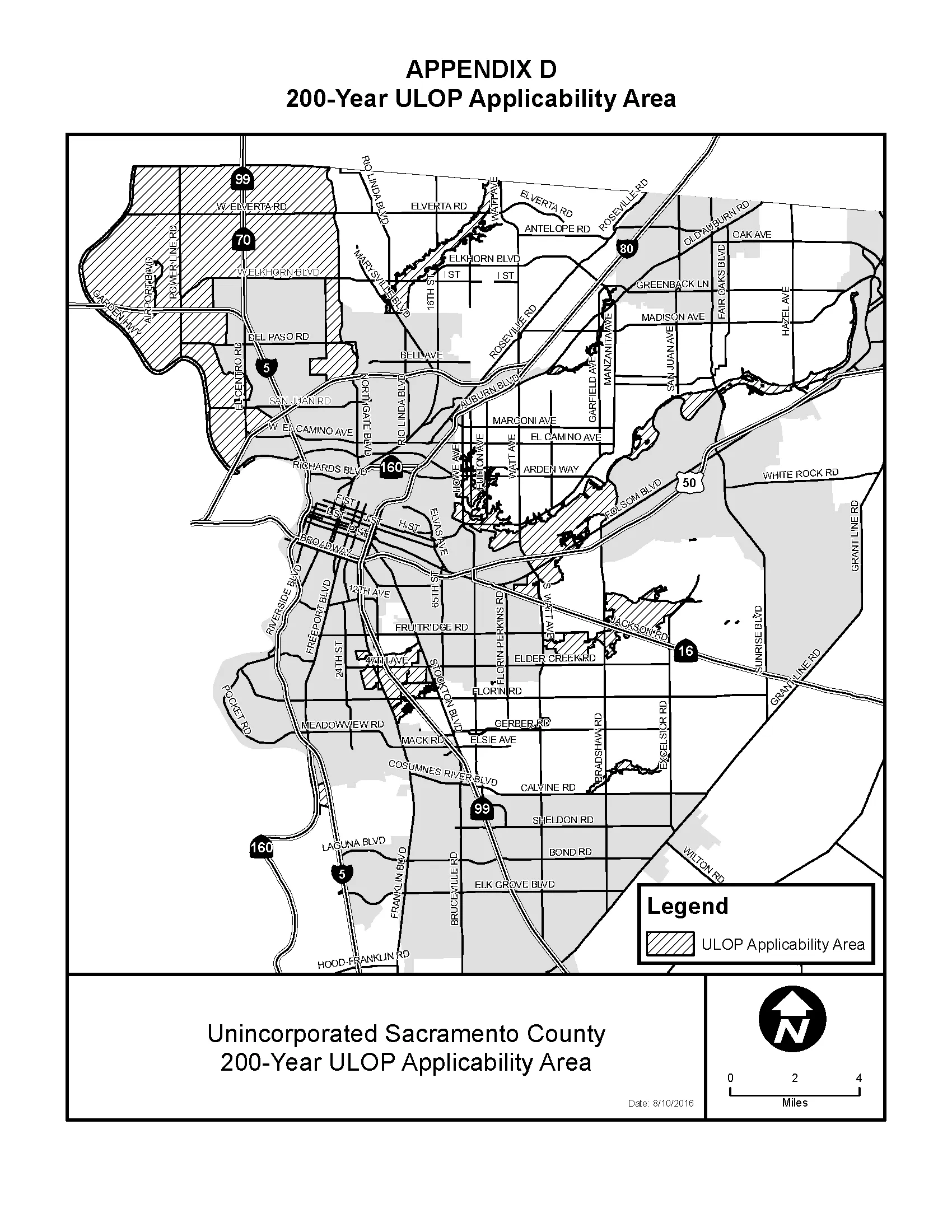
Section titled “902-57.1 Urban Level of Flood Protection (ULOP)”The level of flood protection that is necessary for new development to withstand a 200-year event in accordance with Urban Level of Flood Protection criteria developed by the State of California Department of Water Resources. The ULOP is required for a development project and/or new construction located within an “applicability area” as shown in Appendix D: “ULOP Applicability in Unincorporated Areas of Sacramento County”, indicating locations where all the following criteria apply:
-
The project site is in a Flood Hazard Zone.
-
The project site is in an urban area with 10,000 or more residents, or is in an urbanizing area in which 10,000 or more residents are anticipated within 10 years; and
-
The project site is in a watershed with a contributing area greater than 10 square miles; and
-
The project site has potential flood depths greater than 3’ in the 200-year flood.
902-58. VERTICAL DATUM
Section titled “902-58. VERTICAL DATUM”The National Geodetic Survey Vertical Datum North American Vertical Datum 1988 (NAVD88) used countywide for floodplain mapping.
(Note: NAVD88 replaces the previous county vertical datum NGVD29. All flood insurance rate maps preceding August 16, 2012, are in NGVD29.)
902-59. VARIANCE
Section titled “902-59. VARIANCE”A grant of relief from the requirements of this ordinance which allows development in a manner that would otherwise be prohibited by this ordinance.
902-60. VIOLATION
Section titled “902-60. VIOLATION”The failure of a structure or other development to be fully compliant with this ordinance. A structure or other development without the elevation certificate, other certifications, or other evidence of compliance required in this ordinance is presumed to be in violation until such time as that documentation is provided.
902-61. WATER SURFACE ELEVATION
Section titled “902-61. WATER SURFACE ELEVATION”The height, in relation to the currently adopted Vertical Datum, where specified, of floods of various magnitudes and frequencies in floodplain areas.
902.62. WATERCOURSE
Section titled “902.62. WATERCOURSE”A river, stream, creek, tributary, basin, lake, pond, waterway, or channel, natural or man-made having a defined bed and banks on or over which water flows at least periodically.
902-63. Zone A, AO, A1-A30, AE, A99, AH or AR
Section titled “902-63. Zone A, AO, A1-A30, AE, A99, AH or AR”A Special Flood Hazard Area as shown in the FEMA Flood Insurance Study and depicted on the FIRM.
CHAPTER 3: GENERAL PROVISIONS
Section titled “CHAPTER 3: GENERAL PROVISIONS”903-01. APPLICATION
Section titled “903-01. APPLICATION”This ordinance shall apply to all areas of special flood hazards and local flood hazards within the jurisdiction of the County of Sacramento.
903-02. BASIS FOR ESTABLISHING FLOOD HAZARD AREAS.
Section titled “903-02. BASIS FOR ESTABLISHING FLOOD HAZARD AREAS.”- The areas of special flood hazard identified by the Federal Insurance Administration (FIA) of the Federal Emergency Management Agency (FEMA) in the most recent effective Flood Insurance Study (FIS) for the County of Sacramento and accompanying Flood Insurance Rate Maps and their subsequent amendments and/or revisions, are hereby adopted by reference and declared a part of this ordinance. This FIS and FIRM are the minimum area of applicability of this ordinanceand are on file in the office of the Sacramento County Floodplain Administrator, 827 7th Street, Room 430, Sacramento, CA 95814.
- The area of applicability of this ordinance may be supplemented by the Floodplain Administrator declaring Local Flood Hazard Areas. A map of Local Flood Hazard Areas is on file in the Office of the Floodplain Administrator.
- Floodplain maps are a general graphic representation of a flood insurance study. If the FIRM and the ground data disagree, the Floodplain Administrator will determine the base flood elevation for flood protection purposes.
- The Flood Insurance Rate Map, effective August 16, 2012, shows the area known as East Walnut Grove (RD554) as (provisionally) protected by levees. Any new construction or substantial improvement in the area protected by RD554 levees shall require the recordation of a levee risk disclosure declaration in a form approved by County Counsel. This subsection shall expire upon FEMA accreditation of the levee system or an effective FIRM mapping the area in a special flood hazard area.
903-03. COMPLIANCE
Section titled “903-03. COMPLIANCE”No structure or land shall hereafter be filled, graded, developed, constructed, reconstructed, rehabilitated, or altered without complying with the terms of this ordinance. Violations shall constitute a misdemeanor. Nothing herein shall prevent the Board of Supervisors from taking such lawful action as is necessary to prevent or remedy any violation.
903-04. ABROGATION AND GREATER RESTRICTIONS
Section titled “903-04. ABROGATION AND GREATER RESTRICTIONS”This ordinance is not intended to repeal, abrogate, or impair any existing easements, covenants, deed restrictions, or ordinances. Where this ordinance and another ordinance, easement, covenant, or deed restriction conflict or overlap, whichever imposes the more stringent restrictions shall prevail.
903-05. INTERPRETATION
Section titled “903-05. INTERPRETATION”In the interpretation and application of this ordinance, all provisions shall be considered as minimum requirements, shall be liberally construed in favor of the County, and shall not be deemed to limit or repeal any other powers granted by state statutes.
903-06. DELEGATION
Section titled “903-06. DELEGATION”Whenever in this ordinance an authority or power is vested in or a duty is imposed upon an officer or official, an employee subordinate to the officer or official to whom an appropriate delegation has been made shall be entitled to exercise the power or authority and perform the duty.
903-07. APPLICATION TO GOVERNMENT AGENCIES
Section titled “903-07. APPLICATION TO GOVERNMENT AGENCIES”The provisions of this ordinance shall apply to all government agencies and local agencies, their officers, employees, or agents, to the extent authorized by law.
903-08. WARNING AND DISCLAIMER OF LIABILITY
Section titled “903-08. WARNING AND DISCLAIMER OF LIABILITY”The degree of flood protection required by this ordinance is considered reasonable for regulatory purposes and is based on scientific and engineering considerations. Larger floods can and will occur on rare occasions. Flood heights may be increased by man-made or natural causes. This ordinance does not imply that land outside of areas designated as special flood hazard areas or local flood hazard areas or uses allowed within such areas will be free from flooding or flood damages. This ordinance shall not create liability on the part of the County of Sacramento or the Sacramento County Water Agency, any officer or employee thereof, for any damages or injuries that result from reliance on this ordinance, or any administrative decision lawfully made hereunder.
903-09. SEVERABILITY
Section titled “903-09. SEVERABILITY”If any section, subdivision, sentence, clause, or phrase of this ordinance is declared by a court of competent jurisdiction to be unconstitutional or invalid, such determination shall not affect the validity of the remainder of this ordinance.
CHAPTER 4: FLOODPLAIN ADMINISTRATOR
Section titled “CHAPTER 4: FLOODPLAIN ADMINISTRATOR”904-01. DESIGNATION OF THE FLOODPLAIN ADMINISTRATOR.
Section titled “904-01. DESIGNATION OF THE FLOODPLAIN ADMINISTRATOR.”- The Director of the Sacramento County Department of Water Resources is hereby appointed the Floodplain Administrator, to administer and implement this ordinance and is authorized to promulgate and enforce such rules or regulations consistent with and necessary to implement the purposes, intent, and express terms of this ordinance.
- No rules or regulations promulgated by the Floodplain Administrator, or amendments thereof, shall be enforced or become effective until thirty (30) calendar days following the date on which the proposed rules or regulations are filed with the Clerk of the Board of Supervisors.
904-02. RESPONSIBILITIES OF FLOODPLAIN ADMINISTRATOR
Section titled “904-02. RESPONSIBILITIES OF FLOODPLAIN ADMINISTRATOR”The duties and responsibilities of the Floodplain Administrator shall include, but not be limited to the following:
- Permit Review. Review and approve, conditionally approve, or deny Floodplain Management Permit applications in accordance with the provisions of this ordinance. Permit applications under this ordinance may be reviewed concurrently with building permit applications, grading, and erosion control permit applications, and improvement plans.
- Review and Use of Any Other Base Flood Data. When base flood elevation data has not been provided in accordance with Section 903-02, the Floodplain Administrator shall obtain, review, and reasonably utilize any base flood elevation and floodway data available from a federal or state agency, or other source, other flooding studies, measured high water elevations from historic flooding events, local topography, or other available information in order to administer this ordinance and establish base flood elevations. Any base flood elevation established by the Floodplain Administrator shall not be lower than the base flood elevation established in the FIS for the same location.
- Notification of Other Agencies. In alteration or relocation of a watercourse:
- Notify affected communities prior to alteration or relocation;
- Submit evidence of such notification to the Federal Insurance Administration of the Federal Emergency Management Agency; and
- Assure that the flood-carrying capacity within the altered or relocated portion of said watercourse is maintained.
- Documentation of Floodplain Development. Obtain and maintain for public inspection base flood elevations, where available, and flood hazard area designations, and make available as needed certifications required by:
- Section 906-02 (residential elevations);
- Section 906-03 (nonresidential elevation or flood-proofing);
- Section 906-04 (special elevation and wet flood-proofing standard);
- Section 906-06 (standards for new development); and,
- Section 906-09 (standards affecting floodways).
- Map Determinations.
- Remedial Action.
- Agreements.
- Map Changes.
Make interpretations as to the location of the boundaries of the areas of special flood hazard where there is conflict between a mapped boundary and actual field conditions.
Take action to remedy violations of this ordinance as specified in Section 903-03.
Record declarations of land use restriction.
Notify FEMA within six months of changes to the floodplain.
CHAPTER 5: FLOODPLAIN MANAGEMENT PERMITS
Section titled “CHAPTER 5: FLOODPLAIN MANAGEMENT PERMITS”905-01. ESTABLISHMENT OF FLOODPLAIN MANAGEMENT PERMIT
Section titled “905-01. ESTABLISHMENT OF FLOODPLAIN MANAGEMENT PERMIT”A Floodplain Management Permit shall be obtained before any new construction, substantial improvements, or other development, including alteration of land, begins within any special flood hazard area or local flood hazard area established in Section 903-02. Permits for work in the floodplain requiring approval by the Floodplain Administrator are either in the form of a permit or formal improvement plan. The application for a Floodplain Management Permit shall be filed on a form and submitted with such information as is prescribed by the Floodplain Administrator including, but not limited to the following:
- Plans in duplicate drawn to scale showing the nature, location, dimensions, and elevation of the property, existing or proposed structures, fill, storage of materials, and drainage facilities;
- Proposed elevation in relation to the currently adopted Vertical Datum of the lowest floor of all buildings- in Zone AO, the elevation of the highest adjacent preconstruction natural grade, and the proposed elevation of the lowest floor of all buildings;
- Proposed elevation in relation to the currently adopted Vertical Datum to which any structure will be flood-proofed if required in Chapter 6;
- All appropriate certifications listed in Section 904-02(D);
- Location and elevation of the base flood and the floodway, both before and after proposed development;
- Location, volume, and depth of proposed fill and excavation within the 100-year floodplain and the floodway; and
- Description of the extent to which any watercourse will be altered or relocated as a result of proposed development.
905-02. PERMIT FEES.
Section titled “905-02. PERMIT FEES.”- A fee shall be paid by the applicant to the County for plan checking and review, site inspections, processing, issuance, and other services performed by the Floodplain Administrator in connection with the review of an application for a Floodplain Management Permit. The fees for these services shall be in the amount of the actual costs incurred by the County based on the hourly rate of the personnel performing the services, including all overhead costs, and as determined by the Administration and Finance Agency.
- The permit fees (Appendix C) shall be paid in advance at the time the floodplain management activity is requested, and those fees will be adjusted each January at the Department of Water Resources fully loaded labor rates.
- No services(s) will be performed for an applicant until the applicant has paid the estimated fees attributable to such service(s). If the service(s) are greater than the estimated fee, the applicant shall pay the balance of any fees and interest owed prior to the issuance of a permit.
905-03. NOT USED.
Section titled “905-03. NOT USED.”905-04. ISSUANCE
Section titled “905-04. ISSUANCE”The Floodplain Management Permit shall be issued by the Floodplain Administrator within a reasonable time after all information requested on the application form for floodplain development and any additional information requested by the Floodplain Administrator has been received, including (when applicable) permits and permission from jurisdictional agencies, state agencies, and federal government. Floodplain Management Permits will only be issued in Zone A-99 areas pursuant to specific development and construction requirements that will be set by the Board of Supervisors for each Zone A-99 area.
905-05. CONTENTS OF PERMIT
Section titled “905-05. CONTENTS OF PERMIT”The Floodplain Management Permit shall include but not be limited to a complete description of the activity for which it is issued, the property for which it is issued, the date of issuance, the date of expiration, and a description of any and all conditions upon which the permit has been issued. The permit shall be kept at the site during the development for which the permit was issued.
905-06. CONDITIONS.
Section titled “905-06. CONDITIONS.”- The Floodplain Administrator may at the time of issuance of the Floodplain Management Permit impose such conditions as are necessary to ensure compliance with this ordinance, other County ordinances, or state or federal laws, including the dedication of easements or construction of improvements pursuant to Section 905-07. Such conditions shall be reasonably related to the public needs created by the development. Conditions to mitigate the environmental impacts of the activity may also be imposed by the Floodplain Administrator.
- The Floodplain Administrator may also require that the owner of the property, the permit applicant, or both, enter into a written agreement with the County holding the County of Sacramento and the Sacramento County Water Agency free from liability for any harm that may occur to any real or personal property or person by flooding.
- Any condition imposed shall be embodied, together with the reasons therefore, in the Floodplain Management Permit.
905-07. DEDICATIONS AND IMPROVEMENTS.
Section titled “905-07. DEDICATIONS AND IMPROVEMENTS.”- The Floodplain Administrator may impose, as a condition for the granting of a permit, the requirement of dedication or irrevocable offer of dedication of real property within the property for which the approval is sought, for drainage, floodplain, or floodway easements. Such dedication requirement must be reasonably related to the public needs arising as a result of the development.
- The Floodplain Administrator may impose, as a condition for the granting of a permit, the requirement for the construction of drainage and flood control facilities. Such construction requirements must be reasonably related to the public needs arising as a result of the development.
- Where the Floodplain Administrator has imposed a condition requiring the permittee to construct or install offsite improvements on land in which neither the permittee nor the County has sufficient title or interest, including an easement or license, at the time the permit application is filed with the County, to allow the improvements to be made, the permittee shall make a good faith effort to acquire by negotiation an interest in land which will allow the improvements to be made. If the permittee is unable to acquire such an interest in land, the permittee shall so notify the Floodplain Administrator, providing sufficient evidence of having made a good faith effort. The County shall have 120 days from receipt of such notice and sufficient evidence to acquire by negotiation or commence proceedings pursuant to ordinance 7 of Part 3 of the Code of Civil Procedure to acquire an interest in land which will permit the improvements to be made. If the County fails to meet this 120-day time limitation, the condition for construction of offsite improvements shall be conclusively deemed waived. The County may require the permittee to enter into an agreement to complete the improvements at such time as the County acquires an interest in the land which will allow the improvements to be made. Nothing in this section precludes the County from requiring the permittee to pay the cost of acquiring offsite real property interests required for such improvements.
905-08. MAPPING REQUIREMENTS.
Section titled “905-08. MAPPING REQUIREMENTS.”- In Special Flood Hazard Areas, the Floodplain Administrator shall require a letter of conditional approval in the form of a Conditional Letter of Map Revision (CLOMR) to be obtained from FEMA for any development that will cause an adverse impact (see 906-06 (H)) on the base flood elevation on upstream, downstream, or adjacent properties within a special flood hazard area. The CLOMR must be received by the Floodplain Administrator prior to any grading or development within the floodplain, and the Letter of Map Revision must be approved by FEMA before the start of new construction (as defined in Chapter 2 of this ordinance) in the special flood hazard area on the effective map.
- All new development within Zones AE or AH that will alter or relocate a floodway, or is dependent upon the construction of a levee, shall obtain conditional approval (CLOMR) from the Federal Emergency Management Agency prior to issuance of a Floodplain Management Permit.
- In special flood hazard areas designated as Zone A (without an elevation) all new subdivision proposals and other proposed developments (including proposals for manufactured home parks and subdivisions) greater than 50 lots or 5 acres, whichever is the lesser, shall include a base flood elevation data.
- In Zone A and local flood hazard areas having a watershed area equal to or greater than one square mile, the base flood elevation must be determined and approved by the Floodplain Administrator. The base flood elevation determined must be submitted to FEMA for a letter of map revision, whenever the proposed project includes:
- A residential subdivision of more than 20 lots; or
- A new manufactured home park or subdivision; or
- A multi-family residential development of 5 acres or 50 units; or
- A non-residential development of more than 5 acres.
905-09. TERM
Section titled “905-09. TERM”A Floodplain Management Permit shall be effective on the date of issuance and shall remain in force for one year, unless suspended or revoked by the Floodplain Administrator, or voluntarily relinquished by the permittee. Before the expiration of a permit, a permittee may apply for an extension of time in which to complete the development. One extension of not more than one year may be granted by the Floodplain Administrator.
905-10. TRANSFERABILITY
Section titled “905-10. TRANSFERABILITY”A Floodplain Management Permit shall not be transferred or assigned from one person to another, unless approved by the Floodplain Administrator and the person to whom the permit is to be transferred agrees to comply with the requirements of the original permit and to any conditions imposed therein.
905-11. AMENDMENT OF PERMIT
Section titled “905-11. AMENDMENT OF PERMIT”Any proposed changes in the development authorized by the permit shall be submitted to the Floodplain Administrator for review. The permittee shall not undertake or allow development to occur which does not conform to the plans or conditions of the original permit unless approved by the Floodplain Administrator. The Floodplain Administrator shall review any proposed changes in the same manner and pursuant to the same standards as the original application.
905-12. INSPECTION
Section titled “905-12. INSPECTION”The Floodplain Administrator may inspect the property for which a Floodplain Management Permit has been applied to determine applicability or compliance with this ordinance. The Floodplain Administrator may also inspect any property for which a permit has been issued and on which development is occurring.
905-13. GROUNDS FOR SUSPENSION AND REVOCATION
Section titled “905-13. GROUNDS FOR SUSPENSION AND REVOCATION”Any Floodplain Management Permit issued pursuant to this ordinance may be suspended during its term upon one or more of the following grounds:
- The physical state of the property differs from the descriptions, plans, or information furnished to the Floodplain Administrator in the permit application;
- The development does not conform to the conditions or terms of the permit;
- The development is in violation of this ordinance, other County ordinances, or state or federal laws.
905-14. METHOD OF SUSPENSION OR REVOCATION.
Section titled “905-14. METHOD OF SUSPENSION OR REVOCATION.”- The Floodplain Administrator may suspend or revoke a Floodplain Management Permit by issuing a notice of suspension or revocation, stating the reasons therefore, and serving same, upon the permittee. Upon suspension or revocation of a permit, in accordance with the provisions of this section, the permittee shall immediately cause all development to cease until written authorization is received from the Floodplain Administrator to proceed with the development.
- The permittee shall have fifteen (15) calendar days after the date of service of the suspension or revocation in which to file an appeal in accordance with the provisions of Section 907-03. If such an appeal is filed, the suspension or revocation shall remain in force and be effective until a final decision on the appeal is issued by the Board of Supervisors.
- If the Floodplain Administrator suspends a permit, such permit may either be reinstated or revoked by the Floodplain Administrator, depending upon whether the permittee corrects the grounds stated for the suspension in the notice issued by the Director. If the permittee fails to remedy the grounds for suspension within a time period specified by the Floodplain Administrator, but in no event later than sixty (60) calendar days, the Floodplain Administrator shall revoke the permit.
CHAPTER 6: STANDARDS OF CONSTRUCTION
Section titled “CHAPTER 6: STANDARDS OF CONSTRUCTION”906-01. STANDARDS OF CONSTRUCTION
Section titled “906-01. STANDARDS OF CONSTRUCTION”All new construction or substantial improvements within special flood hazard areas and local flood hazard areas shall comply with the standards set forth in this chapter.
906-02. RESIDENTIAL ELEVATION
Section titled “906-02. RESIDENTIAL ELEVATION”New residential structures, or the entire structure being substantially improved/repaired, shall be constructed such that the lowest finished floor is at, or above elevations as follows:
- In Zone AO with numbered depth, elevate at least 1.5 feet above that depth given on the FIRM as measured from the highest adjacent grade. When no depth is provided on the FIRM, elevate to at least three feet above the highest adjacent preconstruction natural grade. In either case, the Floodplain Administrator may justify and require a higher elevation.
- In Zone A or Zone A-99 where there is no base flood elevation or depth on the FIRM, elevate at least 1.5 feet above the highest value determined by using the methods below:
- The elevation taken from historic high-water data interpreted by the Floodplain Administrator;
- The elevation shown in a County study;
- The elevation as the floodplain is plotted on the topography map; or
- The elevation determined using the detailed method from the FEMA publication, FEMA 265, "Managing Floodplain Development in Approximate Zone A Areas- A Guide for Obtaining and Developing Base (100-year) Flood Elevations" dated July 1995.
- In areas affected by dual zones, such as AE or local flood hazard, the above A-99 regulations or the base flood elevation for the underlying zone, whichever is higher, shall apply.
- In Zone AE, Zone AH, and local flood hazard areas, at least 1.5 feet above the base flood elevation. Building pads for slab-on-grade construction shall be at least one foot above the base flood elevation and the lowest floor must be at least 1.5 feet above the base flood elevation.
- In Zone AR as established on the effective Flood Insurance Rate Map, the standards in this chapter shall apply to the construction of new buildings, including elevating floors 1.5 ft above the base flood elevation. The base flood elevation will be determined as follows:
- The base flood elevation for developed areas shall be the elevation shown on the FIRM or 3 feet above the highest adjacent grade (before grading occurred), whichever is lower.
- In areas that are not designated as developed areas:
- where the AR flood depth is equal to or less than 5 feet above the highest adjacent grade, use the lower of either the AR base flood elevation or the elevation that is 3 feet above the highest adjacent grade; or
- where the AR flood depth is greater than 5 feet above the highest adjacent grade, use the AR base flood elevation
- In areas affected by dual zones, such as AE or local flood hazards, the above AR regulations or the base flood elevation for the underlying zone, whichever is higher, shall apply.
- New residential construction subject to Urban Level of Flood Protection must have the lowest floor at or above the 200-year flood-water surface elevation or be protected by a levee that provides an Urban Level of Flood Protection.
906-03. NONRESIDENTIAL ELEVATION AND FLOOD-PROOFING
Section titled “906-03. NONRESIDENTIAL ELEVATION AND FLOOD-PROOFING”New nonresidential structures or the entire structure being substantially improved shall either be elevated to conform to Section 906-02 or together with attendant utility and sanitary facilities be dry flood-proofed in accordance with FEMA technical bulletin(s) and the following:
- Watertight below 1.5 ft above the base flood elevation so that the building walls are substantially impermeable to the passage of water;
- Have structural components capable of resisting hydrostatic and hydrodynamic loads including the effects of buoyancy; and
- Be certified by a registered professional engineer or architect that the standards of this section are satisfied. Such certification shall be provided to the Floodplain Administrator.
906-04. SPECIAL ELEVATION AND FLOOD-PROOFING.
Section titled “906-04. SPECIAL ELEVATION AND FLOOD-PROOFING.”- Attached garages for residential buildings shall be constructed at least one foot above the base flood elevation and all building materials below the minimum floor elevation shall be flood-resistant. Garage space under a house must be elevated at least 1' above the base flood elevation except as allowed in 906-04 (C) and (J).
- Detached garages, barns, and storage buildings shall be constructed per Section 906-02. At the discretion of the Floodplain Administrator, minor detached structures not meeting these requirements, may be allowed with proper venting and an executed and recorded declaration of land use restriction in a form deemed acceptable to County Counsel, provided they are constructed at or above the base flood elevation.
- Applicable only in the Delta Area, the floodplain of the Beach Stone Lakes Area, areas protected by RD1000 levees (Natomas), and areas protected by Reclamation District 800 levees of the Cosumnes River, where building in accordance with 906-04(B) is impractical and such structures are functionally dependent to the land use, barns and garages may be constructed or substantially improved at grade in accordance with FEMA Technical Bulletin 'Wet Flood-proofing Requirements' (Technical Bulletin TB3-93, as amended), provided:
- The building is constructed of flood-resistant material, fully vented, with at least one opening at least 10 feet wide on at least one side (may be a barn or garage door provided the building is fully vented without including the door opening), and anchored to resist the potential flooding;
- All mechanical, plumbing, and electrical equipment in the building, including utilities and sanitary facilities, shall be 1.5 feet above the base flood elevation or flood-proofed below that elevation;
- Compliance with these criteria, particularly in deep special or local flood hazard areas may require consultation with a qualified registered professional engineer or architect;
- The structure should not be used as collateral for a federally backed lender and shall not be considered an insurable structure under the National Flood Insurance Program, nor shall it be eligible for relief funds in the case of flood damage.
- The property owner executes and records a declaration of land use restriction with the County indicating the use of the building and assuring that all of the above requirements are met and will be maintained for the useful life of the building and that the building will not be converted to habitable, public, or commercial use.
- Non-enclosed parking areas for apartments shall be constructed no lower than 0.50 feet below the base flood elevation and commercial parking lots no more than 1.0 foot below the BFE with signs posting the flood hazard.
- Any new built-in swimming pool deck, filter, and pump equipment must be elevated at least 1.0-foot above the base flood elevation unless the property owners execute and record a declaration of land use restriction in a form acceptable to County Counsel.
- Heating equipment, plumbing fixtures, air conditioning equipment, furnaces, ductwork, electrical panels, solar panels, outlets, switches, and fixtures serving new or substantially improved structures shall be at least 1.5 feet above the base flood elevation.
- New solar panels and appurtenances, except as described in (F) above, should be elevated or flood-proofed safely above the base flood elevation. In the latter case, the property owner must execute and record a declaration of land use restriction with the County, in a form acceptable to County Counsel.
- The addition of an enclosed area attached to an existing pre-FIRM structure, but not substantial improvement, shall be elevated 1.5 feet above the base flood elevation unless determined by the Floodplain Administrator to be a minor addition in which adding steps would be impractical (e.g. expanding a dining room). In levee-protected areas shown as Zone AE, room additions are allowed with detailed documentation proving the addition is not a substantial improvement.
- Lateral additions to post-FIRM buildings (residential or nonresidential) must comply with this ordinance including elevation. Lateral additions must not alter any aspect of the building that had to be met when the building was constructed in compliance with the NFIP and the effective ordinance at the time of original construction. A non-substantial improvement lateral addition may be allowed in special or local flood hazard areas under the following conditions:
- If the base flood elevation has not changed the original construction of the building , the addition must be elevated in compliance with this ordinance. An exception may be granted (above the base flood elevation but lacking 1.5
feet-foot vertical freeboard) for very small dependent expansions such as expanding an existing room or adding a bathroom. - If a revised higher base flood elevation is in effect, a lateral addition may be allowed if the addition is elevated at least as high as the existing floor. This includes areas that were mapped Zone X and are now AE due to levee deaccreditation.
- Parcels on the Garden Highway, Long Island Road, and other parcels in the State floodway of the Sacramento River may construct wet flood-proofed detached garages or homes on elevated foundations where the lower levels may be used for vehicle parking and incidental storage, subject to a signed and recorded deed restriction approved by County Counsel and subject to approval by state and federal regulators, and by RD1000 for those projects on Garden Highway, in accordance with applicable sections of this ordinance.
906-05. SPECIAL CONSTRUCTION STANDARDS.
Section titled “906-05. SPECIAL CONSTRUCTION STANDARDS.”- Anchoring. All new construction and substantial improvements shall be anchored to prevent flotation, collapse, or lateral movement of the building resulting from hydrodynamic and hydrostatic loads including the effects of buoyancy. All manufactured homes shall also meet the standards of Section 906-07.
- Construction materials and methods. Unless specifically described in 906-04, all new construction and substantial improvements shall be constructed with materials and utility equipment resistant to flood damage and using methods and practices that minimize flood damage. Electrical, heating, ventilation, plumbing and air conditioning equipment, and other service facilities shall be designed and/or located to prevent water from entering or accumulating within the components during flooding.
- Compacted Fill. If a site is filled above the base flood elevation, then buildings constructed within special or local flood hazard areas must be constructed on compacted fill in accordance with the Construction Specifications or at least 90% density per ASTM-01557 (known as Modified Proctor) and extending at least five feet beyond the building foundation walls before dropping below the base flood elevation and shall include appropriate protection from erosion and scour. The design of the fill must be approved by a registered professional engineer.
- Drainage Paths -Zones AO and AH. Within zones AO and AH, drainage paths around buildings on slopes are required to guide floodwater around and away from proposed buildings.
- Underground and above-ground tanks shall be designed, constructed, installed, and anchored to prevent flotation, collapse, and lateral movement resulting from floodwater loads, including the effects of buoyancy, hydrostatic pressure, and velocity. Tank inlets, fill openings, outlets, and vents shall be installed 1 foot above the base flood elevation or fitted with covers designed to prevent the inflow of floodwater and outflow of the contents of the tank during the base flood. Water tanks for agricultural operations may be exempted from this elevated venting requirement.
- Foundations. Foundations and walls constructed below the base flood elevation shall be vented to equalize hydrostatic pressures. Vent openings shall be permanent openings in the walls that allow for the free passage of water automatically in both directions without human intervention. Such venting shall be on at least two sides of the structure, or enclosure, and have a bottom at no more than 1 foot above the ground elevation. The total area of such venting shall be at least one square inch per square foot of enclosed footprint. Openings may be equipped with screens, louvers, or automated float control in accordance with FEMA Technical Bulletin TB \#1-08 Foundations and walls below the base flood elevation shall be constructed of flood-resistant materials in accordance with FEMA Technical Bulletin TB \#2-08. Alternatively, the project proponent may submit a design that will allow for automatic equalization of hydrostatic flood forces on exterior walls, signed and stamped by a registered civil engineer and approved by the Floodplain Administrator. A window, a door, or a garage door is not considered a vent opening. If there are multiple enclosed areas within the foundation, each area must be vented as herewith described.
- Non-Conversion. To put current and future tenants and owners on notice that the area below the base flood elevation may not be architecturally finished and converted to living space and that the space may only be used as incidental material storage, building access, and vehicle parking \[also see 906-04\], a declaration of land use restriction shall be executed and recorded whenever there is a height of more than five feet to assure that foundation area is never converted to living space. The declaration of land use restriction shall be in a form acceptable to the Floodplain Administrator and County Counsel. The Floodplain Administrator shall have the right to inspect for conversion with 72-hour notice.
- Basements. A Basement may be constructed with a floor elevation that conforms to Section 906-02.
- Electrical panels for uses other than new or substantially improved residential, commercial, or industrial structures (such as agricultural wells and barns) in areas protected by RD1000 levees (Natomas area), and in the Delta Area may be installed below the base flood elevation. In this case, marine-grade (or otherwise flood-resistant) equipment is recommended.
- Commercial solar power plants are treated as development (Section 906-06), and any structures or electrical panels for such facilities shall be elevated or flood-proofed at least 1.5' above the base flood elevation and designed and anchored in accordance with this section. A declaration of land use restriction in a format approved by County Counsel must be recorded if any part of the commercial solar development will be lower than 1.5' above the base flood elevation.
- Any structure with the increased cost of compliance flood insurance coverage that sustains flood damage on two or more occasions exceeding 25 percent of the market value (measured before the recent damage occurred) but less than 50 percent in any one event should, as such insurance allows, elevate or otherwise mitigate the flood risk.
906-06. STANDARDS FOR NEW DEVELOPMENT
Section titled “906-06. STANDARDS FOR NEW DEVELOPMENT”All development plans and grading plans shall:
- Identify special or local flood hazard areas and the elevation of the base flood
- Provide the elevation of proposed buildings and pads, and ensure the proposed pads will be at least one foot above the base flood elevation and meet minimum floor requirements per section 906-02. If the site is filled above the base flood elevation, the constructed pad elevations shall be as-built surveyed by a registered professional engineer or surveyor, compacted in accordance with 906-05 (C), and certified results shall be provided to the Floodplain Administrator for review and submittal to FEMA for map revision.
- Be designed in accordance with this Code and the County Improvement Standards to minimize flood damage.
- In addition to elevation and flood-proofing requirements for structures described herein, all floodplain management permits for new public utilities (such as pump stations, power plants, and communications) should assure that the flood damageable facility is elevated 1.5 feet above the base flood elevation or certified flood-proof. Utilities deemed critical to emergency management (including sewer, gas, electrical, and water systems) should be protected from damage in the 200-year flood event (in accordance with the Central Valley Flood Protection Board Urban Level of Flood Protection requirements).
- Provide a drainage system report in accordance with the County Improvement Standards with a narrative describing the existing and proposed stormwater management system, including all discharge points, collection, conveyance, and stormwater storage facilities.
- Provide a drainage system map including, but not limited to, sub-watershed boundaries and the property's location within the larger watershed, pre development and post-development terrain at 1-foot contour intervals, and the location of all existing and proposed drainage features. Include a plan of the parcel showing applicable proposed revisions to pre-development and post development surface drainage flows.
- Before any proposed filling in a floodplain is permitted and when a detailed hydraulic model is not available, the volume that will be occupied by the permitted fill below the base flood elevation shall be compensated for and balanced by a hydraulically equivalent volume of excavation taken from below the base flood elevation. This is a general rule on creeks and channels in riverine flow, thus is not necessary on land within the island side of levees in the Delta Area, Beach Stone Lake, and very wide levee breach floodplains of the Cosumnes River floodplain.
- No new construction or substantial improvements or development may occur without the approval of the Floodplain Administrator and without demonstrating that the cumulative effect of the proposed development when combined with all the existing and anticipated development will not have adverse impacts on downstream, upstream, or adjacent properties, and the FEMA mapping requirements of section 905-08 are met.
- In floodplains of natural streams and natural stream tributaries, and other streams subject to review and approval by the Floodplain Administrator, grading causing an adverse impact, as measured at the property lines of the parcel(s) being developed, must be approved by the Floodplain Administrator.
- Stormwater calculations by a professional civil engineer shall be submitted to the Floodplain Administrator, including but not limited to, detention basin sizing, storm drain pipe sizing, and overland flow path design.
- The majority of stormwater management features in the urban services area of the County are maintained in a routine manner funded by the Storm Water Utility; however, on occasion, an operation and maintenance procedure for peculiar features will require a supplemental funding agreement.
- The applicant shall obtain all required state and federal permits.
- All new development within Zone A that creates more than 4 lots or involves more than 5 acres of land shall provide base flood elevation data to the Floodplain Administrator and meet FEMA mapping requirements per section 905-08. The base flood elevation shall be determined to the satisfaction of the Floodplain Administrator.
- Development master plan floodplain models for specific plan areas must establish the existing condition base flood elevation and assure no adverse impact in accordance with this ordinance. The project proponent shall submit the existing condition model to the Floodplain Administrator prior to publishing the environmental impact report for that development proposal. When the watershed area is greater than one square mile, the existing condition floodplain model must be submitted to FEMA for approval before improvement plans are approved for the development. The project proponent must obtain a CLOMR (Conditional Letter of Map Revision) from FEMA for any actions affecting the floodplain before those actions are constructed.
- Development projects subject to the Urban Level of Flood Protection (ULOP) as determined through §902-57.1, must be planned and designed to achieve the Urban Level of Flood Protection developed by the State of California Department of Water Resources. The County of Sacramento must make a finding for projects subject to ULOP, per §5.11 of the Sacramento County Zoning Code. Substantial evidence, such as a study prepared by a registered engineer, must be provided to support any finding(s).
906-07. STANDARDS FOR MANUFACTURED HOMES.
Section titled “906-07. STANDARDS FOR MANUFACTURED HOMES.”- All new or substantially improved manufactured homes that are placed on a foundation at a site located outside of a manufactured home park and within a special flood hazard area or local flood hazard area shall be constructed per Section 906-02 and be anchored in accordance with Section 906-05(A).
- All new manufactured home parks or subdivisions or expansion of existing parks or subdivisions shall be constructed such that the concrete home pads are at least one foot above the base flood elevation.
- All manufactured homes to be placed or substantially improved on sites in an existing manufactured home park or subdivision within a special flood hazard area or local flood hazard area except as otherwise provided in this section or by other standards required by the State regulators of manufactured home parks will be securely fastened to an adequately anchored foundation system to resist flotation, collapse, and lateral movement, and be elevated so that either:
- The lowest floor of the manufactured home is 1.5 feet above the base flood elevation.
- The manufactured home chassis is supported by reinforced piers or other foundation elements of at least equivalent strength that are no less than 36 inches in height above grade.
- On a pad or space in a manufactured home park at which a manufactured home has incurred substantial damage caused by floodwater, the repaired home and all subsequently placed homes must be elevated at least 1.5 feet above the base flood elevation on a secure and anchored foundation.
- Upon the completion of an installation described in (A) through (C) above, the elevation of the lowest floor shall be certified by a registered professional engineer or surveyor and verified by the community building-inspector to be properly elevated. Such certification and verification shall be provided to the Floodplain Administrator.
906-08. STANDARDS FOR RECREATIONAL VEHICLES
Section titled “906-08. STANDARDS FOR RECREATIONAL VEHICLES”All new recreational vehicle parks or additions to parks in a special or local flood hazard area shall clearly post the hazard and methods of flood warning. All recreational vehicles placed on sites within special flood hazard areas or local flood hazard areas shall:
- Be on wheels, mobile, fully licensed, attached to the site only by quick disconnect type utilities and security devices; and
- Have no attached additions on adjoining foundation.
906-09. FLOODWAYS.
Section titled “906-09. FLOODWAYS.”- New construction, substantial improvements, and other development within a floodway is prohibited unless certification by a registered professional engineer is provided which demonstrates to the satisfaction of the Floodplain Administrator that such development will not result in any increase in the base flood elevation.
- All new construction, substantial improvements, and other development within floodways that satisfy the requirements of this section shall also comply with all other applicable provisions of this ordinance.
- All new construction, substantial improvements, and other development within floodways that will cause increases in the base flood elevation shall only be permitted if the County has applied to the Federal Emergency Management Agency for modification of the flood insurance rate maps and has received conditional approval of such modifications, and all other applicable provisions of this ordinance are satisfied.
906-10. CERTIFICATION REQUIREMENTS
Section titled “906-10. CERTIFICATION REQUIREMENTS”When development occurs on property that has been identified by the Floodplain Administrator as being located in a special flood hazard area, the following shall be certified by a registered civil engineer or licensed land surveyor and provided to the Floodplain Administrator:
- Elevation of the lowest floor of all detached buildings
- Elevation of the lowest adjacent grade
- Elevation of the highest adjacent grade
- Elevation to which a structure has been flood-proofed (if applicable)
- Elevation of swimming pools, utilities, and any other structures, as requested by the Floodplain Administrator
- Venting per 906-05(E)
- All known sources of 100-year flooding and which of those is used for certification
906-11. SITE DEVELOPMENT IN THE FLOODPLAIN
Section titled “906-11. SITE DEVELOPMENT IN THE FLOODPLAIN”Unless otherwise approved by the land use authority, the following shall apply:
- When land is divided, there must be a minimum buildable area for each created lot above the base flood elevation, as follows:
- Access crossing the floodplain must be above the 10-year flood and no more than 1-foot deep in the 100-year flood.
- Commercial and industrial development may not allow parking more than 1-foot below the base flood elevation.
- Fencing on the ground that is below the base flood elevation shall be constructed as follows:
- In the floodplain fringe and parallel to the flow shall be open-style
- Nonparallel fencing in the floodplain shall allow free flow of water such as 5-wire or 4-board horizontal rail type.
- Fencing in a floodway is not allowed except upon proof that there is no adverse impact to upstream or adjacent properties and approval by the Floodplain Administrator.
- Alternative designs may be considered, such as break-away fencing, if the applicant submits a design to the Floodplain Administrator for consideration.
- Fee title or easement over floodway areas shall be dedicated to the County unless determined inappropriate by the Floodplain Administrator.
- The Delta Area, Beach Stone Lakes Area, river side of the levees on the Sacramento River, the Natomas Area, and the floodplain east of Natomas East Main Drain are exempt from the above sections (A), (B), (C) and (E).
| Zone | Minimum Buildable Area Above Base Flood Elevation |
|---|---|
| RD-5 to RD-7 | 5200. square feet |
| RD-3 to RD-4 | 7500. square feet |
| RD-2 | 0.25 acre |
| AR-1 and RD-1 | 0.25 acre |
| AR-5 or larger | 0.25 acre |
CHAPTER 7: ADMINISTRATION
Section titled “CHAPTER 7: ADMINISTRATION”907-01. VARIANCES.
Section titled “907-01. VARIANCES.”- Except as provided in Section 907-02, a variance may be granted by the Board of Supervisors if it finds that:
- Failure to grant the variance will result in exceptional hardship to the applicant, because of the exceptional, unusual, and peculiar physical characteristics of the property. The characteristics must be unique to the property and not be shared by adjacent parcels. The unique characteristics must pertain to the land itself, not to the structure, its inhabitants, or the property owners. Mere economic or financial hardship alone is not exceptional. Inconvenience, aesthetic considerations, physical handicaps, personal preferences, or the disapproval of one's neighbors likewise cannot, as a rule, qualify as an exceptional hardship. All of these problems can be resolved through other means without granting a variance, even if the alternative is more expensive, or requires the property owner to build elsewhere or put the parcel to a different use than originally intended;
- There are no viable alternatives to the granting of the variance and, the variance is the minimum necessary to afford relief; and
- The granting of a variance will not result in increased flood heights, threaten the safety or health of the community, neighborhood, or any considerable number of persons, or result in extraordinary public expense or conflict with existing local laws or ordinances.
- In passing upon requests for variances, the Board of Supervisors shall consider all technical evaluations, all relevant factors, standards specified in other sections of this ordinance, and the following factors:
- Danger to persons and property by materials swept onto other lands;
- Danger to persons and property from flooding;
- Susceptibility of the structure and its contents to flood damage;
- Public importance of services to be provided by the structure;
- Necessity to the structure of a waterfront location;
- Availability of alternate locations not subject to flooding;
- Compatibility of the use with existing and anticipated development;
- Relationship of the proposed use to the comprehensive plan and floodplain management program for that area;
- Vehicle access to the property in time of flood;
- Expected heights, velocity, duration, rate of rise, and sediment transport of the flood waters expected at the site; and
- Costs of providing governmental services during and after flood conditions, including maintenance and repair of public utilities and facilities.
- The Board of Supervisors may attach such conditions to the granting of variances as it deems necessary to further the purposes of this ordinance.
- Any applicant to whom a variance is proposed to be granted shall be given written notice by the Floodplain Administrator that the issuance of a variance to construct a structure below the base flood level may result in a significant increased cost of flood insurance premium rates (example, annual premium could be as high as $25 per $100 insured), and such construction below the base flood level increases risks to life and property. If the variance is granted, such notice shall be in a form acceptable to County Counsel and the Board of Supervisors. It shall be executed and recorded on the property.
- The Floodplain Administrator will maintain a record of all variance actions, including the justification for their issuance, and report such variances issued in its biennial report submitted to the Federal Insurance Administration, Federal Emergency Management Agency.
907-02. SPECIAL VARIANCE STANDARDS.
Section titled “907-02. SPECIAL VARIANCE STANDARDS.”- Variances may be issued for the repair or rehabilitation of historic buildings upon a determination that the repair or rehabilitation will not preclude the building's continued designation as a historic building and the variance is the minimum necessary to preserve the historic character and design of the building.
- Variances may be issued for new construction, substantial improvements, and other development necessary for the conduct of a functionally dependent use provided that the provisions of this section are satisfied and that the structure or other development is protected by methods that minimize flood damages during the base flood and does not result in additional threats to public safety.
- Variances shall not be issued within any floodway if any increase in the base flood elevation would result.
907-03. APPEALS
Section titled “907-03. APPEALS”If the applicant for a Floodplain Management Permit, the permittee, or other persons whose property rights may be affected, is dissatisfied with any determination made by the Floodplain Administrator, such person may appeal to the Board of Supervisors. Any such appeal shall be in writing, shall state the specific reasons therefore and grounds asserted for relief and shall be filed with the Clerk of the Board of Supervisors. If it is deemed that the proposed variance may negatively affect the County’s standing in the National Flood Insurance Program, adequate public notice and public hearing shall be required before the Board of Supervisors may act on the proposal.
907-04. ADMINISTRATION FEES
Section titled “907-04. ADMINISTRATION FEES”The Board of Supervisors shall by resolution adopt and, from time to time, amend a schedule of fees for administrative functions authorized or required by this ordinance, including but not limited to, the filing and processing of appeals, the filing and processing of variance requests, the preparation and processing of agreements, and the review and certification of those elevations set forth in Section 906-10. Such fees shall be for the sole purpose of defraying costs incurred for such administrative functions. Fees shall be paid at the time of and with the filing of an appeal, a request for a variance, or a request for any other administrative function. No appeal or variance shall be deemed valid unless the prescribed fee has been paid by the applicant.
907-05. HEARINGS
Section titled “907-05. HEARINGS”Not later than the next regularly scheduled meeting following thirty (30) calendar days after the date of filing an appeal within the time and in the manner prescribed by Section 907-03, the Board of Supervisors shall conduct a hearing for the purpose of determining whether the appeal should be granted. The Board of Supervisors shall conduct a hearing on variance requests within ninety (90) calendar days after the date of filing such a request. Written notice of the time, date, and place of the hearing shall be served upon the Floodplain Administrator, the applicant or permittee, and the appellant not later than ten days preceding the date of the hearing.
907-06. ACTIONS ON APPEALS OR VARIANCES.
Section titled “907-06. ACTIONS ON APPEALS OR VARIANCES.”- The Board of Supervisors shall review the entire proceeding or proceedings relating to the act or decision being appealed, de novo, and may make any order it deems just and equitable, including the granting of a Floodplain Management Permit. Any hearing may be continued from time to time.
- At the conclusion of the hearing, the Board of Supervisors shall prepare a written decision which either grants or denies the appeal or variance request and contains findings of fact and conclusions. The written decision, including a copy thereof, shall be filed with the Clerk of the Board of Supervisors. The Clerk shall serve such decision on the applicant or permittee, the appellant, and the Floodplain Administrator. The decision of the Board of Supervisors shall become final upon the date of filing and service with respect to any appeal or variance request.
907-07. NOTICES.
Section titled “907-07. NOTICES.”- Any notice authorized or required by this ordinance shall be deemed to have been filed, served, and effective for all purposes on the date when it is personally delivered in writing to the party to whom it is directed or deposited in the United States mail, first-class postage prepaid, and addressed to the party to whom it is directed.
- Whenever a provision in this ordinance requires a public hearing to be conducted, a notice of the time, date, place, and purpose of the hearing shall be published at least once not later than ten (10) calendar days in advance of the date of commencement of the hearing in a newspaper of general circulation which is published within the County. The same type of notice shall also be served on each permittee whose permit may be affected by the action taken at the conclusion of the hearing.
907-08. VIOLATIONS.
Section titled “907-08. VIOLATIONS.”- Except as otherwise specifically provided, pursuant to the provisions of Government Code Section 25132, violation of any of the provisions contained in this ordinance shall constitute an infraction subject to a fine of one hundred dollars for each day or any portion thereof a violation continues.
- Violation of any of the provisions of this ordinance following notice to the permittee by the Floodplain Administrator advising of the violation and ordering a cessation thereof, shall constitute a misdemeanor.
- Violation of any of the provisions of this ordinance may be remedied by injunction or other civil proceeding commenced in the name of the County pursuant to direction by the Board of Supervisors.
- It shall be a violation of this ordinance to fail to obtain a Floodplain Management Permit when required hereby to do so.
907-09. LAWS NOT ENFORCED
Section titled “907-09. LAWS NOT ENFORCED”There are many ordinances and other laws applicable to activities permitted under this ordinance that are not sought to be enforced under this permitting process. Such laws include, but are not limited to, building, land grading and erosion control, and land development measures. The issuance of a Floodplain Management Permit shall not be deemed to constitute a representation that the development so permitted or the property upon which such development is occurring complies with such other ordinances or other laws. Nor shall the existence of such an unrevoked permit be deemed to preclude any criminal or civil remedy for violation of such other ordinances or laws. The possession of a Floodplain Management Permit shall not be deemed to relieve the holder of the requirement to apply for or obtain any other license or permit required by ordinance or statute.
APPENDIX A: Map of Delta with Reclamation District names and RD Numbers
Section titled “APPENDIX A: Map of Delta with Reclamation District names and RD Numbers”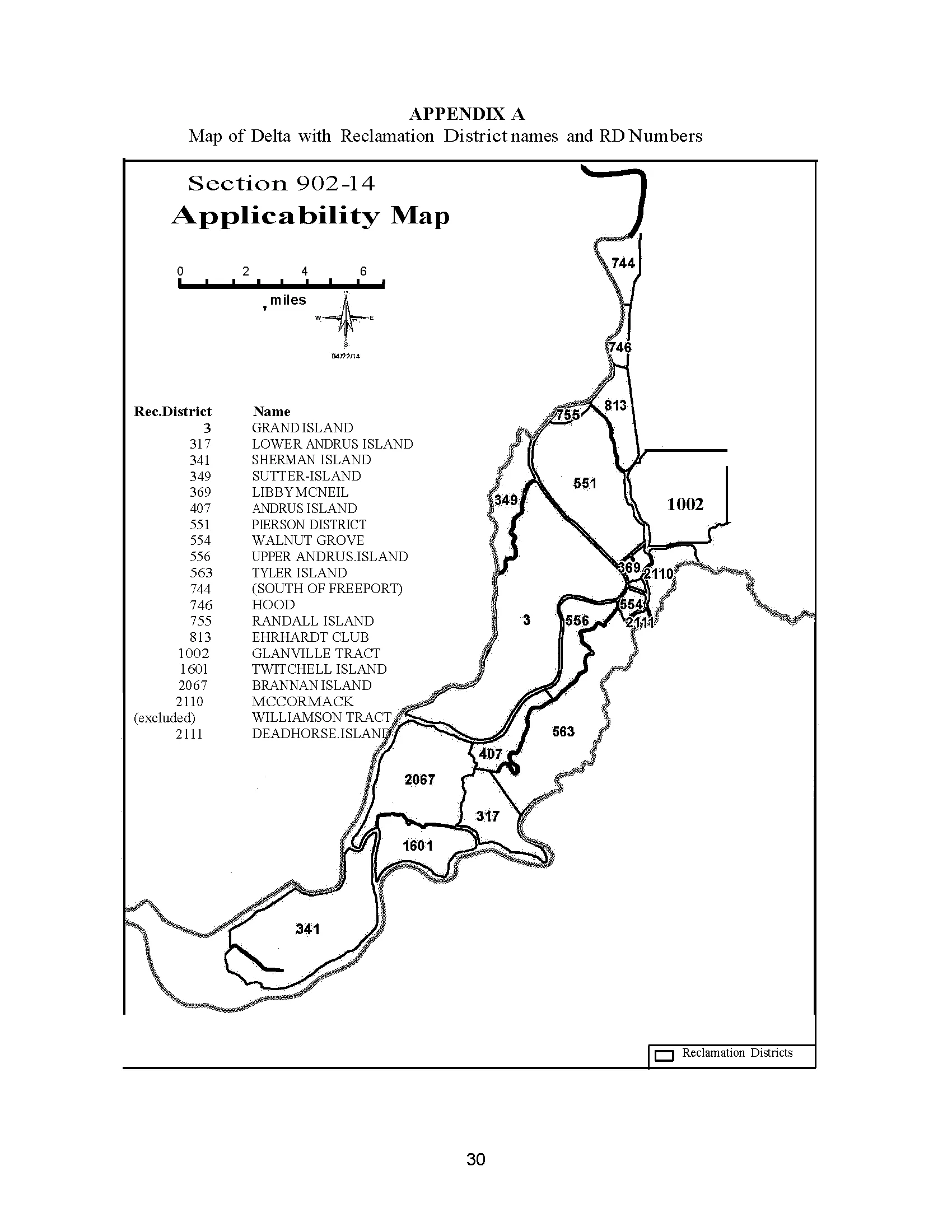
APPENDIX B: NFIP Technical Bulletins
Section titled “APPENDIX B: NFIP Technical Bulletins”As of March 2009, the following Technical Bulletins are available on www.FEMA.gov (search NFIP Technical Bulletins)
-
Technical Bulletin 1 Openings in Foundation Walls and Wall Enclosures Provides guidance on the NFIP regulations concerning the requirement for openings in below-Base Flood Elevation foundation walls for buildings located in Zones A, AE, A1-A30, AR, AO, and AH.
-
Technical Bulletin 2 Flood Damage-Resistant Materials Requirements- Provides guidance on the NFIP regulations concerning the required use of flood damage resistant construction materials for building components located below the Base Flood Elevation in Special Flood Areas (both A and V Zones).
-
Technical Bulletin 3 Non-Residential Floodproofing provides guidance on the NFIP regulations concerning watertight construction and the required certification for floodproofed non-residential buildings in Zones A, AE, A1-A30, AR, AO, and AH whose lowest floors are below the Base Flood Elevation.
-
Technical Bulletin 4 Elevator Installation- Provides guidance on the NFIP regulations concerning the installation of elevators below the Base Flood Elevation in Special Flood Hazard Areas (both A and V Zones).
-
Technical Bulletin 5 Free Of Obstruction Requirements- Provides guidance on the NFIP regulations concerning obstructions to flood waters below elevated buildings and on building sites in Coastal High Hazard Areas (Zones V, VE, and V1-V30).
-
Technical Bulletin 6 Below Grade Parking- Provides guidance on the NFIP regulations concerning the design of below-grade parking garages beneath buildings located in Zones A, AE, A1-A30, AR, AO, and AH.
-
Technical Bulletin 7 Wet Floodproofing - Provides guidance on the NFIP regulations concerning wet floodproofing of certain types of structures located in Zones A, AE, A1-A30, AR, AO, and AH.
-
Technical Bulletin 10 Ensuring That Structures Built On Fill In Or Near Special Flood Hazard Areas Are Reasonably Safe From Flooding - This technical bulletin discusses building techniques, including the use of fill, that can be used to ensure structures are reasonably safe from flooding.
-
Technical Bulletin 11 Crawlspace Construction For Buildings Located In Special Flood Hazard Areas- Provides interim guidance on minimum NFIP requirements as well as best practices for crawlspace construction in the Special Flood Hazard Area. Substantial Improvement I Substantial Damage Desk Reference
-
FEMA 265 ‘The Zone A Manual: Managing Floodplain Development in Approximate Zone A Areas’
-
FEMA P-348 ‘Protecting Building Utilities from Flood Damage’
-
TB 7-93 Wet Floodproofing Requirements for structures located in Special Flood Hazard Areas
-
FEMA P-758 Substantial Improvement and Substantial Damage Desk Reference
APPENDIX C: Section 905-02 Fees
Section titled “APPENDIX C: Section 905-02 Fees”Fees Effective February 28, 2020
| Service | Fee |
|---|---|
| Residential Elevation Certificate for New Construction (limit 3 site visits) | $986 |
| Certified Elevation for Pool Deck (limit 2 site visits) | $735 |
| Floodplain Management Permit for Bam/Garage below BFE such as Delta (limit 2 site visits) | $735 |
| Elevation Certificate for Existing Structure (limit 1 site visit) | $484 |
| Floodplain Management such as fill in a floodplain or a hold harmless (limit 2 site visits) | $735 |
| Letter of Map Amendment [1] | $107 |
| Hold Harmless and Indemnification Documents [1] | $107 |
| Fill in the Floodplain Complaint (2 site visits) | $735 |
| Encroachment Permit Review billed per hour after first 2 hours | hourly |
| Drainage Master Plan review billed per hour (outside of Zone 11) | hourly |
| Improvement plan review billed per hour (outside of Zone 11) | hourly |
| Variances review billed per hour | hourly |
| Appeals billed per hour | hourly |
[1] These are stand-alone fees that are included in any of the above-listed fees.
APPENDIX D: 200-Year ULOP Applicability Area
Section titled “APPENDIX D: 200-Year ULOP Applicability Area”