Chapter 3: Use Regulations
Sacramento County Zoning Code
Chapter 3: Use Regulations
Section titled “Sacramento County Zoning Code Chapter 3: Use Regulations”Amended January 10, 2025
3.1. PURPOSE AND ORGANIZATION
Section titled “3.1. PURPOSE AND ORGANIZATION”3.1.1. Purpose
Section titled “3.1.1. Purpose”This Chapter describes the land uses allowed in Sacramento County and the applicable use- specific standards.
3.1.2. Chapter Organization
Section titled “3.1.2. Chapter Organization”3.1.2.A. Table of Allowed Uses
Section titled “3.1.2.A. Table of Allowed Uses”Section 3.2 contains tables that list the allowed uses, accessory uses, and temporary uses in all zoning districts, along with the approval process required for each use.
3.1.2.B. Use-Specific Standards
Section titled “3.1.2.B. Use-Specific Standards”Sections 3.3 through 3.8 list the specific requirements applicable to certain use types, regardless of the district in which such use is located.
3.1.2.C. Accessory Use Standards
Section titled “3.1.2.C. Accessory Use Standards”Section 3.9 sets out the use-specific standards for accessory uses. In some cases, these standards differ based upon the base or combining zoning district it is located within.
3.1.2.D. Temporary Use Standards
Section titled “3.1.2.D. Temporary Use Standards”Section 3.10 includes use-specific standards for temporary uses. In some cases, these standards may differ due to regulations for the base or combining zoning district.
3.2. TABLES OF ALLOWED USES
Section titled “3.2. TABLES OF ALLOWED USES”3.2.1. Tables Organization
Section titled “3.2.1. Tables Organization”[AMENDED 04-07-2016]
In Tables 3.1, 3.2, and 3.3, land uses and activities are classified into general use categories, use subcategories, and specific use types based on common functional, product, or physical characteristics such as the type and amount of activity, the type of customers or residents, how goods or services are sold or delivered, and site conditions. This classification provides a systematic basis for assigning present and future land uses into appropriate zoning districts.
3.2.2. Explanation of Table Abbreviations
Section titled “3.2.2. Explanation of Table Abbreviations”3.2.2.A. Permitted Uses
Section titled “3.2.2.A. Permitted Uses”“P” in a cell indicates that the use is a “Permitted Primary Use” and is allowed by right, subject to complying with the regulations of the respective zoning district in which the use is located, including Design Review, as provided by Section 6.3.2 of this Code.
3.2.2.B. Conditional Uses
Section titled “3.2.2.B. Conditional Uses”-
A three-letter acronym, as detailed below, in a cell indicates that in the respective zoning district the use is allowed only if reviewed and approved in accordance with the procedures of Section 6.4.3, “Conditional Use Permits.” Conditional Uses are subject to all other applicable regulations of this Code, including the use-specific standards in this Chapter and the requirements of Chapter 5, “Development Standards”.
- "UPM" indicates that the decision authority for the Minor Use Permit shall be the Planning Director, unless bundling rules, described in the County Zoning Code User Guide (User Guide), result in a higher decision body.
- "UPZ" indicates that the decision authority for the Conditional Use Permit shall be the Zoning Administrator, unless the bundling rules, described in the User Guide, result in a higher decision body.
- "UPP" indicates that the decision authority for the Conditional Use Permit shall be the Planning Commission, unless the bundling rules, described in the User Guide, result in a higher decision body.
- "UPB" indicates that the decision authority for the Conditional Use Permit shall be the Board of Supervisors.
-
A conditional use designation in a given district does not constitute an authorization or an assurance that such use will be permitted. Rather, each Conditional Use Permit application shall be evaluated as to its probable effect on adjacent properties and surrounding areas, among other factors, and may be approved or denied based on appropriate findings.
3.2.2.C. Accessory Uses
Section titled “3.2.2.C. Accessory Uses”“A” in a cell indicates that in the respective zoning district the use is allowed by right as an accessory use, without special conditions other than those imposed upon other accessory uses by right in the zoning district. Accessory uses are subject to all other applicable regulations of this Code, including Section 3.9, “Accessory Uses.”
3.2.2.D. Temporary Uses
Section titled “3.2.2.D. Temporary Uses”-
“TUZ” in a cell indicates that in the respective zoning district the use is allowed only if reviewed and approved in accordance with the procedures of Section 6.5.7, “Temporary Use Permit.” Temporary uses are subject to all other applicable regulations of this Code, including Section 3.10, “Temporary Uses.”
-
“T” indicates that a use is allowed by right as a temporary use, subject to all other applicable regulation of the Code, including Section 3.10, “Temporary Uses.”
3.2.2.E. Prohibited Uses
Section titled “3.2.2.E. Prohibited Uses”A blank cell indicates that the use is prohibited in the respective zoning district.
3.2.2.F. Use Standards
Section titled “3.2.2.F. Use Standards”A cross-reference in the last column of the table refers to use standards in this Chapter. Use standards apply to the uses in the zoning districts that are shaded in gray. When a use standard is indicated, the use is allowed when it conforms to the indicated use standard.
3.2.3. Use for Other Purposes
Section titled “3.2.3. Use for Other Purposes”Approval of a use listed in Table 3.1, 3.2, and 3.3, and compliance with the applicable use-specific standards for that use, does not prohibit additional uses as long as those additional uses are specifically allowed in Table 3.1, 3.2, and 3.3 and approved under the appropriate process.
3.2.4. Uses Not Provided in the Tables
Section titled “3.2.4. Uses Not Provided in the Tables”[AMENDED 02-24-2017][AMENDED 05-11-2017]
3.2.4.A.
Section titled “3.2.4.A.”If a use is not listed in Table 3.1, 3.2, or 3.3, included in a use definition, or shown as a permitted or conditionally permitted use in any zoning district, the use is prohibited, unless the Planning Director determines that either:
-
The use is substantially similar in characteristics, intensity, and compatibility to a use or uses within the zoning district, applicable to the property; or
-
The use would be appropriate in the zoning district, applicable to the property as a permitted or conditional use.
3.2.4.B.
Section titled “3.2.4.B.”In those cases where the Planning Director makes a determination that the use meets either Sections 3.2.1 or 3.2.2, the use shall conform to all the regulations, conditions of approval, and use standards applicable to the similar described use(s). If the use would be appropriate in the zoning district as a conditional use, a Conditional Use Permit shall be heard by the designated hearing body for the similar use.
3.2.4.C.
Section titled “3.2.4.C.”Commercial cannabis activities as defined in Section 7.3 of this Code are prohibited in all Zoning Districts. [AMENDED 07-16-2020].
3.2.5. Allowed Uses in All Zoning Districts
Section titled “3.2.5. Allowed Uses in All Zoning Districts”[AMENDED 09-09-2022][AMENDED 06-06-2024]
TABLE 3.1: ALLOWED USES
Section titled “TABLE 3.1: ALLOWED USES”Amended June 22, 2017 & December 1, 2017 & January 12, 2019 & July 16, 2020 & February 25, 2021 & September 9, 2022 & June 6, 2024 & July 4, 2024 & July 11, 2024
TABLE 3.2: ALLOWED ACCESSORY USES
Section titled “TABLE 3.2: ALLOWED ACCESSORY USES”Amended February 24, 2017 & May 11, 2017 & June 22, 2017 & December 1, 2017 & May 11, 2018 & January 12, 2019 & June 20, 2019 & September 18, 2019 & July 16, 2020 & January 15, 2021 & September 9, 2022
TABLE 3.3: ALLOWED TEMPORARY USES
Section titled “TABLE 3.3: ALLOWED TEMPORARY USES”Amended April 7, 2016 & July 16, 2020
3.3. USE STANDARDS, GENERALLY
Section titled “3.3. USE STANDARDS, GENERALLY”3.3.1. Applicability
Section titled “3.3.1. Applicability”The use standards of this Chapter apply to the named use in every zoning district where the use is allowed, unless otherwise specified in the use standard or as specified in a Conditional Use Permit approval. The use standards shall be in addition to, and not in lieu of, all other generally applicable development standards in this Code. Where the provisions of the use standards or requirements conflict with other provisions of this Code, the more restrictive standards or requirements shall apply.
The use standards are not intended to replace or otherwise limit in any manner other County regulations or to preclude the imposition of reasonable Use Permit conditions, as authorized in this Code.
3.4. AGRICULTURAL USE STANDARDS
Section titled “3.4. AGRICULTURAL USE STANDARDS”3.4.1. General Agricultural Uses
Section titled “3.4.1. General Agricultural Uses”3.4.1.A.
Section titled “3.4.1.A.”In the AR-1 zone, general agricultural uses are permitted only on lots of 150 feet or greater in width.
3.4.1.B.
Section titled “3.4.1.B.”[DELETED 03-09-2016]
3.4.2. Beekeeping
Section titled “3.4.2. Beekeeping”[AMENDED 02-24-2017]
3.4.2.A.
Section titled “3.4.2.A.”Commercial beekeeping in all Agricultural and Agricultural-Residential zoning districts (except AR-1zoned properties less than 150 feet in width) is a permitted primary use. Hive owners must maintain current registration with the Sacramento County Agricultural Commissioner in compliance with state statutes, including required hive movement notices. Any commercial colony that is not properly registered shall be removed from the property and may not be returned to the property for at least six weeks from the date of registering the colony at another site.
3.4.2.B.
Section titled “3.4.2.B.”Non-commercial beekeeping use, where the keeping of honey bees is incidental to a permitted residential or non-residential use and beekeeping products do not constitute a significant source of income to a beekeeper, is permitted in the AR-1, Residential, Recreation, Mixed Use, Commercial and Industrial zoning districts provided compliance with the following minimum standards:
1. Registration and Location
Section titled “1. Registration and Location”- Hive owners must maintain a current registration status with the Agricultural Commissioner in compliance with applicable state statutes, including required hive movement notices. Any colony that is not properly registered shall be removed from the property and may not be returned to the property for at least six weeks from the date of registering the colony at another site.
- When hives are located on a parcel where the beekeeper is not the resident or occupant, contact information for the beekeeper shall be legible and visible. A beekeeper must have documentation of specific approval to locate beehives on property owned, rented or leased by others.
- Non- commercial beekeeping is allowed unless it has been determined that beehives will pose a hazard to public health. Nuisance bee behavior may require remedial action upon notice by the County. Procedures for determining where beekeeping is not allowed and for noticing of required remedial actions are detailed in Section 3.4.2.B.3.
- Procedures may require the removal of all hives from a property, through no direct fault of the beekeeper, but because a health or safety situation has been shown to exist. Once property has been declared unsafe for beekeeping, it shall not be legal to maintain bees on that property until such status is removed in writing. Failure to comply with specified remedial action will constitute a violation of this Code.
- The number, location, and arrangement of hives on a property must be in conformance with Section 3.4.2.B.2.
2. Performance Standards
Section titled “2. Performance Standards”- The minimum lot size required for the keeping of bees is 5,000 square feet.
- There shall be no more than two bee hives established on parcels less than 10,000 square feet, except two additional temporary hives are allowed for hive management purposes to minimize the likelihood of swarming. Such temporary hives shall be removed from the property within 60 days.
- There shall be no more than four bee hives established on parcels from 10,000 to 20,000 square feet, except four additional temporary hives are allowed for hive management purposes to minimize the likelihood of swarming. Such temporary hives shall be removed from the property within 60 days.
- There shall be no more than six bee hives established on parcels greater than 20,000 square feet, except six additional temporary hives are allowed for hive management purposes to minimize the likelihood of swarming. Such temporary hives shall be removed from the property within 60 days.
- Ground level hives shall be placed on the parcel such that they are enclosed by fencing or similar barrier that prevents unauthorized access.
- A solid fence, dense hedge, or similar barrier must be established in front of the entrance of all ground level hives so that bee departures and arrivals occur no less than six feet in height at interior property lines.
- The minimum width of the barrier for the purpose of influencing the flyway shall extend two feet from each side of the hive openings.
- Roof level hives are allowed provided physical security is maintained.
- A permanent fresh water source shall be provided on the same parcel prior to the establishment of bee hives and maintained within 15 feet of the hives.
3. Enforcement
Section titled “3. Enforcement”As provided for by Section 6.6 of the Code, any violation of this section may result in the withdrawal of beekeeping privileges from any property by written notification to the property owner by the Planning Director. Withdrawal must be done with cause, however, the causes need not be the fault of the beekeeper, nor be a factor that is under the control of the beekeeper.
Any condition or combination of circumstances that, in the opinion of the Director, creates problems contrary to public health, safety, or general welfare or constitutes a public nuisance will be considered valid cause to withdraw privileges to keep bee colonies on the property. The Planning Director shall remove privileges if:
- Written documentation over a medical doctor's signature certifies that a medical condition caused by beestings to a resident of abutting property would constitute a higher than normal death-threatening or hospitalization event.
- Abnormally aggressive behavior is exhibited by bees beyond the property lines.
- After consultation with the Agricultural Commissioner and/or the Agricultural Advisory Committee, it is found that beekeeping practices are inconsistent with beekeeping best management practices.
- Beekeeping activities do not comply with the performance standards of Section 3.4.2.B.2.
Once any property owner has been noticed of a withdrawal of privilege to keep bee colonies on a particular property, such privilege may be reestablished only upon written request and approval of the Planning Director. A Director’s Determination may be appealed to the Board of Supervisors. Where privilege is withdrawn, all beehives shall be abated as provided for in Section 6.6.9 of the Code.
3.4.3. Feedlots
Section titled “3.4.3. Feedlots”[DELETED]
3.4.4. Hog Farm
Section titled “3.4.4. Hog Farm”In the AR-2 zone, a maximum of three adult hogs are permitted.
3.4.5. Kill Floor
Section titled “3.4.5. Kill Floor”Permitted subject to a Conditional Use Permit approved by the Zoning Administrator and a valid Kill Floor License from the State Department of Food and Agriculture. The operation may be conditioned to limit hours of operation, limit the frequency of customers, and any other conditions deemed appropriate under the specific circumstances.
3.4.6. Stables and Corrals
Section titled “3.4.6. Stables and Corrals”[AMENDED 12-01-2017]
Riding stables, boarding stables, riding academies, and other stables and corrals, whether private or commercial, shall comply with the following minimum standards as applicable.
3.4.6.A.
Section titled “3.4.6.A.”Any corral, riding ring, or exercise yard used for keeping horses shall be enclosed by a fence or other enclosure; and no part of any such corral, riding ring, or exercise yard shall be located closer than 20 feet to any door, window, or other opening of any building or structure on the same or any other parcel used or designed to be used for human habitation.
3.4.6.B.
Section titled “3.4.6.B.”All fences that enclose livestock shall be constructed of an adequate height and shall be designed so as to control and contain such livestock at all times and so as to prevent such livestock from crossing any property lines or damaging adjacent property.
3.4.6.C.
Section titled “3.4.6.C.”An operator of a commercial or private stable or corral shall not allow dust, odor, or flies to cause nuisance or annoyance to any considerable number of persons in the neighborhood or the public and at a minimum shall comply with the following:
-
All areas shall be maintained so as to be sufficiently dust-free so that no visible quantity of dust is observable at the property lines of the parcel. This shall be done by maintaining sufficient natural vegetation, by watering down corral area as often as necessary to prevent dust problems, or by utilizing other more effective dust prevention methods.
-
The operator of a stable shall take every reasonable precaution to prevent the breeding of flies or the emission of dust or odors into the neighborhood. Reasonable precautions shall include:
- Routine manure and bedding clean out of stalls and routine cleanup of manure deposited on the property.
- Disposal of animal wastes, such as:
- Properly drying or composting away from neighboring properties.
- Burying to a minimum depth of two feet.
- Removal to approved disposal site.
- All areas shall be maintained in a sanitary condition and in compliance with the following standards:
- Water usage and drainage shall not mix with manure accumulations and shall not be disposed of contrary to local and state requirements.
- Animal feed shall be stored and utilized in a manner that will not encourage rodent populations.
3.4.6.D. Minimum Lot Area
Section titled “3.4.6.D. Minimum Lot Area”-
For any commercial or public stable or corral the minimum lot area shall be three acres.
-
For any private stable or corral, the minimum lot area shall be 20,000 square feet.
3.4.6.E. Private Stable Development Standards
Section titled “3.4.6.E. Private Stable Development Standards”See Section 5.3.2.C. for standards in Agricultural and Agricultural-Residential zones (Table 5.6) and Section 5.4.5.B. for standards in Residential zones (Table 5.10- Agricultural Accessory Structures).
3.4.6.F. Commercial or Public Stable Development Standards
Section titled “3.4.6.F. Commercial or Public Stable Development Standards”-
In Residential zones:
- Building areas shall not exceed 1,000 square feet.
- Building height shall not exceed 30 feet and two stories.
- Front yard setbacks shall be 30 feet without a PUPFE and 35 feet with a PUPFE.
- Side and rear yard setbacks shall be 30 feet.
-
In Agricultural-Residential zoning districts, the standards of Section 5.3.2.C. (Table 5.6) shall apply.
-
In Agricultural and Recreation zoning districts, where allowed, the standards of Section 5.3.2.B. (Table 5.5) shall apply.
3.4.7. Field Retail Stands, Farm Stands, Produce Stands, Urban Agricultural Stands, Agricultural Markets
Section titled “3.4.7. Field Retail Stands, Farm Stands, Produce Stands, Urban Agricultural Stands, Agricultural Markets”[AMENDED 02-24-2017]
3.4.7.A. Application
Section titled “3.4.7.A. Application”The standards for roadside crop sales that follow shall apply to Field Retail Stands, Farm Stands, Produce Stands, Urban Agricultural Stands, and Agricultural Markets, as defined in Section 7.3.
3.4.7.B. Purpose
Section titled “3.4.7.B. Purpose”Provide for sales locations (field retail stands, farm stands, produce stands, urban agricultural stands, and agricultural markets) where food products are grown and to set forth the permitting requirements and development standards to be applied to field retail stands, farm stands, produce stands, urban agricultural stands, and agricultural markets for the sale of crops.
3.4.7.C. Allowed Use
Section titled “3.4.7.C. Allowed Use”-
Roadside crop sales at field retail stands, farm stands, produce stands, and agricultural markets are permitted by right in the AG, UR, IR, AR-10, AR-5, AR-2, RR, and O zones, subject to compliance with the standards that follow.
-
Roadside crop sales at field retail stands may be allowed by Conditional Use Permit approved by the Zoning Administrator in the AR-1, RD-1, and RD-2 zones, subject to compliance with the standards that follow.
-
Roadside crop sales at farm stands may be allowed by Conditional Use Permit approved by the Zoning Administrator in the AR-1, RD-1, RD-2, and RD-3 zones, subject to compliance with the standards that follow.
-
Roadside crop sales at urban agricultural stands are permitted at private, market and community gardens subject to compliance with the standards of Section 3.4.7.G.
-
The sale of locally grown agricultural products in addition to those identified in the following standards for Field Retail Stands, Farm Stands, Produce Stands, and Agricultural Markets may be permitted subject to issuance of a Conditional Use Permit approved by the Zoning Administrator. The sale of products at Urban Agricultural Stands is limited to those items grown or produced on site.
3.4.7.D. Standards for Field Retail Stands
Section titled “3.4.7.D. Standards for Field Retail Stands”Field retail stands allowed under Section 3.4.7.C shall comply with the following standards:
-
Field Retail Stands shall be operated by the producer and on premises controlled by the producer.
-
Products sold shall be limited to shell eggs and crops that are grown by the producer; and agricultural and food preparation related items. Local crops not grown by the producer may be sold at events subject to a community event permit from the Environmental Management Department.
-
Agricultural and food preparation related items shall be limited to 25 percent of the total storage and sales area of the Field Retail Stand.
-
No activities related to the sale of products from Field Retail Stands shall take place on public property right-of-way.
-
There shall be no more than one Field Retail Stand per parcel.
-
Field Retail Stands shall meet the setback standards of the zoning district in which they are located.
-
No building shall have more than 1,500 square feet of indoor sales area and shall have a total enclosed area of no more than 3,000 square feet.
-
The use, including location of merchandise and parking areas, shall comply with the visibility requirements of the Sacramento County Improvement Standards.
-
Signs shall be allowed provided that:
- There is no more than one sign at each entrance.
- The sign is not over 50 square feet in area.
- The sign is not more than six feet above road grade.
- The sign is setback at least 10 feet from the street right-of-way unless a lesser setback is approved by the Division of Planning and Environmental Review. For rights-of-way with public utility, public facility easements, the sign is setback at least 14 feet from the street right-of-way unless a lesser setback is approved by the Division of Planning and Environmental Review.
- Illumination of the sign, if any, is indirect.
- The sign is stationary.
3.4.7.E. Standards for Farm Stands
Section titled “3.4.7.E. Standards for Farm Stands”Farm stands allowed under Section 3.4.7.C shall comply with the following standards:
-
Farm Stands shall be operated by the producer and on premises controlled by the producer.
-
Products sold shall be limited to shell eggs and crops that are grown by the producer; and agricultural and food preparation related items. Local crops not grown by the producer may be sold at events subject to a community event permit from the Environmental Management Department.
-
Non-potentially hazardous prepackaged food products, including bottled water and soft drinks, from an approved source that have not been grown or produced in close proximity to the Farm Stand shall be limited to a five square foot storage and sales area.
-
Agricultural and food preparation related items shall be limited to 25 percent of the total storage and sales area of the Farm Stand.
-
No activities related to the sale of products from Farm Stands shall take place on public property right-of-way.
-
There shall be no more than one farm stand per parcel.
-
Farm Stands shall meet the setback standards of the zoning district in which they are located.
-
No building shall have more than 1,500 square feet of indoor sales area and shall have a total enclosed area of no more than 3,000 square feet.
-
No part of this use, including merchandise or parking area, shall be located within the triangular clear visibility area defined in this Code.
-
Signs shall be allowed provided that:
- There is no more than one sign at each entrance.
- The sign is not over 50 square feet in area.
- The sign is not more than six feet above road grade.
- The sign is setback at least 10 feet from the street right-of-way unless a lesser setback is approved by the Division of Planning and Environmental Review. For rights-of-way with public utility, public facility easements, the sign is setback at least 14 feet from the street right-of-way unless a lesser setback is approved by the Division of Planning and Environmental Review.
- Illumination of the sign, if any, is indirect.
- The sign is stationary.
3.4.7.F. Standards for Produce Stands
Section titled “3.4.7.F. Standards for Produce Stands”Produce stands allowed under Section 3.4.7.C shall comply with the following standards:
-
Produce stands shall be operated by the property owner or lessee of the agricultural property.
-
Products sold shall be limited to shell eggs and crops that are locally grown; and agricultural and food preparation related items.
-
Agricultural and food preparation related items shall be limited to 25 percent of the total storage and sales area of the Produce Stand.
-
Produce Stands shall be located within fully enclosed structures with potable hot and cold running water, and shall have septic systems or be hooked up to the sewer system.
-
No activities related to the sale of products from Produce Stands shall take place on public property right-of-way.
-
There shall be no more than one Produce Stand per parcel.
-
Produce Stands shall meet the setback standards of the zoning district in which they are located.
-
No building shall have more than 1,500 square feet of indoor sales area and shall have a total enclosed area of no more than 3,000 square feet, including storage area.
-
No part of this use, including merchandise or parking area, shall be located within the triangular clear visibility area defined in this Code.
-
Signs shall be allowed provided that:
- There is no more than one sign at each entrance.
- The sign is not over 50 square feet in area.
- The sign is not more than six feet above road grade.
- The sign is setback at least 10 feet from the street right-of-way unless a lesser setback is approved by the Division of Planning and Environmental Review. For rights-of-way with public utility, public facility easements, the sign is setback at least 14 feet from the street right-of-way unless a lesser setback is approved by the Division of Planning and Environmental Review.
- Illumination of the sign, if any, is indirect.
- The sign is stationary.
3.4.7.G. Standards for Urban Agricultural Stands
Section titled “3.4.7.G. Standards for Urban Agricultural Stands”Urban agricultural stands allowed under Section 3.4.7.C. shall comply with the following standards:
-
Urban agricultural stands shall be operated by the property owner or lessee on which a private, market or community is established.
-
Products sold at urban agricultural stands shall be limited to produce, eggs, and honey grown on site or cottage foods when processed and sold consistent with a cottage food permit and any other applicable permits and/or requirements.
-
Cottage foods sold shall be limited to the approved cottage foods list maintained by the California Department of Public Health.
-
Cannabis or products containing cannabis shall not be sold. [AMENDED 07-16-2020]
-
Products sold are subject to all quarantine laws and regulations in place at the time of sale.
-
The sale of produce must meet the requirements for labeling, record keeping, signage and best management practices as listed in the CA HSC §114376.
-
There shall be no more than one urban agricultural stand per parcel.
-
No activities related to the sale of products from urban agricultural stands shall take place within the public right-of-way, or block pedestrian or vehicle mobility on the parcel.
-
One sign shall be allowed provided that:
- The sign shall be a portable sign, and may be an A frame.
- The sign, including supports, shall fit into an area of not more than four feet in height, three feet in width, and three feet in depth.
- The sign is not located within the public right-of-way and does not block pedestrian or vehicle mobility.
- The sign is removed and stored out of public view during non-operation hours.
-
An urban agricultural stand may operate only between sunrise and sunset.
-
Urban agricultural stands shall consist of removable “pop up” canopy tents or similar temporary, removable shade structure no more than 12 feet in height and removable tables.
-
Urban agricultural stands shall be dismantled, removed or stored out of public view during non-operation hours.
-
Urban agricultural stands with 120 square feet of tented space or less are allowed with a Temporary Use Permit subject to these standards and the temporary use standards specific to urban agricultural stands of Section 3.10.3.I.
-
Urban Agricultural Stands with greater than 120 square feet of tented space shall be subject to a Conditional Use Permit approved by the Zoning Administrator. Failure to comply with the standards of this section or any conditions of the Conditional Use Permit may result in the revocation of the Use Permit pursuant to Section 6.4.1.G.
3.4.7.H. Standards for Agricultural Markets
Section titled “3.4.7.H. Standards for Agricultural Markets”Agricultural Markets allowed under Section 3.4.7.C. shall comply with the following standards:
-
Agricultural Markets shall be operated by the property owner or lessee of the agricultural property.
-
Products sold shall be limited to shell eggs and crops that are locally grown; non- potentially hazardous prepackaged food products from an approved source that were grown or produced in close proximity to the agricultural market; non-potentially hazardous prepackaged food products from an approved source, including bottled water and soft drinks, that have not been grown or produced in close proximity to the agricultural market; and agricultural and food preparation related items.
-
Non-potentially hazardous prepackaged food products that have not been grown or produced in close proximity to the agricultural market shall be limited to 25 percent of the total storage and sales area of the Agricultural Market.
-
Agricultural and food preparation related items shall be limited to 25 percent of the total storage and sales area of the Agricultural Market.
-
Agricultural Markets shall be located within fully enclosed structures with potable hot and cold running water, and shall have septic systems or be hooked up to the sewer system.
-
No activities related to the sale of products from Agricultural Markets shall take place on public property right-of-way.
-
There shall be no more than one Agricultural Market per parcel.
-
Agricultural Markets shall meet the setback standards of the zoning district in which they are located.
-
No building shall have more than 1,500 square feet of indoor sales area and shall have a total enclosed area of no more than 3,000 square feet, including storage area.
-
No part of this use, including merchandise or parking area, shall be located within the triangular clear visibility area defined in this Code.
-
Signs shall be allowed provided that:
- There is no more than one sign at each entrance.
- The sign is not over 50 square feet in area.
- The sign is not more than six feet above road grade.
- The sign is setback at least 10 feet from the street right-of-way unless a lesser setback is approved by the Division of Planning and Environmental Review. For rights-of-way with public utility, public facility easements, the sign setback is at least 14 feet from the street right-of-way, unless a lesser setback is approved.
- Illumination of the sign, if any, is indirect.
- The sign is stationary.
3.4.7.I. Events at Field Retail Stands, Farm Stands, Produce Stands, and Agricultural Markets
Section titled “3.4.7.I. Events at Field Retail Stands, Farm Stands, Produce Stands, and Agricultural Markets”Events shall be allowed at Field Retail Stands, Farm Stands, Produce Stands, and Agricultural Markets pursuant to Table 3.4. Larger events may be allowed pursuant to issuance of a Conditional Use Permit approved by the Zoning Administrator.
TABLE 3.4
Section titled “TABLE 3.4”| Total Parcel Size (Acres) | Maximum Number of Attendees (Peak) [1][2][3] |
|---|---|
| 1.0-2.5 | 50 people |
| 2.51-5.0 | 100 people |
| 5.01-10.0 | 200 people |
| 10.01-20.0 | 300 people |
| Over 20.0 | 350 people |
[1] Permitted as an accessory use; the primary use of the parcel must be agricultural.
[2] Outdoor activities are limited to Sunday through Thursday 8:00 a.m. to 7:00 p.m.; and Friday, Saturday, and holidays 8:00 a.m. to 11:00 p.m. Indoor activities are permitted without restrictions as to day and time.
[3] All events are subject to the Sacramento County Noise Ordinance.
3.4.7.J. Parking Requirements for Field Retail Stands, Farm Stands, Produce Stands, Urban Agricultural Stands, and Agricultural Markets
Section titled “3.4.7.J. Parking Requirements for Field Retail Stands, Farm Stands, Produce Stands, Urban Agricultural Stands, and Agricultural Markets”-
Field Retail Stands, Farm Stands, Produce Stands, Urban Agricultural Stands, and Agricultural Markets shall not be subject to the development standards for off-street parking outlined in this Code.
-
An off-street parking ratio of one space per 400 square feet of gross floor area dedicated to sales shall be required for Field Retail Stands, Farm Stands, Produce Stands, and Agricultural Market.
-
All access roads must meet the standards of the Fire Marshall. All parking areas for Field Retail Stands, Farm Stands, Produce Stands, and Agricultural Markets must have an active dust control program.
-
Parking lot lighting as defined in the Code will be required if the Field Retail Stand, Farm Stand, Produce Stand, or Agricultural Market is open to the public after sunset.
-
Parking for two cars for Urban Agricultural Stands shall be provided either on-street or in an off-street parking facility accessed by an approved driveway.
3.4.7.K. Advisory for Other Permitting Requirements
Section titled “3.4.7.K. Advisory for Other Permitting Requirements”-
All waste, both solid and liquid, shall be managed in accordance with local, state, and federal rules, regulations, and ordinances pertaining to such waste.
-
Environmental Management Department approval/permit for a water system is required for Field Retail Stands, Farm Stands, Produce Stands, and Agricultural Markets unless documentation that the regulations are not applicable is provided.
-
Environmental Management Department approval is required for Farm Stands, Produce Stands, Community Stands and Agricultural Markets (Environmental Management Department regulations for Agricultural Markets are similar to those for convenience stores).
-
Environmental Management Department approval/permit is required for events at Field Retail Stands, Farm Stands, Produce Stands and Agricultural Markets. Community event permits from Environmental Management Department that allow the sale of locally grown crops not grown on premises controlled by the producer at Field Retail Stands and Farm Stands must adhere to the definition of community event in the CA HSC §113755.
-
The sale of cottage foods are allowed at Urban Agricultural Stands when processed and sold consistent with a cottage food permit and any other applicable permits and/or requirements.
-
Should any cultural resources, such as structural features, unusual amounts of bone or shell, artifacts, human remains, or architectural remains be encountered during any development activities, associated with Field Retail Stands, Farm Stands, Produce Stands, and Agricultural Markets, work shall be suspended and the Division of Planning and Environmental Review shall be immediately notified.
At that time, the Division of Planning and Environmental Review will coordinate any necessary investigation of the find with appropriate specialists as needed. The project proponent shall be required to implement any mitigation deemed necessary for the protection of the cultural resources. In addition, pursuant to CA PRC §5097 and CA HSC §7050.5, in the event of the discovery of human remains, all work is to stop and the County Coroner shall be immediately notified. If the remains are determined to be Native American, guidelines of the Native American Heritage Commission shall be adhered to in the treatment and disposition of the remains. -
In order to mitigate impacts to potentially historic buildings associated with Field Retail Stands, Farm Stands, Produce Stands, and Agricultural Markets (buildings 100 years old and older), perform one of the following:
- Structures that have not been subject to a previous architectural evaluation and are at least 100 years or older and are subject to renovation shall have a historical architectural study performed by a qualified, professional architectural historian. A significance determination shall be prepared for review by the staff of the Division of Planning and Environmental Review. If the structure is deemed a significant historic resource, the applicant shall comply with Section 3.4.7.J.7.; or,
- Property owners proposing to renovate an existing structure shall submit photographs of the structure to the Division of Planning and Environmental Review. Planning and Environmental Review staff shall determine whether a historical evaluation is warranted. If Planning and Environmental Review staff determines that a historical evaluation is warranted, the applicant shall have a historical architectural study performed by a qualified, professional architectural historian for review by Planning and Environmental Review staff. If the structure is deemed a significant historic resource, the applicant shall comply with Section 3.4.7.J.7.; or,
- Comply with Section 3.4.7.J.7. and forgo the need to submit photographs or a historical architectural evaluation.
-
Structures deemed to be significant historical architectural resources shall be preserved in situ with all proposed modifications carried out to the Secretary of Interior’s Standards for the Treatment of Historic Properties with Guidelines for Preserving, Rehabilitating, Restoring, and Reconstructing Historic Buildings.
-
Summary of Field Retail Stands, Farm Stands, Produce Stands, Urban Agricultural Stands, and Agricultural Markets.
| Type of Roadside Crop Sale | Sells Shell Eggs and Crops Grown on Premises controlled by Producer | Sells Locally Grown Crops not Grown on the Premises | Sells Non-Potentially Hazardous Pre-packaged Food | Sells Agricultural and Food Preparation Related Items | Holds Events | Maximum Size: 1,500 s.f. of indoor sales area and 3,000 s.f. of total enclosed area | Sells food prepared with a cottage food permit | Requires EMD Approval |
|---|---|---|---|---|---|---|---|---|
| Field Retail Stand | X | 1 per parcel | X | X | X | |||
| Farm Stand | X | 1 per parcel | X | X | X | X | X | X |
| Produce Stand | X | X | X | X | X | X | ||
| Community Stand | X | X | X | X | X | X | ||
| Urban Agricultural Stand | X | X | ||||||
| Agricultural Market | X | X | X | X | X | X | X |
3.4.8. Small Winery/Specialty and Craft Breweries
Section titled “3.4.8. Small Winery/Specialty and Craft Breweries”3.4.8.A. Application
Section titled “3.4.8.A. Application”The provisions of this Section shall apply to small wineries and breweries, specialty and craft as defined by Section 7.3.
3.4.8.B. Purpose
Section titled “3.4.8.B. Purpose”The purpose of this Section is to provide for the orderly development of wineries and specialty and craft breweries and associated activities within Agricultural, Commercial, Mixed Use, and Industrial zoning districts to promote economic development opportunities for the agricultural industry and to preserve agricultural lands within Sacramento County.
3.4.8.C. Allowed Uses
Section titled “3.4.8.C. Allowed Uses”-
Growing and harvesting grapes and other fruit products suitable for wine and beer, and processing and bottling of grapes, fruit, and other fruit products produced on the premises.
-
Processing and bottling of grapes, fruit, and other fruit products produced off the winery or specialty and craft brewery premises.
-
Sale of wine or beer for consumption off premises whether grown or produced on or off premises.
-
Tasting involving serving wine or beer to the public for the purpose of sampling the product produced or offered for sale, subject to the following restrictions:
- Wine or beer tasting shall be limited to five days per week unless a Minor Use Permit is approved by the Planning Director.
- Use of outdoor amplified sound shall be regulated per the Sacramento County noise ordinance.
- Sanitary facilities and potable water shall be provided pursuant to applicable codes.
-
In the AG or AR zoning districts, events shall be allowed pursuant to Table 3.6. Larger events may be allowed pursuant to the issuance of a Conditional Use Permit approved by the Zoning Administrator:
TABLE 3.6
Section titled “TABLE 3.6”Total Parcel Size (Acres) Maximum Number of Attendees (Peak) [1][2][3] 1.0-2.5 50 people 2.51-5.0 100 people 5.01-10.0 200 people 10.01-20.0 300 people Over 20.0 350 people [1] Permitted as an accessory use; the primary use of the parcel must be agricultural (if located in the AR or AG zoning districts).
[2] Outdoor activities are limited to Sunday through Thursday 8:00 a.m. to 7:00 p.m.; and Friday, Saturday, and holidays 8:00 a.m. to 11:00 p.m. Indoor activities are permitted without restrictions as to day and time.
[3] All events are subject to the Sacramento County Noise Ordinance.
-
In the Commercial, Mixed Use, and M-1 and M-2 zoning districts, there are no restrictions on the size and frequency of events provided that:
- Outdoor activities are limited to Sunday through Thursday 8:00 a.m. to 7:00 p.m.; and Friday, Saturday, and holidays 8:00 a.m. to 11:00 p.m. Indoor activities are permitted without restrictions as to day and time.
- All events are subject to the Sacramento County Noise Ordinance.
-
Processing and distillation, bottling and sale of other wine products such as brandy may occur in conjunction with the winery or specialty and craft brewery, provided that the use is incidental to the processing, bottling and sale of wine, and subject to the issuance of a Conditional Use Permit approved by the Zoning Administrator.
3.4.8.D. Standards
Section titled “3.4.8.D. Standards”- The parcel shall be licensed by the State of California Department of Alcohol Beverage Control, license Type 02, “Winegrower” or license Type 23 “Small beer manufacturer”.
- If the winery or specialty and craft brewery is located in an AG or AR zoning district, the premises shall have a minimum size of three acres.
- If the winery or specialty and craft brewery is accessed only via a private road shared by others, a Conditional Use Permit approved by the Zoning Administrator shall be required, and the permit shall require the applicant to pay its fair share of the road maintenance costs. The Planning Director may waive the requirement for a Conditional Use Permit if written verification from all property owners along the private road is submitted.
- If the winery or specialty and craft brewery is located in an AG or AR zoning district and is located less than a half mile away from a RD zoning district, a Conditional Use Permit approved by the Zoning Administrator shall be required to exceed 2,500 cases annual production.
- Annual production is limited to no more than 6,000 barrels of beer in the agricultural zoning districts.
- Annual production is limited to no more than 15,000 barrels of beer in the commercial and industrial zoning districts.
- Retail sales of wine and beer shall be limited to wine and beer manufactured on site.
- All waste, both solid and liquid, shall be managed, treated, stored, and/or disposed of in accordance with local, state, and federal rules, regulations, and ordinances pertaining to such waste.
- The primary focus of the tasting area shall be for the marketing and sale of wine, beer, or fruit products produced on site. The sale of wine related merchandise and food shall be incidental to the tasting and limited to 15 percent of the square footage of the tasting areas. Food facilities, as defined in the California Retail Food Code, Section 113789, must meet all applicable codes. If no other beverage except bottles of wine and prepackaged nonpotentially hazardous beverages is offered on sale for on-site consumption and no food except for crackers are served, the facility is not subject to the California Retail Food Code regulations. If other foods are sold, the facility shall be subject to the California Retail Food Code regulations and shall require permitting by the Environmental Management Department.
- All buildings shall meet the general agricultural building standards of the zoning district in which they are located.
3.4.8.E. Signage
Section titled “3.4.8.E. Signage”-
In the AG or AR zoning district, signs shall be allowed provided that:
- There is no more than one sign at each entrance.
- The sign is not over 50 square feet in area.
- The sign is not more than six feet above road grade or signs attached flat against the main building, or signage applied to a conforming wall or fence (in such case, area shall be computed by circumscribing the lettering and counting 100 percent).
- The sign is setback at least 10 feet from the street right-of-way unless a lesser setback is approved by the Division of Planning and Environmental Review. For rights-of-way with public utility, public facility easements, the sign setback is at least 14 feet from the street right-of-way, unless a lesser setback is approved.
- Illumination of the sign, if any, shall be externally lit. No internal illumination.
- Signs are stationary.
-
In the Commercial, Mixed Use, and M-1 and M-2 zoning districts, signs shall be allowed subject to the regulations of the commercial, mixed use, and industrial zoning district.
3.4.8.F. Advisory for Other Permitting Requirements
Section titled “3.4.8.F. Advisory for Other Permitting Requirements”-
All waste, both solid and liquid, shall be managed in accordance with local, state, and federal rules, regulations, and ordinances pertaining to such waste.
-
Environmental Management Department approval/permit for a water system is required, unless documentation is provided that the regulations are not applicable.
-
Environmental Management Department approval/permit is required for events that involve food that is sold or given away to the public.
-
Approval from the Building Inspection Division and the Fire Marshall may be required prior to the use of existing buildings for events.
-
Should any cultural resources, such as structural features, unusual amounts of bone or shell, artifacts, human remains, or architectural remains be encountered during any development activities, work shall be suspended and the Division of Planning and Environmental Review shall be immediately notified at (916) 874-7914.
-
At that time, the Division of Planning and Environmental Review will coordinate any necessary investigation of the find with appropriate specialists as needed. The project proponent shall be required to implement any mitigation deemed necessary for the protection of the cultural resources. In addition, pursuant to CA PRC §5097.97 and CA HSC §7050.5, in the event of the discovery of human remains, all work is to stop and the County Coroner shall be immediately notified. If the remains are determined to be Native American, guidelines of the Native American Heritage Commission shall be adhered to in the treatment and disposition of the remains.
-
In order to mitigate impacts to potentially historic buildings (buildings 100 years old and older), perform one of the following:
- Structures that have not been subject to a previous architectural evaluation and are at least 100 years or older and are subject to renovation shall have a historic architectural study performed by a qualified, professional architectural historian. A significance determination shall be prepared for review by the staff of the Division of Planning and Environmental Review. If the structure is deemed a significant historic resource, the applicant shall comply with Section 3.4.8.F.7; or,
- Property owners proposing to renovate an existing structure shall submit photographs of the structure to the Division of Planning and Environmental Review. Planning and Environmental Review staff shall determine whether a historical evaluation is warranted. If Planning and Environmental Review staff determines that a historical evaluation is warranted, the applicant shall have a historical architectural study performed by a qualified, professional architectural historian for review by CPDD staff. If the structure is deemed a significant historic resource, the applicant shall comply with Section 3.4.8.F.7; or,
- Comply with Section 3.4.8.F.7. and forgo the need to submit photographs or a historical architectural evaluation.
-
Structures deemed to be significant historical architectural resources shall be preserved in situ with all proposed modifications carried out to the Secretary of Interior’s Standards for the Treatment of Historic Properties with Guidelines for Preserving, Rehabilitating, Restoring, and Reconstructing Historic Buildings.
3.4.9. Large Winery/Brewery
Section titled “3.4.9. Large Winery/Brewery”3.4.9.A. Application
Section titled “3.4.9.A. Application”The provisions of this Section shall apply to large wineries or breweries as defined by Section 7.3.
3.4.9.B. Purpose
Section titled “3.4.9.B. Purpose”The purpose of this Section is to provide for the orderly development of wineries or breweries and associated activities within Agricultural and Industrial zoning districts to promote economic development opportunities for the agricultural industry and to preserve agricultural lands within Sacramento County.
3.4.9.C. Standards
Section titled “3.4.9.C. Standards”Landowners shall comply with all standards for small wineries or specialty and craft breweries, except for annual production limitations.
3.4.9.D. Allowed Uses
Section titled “3.4.9.D. Allowed Uses”-
Growing and harvesting grapes and other products suitable for wine or beer, and processing and bottling of grapes, fruit, and other products produced on the premises.
-
Processing and bottling of grapes, fruit, and other products produced off the winery or brewery premises.
-
Sale of wine or beer for consumption off premises whether grown or produced on or off premises.
-
Wine or beer tasting involving serving wine or beer to the public for the purpose of sampling the product produced or offered for sale, subject to the following restrictions:
- Use of outdoor amplified sound shall be regulated per the Sacramento County Noise Ordinance.
- Sanitary facilities and potable water shall be provided pursuant to applicable codes.
-
Events
- Events shall be allowed in the AG-20, AG-40, AG-80, and AG-160 zones, subject to the Conditional Use Permit.
- In the M-1 and M-2 zones, there are no restrictions on the size and frequency of events provided that:
- Outdoor activities are limited to Sunday through Thursday 8:00 a.m. to 7:00 p.m.; and Friday, Saturday, and holidays 8:00 a.m. to 11:00 p.m. Indoor activities are permitted without restrictions as to day and time. All events are subject to the Sacramento County Noise Ordinance.
-
Processing and distillation, bottling and sale of other wine products such as brandy may occur in conjunction with the winery or brewery, provided that the use is incidental to the processing, bottling and sale of wine, and subject to the issuance of a Conditional Use Permit approved by the Zoning Administrator.
3.4.9.E. Parking Requirements
Section titled “3.4.9.E. Parking Requirements”-
Wineries or breweries shall not be subject to the development standards for off- street parking, outlined in this Code.
-
The following ratios of off-street parking shall be required for all wineries or breweries:
- Office area: 3.5 spaces/1,000 square feet
- Production and storage area: one space/2,000 gross square feet
- Tasting room facilities: one space/300 square feet
- Events: one space/ three attendees
-
All access roads must meet the standards of the Fire Marshall. All parking areas must have an active dust control program.
-
Parking lot lighting, as defined in this Code, will be required if the tasting room is open to the public after sunset.
3.4.9.F. Signage
Section titled “3.4.9.F. Signage”-
In the AG zoning districts, signs shall be allowed, provided they comply with all sign standards identified for small wineries or breweries.
-
In the M-1 and M-2 zones, signs shall be allowed subject to the regulations of the industrial zoning district.
3.4.9.G. Advisory for Other Permitting Requirements
Section titled “3.4.9.G. Advisory for Other Permitting Requirements”Landowners shall refer to advisory requirements for other permitting, identified for small wineries or specialty and craft breweries per Section 3.4.8.F.
3.4.10. Food Processing Industry
Section titled “3.4.10. Food Processing Industry”The use shall be permitted in agricultural zoning districts only where the Food Processing (FP) combining zoning district has been established. The use shall be subject to a Conditional Use Permit approved by the Board of Supervisors upon a recommendation by the Planning Commission, and shall be subject to those standards for the FP combining zoning district set forth in Section 4.3.
3.4.11. Water Impoundment, Constructed Lake/Pond
Section titled “3.4.11. Water Impoundment, Constructed Lake/Pond”3.4.11.A.
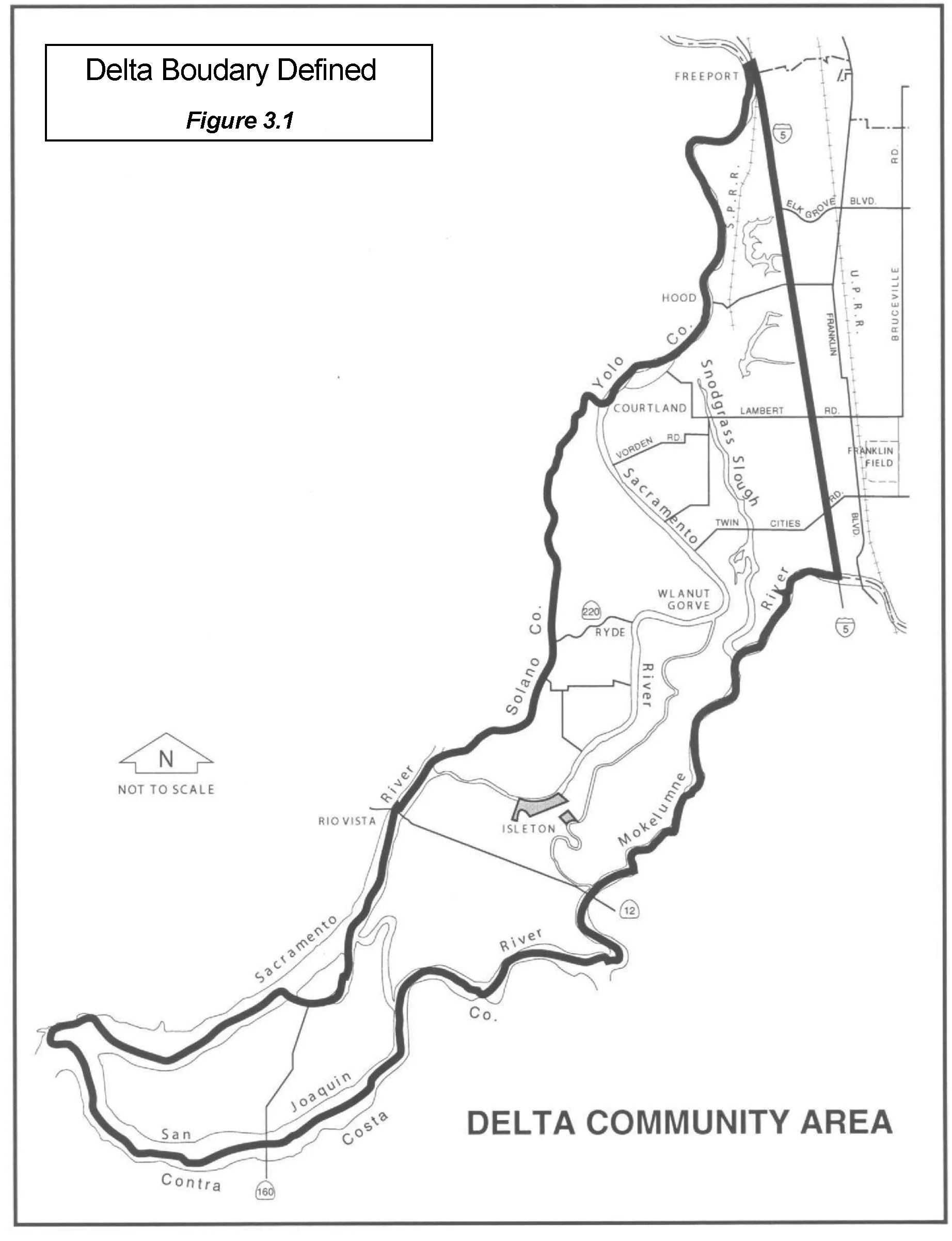
Section titled “3.4.11.A.”Permitted, except any facilities located in the Delta shall require a Conditional Use Permit approved by the Board of Supervisors. The Delta Boundary shall be defined by Figure 3.1. The following features shall be exempt from the Use Permit requirement in the Delta:
-
Small ponds, where the design water level does not exceed the lowest adjacent grade level and where the pond is located at least 50 feet from an adjoining property line, with the following acreage limitations based on parcel size:
- 0 – 5 acre parcels – ¼ acres or less
- 5 – 20 acres parcels – ½ acre or less
- 20 acres or more – one acre or less
-
Ditches and canals used to transfer water.
-
Swimming pools.
-
Seasonal, intermittent farming practices supporting crop or animal-based agriculture. Also included is winter flooding (October 1 – April 1) for wetland habitat purposes.
-
Reclamation and Levee Maintenance District facilities.
3.4.12. Industrial Hemp
Section titled “3.4.12. Industrial Hemp”3.4.12.A.
Section titled “3.4.12.A.”Outdoor industrial hemp cultivation, commercial hemp production, seed production, and related nursery uses are permitted in all AG zones if the following standards are met:
-
Minimum parcel size of 40 acres.
-
Minimum setback requirements shall be as outlined in Chapter 6.87 of the SCC and as may be modified by the Agricultural Commissioner’s Office.
-
Signage required for hemp cultivation shall comply with Chapter 6.87 of the SCC.
-
Primary processing of industrial hemp (drying, curing, pressing, and/or similar activities occurring after harvest) in AG zones shall take place in a fully enclosed legally permitted building where the odor cannot be detected from outside the structure and is limited to a maximum area of five acres dedicated to structures related to the cultivation and or processing of industrial hemp as a permitted use. All methods of processing shall be non-volatile. If the indoor cultivation, processing, or storage area exceeds five acres or processing or storage occurs outside of a fully enclosed building a Conditional Use Permit approved by the Zoning Administrator is required (see Section 3.4.12.C for additional requirements).
-
Grower must be licensed and registered with the Agricultural Commissioner.
3.4.12.B.
Section titled “3.4.12.B.”Indoor industrial hemp cultivation and processing, seed production, or related nursery production and including incidental activities related thereto within the M-1 and M-2 zones shall meet the following standards:
-
Structure(s) must comply with all applicable building codes.
-
Sites shall be developed in compliance with the development standards listed in Chapter 5.6 for projects in Industrial Zones.
-
All odor shall be mitigated so as not to be detected from outside the building structure.
-
All methods of processing shall be non-volatile.
-
Grower must be licensed and registered with the Agricultural Commissioner.
-
Processing in the M-1 zone requires a Conditional Use Permit approved by the Zoning Administrator pursuant to Section 3.4.12.C.
3.4.12.C.
Section titled “3.4.12.C.”Processing of industrial hemp in the M-1 zone and any processing of industrial hemp that exceeds the requirements of Code Section 3.4.12.A.4 above, shall require a Conditional Use Permit approved by the Zoning Administrator. Applications for Use Permits to process industrial hemp shall include the following in addition to any requirements listed in Section 6.4.3; Conditional Use Permits:
-
An odor control and mitigation plan to ensure odors of industrial hemp cannot be detected from outside of the building(s) in which the business operates. The odor control and mitigation plan shall be certified by a licensed professional engineer and shall include the following components:
- Operational processes and maintenance plan, including activities undertaken to ensure the odor mitigation system remains functional;
- Staff training procedures; and
- Engineering controls, which may include carbon filtration or other methods of air cleansing, and evidence that such controls are sufficient to effectively mitigate odors from all odor sources. All odor mitigation systems and plans submitted pursuant to this subsection shall be consistent with accepted and best available industry-specific technologies designed to effectively mitigate industrial hemp odors.
- For Processing in Agricultural zones that require a use permit, the Odor Control and Mitigation Plan shall identify ways to mitigate/reduce odor based on surrounding uses and compliance with the County Right to Farm Ordinance.
-
A Safety Plan demonstrating adequate security on the premises, including lighting and alarms, to ensure the public safety, the safety of persons within the facility, and to protect the premises from theft. The Safety Plan shall include the following minimum requirements:
- Lighting Plan: An interior and exterior lighting plan that utilizes best management practices to reduce glare, light pollution, and light trespass onto adjacent properties while still maintaining adequate security to provide illumination and clear visibility of outdoor areas surrounding buildings and in particular any points of ingress and egress. Interior lighting systems shall confine light and glare to the interior of the building.
- Security cameras. Surveillance video cameras shall be installed and maintained in good working order to provide coverage on a 24-hour basis of all internal and exterior areas where industrial hemp is cultivated, weighed, manufactured/processed, packaged, stored, and/or transferred. The security surveillance cameras shall be oriented in a manner that provides clear and certain identification of all individuals within those areas. Cameras shall remain active at all times and shall be capable of operating under any lighting condition. Security video must use standard industry format to support criminal investigations and shall be maintained for 60 days.
- A professionally monitored alarm system shall be installed and maintained in good working condition and in compliance with SCC Chapter 9.96; Emergency Alarms.
- Secure storage and waste. Identify how industrial hemp products and associated product waste will be stored and secured in a manner that prevents diversion, theft, loss, hazards and nuisance.
- Transportation. Identify procedures for safe and secure transportation and delivery of industrial hemp to and from the facility.
- Locks. All points of ingress and egress to the industrial hemp processing facility shall be secured with Building Code compliant commercial-grade, non-residential door locks or window locks. Any exterior fences with locked gates shall utilize a fire/police accessible lock system such as a knox-box.
- Emergency Access. Identify security measures designed to ensure emergency access in compliance with the California Fire Code and local Fire Department standards.
- Noise. Facilities located within 300 feet of a non-industrial use or zoning district shall provide a noise analysis demonstrating that any ventilation system or other equipment shall comply with County noise regulations.
3.4.12.D.
Section titled “3.4.12.D.”Industrial hemp cultivation or seed production for research purposes is permitted in all AG zoning districts if the following standards are met:
-
Must be associated with an accredited university or college.
-
Minimum parcel size of 40 acres.
-
Minimum setback requirements shall be as outlined in Chapter 6.87 of the SCC and as may be modified by the Agricultural Commissioner’s Office.
-
The maximum cultivation area shall not exceed one acre.
-
Signage required for hemp cultivation shall comply with Chapter 6.87 of the SCC.
-
Grower must be licensed and registered with the Agricultural Commissioner.
3.5. RESIDENTIAL USE STANDARDS
Section titled “3.5. RESIDENTIAL USE STANDARDS”3.5.1. Household Living Uses
Section titled “3.5.1. Household Living Uses”[AMENDED 09-09-2022]
3.5.1.A. Residential Uses, not otherwise listed
Section titled “3.5.1.A. Residential Uses, not otherwise listed”[AMENDED 06-07-2018]
-
In the C-O, NMC, CMC, CMZ, BP, and LC zones, residential uses that are not listed in the table shall be considered on a case-by-case basis, subject to the issuance of a Conditional Use Permit approved by the Zoning Administrator and the development provisions of Chapter 5, “Development Standards.”
-
[DELETED 07-16-2020]
3.5.1.B. Dwelling, Duplex or Halfplex
Section titled “3.5.1.B. Dwelling, Duplex or Halfplex”[AMENDED 04-07-2016][AMENDED 07-16-2020] [AMENDED 09-09-2022][AMENDED 09-19-2024]
-
In RD-3 through RD-10 zones:
- Duplex and halfplex projects shall be developed at residential densities allowed by the zoning district.
- Duplex and halfplex lots proposed as part of a mixed residential product type development are permitted by right, provided they are limited to five lots (duplex) or ten lots halfplex. Larger projects require a Conditional Use Permit approved by the Zoning Administrator.
-
In RD-15 through RD-25 zones, duplex and halfplex projects shall be developed at residential densities allowed by the zoning district.
-
In the RD-30 and RD-40 zones:
- In the RD-30 zone, duplex and halfplex projects shall be developed at a minimum density of 22.5 dwelling units per acre and a maximum density of 30 dwelling units per acre.
- In the RD-40 zone, duplex and halfplex projects shall be developed at a minimum density of 30 dwelling units per acre and a maximum density of 40 dwelling units per acre.
-
In the BP zone, duplex/halfplex projects shall be developed at a minimum density of ten dwelling units per acre and maximum density of 20 dwelling units per acre.
-
Conversion of existing duplex dwelling units to halfplex units is subject to a Tentative Parcel Map, the California Building Standards Code, and Building Permits and Inspection Division permit processes.
3.5.1.C. Dwelling, Multifamily
Section titled “3.5.1.C. Dwelling, Multifamily”[AMENDED 07-16-2020] [AMENDED 09-09-2022] [AMENDED 07-11-2024][AMENDED 09-19-2024]
-
In the RD-10 zone:
- Multifamily projects shall be developed at residential densities allowed by the zoning district.
- Multifamily projects developed as a stand-alone project or part of a mixed residential product type development require a Conditional Use Permit approved by the Zoning Administrator.
-
In the RD-15 through RD-25 zones:
- Multifamily projects shall be developed at residential densities allowed by the zoning district.
- Multifamily projects of 150 units or less are permitted by right.
- Multifamily projects of greater than 150 dwelling units are permitted with approval of a Minor Use Permit.
- The Affordable Housing Incentive Program is not subject to this requirement.
-
In the RD-30 and RD-40 zones:
- Density.
- In the RD-30 zone, multifamily projects shall be developed at a minimum density of 22.5 dwelling units per acre and maximum density of 30 dwelling units per acre.
- In the RD-40 zone, multifamily projects shall be developed at a minimum density of 30 dwelling units per acre and maximum density of 40 dwelling units per acre.
- Project size.
- Multifamily projects of 150 units or less are permitted by right.
- Multifamily projects of greater than 150 dwelling units are permitted with approval of a Minor Use Permit.
- The Affordable Housing Incentive Program is not subject to this requirement.
-
In the BP zone, multifamily projects shall be developed at a minimum density of ten dwelling units per acre and maximum density of 20 dwelling units per acre.
- A Conditional Use Permit pursuant to Table 3.1 shall be required for multifamily projects in the BP zoning district, except projects developed in compliance with all provisions of the Middle Class Housing Act of 2022 (CA GOV §65852.24 and §65913.4), or in compliance with all provisions of the Affordable Housing and High Road Jobs Act of 2022 (CA GOV §65912.100 - §65912.105, §65912.110 - §65912.114, §65912.120 - §65912.124, and §65912.130 - §65912.131), shall be permitted by right.
-
In the LC, GC, NMC, CMC, and CMZ zones:
- Density.
- Multifamily projects shall be developed at a minimum density of 20 dwelling units per acre and a maximum density of 30 dwelling units per acre.
- If the property is located within one-quarter mile of a transit stop, as defined in Chapter 7, maximum density can increase to 40 dwelling units per acre.
- Higher densities than allowed by "i" and "ii" may be permitted, subject to a Conditional Use Permit approved by the Planning Commission.
- Project size.
- Multifamily projects of up to 150 dwelling units are permitted by right at the densities listed above.
- Multifamily projects of greater than 150 dwelling units are permitted with approval of a Minor Use Permit at the densities listed above.
- The Affordable Housing Incentive Program is not subject to this requirement.
- Multifamily projects developed in compliance with all provisions of the Middle Class Housing Act of 2022 (CA GOV §65852.24 and §65913.4), or in compliance with all provisions of the Affordable Housing and High Road Jobs Act of 2022 (CA GOV §65912.100 - §65912.105, §65912.110 -§65912.114, §65912.120 - §65912.124, and §65912.130 - §65912.131) are not subject to this requirement.
-
In the C-O, MP, M-1, and M-2 zones:
- Multifamily projects are prohibited, except projects developed in compliance with all provisions of the Middle Class Housing Act of 2022 (CA GOV §65852.24 and §65913.4), or in compliance with all provisions of the Affordable Housing and High Road Jobs Act of 2022 (CA GOV §65912.100 - §65912.105, §65912.110 - §65912.114, §65912.120 - §65912.124, and §65912.130 - §65912.131), shall be permitted by right.
3.5.1.D. Dwelling, Single-family, Attached
Section titled “3.5.1.D. Dwelling, Single-family, Attached”[AMENDED 09-09-2022][AMENDED 09-19-2024]
-
In the RD-3 through RD-10 zones:
- Single- Family Attached projects shall be developed at residential densities allowed by the zoning district.
- Single-Family Attached projects proposed as part of a mixed residential product type development are permitted by right, provided they are limited to 10 lots. Larger projects require a Conditional Use Permit approved by the Zoning Administrator.
-
In RD-15 through RD-25 zones, Single-Family Attached projects shall be developed at residential densities allowed by the zoning district.
-
In the RD-30 and RD-40 zones:
- In the RD-30 zone, Single Family, Attached projects shall be developed at a minimum density of 22.5 dwelling units per acre and maximum density of 30 dwelling units per acre.
- In the RD-40 zone, Single Family, Attached projects shall be developed at a minimum density of 30 dwelling units per acre and maximum density of 40 dwelling units per acre.
-
In the BP zone, Single-Family Attached projects shall be developed at a minimum density of 10 dwelling units and a maximum density of 20 dwelling units per acre.
-
In the LC, GC, NMC, CMC, and CMZ zones:
- Single-Family Attached projects shall be developed at a minimum density of 20 dwelling units per acre and a maximum density of 30 dwelling units per acre.
- If the property is located within one-quarter mile of a transit stop, as defined in Chapter 7, maximum density can increase to 40 dwelling units per acre.
- Higher densities may be permitted than allowed by "a" and "b", subject to a Conditional Use Permit approved by the Planning Commission.
-
In the RM-2 zone, Single-Family Attached projects shall be developed at a minimum density of 10 dwelling units per acre and maximum density of 20 dwelling units per acre.
3.5.1.E. Dwelling, Single-Family, Detached
Section titled “3.5.1.E. Dwelling, Single-Family, Detached”[AMENDED 09-09-2022][AMENDED 09-19-2024]
-
In the RD-1 through RD-25 zones, Single-Family Detached projects shall be developed at residential densities allowed by the zoning district.
-
In the RD-30 and RD-40 zones:
- In the RD-30 zone, Single Family, Detached projects shall be developed at a minimum density of 22.5 dwelling units per acre and maximum density of 30 dwelling units per acre.
- In the RD-40 zone, Single Family, Detached projects shall be developed at a minimum density of 30 dwelling units per acre and maximum density of 40 dwelling units per acre.
-
In the BP zone, Single-Family Detached projects shall be developed at a minimum density of seven dwelling units and a maximum density of 10 dwelling units per acre.
-
In the NMC AND CMZ zones, Single-Family Detached projects shall be allowed in small-lot configurations at densities that encourage compact, walkable neighborhoods and that, in combination with other uses in the same development project, fall within the typical densities, indicated for the zoning district.
-
Mobile/manufactured homes are permitted by right at residential densities allowed by the zoning district, provided they are:
- Manufactured pursuant to the standards of the National Manufactured Housing Construction Safety Standards Act after June 15, 1976.
- Installed on a foundation system pursuant to CA HSC §18551.
A mobile/manufactured home used as a temporary dwelling is subject to the requirements of Section 3.10.3.H, "Temporary Uses of Mobile Homes and Commercial Coaches."
3.5.1.F. Family Day Care Home
Section titled “3.5.1.F. Family Day Care Home”[AMENDED 07-11-2024]
- The use of a legally permitted and lawfully occupied dwelling as a family day care home shall be a permitted use in all zoning districts and shall not require any permit pursuant to this ordinance.
3.5.1.G. Transitional Housing, Supportive Housing
Section titled “3.5.1.G. Transitional Housing, Supportive Housing”[ADDED 06-06-2024]
-
Transitional Housing and Supportive Housing, as defined in Chapter Seven, shall be considered residential uses and are subject only to the restrictions that apply to other residential dwellings of the same type in the same zoning district per CA GOV §65583, Subdivision (c)(3).
-
Where residential dwellings are permitted and conditionally permitted, Transitional Housing and Supportive Housing of the same type are permitted and conditionally permitted in the same zoning districts, subject to applicable standards of this Code and pursuant to CA GOV §65583, Subdivision (c)(3).
- For the purposes of this Section, "housing of the same type" means one of the following types of residential structures as provided in Section 3.2.5, Table 3.1, Residential Uses:
-
Dwelling, Duplex – 5 or fewer lots or Halfplex – 10 or fewer lots
-
Dwelling, Duplex – more than 5 lots or Halfplex – more than 10 lots
-
Dwelling, Multifamily – 10 or fewer units
-
Dwelling, Multifamily – more than 10 units
-
Dwelling, Single-family Attached – 10 or fewer lots
-
Dwelling, Single-family Attached – more than 10 lots
-
Dwelling, Single-family Detached
-
Supportive Housing is permitted by right where Multifamily and Mixed-Use Projects are permitted by right if the proposed Supportive Housing Project satisfies all of the requirements of this Section. Supportive Housing shall be developed at densities allowed by the underlying zoning district, but is not precluded from seeking a density bonus, including concessions, incentives, or waivers of development standards pursuant to Section 6.5.4.
- Units within the development are subject to a recorded affordability restriction for 55 years.
- One hundred percent of the units, excluding managers' units, within the development are restricted to lower income households and are or will be receiving public funding to ensure affordability of the housing to lower income Californians. See CA HSC §50079.5 for the definition of "lower income households". The rents in the development shall be set at an amount consistent with the rent limits stipulated by the public program providing financing for the development.
- At least 25 percent of the units in the development or 12 units, whichever is greater, are restricted to residents in supportive housing who meet criteria of the target population, as defined in CA HSC §50675.14. If the development consists of fewer than 12 units, then 100 percent of the units, excluding managers' units, in the development shall be restricted to residents in supportive housing.
- The developer shall provide Planning and Environmental Review with the information required by CA GOV §65652 upon submittal of Design Review application.
- Nonresidential floor area shall be used for onsite supportive services in the following amounts:
- For a development with 20 or fewer total units, at least 90 square feet shall be provided for onsite supportive services.
- For a development with more than 20 units, at least 3 percent of the total nonresidential floor area shall be provided for onsite supportive services that are limited to tenant use, including, but not limited to, community rooms, case management offices, computer rooms, and community kitchens.
- The developer replaces any dwelling units on the site of the supportive housing development in the manner provided in paragraph (3) of subdivision (c) of Section 65915.
- Units within the development, excluding managers' units, include at least one bathroom and a kitchen or other cooking facilities, including, at minimum, a stovetop, a sink, and a refrigerator.
- The project shall comply with all written, objective development and design standards and policies that apply to other multifamily development projects within the same zone.
- The project developer shall submit a plan for providing supportive services, with documentation demonstrating that supportive services will be provided onsite to residents in the project, as required by CA GOV §65651, and describing those services, which shall include all of the following:
- The name of the proposed entity or entities that will provide supportive services;
- The proposed funding source or sources for the provided onsite supportive services; and
- Proposed staffing levels.
-
Examples of Permitting Requirements for Transitional and Supportive Housing (pursuant to Section 3.2.5, Table 3.1, Residential Uses) may be, but are not limited to:
- Transitional Housing in a 6-Duplex Project (12 units total) in the Residential-7 (RD-7) zoning district requires a UPZ.
- Supportive Housing in one Single-family, Detached dwelling in the Agricultural-Residential 5 (AR-5) zoning district is permitted by right.
- Transitional Housing in one Single-family, Detached dwelling in the Business Professional (BP) zoning district requires a UPM.
- Supportive Housing in a 20-unit Multifamily Project in the Limited Commercial (LC) zoning district is permitted by right, subject to the requirements of Section 3.5.1.G.3.
3.5.1.H. Mobile Home Park
Section titled “3.5.1.H. Mobile Home Park”A mobile home park use shall comply with the standards of Section 4.4, “Mobile Home Park (MHP) Combining Zoning District.”
3.5.1.I. Residential Care Home
Section titled “3.5.1.I. Residential Care Home”[AMENDED 09-09-2022][AMENDED 06-06-2024]
-
In the agricultural (AG, UR and IR), agricultural-residential (AR), low-density residential (RD-1, RD-2, RD-3, RD-4, RD-5, RD-7, and RD-10), and RR zoning districts, a residential care home use shall be permitted by right where it does not exceed a total of six persons receiving care, including children of the resident family who are under 12 years of age. For seven to 15 persons, the use shall be subject to issuance of a Use Permit approved by the Zoning Administrator. For AG and AR zoning districts, refer to the additional required findings listed in 3.6.0. In agricultural, agricultural-residential, and low-density zoning districts, facilities with more than 15 persons are considered an institutional/social care use.
-
In the high density residential (RD-15, RD-20, RD-30, RD-40, and RM-2), mixed use (NMC, CMC, and CMZ), and commercial (BP, LC, and GC) zoning districts, a residential care home shall be permitted by right where it does not exceed a total of 20 persons receiving care, including children of the resident family who are under 12 years of age. Facilities with more than 20 persons are classified as an institutional/social care use.
3.5.1.J. Condominium Conversions
Section titled “3.5.1.J. Condominium Conversions”A Conditional Use Permit approved by the Planning Commission shall be required for the conversion of residential condominiums or stock cooperatives. Minimum requirements for application, notification and relocation assistance are set forth in Section 6.4.4.
3.5.2. Group Living Uses
Section titled “3.5.2. Group Living Uses”[AMENDED 09-09-2022]
3.5.2.A. Emergency Shelter and Low Barrier Navigation Centers
Section titled “3.5.2.A. Emergency Shelter and Low Barrier Navigation Centers”[AMENDED 12-01-2017] [AMENDED 09-09-2022]
The provision of these shelters will provide temporary shelter in unincorporated County area(s).
1. Development Standards
Section titled “1. Development Standards”Development or conversion of emergency shelters and Low Barrier Navigation Centers (LBNC) are subject to the following standards and requirements:
- Compliance with Section 5.5.2.A [AMENDED 07-16-2020]
- All emergency shelters and LBNCs shall be subject to Design Review and approval by the Planning Director prior to issuance of a building permit or occupancy permit. All shelters shall include, at a minimum, the following:
- On-site personnel during hours of operation when clients are present. The manager’s area shall be located near the entry to the facility.
- A Security Plan that at a minimum addresses:
- Adequate interior and exterior lighting: Exterior lighting shall comply with Section 5.9.4.G;
- Secure areas for personal property; and,
- Crime Prevention through Environmental Design.
- Off-street parking, provided in the ratio of at least one space for every staff person. Parking shall comply with the off-street parking development standards outlined in Section 5.9.
- Emergency Shelters and LBNCs are encouraged to provide additional amenities and services to their clients such as but not limited to access to a public phone; an area where clients can charge their mobile phones; an area or room where clients can meet privately with service providers (in person or by phone/computer); and, facilities that allow pets are encouraged to provide an animal relief area.
- Maximum Number of Beds. No more than 100 beds shall be provided in any single emergency shelter, unless a Conditional Use Permit is approved by the Board of Supervisors to exceed the 100-bed limit. (Note: This maximum number of beds may be exceeded in situations of disaster or catastrophic conditions.)
- Hours of Operation. Facilities shall establish, maintain, and post set hours for client intake and discharge.
- Locational Requirements. Emergency shelters and LBNCs must meet the following locational requirements:
- Shelter programs serving single adults only must be situated more than 300 feet from any other similar program and 1,000 feet from any public park, a public or private K-12 school, an indoor or outdoor recreational facility designed to serve primarily persons under 18 years old, a child care facility, or 100 feet from a residential zoning district. Programs may have multiple buildings.
- All other shelter programs must be situated more than 300 feet from any other similar program. Programs may have multiple buildings.
- The distance requirement shall be measured from property line to property line, except that if the proposed project is separated by a freeway from other shelter programs or other affected uses as set forth in Section 3.5.2.A.1.f.i, the distance shall be measured along the most direct public pedestrian route between the shelter programs or affected uses.
2. Additional requirements for Low Barrier Navigation Centers (LBNCs)
Section titled “2. Additional requirements for Low Barrier Navigation Centers (LBNCs)”In compliance with CA GOV §65662, LBNCs shall submit an application for a Zoning Determination which the County shall review for completion within 30 days of application receipt and shall make a final determination of compliance within 60 days of receipt of a complete application and submittal fee. The Zoning Determination application shall include the following information.
- A service plan that identifies services and staffing that connect people to permanent housing.
- Documentation that the LBNC is linked to a coordinated entry system, so that staff in the interim facility or staff who collate in the facility may conduct assessments and provide services to connect people to permanent housing. “Coordinated entry system” means a centralized or coordinated assessment system developed pursuant to Section 576.400(d) or Section 578.7(a)(8), as applicable, of Title 24 of the Code of Federal Regulations, as those sections read on January 1, 2020, and any related requirements, designed to coordinate program participant intake, assessment, and referrals.
- Documentation that the LBNC complies with or will comply with Chapter 6.5 (commencing with Section 8225) of Division 8 of the CA WIC.
- Documentation that it has a system for entering information regarding client stays, client demographics, client income, and exit destination through the local Homeless Management Information System as defined by Section 578.3 of Title 24 of the Code of Federal Regulations.
Emergency shelters and LBNCs not meeting the requirements of Section 3.5.2.A.1. are subject to a Conditional Use Permit approved by the Board of Supervisors, except when pursuant to Section 3.6.3.A.4.
3.5.2.B. Scattered Shelter
Section titled “3.5.2.B. Scattered Shelter”[ADDED 06-06-2024]
-
Occupancy shall not exceed two persons per legally permitted bedroom.
-
Parking shall be provided as follows: One space per three clients/program participants. Parking may be located within a garage, driveway, or other onsite parking area in compliance with the development standards of Section 5.9.3.F.
3.5.2.C. Farmworker Housing
Section titled “3.5.2.C. Farmworker Housing”[AMENDED 06-06-2024]
Farmworker housing provided by the employer and maintained in connection with the work or place where work is being performed must comply with all provisions of CA HSC §17008(a). Farmworker housing, not maintained in connection with any workplace, and provided by someone other than an agricultural employer must comply with all provisions of CA HSC §17008(b) and §17032. Construction, operation, or maintenance of farmworker housing shall comply with the requirement of this Section and all applicable health, safety, and building codes and standards.
-
Farmworker housing for agricultural farm employees and their families, consisting of up to 45 beds in group quarters or 16 single-family, household units or spaces (i.e., recreational vehicle) is permitted by right in the Agricultural (AG, UR, and IR) zoning districts. Farmworker housing shall be subject to the same fees applicable to agricultural uses.
-
Prior to issuance of a Building Permit for farmworker housing, the following information shall be submitted to the County:
- Type of housing proposed (e.g., stick-built, modular, manufactured, group quarters, RVs, etc.);
- Number of dwelling units/beds provided;
- Length of occupancy;
- Number of occupants;
- Proof of a Deed Restriction, recorded with the County Recorder, that limits the use of the proposed housing to farmworkers and their families;
- Proof that adequate utilities (i.e., septic, well) are or will be available onsite; and,
- For farmworker housing intended for five or more workers, proof that a permit to operate from the California Department of Housing and Community Development (HCD) has been obtained and maintained.
-
Single-family-style Farmworker Housing
- A farmworker dwelling unit pursuant to this section must meet the minimum size and use standards for accessory dwellings, which cannot exceed 1,200 square feet in size and shall not be subdivided from the primary parcel.
- Each farmworker dwelling unit shall provide at least one parking space per unit or one space per three beds, whichever is greater.
- 500 square feet of attached non-habitable space is permitted for each farmworker dwelling unit (i.e., garage, patio, etc.).
- Detached residential accessory structures related to the farmworker dwelling units are not permitted.
-
Group-style Farmworker Housing
- One parking space per three beds shall be provided.
- Attached, non-habitable space (i.e., garage, patio, etc.) not to exceed 25 percent of the total square footage of the habitable space in the structure is permitted.
- Detached residential accessory structures related to the farmworker dwelling units are not permitted.
-
Farmworker housing of all styles does not need to be located on the site of a qualifying agricultural operation where the farmworkers are employed.
-
Farmworker housing shall be located a minimum of 50 feet from any existing or proposed enclosure used or intended for the keeping of livestock or animals. Otherwise, farmworker housing of all styles is subject to the setback requirements of Section 5.4.2.C.
-
If use of a property for farmworker housing ceases, all structures associated with the farmworker housing shall be removed or converted to another approved use within 45 days.
-
Use of recreational vehicles for seasonal farmworker housing is subject to the following regulations:
- Use of recreational vehicles is permitted for a maximum of 120 consecutive days per calendar year.
- Recreational vehicles shall be connected to all necessary permanent or temporary service facilities (sewer/septic, water, power) as required by the Environmental Management Department and Building Permits and Inspection.
- After the 120 permitted days has concluded, all recreational vehicles shall no longer be occupied and shall be removed from the subject property within 10 days and shall not be re-occupied for the remainder of the calendar year.
-
Agricultural Accessory Dwellings are permitted subject to Sections 3.9.3.C. and 5.3.3. [AMENDED 07-16-2020]
3.5.2.D. Single Room Occupancy Residential Facility
Section titled “3.5.2.D. Single Room Occupancy Residential Facility”1. Intent
Section titled “1. Intent”Development or conversion of Single Room Occupancy residential units is permitted in the RD-20, RD-25, RD-30, RD-40, and GC zones, subject to development standards and locational requirements as defined and set forth below. The provision of this type of living quarters is expected to provide affordable housing opportunities and diversity in the County housing stock, pursuant to the Housing Element of the General Plan.
2. Development Standards
Section titled “2. Development Standards”An SRO facility shall comply with the development standards of this Section. Setbacks, height, landscaping, or other development standards not otherwise addressed in this Section shall be as in Section 5.4.3, “Multifamily Residential Development Standards.”
a. Common Dining, Lounge, or Meeting Room Facilities
Section titled “a. Common Dining, Lounge, or Meeting Room Facilities”Unless cooking facilities are provided in all rooms, SRO buildings shall provide one or several common dining, lounge, or meeting room facilities. The minimum total amount of common space provided shall be 10 square feet per unit with a minimum of 150 square feet. A maximum of 50 percent of the required common space may be exterior designated areas.
b. Facility Size
Section titled “b. Facility Size”The maximum number of SROs in one facility shall not exceed 125 units excluding the manager’s unit. For conversion of an existing structure to an SRO facility, the same 125-unit maximum count shall be utilized. If a new or converted facility exceeds 125 units, a Conditional Use Permit approved by the Board of Supervisors is required.
c. Security
Section titled “c. Security”Applicants shall consult with the Sheriff’s Department Community Resources Bureau for advice on security measures prior to submitting an application for Design Review. The Planning Director shall obtain recommendations from the Sheriff’s Department prior to approval of development plans. The Sheriff’s Department recommendations may address, but are not limited to:
- Locations for Closed Circuit TV (CCTV) units (these units may be monitored or taped as required);
- Location and design of entrances into the facility, including visibility of the entry way and lobby from outside of the building;
- Alarms on exit doors;
- Type of locks (for the overall facility and for individual rooms);
- Optical viewers (peep holes); and
- Lighting.
d. Manager’s Office
Section titled “d. Manager’s Office”- Facilities with 16 units or more shall be required to have 24-hour, desk-staffed service.
- Facilities with over 30 units shall be required to have 24-hour, desk-staffed service and an on-site resident manager.
- Facilities with fewer than 16 units shall provide a 24-hour telephone service (limited to outgoing calls only) in the lobby with posted phone numbers of responsible operators, unless staffed desk service is provided. The phone numbers shall be posted in each room and in a conspicuous location in the common area. Telephones in residents' individual rooms need not be limited to outgoing calls only.
e. Parking
Section titled “e. Parking”Off-street parking, provided in the ratio of one space for every five units, plus an additional space designated exclusively for the manager. Additional area shall be designated as “phantom” parking that if developed as parking would result in the total amount of parking provided to be equivalent to one parking space per two units. The Planning Director, based upon valid complaints by neighbors, Fire, or Sheriff’s Department personnel, or other agencies concerned with health and welfare issues, shall have the authority to require that some or all of the additional phantom parking area be fully improved for use by project residents or visitors. Until such time as the phantom parking area is needed for parking, it shall be maintained in live landscaping.
f. Locational Requirements
Section titled “f. Locational Requirements”SRO facilities with 16 units or more must be situated more than 1,000 feet from any other SRO facility.
- The 1,000-foot distance shall be measured from property line to property line except as in Section 3.5.2.C.2.f.(ii).
- If the proposed project is separated by a freeway from other SRO facilities, the 1,000-foot distance shall be measured along the most direct public pedestrian route between the two facilities.
g. Child Care Center
Section titled “g. Child Care Center”A child care center is allowed as an ancillary use to the SRO facility, subject to the following criteria:
- Parking. A free-standing center or a center in a mixed use project shall provide one parking space per every eight children for which the center is licensed.
- Masonry Wall. If the proposed center abuts a residential zoning district, a minimum six-foot-high solid wall of masonry, brick, stucco, or similar material shall be provided. The wall shall be placed along all property lines that abut a residential zoning district. A masonry wall shall not be required if:
- The center is separated from a residential zoning district by an alley or a public street; or
- The center will be located in an existing commercial building that did not require a wall when built, no expansion of the building will occur and the building is located between the play yard and the residential zoning district.
- Outdoor Play Areas. Outdoor play areas should be separated from vehicular circulation, parking areas, equipment enclosures, storage areas, refuse, and recycling areas so as to create a safe environment for children.
h. Storage
Section titled “h. Storage”A minimum of 80 cubic feet of secure storage space shall be provided for each unit; the storage space may be either inside or outside of the unit.
i. Accessibility by Transit
Section titled “i. Accessibility by Transit”Facilities must either be located within one-half mile of a designated transit stop or existing bus route, or the applicant must submit evidence to the Planning Director in conjunction with the application that transportation will be provided between the facility and a transit corridor or bus line.
3. Design Review
Section titled “3. Design Review”All SRO facilities shall be subject to approval of development plans by the Planning Director, prior to issuance of building or occupancy permits.
- With respect to security measures of Section 3.5.2.C.2.c, if either the Sheriff’s Department or the applicant does not agree with the Planning Director’s action on the application, the Planning Director shall forward the application to the Planning Commission. The Planning Commission’s deliberations shall be limited to review and determination of the security measures to be incorporated into the project and that determination, with respect to security measures, shall be final. The Planning Commission shall then resend the application back to the Planning Director for final action.
- For all matters other than the determination of appropriate security measures, the normal appeal process of Section 6.1.3, “Appeals,” shall apply.
- At the time of application for Design Review, facility proponents shall submit, for concurrent review by the Sheriff's Department and Planning Director, a set of house rules for the SRO facility. Such house rules shall include, but are not limited to, rules governing the following:
- Alterations to living units
- Garbage and litter control
- Guests, including visitation
- Harassment
- Heating
- Inspections of living units
- Insurance of personal property
- Keys/lock outs
- Laundry rooms
- Loitering
- On-site consumption of alcoholic beverages
- On-site automobile repair
- Pets
- Phones
- Registration of occupants
- Smoking
- Soliciting
- Subletting
- Substance abuse
- Use of common areas, including quiet time
4. Operation
Section titled “4. Operation”- ALL SRO facilities shall comply with Section 5.4.3.
- All SRO facilities shall be operated so as not to constitute a public nuisance.
3.6. PUBLIC, CIVIC, AND INSTITUTIONAL USE STANDARDS
Section titled “3.6. PUBLIC, CIVIC, AND INSTITUTIONAL USE STANDARDS”3.6.0. Uses in the Agricultural and Agricultural-Residential Zoning Districts
Section titled “3.6.0. Uses in the Agricultural and Agricultural-Residential Zoning Districts”[AMENDED 06-07-2018]
In the agricultural and agricultural-residential zoning districts, the following uses shall be subject to issuance of a Conditional Use Permit approved by the appropriate authority, as listed in the use tables or herein. The Agricultural Commissioner and the Agricultural Advisory Committee, if existing and active, shall be consulted during the project review process.
- Places of worship
- Private social centers/Fraternal Hall/Lodge
- Adult day care over 36 persons
- Private schools (all sizes)
- Congregate care facilities
- Hospitals
- Social rehabilitation facilities
- Colleges and universities
- Residential care homes over six persons
- Bed and Breakfast Inns
The appropriate authority shall not grant the Conditional Use Permit in these zoning districts, unless it makes the following findings:
-
The proposed development will carry out the intent of the General Plan and the appropriate community plan.
-
The intensity and scale of development is proportional with the allowable residential and agricultural uses in the zone in terms of traffic generation and scale of proposed buildings.
-
The development does not alter the rural character of the community.
-
The development does not result in the need to extend public water and sewer.
-
A greater intensity may only be allowed if the appropriate authority finds that the proposed use is either along a major roadway and similar in scale to nearby established uses (e.g., existing places of worship) or is a continuation of an existing use at a consistent scale with historic activity.
3.6.1. Assembly Uses
Section titled “3.6.1. Assembly Uses”3.6.1.A. Places of Worship and Other Religious Institutions
Section titled “3.6.1.A. Places of Worship and Other Religious Institutions”In the agricultural, and agricultural-residential zoning districts, places of worship and other religious institutions with seating capacity over 150 persons shall be subject to issuance of a Conditional Use Permit approved by the Planning Commission in addition to complying with Section 3.6.0.
3.6.2. Education and Cultural Uses
Section titled “3.6.2. Education and Cultural Uses”3.6.2.A. School, Private
Section titled “3.6.2.A. School, Private”In the commercial and MP zoning districts, a private school with capacity of 500 students or less, shall be subject to a Minor Use Permit approved by the Planning Director. Schools exceeding 500 students in these zoning districts shall be subject to a Conditional Use Permit approved by the Zoning Administrator.
In the agricultural, and agricultural-residential zoning districts, comply with Section 3.6.0.
3.6.3. Government Uses
Section titled “3.6.3. Government Uses”3.6.3.A. Government and Local Agency Uses and Buildings
Section titled “3.6.3.A. Government and Local Agency Uses and Buildings”-
State and Federal Government Uses and Facilities
- A government use or building owned by a state or federal government entity and located on federal or state-owned property shall be permitted by right in any district.
- A federal or state government use within a privately-owned building, facility, or premises shall be permitted in any zoning district and shall be regulated as set forth this Code for the proposed use to the extent permitted by law.
-
Government Use and Facilities Other than Federal and State
- A government use or building owned by a government entity other than state or federal government within a privately-owned building, facility, or premises shall be permitted in any zoning district and shall be regulated as set forth in this Code for the proposed use to the extent permitted by law.
- If not permitted by paragraph 2.a. above, a government use or building owned by and located on property owned by a government entity other than state or federal government may be allowed by Conditional Use Permit in any zoning district.
-
Privately Owned or Operated Uses in Government-owned Premises
- A private use in a government-owned building, facility, grounds, or other premises shall be regulated as provided for elsewhere in this Code for the use type, except that a use located within a government-owned and operated facility such as a state park or office building that is regulated by that agency shall be a permitted use.
-
A Use Permit will not be required for County agency facilities for which budgetary responsibility rests wholly or partly with the Board of Supervisors, such as the water agencies, airports, dependent park districts, Sacramento Housing and Redevelopment Agency, and where the facility has already been subject to public hearings for the purpose of allocating funds to purchase the property, to construct the facility, or to commit the property to a specific use.
-
A Use Permit will not be required for fire stations if located more than 500 feet from a residential or agricultural residential zoning district, or if the fire station site had been designated on an approved tentative subdivision, and the public notices for the tentative subdivision map indicated that a fire station site was proposed.
3.6.4. Parks and Open Space Uses
Section titled “3.6.4. Parks and Open Space Uses”[AMENDED 02-24-2017]
3.6.4.A. Cemetery
Section titled “3.6.4.A. Cemetery”All areas within cemeteries used for the storage of service vehicles and equipment shall be surrounded by either a sight-barrier fence or screen planting and shall be located not less than 100 feet from the boundary line of a residential zoning district or property used for residential purposes.
3.6.4.B. Community and Market Gardens
Section titled “3.6.4.B. Community and Market Gardens”[AMENDED 12-01-2017][AMENDED 06-07-2018] [AMENDED 07-16-2020]
Community and Market gardens are permitted, provided that permission to use the property has been given in writing by the property owner and subject to the standards included in this Section. Nothing in this Section shall be construed to preempt any provision related to the cultivation of cannabis as found in Title 6 of the SCC, or the provisions of the Land Grading and Erosion Control Ordinance, Stormwater Quality Ordinance, or Floodplain Management Ordinance.
1. Maintenance
Section titled “1. Maintenance”- Community and market gardens shall be maintained in an orderly manner, including litter removal, irrigation, weeding, pruning, pest control and removal of dead or diseased plant materials.
- Community and market gardens are situated so that they do not generate odors, pests or noises that negatively affect adjacent properties.
2. Equipment
Section titled “2. Equipment”- Regular use of mechanized farm equipment is prohibited in residential districts.
- The use of equipment up to 8,000 pounds may be used in the initial preparation of lands for community and market gardens between the hours of 6:00am and 8:00pm and consistent with the Sacramento County Noise Ordinance.
- Regular use of standard landscaping and gardening equipment designed for household use is permitted.
- Equipment when not in use must be within enclosed structures or otherwise not visible to the public.
3. Structures
Section titled “3. Structures”Structures used to support community and market gardens, such as tool sheds, greenhouses, produce stands, and instructional spaces are permitted, subject to all other applicable zoning regulations and development standards found in Section 5.3.2.C. for Agricultural and Agricultural-Residential zoning districts (Table 5.6) and Section 5.4.5.B. in Residential zones (Table 5.10-Agricultural Accessory Structures).
Structures including fencing, pens, barns and similar buildings utilized to secure and shelter animals shall comply with Section 3.9.3.G. All structures shall be constructed of quality materials and situated so that they do not pose a nuisance to surrounding properties.
4. Compost
Section titled “4. Compost”Compost systems utilized to support urban community and market gardens shall be maintained to be free of pests and odors. Compost systems shall be located away from public street frontages and may not be located within 20 feet of interior property lines.
5. Trash
Section titled “5. Trash”Trash receptacles used to support community and market gardens shall be located indoors or screened from the street and adjacent properties through the utilization of landscaping, fencing or similar appropriate screening materials.
6. Fencing
Section titled “6. Fencing”Fences related to urban agriculture are permitted as regulated in the underlying zoning districts.
7. Parking
Section titled “7. Parking”Adequate off-street parking shall be available.
8. Hours of Use
Section titled “8. Hours of Use”Cultivation, maintenance and harvesting activities shall be limited to between sunrise and sunset.
9. Water Efficiency
Section titled “9. Water Efficiency”Garden areas for edible plants that are incidental to a primary use with traditional landscaping shall be designated as “Special Landscape Areas” (SLA), and comply with the requirements of the Water Efficient Landscape Ordinance and all applicable requirements of the local water purveyor for the site.
Market and community gardens, on vacant lands that are not subject to the Water Efficient Landscape Ordinance, must be in compliance with all applicable requirements of the local water purveyor for the site, and shall include best practices to maximize water efficiency and to avoid water waste.
Appropriate irrigation systems and techniques shall be utilized to maximize water efficiency and avoid water waste to the greatest extent practicable. Irrigation systems and techniques may include appropriately designed gardens to minimize water evaporation and runoff, the use of drip irrigation systems, the installation of appropriate soil amendments and a mulch layer around plants and other similar techniques.
10. Brownfields
Section titled “10. Brownfields”Market and community gardens developed on brownfields or sites that may contain contaminated soils should be reviewed by garden proponents for past uses, including historic crops grown. If past uses indicate a potential for contaminated soils, then the Sacramento County Environmental Management Department shall be consulted with to determine site suitability which may include a program of surficial soils sampling and testing for persistent pesticide and/or industrial chemical residuals.
11. Cultural Resources
Section titled “11. Cultural Resources”Should any cultural resources, such as structural features, unusual amounts of bone or shell, artifacts, human remains, or architectural remains be encountered during any development activities associated with community or market gardens, work shall be suspended and the Division of Planning and Environmental Review shall be immediately notified.
At that time, the Division of Planning and Environmental Review will coordinate any necessary investigation of the find with appropriate specialists as needed. The project proponent shall be required to implement any mitigation deemed necessary for the protection of the cultural resources. In addition, pursuant to CA PRC §5097.97 and CA HSC §7050.5, in the event of the discovery of human remains, all work is to stop and the County Coroner shall be immediately notified. If the remains are determined to be Native American, guidelines of the Native American Heritage Commission shall be adhered to in the treatment and disposition of the remains.
12. Nonconforming Uses
Section titled “12. Nonconforming Uses”Community and market gardens in existence prior to the enactment of this Ordinance are considered to have been legally established. If they do not meet the current regulations, they are nonconforming, and changes to size, operation, or other aspects are regulated by Section 1.9. of the Code.
3.6.5. Social Care Uses
Section titled “3.6.5. Social Care Uses”3.6.5.A. Adult Day Care Center
Section titled “3.6.5.A. Adult Day Care Center”-
In the agricultural, agricultural-residential, and residential zoning districts, an adult day care center facility, with capacity of up to 36 persons, shall be subject to a Conditional Use Permit approved by the Zoning Administrator. An adult day care center facility, exceeding 36 persons, shall be subject to a Conditional Use Permit approved by the Planning Commission. In the agricultural, and agricultural-residential zoning districts, comply with Section 3.6.0.
-
In the recreational zoning districts, adult day care centers shall be subject to a Conditional Use Permit approved by the Planning Commission.
3.6.5.B. Child Day Care Center
Section titled “3.6.5.B. Child Day Care Center”-
In the agricultural, agricultural-residential, residential, and recreational zoning districts, a child day care center facility with:
- Capacity of up to eight persons shall be permitted by right;
- Capacity between nine and 14 persons shall be permitted, subject to a Minor Use Permit approved by the Planning Director;
- Capacity of 15 or more persons shall be subject to a Conditional Use Permit approved by the Zoning Administrator.
-
These standards do not apply in the multifamily zones. [ADDED 07-16-2020]
3.6.5.C. Congregate Care Facility, Convalescent Hospital, and Social Rehabilitation Center
Section titled “3.6.5.C. Congregate Care Facility, Convalescent Hospital, and Social Rehabilitation Center”In the agricultural and agricultural-residential zoning districts, congregate care facilities, convalescent hospitals, and social rehabilitation centers shall be subject to issuance of a Conditional Use Permit approved by the Planning Commission in addition to complying with Section 3.6.0.
3.6.6. Utility and Public Service Facility Uses
Section titled “3.6.6. Utility and Public Service Facility Uses”3.6.6.A. Utility and Public Service Facility Uses, Major
Section titled “3.6.6.A. Utility and Public Service Facility Uses, Major”1. Transmission Facilities of Sacramento Municipal Utility District (SMUD)
Section titled “1. Transmission Facilities of Sacramento Municipal Utility District (SMUD)”a. Permitting
Section titled “a. Permitting”SMUD electrical transmission lines and substations with less than 100,000-volt capacity are permitted with no review required by the County. Within 60 days of receipt of a proposal from SMUD to locate and construct electrical transmission lines or substations of 100,000-volt or greater capacity, the Board of Supervisors shall conduct a public hearing to consider the compliance of such proposal with the provisions of this Code, and shall adopt a resolution approving, approving an alternative, or disapproving the proposed facilities. Any such resolution shall contain findings concerning:
- The consistency of the proposed facilities with the County's adopted General Plan and community plan;
- Feasible alternatives to the proposal;
- The necessity for, as compared to the impact of, the proposed facilities on the health, convenience, safety, and welfare of County residents.
b. Siting
Section titled “b. Siting”- Electrical transmission lines of 100,000-volt or greater capacity may be located in any zoning district and shall be located in easements or rights of way that permit access for maintenance with minimal disruption to surrounding properties.
- Every reasonable effort shall be exerted to avoid established residential areas. In the event SMUD determines that it has no alternative but to route a 100,000-volt or greater capacity transmission line through an established residential area, such lines shall be installed underground except when SMUD can demonstrate that it is not feasible to do so. "Feasible" as used in this use standard shall be defined in CA GOV §53096(c). Preference shall be given to the location of transmission lines in the rank order specified in Sections 3.6.6.A.1.b.ii.1. through 3.6.6.A.1.b.ii.7.:
- Within existing SMUD transmission rights of way or those anticipated for other projects proposed, subject to this Code.
- Adjacent to railroads or adopted freeway routes.
- Along or adjacent to major arterial streets, where existing or planned uses are commercial or industrial.
- Adjacent to or through existing or planned commercial, industrial, or agricultural uses.
- Along arterial streets where residential uses, designated in an adopted plan, are RD-20 or a greater density.
- Through areas where land uses in an adopted plan are predominately commercial, but include residential uses.
- Through residential areas, including side and rear yards, irrespective of density.
- “Substation” for the purposes of this Section means any structure with 100,000-volt or greater incoming capacity that either:
- Converts electrical energy to a lesser voltage for the purpose of subregional or localized distribution;
- Functions as a transition point from overhead to underground electrical transmission lines; or
- Acts as the point of convergence for two or more transmission lines. Substations may be located on sites in all zoning districts, provided mitigation measures are instituted as provided in Section 3.6.6.A.1.c, “Advisory for Other Permitting Requirements”. Preference shall be given to the location of substations in the following rank order:
- Areas designated for industrial or commercial land uses in an adopted plan.
- Undeveloped areas designated for residential use in an adopted plan.
- Areas designated agricultural urban reserve in an adopted plan.
- Sites designated for residential use in an adopted plan and surrounded by existing residential uses.
c. Advisory for Other Permitting Requirements
Section titled “c. Advisory for Other Permitting Requirements”- Overhead electrical transmission lines of 100,000 volts or greater capacity should be installed in a manner so as to minimize possible adverse impacts to existing land use and conditions, including health, safety, biological, visual, and aesthetic impacts. Consolidating lines on fewer poles should be explored whenever feasible, as long as doing so would not negatively affect reliability or safety. When feasible, SMUD should relocate and combine existing overhead transmission poles and lines with new installations.
- Substations should be designed and constructed in such a manner as to minimize off-site visual and noise impacts. Planted or landscaped setbacks of at least 25 feet should be provided on all public street frontages of the parcel. For rights-of-way with PUPFs, planted or landscaped setbacks of at least 31 feet should be provided on all public street frontages of the parcel.
- For rights-of-way with public utilities, public facilities easements, substations should be designed and constructed in such a manner as to minimize off-site visual and noise impacts. Planted or landscaped setback of at least 31 feet should be provided on all public street frontages of the parcel.
- SMUD proposals to the Board of Supervisors to locate and construct electrical transmission lines and substations subject to this Code should include a description of mitigation measures to be utilized and a plan indicating the specific site treatments to be employed.
3.6.6.B. Utility and Public Service Facility Uses, Minor
Section titled “3.6.6.B. Utility and Public Service Facility Uses, Minor”The following minor utility and public service facility uses are permitted, as noted in Sections 3.6.6.B.1; otherwise, subject to a Conditional Use Permit approved by the Zoning Administrator.
- Minor utility distribution facilities such as water well sites, telephone switching vaults, electrical transmission facilities, and similar facilities, if the site had been designated on an approved tentative subdivision map and the final map has been recorded or has been committed to recordation to the satisfaction of the County Engineer.
3.6.6.C. Solar Energy Facilities
Section titled “3.6.6.C. Solar Energy Facilities”[AMENDED 07-16-2020]
The County Board of Supervisors recognizes the need to accommodate new sources of renewable energy to help energy providers meet the requirements of state law for renewable sources. This Section regulates solar energy facilities. Solar energy facilities include solar panels (photovoltaic systems), solar thermal systems that convert solar energy to electricity by heating a working fluid to power a generator, and solar hot water systems designed to heat water for use by either domestic or commercial uses. Definitions applicable to solar energy facilities, including the types of solar facilities are defined in Section 7.3.
1. General Provisions for All Solar Energy Facilities
Section titled “1. General Provisions for All Solar Energy Facilities”Solar energy facilities are classified as either accessory solar facilities or commercial solar facilities.
- Accessory Solar Facilities are designed to produce no more than what is necessary for on-site energy demand, and include two levels: Accessory I and Accessory II solar facilities.
- Accessory I – Rooftop or ground mounted solar panels or hot water systems accessory to a permitted residence where ground mounted systems do not exceed one-half acre.
- Accessory II – Rooftop or ground mounted solar panels or solar hot water systems that are accessory to a permitted non-residential use.
- Commercial Solar Facilities include two levels: Commercial I and Commercial II solar facilities.
- Commercial I are photovoltaic technologies (solar panels) or solar thermal technologies producing energy for off-site uses, and covering 10 acres or less.
- Commercial II are photovoltaic technologies (solar panels) or solar thermal technologies producing energy for off-site uses, and covering more than 10 acres.
b. Process
Section titled “b. Process”The permit type required, approving body for each type of solar facility, and need for each solar type are referenced in the applicable use tables (Table 3.1 and 3.2).
c. Safety Certification of Facilities
Section titled “c. Safety Certification of Facilities”All solar facilities shall be properly certified as safe and must meet current industry standards of efficiency and longevity.
- Solar Panels. All solar energy systems for producing electricity shall meet all applicable safety and performance standards established by the National Electrical Code, the Institute of Electrical and Electronics Engineers, and accredited testing laboratories such as Underwriters Laboratories and, where applicable, rules of the Public Utilities Commission regarding safety and reliability.
- Solar Hot Water Systems. A solar energy system for heating water shall be certified by the Solar Rating Certification Corporation (SRCC) or other nationally recognized certification agencies. SRCC is a nonprofit third party supported by the United States Department of Energy. The certification shall be for the entire solar energy system and installation.
2. Accessory I and II Solar Energy Facilities
Section titled “2. Accessory I and II Solar Energy Facilities”These facilities may be roof-mounted or ground-mounted. These facilities shall comply with the following:
a. Applicability to Zoning Districts
Section titled “a. Applicability to Zoning Districts”Accessory I and II solar facilities are allowable in all zoning districts, as indicated in Table 3.2.
b. Application Procedures
Section titled “b. Application Procedures”- Standard application packet required for all planning applications.
- Required certifications for safety.
- No grid-intertied solar system shall be approved until evidence has been given to the Planning Director that the owner has obtained the consent of the utility company for the customer’s intent to install an interconnected customer-owned generator. Off-grid systems are exempt from this requirement.
c. Area Limitation
Section titled “c. Area Limitation”Accessory II ground-mounted solar facilities in agricultural zoning districts may occupy up to one-half acre of the site.
d. Setbacks
Section titled “d. Setbacks”- The setbacks for Accessory I solar facilities shall be the standard setbacks for accessory structures in residential zones.
- The setbacks for Accessory II solar facilities shall be the standard setbacks for the applicable zoning district.
e. Height Limitation
Section titled “e. Height Limitation”- Ground-mounted Accessory I solar facilities shall not exceed the height restrictions for residential accessory structures.
- Roof-mounted solar panels shall extend no more than three feet above the finished roof to which it is mounted.
- Ground-mounted Accessory II solar facilities shall be allowed to a height of 25 feet. Deviations to this height limit may be considered with a Special Development Permit.
- Exceptions to the height requirements for solar panels in a zoning district may be allowed under specific circumstances described in Section 5.2.2.
f. Aesthetics
Section titled “f. Aesthetics”In considering the placement of solar facilities, aesthetic impacts of solar facilities to surrounding properties and streets shall be minimized, without compromising the performance of the solar facility, by methods which may include:
- Locating accessory solar on rooftops or over covered parking areas or other hardscape areas;
- Minimizing aesthetic impacts of rooftop panels facing toward the street. Typical methods to achieve this are to mount panels close to parallel with the pitch of the roof, in close proximity to the roofing material;
- Avoiding placement of accessory solar facilities on historic structures;
- Considering visual impacts in placement and design of solar panels. Balance the functionality of the solar facilities with the visual impacts to adjacent properties, or to public access areas (e.g., parks and streets);
- Using “integrated solar” photovoltaic panels or a solar hot water system, when appropriate, for lessening aesthetic impacts;
- Using landscaping to lessen the visual impacts of solar facilities to adjacent properties, if possible, without affecting the performance of the solar facility; and
- Avoiding unreasonable glare from solar collectors to adjacent properties.
g. Commercial Parking Reductions
Section titled “g. Commercial Parking Reductions”Commercial parking requirements may be reduced as an incentive for installation of solar energy facilities, per Section 5.9.5, Parking Reductions.
h. Landscaping
Section titled “h. Landscaping”Alternatives to the landscape standards of Section 5.2.4.F. for new parking lots where ground mounted “carport” style solar facilities are utilized may be considered through the design review process.
3. Commercial I and II Solar Energy Facilities
Section titled “3. Commercial I and II Solar Energy Facilities”Solar facilities shall comply with the following provisions, to be included as conditions of approval for the Use Permit:
a. Applicability to Zoning Districts
Section titled “a. Applicability to Zoning Districts”- Commercial Solar I facilities are permitted in Agricultural, Recreational, Mixed-Use, Commercial, and Industrial zoning districts, subject to the applicable Use Permit, indicated in Table 3.1.
b. Application Materials
Section titled “b. Application Materials”- Standard application packet required for all planning applications, including a site map and elevations
- Landscape and fencing plans and details
- Visual analysis, as needed, of views from impacted residences, roadways, etc.
- Solar pathways study, when merited by possible shading over the life of the project
- Signage warning of site dangers
- Security Plan (fencing, surveillance cameras, etc.)
- Purchase power agreement signed by the utility or other purchaser
- Reclamation Plan
- Decommission Plan
- No grid-intertied photovoltaic system shall be approved until evidence has been provided to the Planning Director that the owner has obtained the consent of the utility company for the customer’s intent to install an interconnected customer-owned generator. Off-grid systems are exempt from this requirement.
c. Location
Section titled “c. Location”- Avoid Prime Farmlands, unless mitigated consistent with County policy.
- Avoid sensitive habitat areas, unless mitigated consistent with County policy.
- Avoid locations in the viewscapes of scenic highways or in areas that would impact the views from historic places.
- Solar facilities are not allowed on Williamson Act Agricultural Preserves except when specifically allowed under the Williamson Act contract.
- Solar facilities shall not be allowed where it has been determined the facility will adversely impact airport flight operations, including military flight paths.
d. Setbacks
Section titled “d. Setbacks”The standard setbacks for structures in the applicable zoning district shall apply to the construction of commercial solar energy facilities.
e. Fencing
Section titled “e. Fencing”- Security fencing is required to protect the site. The fencing shall be:
- Vinyl covered cyclone fence, neutral colors, or
- Vinyl slats, neutral color compatible with fence color, or
- Alternative fencing may be considered by the appropriate hearing body.
f. Landscaping
Section titled “f. Landscaping”[AMENDED 12-01-2017]
- The applicant shall submit a landscape plan to Planning and Environmental Review which shall include the location, description and timing of plantings, fences, sound walls as required by the Code, and berms. The description of fencing shall include color and materials, when appropriate. The landscaping plan shall be designed to be generally compatible with the surrounding uses and existing landscaping patterns, to the satisfaction of the Landscape Architect, Planning and Environmental Review.
- In rural areas, the following shall be considered when approving the landscape plan:
- Maintenance of visual openness and the preservation of rural character through design that may include clustering of plant species;
- Protection of watering systems and/or landscaping from theft; and
- Availability of water source.
- Landscaping shall be designed to bring immediate aesthetic relief upon planting by designating minimum sized plantings appropriate to the project and its surroundings.
- Landscaped areas shall be kept free of trash and weeds.
g. Operations
Section titled “g. Operations”- Maintain and operate facilities in compliance with County and State health regulations.
h. Reclamation
Section titled “h. Reclamation”- Reclamation shall start within six months, and be completed within 18 months, after operation cease or expiration of the Use Permit.
i. Decommission Plan
Section titled “i. Decommission Plan”- The Decommissioning Plan which shall include at a minimum, a detailed plan for decommissioning and deconstruction of the solar facility and for restoration of the site.
- The Decommissioning Plan shall be developed and approved to the satisfaction of the Planning Director.
j. Performance and Financial Assurance Guarantees
Section titled “j. Performance and Financial Assurance Guarantees”- Prior to issuance of any building permits, the applicant shall provide performance and financial assurance guarantees in an amount sufficient to ensure the performance of the approved Decommissioning Plan. The performance and financial guarantees shall be provided and approved to the satisfaction of the Planning Director.
- The performance and financial assurance guarantee may be comprised of, but not limited to, one or more of the following to the satisfaction of the Planning Director: an irrevocable letter of credit; or a trust fund or escrow established and maintained in accordance with the approved financial assurances and practices to guarantee that decommissioning will be completed in accordance with the approved Decommissioning Plan.
k. Signage
Section titled “k. Signage”- Warning signs and no trespassing signs shall be placed at entryways to the site and at regular intervals around the site.
- No advertising shall be allowed on fencing or equipment.
3.6.6.D. Wind Turbine Facilities
Section titled “3.6.6.D. Wind Turbine Facilities”The County Board of Supervisors recognizes the need to accommodate new sources of renewable energy to help energy providers meet the requirements of state law for renewable sources. This Section regulates wind turbine facilities, including small wind turbines and large wind turbines, as defined in Section 7.3.
1. General Provisions for All Wind Turbine Facilities
Section titled “1. General Provisions for All Wind Turbine Facilities”- Wind turbine facilities have been classified as either, small wind turbines or large wind turbines.
- Small Wind Turbines are rated 20kW or less, and are designed to produce no more than what is necessary for on-site energy demand.
- Large Wind Turbines are all other wind energy systems.
b. Process
Section titled “b. Process”The permit type required, approving body for each type of wind turbine facility, and need for each wind facility type are described in Table 3.1.
c. Safety Certification of Facilities
Section titled “c. Safety Certification of Facilities”- All wind turbine energy systems for producing electricity shall meet all applicable safety and performance standards established by the National Electrical Code, the Institute of Electrical and Electronics Engineers, and accredited testing laboratories such as Underwriters Laboratories and, where applicable, rules of the Public Utilities Commission regarding safety and reliability (CA GOV §65850-§65863.13).
- All wind turbines must be certified to either the International Electrotechnical Commission 61400-2 (IEC 61400-2) standard or the American Wind Energy Association 9.1-2009 (AWEA 9.1-2009) standard by the Small Wind Certification Council (SWCC) or a Nationally Recognized Testing Laboratory (NRTL) such as Intertek.
- All wind turbines must also have a certified power curve tested to the standards of IEC 61400-12-1, or Section 2 of the AWEA 9.1-2009 standards. The certified power curve must also come from the Small Wind Certification Council (SWCC) or a Nationally Recognized Testing Laboratory (NRTL).
2. Small Wind Turbines
Section titled “2. Small Wind Turbines”a. Applicability to Zoning Districts
Section titled “a. Applicability to Zoning Districts”Small wind turbines are allowed in all zoning districts, as addressed in Table 3.1.
b. Application Procedures
Section titled “b. Application Procedures”- Standard application packet required for all planning applications, including site plans and elevations.
- Required certifications for safety.
- No grid-intertied wind system shall be approved until evidence has been provided to the Planning Director that the owner has obtained consent by the utility company for the customer’s intent to install an interconnected customer-owned generator. Off-grid systems are exempt from this requirement.
c. Setbacks
Section titled “c. Setbacks”The standard setbacks for structures in the applicable zoning district shall apply to the construction of small wind turbines.
d. Height Limitation
Section titled “d. Height Limitation”- Ground-mounted wind turbines shall not exceed the standard height restrictions for structures in the applicable zoning district.
- Roof-mounted small wind turbines shall extend no more than six feet above the finished roof of the building to which it is mounted.
- Exceptions to the height requirements for wind turbines may be allowed under specific circumstances, as described in Section 5.2.2.
e. Aesthetics
Section titled “e. Aesthetics”Aesthetic impacts of small wind turbines shall be avoided by methods which may include:
- Avoiding placement of small wind turbines on the street side of a building;
- Avoiding placement of small wind turbines on historic structures;
- Balancing the functionality of small wind turbines with the visual impacts to adjacent properties, or to public access areas, such as parks and streets. Consider visual impacts in the placement and design of small wind turbines; and
- Using landscaping to lessen the visual impacts of small wind turbines to adjacent properties.
f. Noise
Section titled “f. Noise”Small wind turbines are subject to the noise standards for new uses under General Plan Policy. Noise calculations shall not be adjusted (e.g. averaged) for non-operational periods.
g. Density Bonuses for Accessory Wind Facilities
Section titled “g. Density Bonuses for Accessory Wind Facilities”Multifamily developments proposing installation of small wind turbines shall be eligible for a density bonus as regulated in Section 6.4.6.G.
- Any subdivision of land in any residential zone that will allow the development of at least four new lots of record may increase the maximum number of lots by up to 25 percent, per Section 6.4.6.G.2.b(ii), provided:
- All setbacks can be met with the increased density, and
- The project includes the installation of a small wind turbine, with the potential to produce at least one kilowatt for each new residence.
h. Commercial Parking Reductions
Section titled “h. Commercial Parking Reductions”Commercial parking requirements may be reduced as an incentive for installation of small wind energy facilities, per Section 5.9.5, “Parking Reductions”.
3. Large Wind Turbines
Section titled “3. Large Wind Turbines”a. Applicability to Zoning Districts
Section titled “a. Applicability to Zoning Districts”Large wind turbines are permitted in agricultural, mixed use and industrial zoning districts, subject to issuance of a Conditional Use Permit approved by the Planning Commission, as defined in Table 3.1.
b. Application Procedures
Section titled “b. Application Procedures”- Standard application packet required for all planning applications, including a site map and elevations
- Decommissioning Plan
- No grid-intertied wind turbine system shall be approved until evidence has been provided to the Planning Director that the owner has obtained consent by the utility company for the customer’s intent to install an interconnected customer-owned generator. Off-grid systems are exempt from this requirement.
ii. Required certifications for safety
iii. Visual analysis, as needed, of views from impacted residences, roadways, etc.
iv. Signage warning of site dangers
c. Location
Section titled “c. Location”- Avoid Prime Farmlands, unless mitigated consistent with County policy.
- Avoid sensitive habitat areas, unless mitigated consistent with County policy.
- Avoid locations in the viewscapes of scenic highways or in areas that would impact the views from historic places.
- Wind turbine facilities are not allowed on Williamson Act Agricultural Preserves except when specifically allowed under the Williamson Act contract.
- Wind turbine facilities shall not be allowed where it has been determined the facility will adversely impact airport flight operations, including military flight paths.
d. Setbacks
Section titled “d. Setbacks”The standard setbacks for structures in the applicable zoning district shall apply to the construction of large wind turbines.
e. Fencing
Section titled “e. Fencing”- Security fencing is required to protect the site. The fencing shall be: 1. Vinyl covered cyclone fence, neutral colors; 2. Vinyl slats, neutral color compatible with fence color; or 3. Alternative fencing may be considered by the appropriate hearing body.
f. Noise
Section titled “f. Noise”Large wind turbines are subject to the noise standards for new uses under General Plan Policy. Noise calculations shall not be adjusted (e.g. averaged) for non-operational periods.
g. Landscaping
Section titled “g. Landscaping”[AMENDED 12-01-2017]
- The applicant shall submit a landscape plan to Planning and Environmental Review which shall include the location, description and timing of plantings, fences, sound walls as required by the Code, and berms. The description of fencing shall include color and materials. The landscaping plan shall be designed to be generally compatible with the surrounding uses and existing landscaping patterns, to the satisfaction of the Landscape Architect, Planning and Environmental Review.
- In rural areas the following shall be considered when approving the landscape plan:
- Maintenance of visual openness and the preservation of rural character through design that may include clustering of plant species;
- Protection of watering systems and/or landscaping from theft; and
- Availability of water source.
- Landscaping shall be designed to bring immediate aesthetic relief upon planting by designating minimum sized plantings appropriate to the project and its surroundings.
- Landscaped areas shall be kept free of trash and weeds.
h. Operations
Section titled “h. Operations”Maintain and operate facilities in compliance with County and State health regulations.
i. Reclamation
Section titled “i. Reclamation”Reclamation shall start within six months and be completed within 18 months after operations cease or expiration of the Use Permit.
j. Decommission Plan
Section titled “j. Decommission Plan”[AMENDED 12-01-2017]
- The applicant shall provide to Planning and Environmental Review prior to approval of the wind turbine facility, a Decommissioning Plan which shall include at a minimum detailed plan for decommissioning and deconstruction of the wind turbine facility and for restoration of the site.
- The Decommissioning Plan shall be developed and approved to the satisfaction of the Planning Director.
k. Performance and Financial Assurance Guarantees
Section titled “k. Performance and Financial Assurance Guarantees”- Prior to issuance of any building permits, the applicant shall provide performance and financial assurance guarantees in an amount sufficient to ensure the performance of the approved Decommissioning Plan. The performance and financial guarantees shall be provided and approved to the satisfaction of the Planning Director.
- The performance and financial assurance guarantee may be comprised of, but not limited to, one or more of the following to the satisfaction of the Planning Director: an irrevocable letter of credit; or a trust fund or escrow established and maintained in accordance with the approved financial assurances and practices to guarantee that decommissioning will be completed in accordance with the approved Decommissioning Plan.
l. Signage
Section titled “l. Signage”- Warning signs and no trespassing signs shall be placed at entryways to the site and at regular intervals around the site.
- No advertising shall be allowed on fencing or equipment.
3.6.7. Communication Facilities and Uses
Section titled “3.6.7. Communication Facilities and Uses”3.6.7.A. Wireless Communication Facilities, Small Cell WCFs, and Eligible Facility WCFs
Section titled “3.6.7.A. Wireless Communication Facilities, Small Cell WCFs, and Eligible Facility WCFs”The County Board of Supervisors recognizes the need to accommodate Wireless Communications Facilities (WCFs), Small Cell WCFs, and Eligible Facility WCFs, and has promulgated the following use and development standards to address them within the unincorporated areas of the County.
1. WCF Use Standards
Section titled “1. WCF Use Standards”For the purposes of regulating WCFs, zoning districts are organized into Groups, as show in Table 3.6.1, below.
Table 3.6.1 Zoning Groups for WCFs [1]
Section titled “Table 3.6.1 Zoning Groups for WCFs [1]”| Group | Zoning Districts |
|---|---|
| Group 1 | RD, AR, O, C-O, RM-2, DW, RR, and SPA zoning districts (unless otherwise specified in the particular SPA ordinance. |
| Group 2 | BP, LC, GC, and Mixed-Use zoning districts |
| Group 3 | M-1, M-2, MP, AG, IR, and UR zoning districts |
[1] WCFs area not allowed within Public Rights of Way (PROWs) in any zoning district unless classified as a Small Cell WCF or Eligible Facility WCF.
b. Appropriate Authority for Approval
Section titled “b. Appropriate Authority for Approval”- Group 1 zoning districts: Subject to the issuance of a Conditional Use Permit approved by the Planning Commission, provided they meet the development standards of Section 3.6.7.A.4, Table 3.6.2, as applicable. The Planning Commission may impose conditions on the Use Permit as outlined in Sections 6.4.3.E.3 and 6.4.3.E.4.
- Group 2 and Group 3 zoning districts: Subject to the issuance of a Conditional Use Permit approved by the Zoning Administrator, provided they meet the development standards of Section 3.6.7.A.4, Table 3.6.2, as applicable. The Zoning Administrator may impose conditions on the Use Permit as outlined in Sections 6.4.3.E.3 and 6.4.3.E.4.
2. Small Cell WCF Use Standards
Section titled “2. Small Cell WCF Use Standards”a. Attached to existing infrastructure:
Section titled “a. Attached to existing infrastructure:”- Permitted in all zoning districts provided they:
- Meet the development standards of Section 3.6.7.A.5, Table 3.6.3, as applicable.
- Enter into a Master License Agreement with the County of Sacramento, if County Facilities are to be utilized.
- Receive all required authorizations from non-County entities (such as PG&E or SMUD) to proceed with the installation of the antenna or any associated communication facilities on their facilities.
- Receive an Encroachment Permit and/or Pole Licenses by the Director of the Department of Transportation (DOT) or designee if located within a Public Right of Way (PROW).
b. New Towers
Section titled “b. New Towers”- Permitted in all zoning districts provided they obtain a Minor Use Permit, and
- Meet the development standards of Section 3.6.7.A.5, Table 3.6.3, as applicable.
- Receive an Encroachment Permit or Pole License by the Director of the Department of Transportation (DOT) or designee if located within a Public Right of Way (PROW).
3. Eligible Facility WCF Use Standards
Section titled “3. Eligible Facility WCF Use Standards”Permitted in all zoning districts, provided that the Eligible Facility WCF falls within the Federal Communications Commission (FCC) guidelines for “Eligible Facilities Requests,” as described in 47 C.F.R. Subsection 1.6100(b)(3) & (7), and updated from time to time.
4. WCF Development Standards
Section titled “4. WCF Development Standards”The Development Standards for WCFs are summarized in Table 3.6.2.
Table 3.6.2 WCF Development Standards
Section titled “Table 3.6.2 WCF Development Standards”This table has been split into multiple tables to comply with accessibility requirements. The following four tables shall all be referred to as a part of Table 3.6.2.
WCFs – New Towers
| Standard | Group 1 | Group 2 | Group 3 |
|---|---|---|---|
| Height – Maximum | 55 ft. | 65 ft. | 130 ft. |
| Separation – Interior Property Boundaries | 25 ft. (tower and equipment enclosure) | 25 ft. (tower and equipment enclosure) | 25 ft. (tower and equipment enclosure) |
| Separation – Public Right of Way | 25 ft. (tower and equipment enclosure) 31 ft. if PUPFE (tower and equipment enclosure) | 25 ft. (tower and equipment enclosure) 31 ft. if PUPFE (tower and equipment enclosure) | 25 ft. (tower and equipment enclosure) 31 ft. if PUPFE (tower and equipment enclosure) |
| Separation – Group 1 Zone Property - Minimum | Three times height of the tower | Three times height of the tower | Three times height of the tower |
WCFs – Façade Mounted Antennas
| Standard | All WCF Zone Groups |
|---|---|
| Height – Maximum [1] | No portion of antenna, support equipment, or cables shall project above roof parapet or penthouse roofline. |
| Area – Maximum | Total of all antenna panels shall not exceed greater of 10% of façade square footage for building or 25 sq. ft. per façade. |
| Elevation – Minimum | 20 ft. above grade level (lowest portion of antennas) |
| Horizontal Extension – Maximum | 18 inches from the facade of the building (antenna and equipment) |
| Design | Antennas shall be constructed or mounted and painted to blend with the predominant architecture of the building or appear to be part of the building to which it is attached. |
WCFs – Roof-Mounted Antennas
| Standard | All WCF Zone Groups |
|---|---|
| Height – Maximum | 12 ft. from roof top (antenna) |
| Antenna – Location | Antennas shall be located towards the center of the roof |
| Equipment – If Location of Roof | Wireless equipment located on the roof must meet standards for mechanical equipment located on roofs, subject to Section 5.2.2.B – Height Exceptions for Certain Structures. |
| Design | Antennas shall be constructed or mounted and painted to blend with the predominant architecture of the building or appear to be part of the building to which it is attached. |
WCFs – Ancillary Equipment and Enclosures
| Standard | All WCF Zone Groups |
|---|---|
| Location – New Towers | All equipment shelters, cabinets, or structures utilized or built in connection with the antennas shall be located on the ground outside of the setback area for the underlying Zoning Group or vehicle parking space allotment required. |
| Location – Façade or Roof Mounted WCFs | All equipment shelters, cabinets, or other structures utilized or built in connection with façade or roof mounted WCFs shall be located within the building being utilized for the antennas, or on the ground outside of the setback area for the underlying Zoning Group or vehicle parking space allotment required. |
| Screening – All | Screened fencing required around equipment enclosures as outlined in Section 5.2.5.D.5- Screen Fencing. |
[1] If incorporated into a sign or on a sign, water tank, utility pole or tower, light standard, or similar, the Wireless Communications Facility shall be treated as building facade mounted.
5. Small Cell WCF Development Standards
Section titled “5. Small Cell WCF Development Standards”The development standards for Small Cell WCFs are summarized in Table 3.6.3.
This table has been split into multiple tables to comply with accessibility requirements. The following three tables shall all be referred to as a part of Table 3.6.3.
Small Cell WCFs - Attached Antennas
| Standard | Requirement |
|---|---|
| Attachment [1][2] | Antennas may be attached to existing structures. Multiple carriers may utilize the same structure depending on structural load capacities. |
| Antenna Height – Maximum | Not to exceed 10% of existing structure height. |
| Antenna Elevation – Minimum | Shall be located within the joint use area of the pole if applicable, but no less than 16 feet above grade if within a PROW. |
| Antenna Size – Maximum | Arrays shall be no greater than 3 cubic (cu.) ft. each. Cumulative size of arrays may not be increased beyond 3 cu. ft. on light poles. Array size may be increased up to a total of 10 cu. ft. on utility poles at the discretion of the pole owner and based upon structural load capacities. |
| Antenna Design | Arrays must meet the following design standards: (i) All antennas shall match coloring of host structure. (ii) All wires shall be enclosed and concealed within pole or within color-matched conduit. (iii) If placed on a light pole in the PROW, antenna arrays shall be flush mounted against one extension pole. No branching arrays shall be allowed. |
Small Cell WCFs – New Towers
| Standard | Requirement |
|---|---|
| Use of Existing Infrastructure | New towers are not allowed within 200 ft. of any existing infrastructure that is available to support a Small Cell Wireless Facility. |
| Separation – Minimum | New towers must be located at least 200 ft. from any existing Small Cell Wireless Facility. |
| Height – Maximum [3] | New towers may be no more than 10% taller than adjacent light or utility infrastructure or no greater than 50 ft. in overall height. |
| Antenna Size – Maximum | Arrays shall be no greater than 3 cu. ft. each. Cumulative size of arrays may be increased based upon structural load capacities up to a cumulative total of 10 cu. ft. |
| Antenna – Design | Arrays must meet the following design standards: (i) All antennas shall match coloring of host structure. (ii) No branching arrays shall be allowed in the PROW. (iii) All wires shall be enclosed and concealed within pole or within color-matched conduit. |
| Tower Design | New towers shall have a design that is consistent with existing PROW facilities in size, height, and coloring. New towers shall be consistent with County Street Light Design Standards. |
Equipment
| Standard | Requirement |
|---|---|
| Location and Size | If located within the PROW equipment must be placed entirely in one of the following: (i) An underground vault. (ii) In cabinets no more than six cubic feet in area, for a cumulative total of 28 cu. ft., attached to the pole no less than 8 ft. from grade. (iii) Entirely within the host pole, pole base and/or pedestal. |
| Design | Equipment must match coloring of host structure if attached. |
[1] Existing structures in this case shall include utility poles or light poles but do not include traffic signals or decorative light standards as identified by DOT. [2] The Small Cell WCF may include substitution of a pole for the existing structure in order to conceal equipment and support antenna array safely. Replacement poles may be considered existing infrastructure for purposes of permitting requirements. Replacement poles must maintain the setback and height of the existing structure. [3] Maximum height shall include antenna array.
- Facilities that do not meet the standards of Table 3.6.3 will not be considered Small Cell WCFs, as defined, and so will be subject to issuance of a Conditional Use Permit as outlined in Section 3.6.7.A.1, and the development standards of Section 3.6.7.A.4, Table 3.6.2.
6. Eligible Facility Development Standards
Section titled “6. Eligible Facility Development Standards”- Eligible Facility WCFs that do not meet the standards of an “Eligible Facilities Request,” as defined, are considered a new WCF, and are subject to issuance of a Conditional Use Permit as outlined in Section 3.6.7.A.1, and the development standards of Section 3.6.7.A.4, Table 3.6.2.
In addition to the requirements listed in this Section, all Wireless Communication Facilities are subject to all other applicable regulations and permits, including those of the Public Utilities Commission (PUC) of the State of California and the Federal Communication Commission (FCC).
3.7. COMMERCIAL USE STANDARDS
Section titled “3.7. COMMERCIAL USE STANDARDS”3.7.1. General Standards for All Uses in Commercial Zoning Districts
Section titled “3.7.1. General Standards for All Uses in Commercial Zoning Districts”Unless otherwise specified in the zoning district standards, the following standards shall apply in all commercial zoning districts:
3.7.1.A. Conduct of Business on Lot
Section titled “3.7.1.A. Conduct of Business on Lot”[AMENDED 01-12-2019]
The entire business operation shall be conducted within a completely enclosed building or completely fenced within the buildable area of the lot. Where automobiles are allowed to be sold, outdoor automobile displays are allowed consistent with Section 3.7.9.B. when not projecting over required landscaped areas.
3.7.1.B. Distance Separation and Overconcentration Requirements
Section titled “3.7.1.B. Distance Separation and Overconcentration Requirements”[AMENDED 07-08-2016] [AMENDED 12-01-2017][AMENDED 06-07-2018][AMENDED 01-10-2025]
The following uses shall be regulated as set forth in Table 3.1 and shall meet the distance separation requirements set forth in Table 3.7.
Table 3.7
Section titled “Table 3.7”[AMENDED 12-01-2017][AMENDED 01-10-2025]
| Use | Separation from RD and/or AR Zoning Districts | Separation from Sensitive Use [1] | Separation between the same use |
|---|---|---|---|
| Hookah/Smoking/Vape Lounges | 100 ft. | 1,000 ft. | 1,000 ft. |
| Pawn Shops | 100 ft. | 100 ft. | 1,000 ft. |
| Smoke Shops | 100 ft. | 1,000 ft. | 1,000 ft. |
| Check Cashing/Payday Loans | 100 ft. | 100 ft. | 1,000 ft. |
| Thrift Stores | None | None | 1,000 ft. |
| Adult Novelty Stores | 100 ft. | 1,000 ft. | 1,000 ft. |
[1] Sensitive uses include: child day care center, library, public park, church, community center, public or private school, or indoor or outdoor recreation facilities that are primarily designed to serve persons under the age of 18.
-
The distance separation requirements prevail over any provision in a Special Planning Area (SPA) unless the SPA is more restrictive.
-
Required separation distances shall be measured as a radius from the primary entrance of the business or establishment to the nearest property line of the property so zoned or used.
-
Please note that additional uses may also have separation requirements for uses are listed in a separate section. Examples include recycling facilities, adult uses and adult-related uses.
-
For Commercial uses, including Hookah/Smoking Lounges, Pawn Shops, Tobacco Shops, Check Cashing Establishments, and Adult Novelty Stores the following overconcentration requirement applies:
-
There is not an overconcentration of the following uses within 1,000 feet: hookah/smoking lounges, pawn shops, smoke shops, thrift shops, adult novelty stores, check cashing/pay day loan establishments, and adult uses. Overconcentration is defined as more than three of these uses within a 1,000 foot radius. The reviewing authority may approve exceptions based on physical characteristics of the neighborhood, such as the major arterials, freeways, railroads or other facilities that separate neighborhoods. The reviewing authority may also take into account the same uses located within an adjacent jurisdiction.
3.7.2. Commercial Service Uses
Section titled “3.7.2. Commercial Service Uses”3.7.2.A. Animal and Pet Services
Section titled “3.7.2.A. Animal and Pet Services”1. Kennel, Cattery, Animal Boarding and Training
Section titled “1. Kennel, Cattery, Animal Boarding and Training”A kennel, cattery, or animal boarding and training use shall comply with the following minimum standards:
- Every lot or parcel used for a kennel shall have a net lot area of not less than one acre, except in commercial and mixed-use zoning districts.
- Small animal training shall be permitted by right in the agricultural zoning districts, on the condition that the owner of each animal shall be present during such training.
- Cattery facilities, fully operated indoors, shall be permitted by right in the commercial zoning districts.
3.7.2.B. Business Services
Section titled “3.7.2.B. Business Services”1. General Business Services
Section titled “1. General Business Services”- Applies to business service uses as defined in Section 7.3, and other similar uses, not otherwise listed under this land use category.
- In the BP and MP zoning districts, permitted subject to a finding by the Planning Director that the use is compatible to the office and industrial uses in the area if limited to 25 percent of project area; otherwise, the use requires a Minor Use Permit.
- Permitted in residential zoning districts as a standalone or as part of a small commercial center provided that the use or commercial center does not exceed three gross acres in size, subject to a Conditional Use Permit approved by the Zoning Administrator. Permitted in multiple family projects, regardless of size, subject to a finding by the Planning Director that the use is incidental to the project and does not exceed 25 percent of the project area, and is intended for the convenience of the residents of the project in which they are located; otherwise, the use requires a Conditional Use Permit approved by the Zoning Administrator.
2. Intensive Business Services
Section titled “2. Intensive Business Services”- Applies to business service uses as defined in Section 7.3.
- In the CMC, GC, BP, and MP zones, subject to issuance of a Conditional Use Permit approved by the Zoning Administrator when a finding can be made that the proposed use will not have any greater adverse impacts than adjoining uses or other uses permitted in the zoning district.
3.7.2.C. Personal Services
Section titled “3.7.2.C. Personal Services”[AMENDED 07-08-2016][AMENDED 06-07-2018][AMENDED 01-10-2025]
1. General Personal Services
Section titled “1. General Personal Services”Applies to personal service uses as defined in Section 7.3, and other similar uses not otherwise listed under this land use category.
2. Beauty or Barber Shop, Spa, Tanning
Section titled “2. Beauty or Barber Shop, Spa, Tanning”- In the residential zoning districts, permitted for projects of not more than three gross acres in size and subject to issuance of a Conditional Use Permit approved by the Zoning Administrator, except that beauty and barber shops, Spas, and Tanning are permitted in multiple family developments of any size where they are clearly incidental to the project, do not advertise off-site, and are intended only for the convenience of the residents of the project in which they are located.
- In BP and MP zones, permitted subject to a finding by the Planning Director that the use is incidental to the business center and intended to serve its employees, otherwise a Conditional Use Permit approved by the Zoning Administrator is required.
3. Crematory
Section titled “3. Crematory”- Permitted in the GC zoning district, provided that the crematory is located no less than 500 feet from any agricultural-residential, residential, or interim residential zoning district; or established residential use subject to the issuance of a Conditional Use Permit approved by the Board of Supervisors after a recommendation by the Planning Commission. The crematory can be stand alone or associated with a funeral establishment. Required noticing shall be based on a 1,000 foot radius of the exterior boundaries of the subject parcel. The applicant shall be responsible for additional noticing requirements.
- Permitted in the M-1 and M-2 zones, provided that the crematory is located no less than 500 feet from any agricultural-residential, residential, or interim residential zoning district and subject to the issuance of a Conditional Use Permit approved by the Planning Commission. Uses located less than 500 feet from any agricultural-residential, residential, or interim residential zoning district shall be subject to the issuance of a Conditional Use Permit approved by the Board of Supervisors after a recommendation by the Planning Commission. The crematory can be stand alone or associated with a funeral establishment. Required noticing shall be based on a 1,000-foot radius of the exterior boundaries of the subject parcel. The applicant shall be responsible for additional noticing requirements.
4. Massage Establishments and Providers
Section titled “4. Massage Establishments and Providers”- Massage establishments and providers shall have a valid General Business License and if applicable a Special Business License issued by Sacramento County Department of Finance, and shall comply with all standards of Sacramento County Code Section 4.36.
- In the C-O and BP zoning districts massage is only permitted as an incidental use (less than 25 percent of the floor area) to a permitted salon, spa, health club, resort, and/or medical office. In the BP zone, if massage is not incidental to a primary use listed above it is permitted as a sole practitioner if limited to a maximum of 400 square feet of floor area. A Minor Use Permit is required to exceed the floor area restrictions for massage in either the C-O or BP zones.
3.7.3. Eating/Drinking Uses
Section titled “3.7.3. Eating/Drinking Uses”3.7.3.A. Restaurant, Carry-out/Drive-through/Sit-down
Section titled “3.7.3.A. Restaurant, Carry-out/Drive-through/Sit-down”[AMENDED 12-01-2017]
-
Drive-throughs are permitted in the zoning districts listed in Table 3.2 if in compliance with the standards in Section 3.9.3.V. “Drive-Throughs.”
-
In the BP and MP zones, permitted subject to a finding by the Planning Director that the use is incidental to the business center and intended to serve its employees.
3.7.3.B.
Section titled “3.7.3.B.”[DELETED 07-04-2024]
3.7.3.C. Bars and Taverns
Section titled “3.7.3.C. Bars and Taverns”[ADDED 12-01-2016]
-
Bars and taverns must have a minimum setback of 100 feet from residentially zoned properties, as measured from the establishment’s main entrance.
-
In no case shall any bar or tavern be greater than 5,000 square feet in area.
-
Service and consumption of alcohol must cease by 2:00 a.m.
-
The Sheriff’s Department shall make a recommendation to the Planning Director for security measures.
-
The owner and/ or proprietor, and/or operator of the establishment is responsible to provide supervision (i.e., security) to prevent loitering in the immediate vicinity of the establishment.
- During operating hours, the owner and/or proprietor shall prohibit loitering in the parking area.
- After closing hours, the immediate vicinity of the establishment including designated parking areas, shall be cleared within 15 minutes. The designated parking area shall be oriented away from residences as much as possible.
3.7.3.D.
Section titled “3.7.3.D.”Patios and designated outside seating areas shall be oriented and designed away from residences and must be buffered to ensure that noise is mitigated per the Noise Ordinance.
3.7.4. Entertainment/Recreation Uses
Section titled “3.7.4. Entertainment/Recreation Uses”3.7.4.A. Recreation Facility, Indoor
Section titled “3.7.4.A. Recreation Facility, Indoor”An indoor recreation facility with capacity exceeding 300 persons or a theater with four or more screens shall be subject to a Conditional Use Permit approved by the Zoning Administrator. Indoor shooting ranges shall require a Conditional Use Permit approved by the Zoning Administrator. In the BP, MP, M-1, and M-2 zones, the use shall be permitted, regardless of size or location, subject to a finding that the use is incidental to the business center and intended to serve its employees and customers; otherwise, the use is subject to a Conditional Use Permit approved by the Zoning Administrator.
3.7.4.B. Recreation Facility, Outdoor
Section titled “3.7.4.B. Recreation Facility, Outdoor”In all agricultural, agricultural-residential, residential, recreation zoning districts, and in the DW zoning district, the use is permitted subject to issuance of a Conditional Use Permit approved by the Planning Commission. Such Use Permit may include indoor recreation facilities and uses if the appropriate authority finds they are clearly accessory to the requested outdoor use. If the capacity of the facility exceeds 2,500 persons, then the facility shall be subject to issuance of a Conditional Use Permit approved by the Board of Supervisors.
3.7.4.C. Adult Uses and Adult-Related Establishments
Section titled “3.7.4.C. Adult Uses and Adult-Related Establishments”[AMENDED 06-07-2018]
1. Allowed Uses
Section titled “1. Allowed Uses”- Sexually oriented businesses, as defined, shall be permitted, subject to compliance with all of the locational conditions in Section 3.7.4.C.2.
- Adult Related Establishments, as defined, require a Conditional Use Permit approved by the Board of Supervisors and will only be permitted, subject to compliance with all of the locational conditions in Section 3.7.4.C.2.
2. Purpose and Intent for Sexually Oriented Businesses
Section titled “2. Purpose and Intent for Sexually Oriented Businesses”- As defined in this Code, sexually oriented businesses include adult bookstores, adult motion picture theaters and adult live theaters. Subparagraph (g) of CA GOV §65850 provides that the Board of Supervisors may regulate, pursuant to a content neutral ordinance, the time, place and manner of operation of sexually oriented businesses. As hereinafter set forth, the Board of Supervisors has determined that the regulations of this Chapter serve a substantial governmental interest and do not unreasonably limit alternative avenues of communication and are based on narrow, objective and definite land use standards. [AMENDED 04-2004]
In adopting this Chapter, the Board of Supervisors takes legislative notice of, and relies upon, the experience and studies of the following jurisdictions concerning the adverse secondary effects of sexually oriented businesses: Phoenix, Arizona; Tucson, Arizona; Garden Grove, California; Los Angeles, California; Whittier, California; Denver, Colorado; Indianapolis, Indiana; Minneapolis, Minnesota; Saint Paul, Minnesota; Kansas City, Missouri; New York, New York; Oklahoma City, Oklahoma; Amarillo, Texas; Austin, Texas; Dallas, Texas; Newport News, Virginia; Renton, Washington; Seattle Washington, and the findings of federal and state court decisions in establishing the reasonableness and the constitutionality of the provisions of this Chapter and the reliance there to the specific effects such adult businesses may have on the residents and businesses of Sacramento County, and the proximity of such businesses to other land uses, including but not limited to churches, schools, parks, places frequented by children, and other sexually oriented businesses. [AMENDED 04-2004]
- The Board of Supervisors as a result of concerns regarding the harmful secondary effects of sexually oriented businesses, finds that such establishments require special regulations to restrict the location, operation, and concentration of these businesses.
- Preliminary to the adoption of this Article, the Board of Supervisors, in response to concerns regarding the harmful secondary effects of sexually oriented businesses, adopted interim urgency ordinances restricting the location of sexually oriented businesses to industrially zoned property within the unincorporated area of the County of Sacramento. This Article continues the locational criteria of the interim urgency ordinances.
- Increasing urbanization, changing community standards, and evolving legal standards for the regulation of such sexually oriented businesses dictated that the County of Sacramento address its regulations of such establishments so as to provide for such uses taking into consideration the compatibility thereof with existing land uses and land use regulations, and to minimize cumulative impacts and harmful secondary effects. [AMENDED 04-2004]
- The Board of Supervisors recognizes that the land uses regulated by this Chapter constitute protected expressions of speech and that said uses must be permitted, and reasonably available to potential patrons, within certain areas of the unincorporated area of the County of Sacramento. The Board also recognizes that the nature of such uses, and the activities of patrons on or near the premises on which the adult uses are located, can be a threat to the public health, safety and welfare of the citizens of the County of Sacramento. The Board is fully aware that the activities conducted in such businesses are provided protection under the federal and state constitutions. Accordingly, the Board finds that the regulations of this Article are based on narrow, objective and definite standards that are intended to provide a reasonable number of available sites for such uses while minimizing the harmful secondary effects of these uses. [AMENDED 11-1995][AMENDED 04-2004]
- It is the intent of the Board of Supervisors to prohibit nude dancing within the unincorporated area of Sacramento County, with the exception of existing businesses that have been continuously lawfully licensed for such use by the County since on or before July 1, 1998. The prohibition is based on federal and state court decisions regarding local regulation of public nudity, including but not limited to, Barnes v. Glen Theater, Inc., 501 U.S. 560 (1991); Erie v. Pap’s A.M. (Kandyland), 529 U.S. 277 (2000); Schultz v. City of Cumberland, 228F.3d 831 (7th Cir. 2000); and Tily B. v. City of Newport Beach, 69 Cal.app.4th 1 (1998). Businesses featuring nude dancing that have been continuously licensed by the County for such use since on or before July 1, 1998, may continue to feature nude dancing, pursuant to CA PEN §318.5 and §318.6.
3. Location Conditions for Sexually Oriented Businesses
Section titled “3. Location Conditions for Sexually Oriented Businesses”- Is in either an M-1 or M-2 zone.
- Is more than 1,000 feet from any other sexually oriented business.
- Is more than 1,000 feet from any existing residential use or property zoned agricultural, agricultural-residential, or residential, or that is regulated by Title V or Title VI of the SCC.
- Is more than 1,000 feet from any of the following existing sensitive uses:
- Single-family, duplex, or multifamily residences
- Child day care center
- Library
- Public park
- Places of worship
- Community center
- Public or private K-12 school
- Indoor or outdoor recreation facilities that are designed to serve primarily persons under the age of 18.
- Required separation distances shall be measured as a radius from the primary entrance of the business or establishment to the nearest property line of the property so zoned or used.
- Is located pursuant to the overconcentration requirements of Section 3.7.1.B.4.
4. Additional Regulations for Adult Live Theaters
Section titled “4. Additional Regulations for Adult Live Theaters”- It shall be unlawful for any person on the premises of an adult live theater or any other sexually oriented business to appear in a state of nudity.
- The provisions of this use standard that require an opaque covering of specific anatomical areas may not be complied with by applying an opaque covering that simulates the appearance of the specific anatomical part that is required to be covered.
- This Section shall not be applicable to any live adult theater that was compliance with the local requirements of Section 3.7.4.C.3.b as of July 1, 1988, and has continuously held a valid business license to operate an adult live theater from the date that it was originally established.
- Is located pursuant to the overconcentration requirements of Section 3.7.1.B.4.
5. Location Conditions for Adult-Related Establishments.
Section titled “5. Location Conditions for Adult-Related Establishments.”- Is located in an M-1 or M-2 zone subject to the issuance of a Conditional Use Permit approved by the Board of Supervisors.
- Is more than 1,000 feet, measured from the nearest property lines of each such use, of any other adult related establishment or any sexually oriented business.
- Is more than 1,000 feet, measured from the nearest property lines of each of the affected parcels, of any existing agricultural, agricultural-residential or residential zoning district or residential use.
- Is more than 1,000 feet from any of the following existing sensitive uses:
- Single-family, duplex, or multifamily residences
- Child day care center
- Library
- Public park
- Places of worship
- Community center
- Public or private K-12 school
- Indoor or outdoor recreation facilities that are designed to serve primarily persons under the age of 18.
- Is located pursuant to the overconcentration requirements of Section 3.7.1.B.4.
3.7.4.D. Arcade, Electronic, Mechanical, Video Games, and Computer Gaming Centers
Section titled “3.7.4.D. Arcade, Electronic, Mechanical, Video Games, and Computer Gaming Centers”This use standard applies to the installation of more than three electronic, mechanical, or video games in a single structure or use and to computer gaming centers. Where permitted, requires the issuance of a Conditional Use Permit approved by the Zoning Administrator, subject to complying with the following standards. Additional standards and conditions may be imposed.
-
Public restrooms must be available and so designated within the same commercial building or portion of the building where the games are located.
-
One adult supervisor shall be on the premises at all times during business hours. Additional adult supervisors or uniformed guards may be required.
-
Electronic, mechanical, or video games shall not be located within 1,000 feet of the property line of any public or private school (kindergarten through 12th grade). This distance shall be measured from the entrance of the commercial facility to the school property line.
-
Electronic, mechanical, or video games shall not be located within 500 feet of a residential zoning district or habitable dwelling. This distance shall be measured from the entrance of the commercial facility to the zoning district boundary or the entrance to the habitable dwelling, whichever is the shorter distance.
-
Bicycle racks shall be provided near the entrance to the facility.
-
Exterior lighting shall be maintained during all hours of operation at a minimum of 1.5 foot-candles per square foot of paved surface adjacent to all exterior walls of the commercial building or portion of the commercial building where the games are located. Said lights shall be shielded to prevent any stray light on adjacent residential properties.
-
Except when accompanied by and under the supervision of a responsible adult, minors shall be prohibited from using the games during hours when schools within the applicable school district are in regular session.
-
Use does not permit gambling, as controlled by federal and state regulations.
3.7.4.E. Dancing in a Bar or Restaurant, Incidental
Section titled “3.7.4.E. Dancing in a Bar or Restaurant, Incidental”Permitted subject to issuance of a Conditional Use Permit approved by the Zoning Administrator and provided a valid dancing license is obtained.
3.7.4.F. Hunting Club, Gun Club, Shooting Range
Section titled “3.7.4.F. Hunting Club, Gun Club, Shooting Range”An independent or self-contained mobile home may be used for the purpose of a clubhouse for a hunting club provided that a permit to occupy is approved by the County Division of Building Permits and Inspections.
3.7.4.G. Internet Cafes
Section titled “3.7.4.G. Internet Cafes”Internet cafes shall be permitted in all commercial and mixed-use zoning districts, subject to a Conditional Use Permit approved by the Planning Commission, and only if the use does not involve sweepstake games, gambling, or other activities/games that violate state or federal regulations.
3.7.4.H. Event Center/Reception Hall
Section titled “3.7.4.H. Event Center/Reception Hall”[ADDED 12-01-2017]
-
An event center or reception hall in the LC or GC zones with capacity exceeding 300 persons (per Fire Department occupancy load calculations) shall be subject to a Conditional Use Permit approved by the Zoning Administrator.
- Conditions of approval may include restricted hours and frequency of events, restrictions on alcohol sales, additional on-site security, and additional parking or traffic controls, if needed to ensure minimal nuisance impacts to surrounding properties.
-
There shall be no on-sale of alcoholic beverages at the facility except as allowed by one-day permits related to specific events and issued by the Sheriff’s Department.
-
All events are subject to the Sacramento County Noise Ordinance. Violation of the Noise Ordinance is grounds for suspension or revocation of business licenses and/or Conditional Use Permits.
-
All outdoor areas used for event activities (patios, designated smoking areas) must be located at least 100 feet away from residentially zoned property.
-
Parking requirements are as described for Auditoriums, Exhibition Halls, and Public Assembly Uses in Table 5.21 of Section 5.9.2.B. Shared parking arrangements for event centers in commercial strip centers may be considered with a Special Development Permit.
3.7.5. Financial Institutions
Section titled “3.7.5. Financial Institutions”3.7.5.A. Financial Institution
Section titled “3.7.5.A. Financial Institution”[AMENDED 12-01-2017]
Permitted in the listed zoning districts, if in compliance with the standards in Section 3.9.3.V, “Drive-Throughs.”
3.7.6. Lodging Uses
Section titled “3.7.6. Lodging Uses”3.7.6.A. Bed and Breakfast Inn
Section titled “3.7.6.A. Bed and Breakfast Inn”Permitted subject to issuance of a Conditional Use Permit approved by the Zoning Administrator, except in the agricultural and agricultural-residential zoning districts, the Planning Commission shall hear all projects, in addition to complying with the findings listed in Section 3.6.0. The Use Permit may authorize limited ancillary social gatherings such as conferences, weddings, fundraisers, and other similar events attended by any nonlodger, subject to any conditions imposed including, but not limited to, restrictions on the frequency and timing of events and the maximum number of persons per event. Except as expressly authorized in the Use Permit, such activities are prohibited.
3.7.6.B. Farm Stay Operations
Section titled “3.7.6.B. Farm Stay Operations”1. Application
Section titled “1. Application”The provision of this Section shall apply to farm stay operations as defined in Section 7.3.
2. Purpose
Section titled “2. Purpose”The purpose of this Section is to facilitate the operation of Farm Stays in Sacramento County, in order to expand the understanding of the role of agriculture in the County, provide farmers with an opportunity to diversify income potential, and boost tourism to the County.
3. Development Standards for Farm Stay Operations
Section titled “3. Development Standards for Farm Stay Operations”- No more than five guest rooms shall be allowed.
- Accommodations for no more than 15 total guests shall be allowed.
- Food shall be served only to registered guests, and the price of meals shall be included in the price of overnight accommodations.
- Lodging and meals shall be incidental and not the primary function of the agricultural home stay establishment.
- Identification signs shall be provided that:
- There is no more than one sign at each entrance.
- The sign is not over 50 square feet in area.
- The sign is not more than six feet above road grade.
- The sign is setback at least 16 feet from the street right-of-way unless a lesser setback is approved by the Division of Planning and Environmental Review.
- Illumination of the sign, if any, is indirect.
- The sign is stationary.
- Farm stay operations that do not meet the development standards shall be permitted subject to the issuance of a Conditional Use Permit approved by the Planning Commission.
4. Parking Requirements for Farm Stays
Section titled “4. Parking Requirements for Farm Stays”- Farm stay operations shall not be subject to the development standards for off- street parking outlined in this Code.
- Farm stay operations shall provide one space per bedroom.
- All access roads must meet the standards of the Fire Marshall. All parking areas must have an active dust control program.
5. Advisory for Other Permitting Requirements
Section titled “5. Advisory for Other Permitting Requirements”- Environmental Management Department approval/permit for a water system is required unless documentation that the regulations are not applicable is provided.
- Building permits from the Building Inspection Division may be required.
- Should any cultural resources, such as structural features, unusual amounts of bone or shell, artifacts, human remains, or architectural remains be encountered during any development activities, work shall be suspended and the Division of Planning and Environmental Review shall be immediately notified.
- In order to mitigate impacts to potentially historic buildings (buildings 100 years old and older), perform one of the following:
- Structures that have not been subject to a previous architectural evaluation and are at least 100 years or older and are subject to renovation shall have a historic architectural study performed by a qualified, professional architectural historian. A significance determination shall be prepared for review by the staff of the Division of Planning and Environmental Review. If the structure is deemed a significant historic resource, the applicant shall comply with Section 3.7.6.B.5.e; or,
- Property owners proposing to renovate an existing structure shall submit photographs of the structure to the Division of Planning and Environmental Review staff shall determine whether a historical evaluation is warranted. If Planning and Environmental Review staff determines that an historical evaluation is warranted, the applicant shall have a historical architectural study performed by a qualified, professional architectural historian for review by Planning and Environmental Review staff. If the structure is deemed a significant historic resource, the applicant shall comply with Section 3.7.6.B.5.e; or,
- Comply with Section 3.7.6.B.5.e, and forgo the need to submit photographs or a historical architectural evaluation.
- Structures deemed to be significant historical architectural resources shall be preserved in situ with all proposed modifications carried out to the Secretary of Interior’s Standards for the Treatment of Historic Properties with Guidelines for Preserving, Rehabilitating, Restoring, and Reconstructing Historic Buildings.
At that time, the Division of Planning and Environmental Review will coordinate any necessary investigation of the find with appropriate specialists as needed. The project proponent shall be required to implement any mitigation deemed necessary for the protection of the cultural resources. In addition, pursuant to CA PRC §5097.97 and CA HSC §7050.5, in the event of the discovery of human remains, all work is to stop and the County Coroner shall be immediately notified. If the remains are determined to be Native American, guidelines of the Native American Heritage Commission shall be adhered to in the treatment and disposition of the remains.
3.7.7. Office Uses
Section titled “3.7.7. Office Uses”3.7.7.A. Office Uses, General
Section titled “3.7.7.A. Office Uses, General”[AMENDED 06-07-2018]
-
In the M-1 and M-2 zones, office uses are permitted as ancillary uses up to a maximum of 25 percent of the gross floor area of structure(s) committed to the primary use; otherwise, a Conditional Use Permit approved by the Zoning Administrator is required.
-
Office uses are not allowed in the AR-10 zone. In the AR-1, AR-2, AR-5 and RD zones, allowed office uses shall be limited to the following: real estate, legal, medical, dental, optician, insurance, accountant, beauty or barber shops, bookkeeper, and counseling and consulting service, and shall require a Conditional Use Permit approved by the Zoning Administrator. See Use Table for permitted activities in conjunction with mixed use projects.
3.7.7.B. Medical, Dental, or Optical Laboratory
Section titled “3.7.7.B. Medical, Dental, or Optical Laboratory”Permitted in the listed zoning districts, if in compliance with the following standards.
-
Outdoor storage of materials shall be prohibited unless fully enclosed in a structure or screened from public view with landscaping.
-
The use shall not create adverse levels of noise or vibration beyond ambient levels in the surrounding neighborhood. The applicant shall be required to take all measures necessary to reduce noise levels to ambient levels and to demonstrate there shall be no vibration affecting properties beyond the limits of the lot.
-
The location, arrangement, size, and intensity of operations and design of the use shall be compatible with the neighborhood in which it is location and shall safeguard surrounding properties from glare, unsightly view, odors, or other undesirable characteristics, as determined by the Planning Director.
3.7.8. Retail, Auction, and Wholesale Sales
Section titled “3.7.8. Retail, Auction, and Wholesale Sales”3.7.8.A. Neighborhood Convenience Store, Food Market (Up to 6,000 square feet)
Section titled “3.7.8.A. Neighborhood Convenience Store, Food Market (Up to 6,000 square feet)”-
Residential Zoning Districts. In residential zoning districts, the use is permitted subject to a Conditional Use Permit approved by the Planning Commission.
-
Commercial and Mixed-Use Zoning Districts. In commercial and mixed-use zoning districts, the use is permitted if located 500 feet or more from a residential zoning district, and 1,000 feet or more from the property line of any public or private school (kindergarten through twelfth grade). If located less than 500 feet from a residential zoning district, or less than 1,000 feet from the property line of any public or private school (kindergarten through twelfth grade), the hours of operation shall be limited to between 6:00 a.m. and 11:00 p.m., unless a Conditional Use Permit is approved by the Board of Supervisors for extended hours. The distance shall be measured from the entrance of the commercial structure to the zone district boundary or the school property line.
-
The use shall comply with all of the following standards:
- The use shall be consistent with all applicable development requirements of Chapter 5, “Development Standards.”
- Signs shall be posted prohibiting consumption of alcoholic beverages in the business or in the parking areas.
- All illegal activities observed on or around the business shall be promptly reported to authorities.
- Business policies shall be posted on the interior in a conspicuous place.
- At least two toilet facilities shall be available to the public at all times.
- Signs shall be posted prohibiting loitering in parking areas.
- Bicycle security racks shall be provided.
-
The use shall comply with all of the following additional standards, unless the Sheriff’s Department waives the standard in writing:
- Project lighting levels shall be 1.5 foot-candles of minimum maintained illumination per square foot of parking surface during business hours and 0.25 foot-candles of minimum maintained illumination per square foot of surface on any walkway, alcove, passageway, etc., from one-half hour before dusk to one-half hour after dawn.
- All light fixtures shall be vandal resistant.
- Management shall be responsible for the removal of litter from adjacent property and streets that results from this project (with adjacent property owner consent).
- Store windows shall be left unobstructed to all viewing of the interior of the business by patrolling police. Design to allow for window surveillance by employees of all outside areas from the employees primary work positions.
- Building security to resist crime attempts by both hardware and electronic systems:
- Raised cashier stations to give an advantage of height against would-be criminals.
- Display counter height that is low enough that the cashier has visibility throughout the store and mirrors that allow monitoring of any corners or hidden areas.
- Buzzers on doors of the coldbox, so that the clerks will know when someone has removed merchandise from the refrigerator areas.
- Cashier station that is visible from the parking area, with no blocking of windows or doors (such as with posters or signs) and counters that are clean of excess displays that impair the visibility.
- Two-way mirrors on inside doors to storage, utility, and office areas that create uncertainty as to how many people are actually in the store so as to deter criminals.
- Timed drop safe adjacent to cashier so that no more than $30.00 is available and premised posted that no more than $30.00 is available.
- Height tape installed next to exit.
- A prominently-displayed video camera for identifying robbers or shoplifters.
3.7.9. Vehicle-related Uses
Section titled “3.7.9. Vehicle-related Uses”3.7.9.A. Armored Car Service
Section titled “3.7.9.A. Armored Car Service”Permitted in GC and industrial zoning districts, provided the entire operation including the parking and storage of vehicles used in connection with the operation, is conducted within a completely enclosed building or screened from view within a fenced-in area.
3.7.9.B. New and Used Auto Sales
Section titled “3.7.9.B. New and Used Auto Sales”The sale, lease, and rental of merchandise, which is specifically allowed, may be displayed in the required yard areas, provided no merchandise, in combination with display platforms, shall exceed six feet in height when displayed within 25 feet of a street right-of-way and no merchandise shall exceed 10 feet in height when displayed within 50 feet of a street right-of-way. Such merchandise shall not project over required landscaped areas.
3.7.9.C. Automobile Service Station
Section titled “3.7.9.C. Automobile Service Station”[AMENDED 06-07-2018][AMENDED 07-11-2024]
The following requirements apply to all freestanding automobile service stations and stations that are part of another commercial use. [AMENDED 07-16-2020]
1. Procedures
Section titled “1. Procedures”a. Hearing
Section titled “a. Hearing”The Board of Supervisors shall be the appropriate authority to hear and decide all applications for Conditional Use Permits for automobile service stations, pursuant to the provisions of Section 6.4.3, “Conditional Use Permits.”
b. Conditions
Section titled “b. Conditions”In addition to any other conditions that may be lawfully imposed, any Conditional Use Permit issued pursuant to this use standard shall include the following conditions, that:
- If the operation of the automobile service station is discontinued for any reason for a continuous period in excess of 180 days, such discontinuance of operation shall be grounds for revocation or modification of the Conditional Use Permit as provided by Section 6.4.3, “Conditional Use Permits.”
- Upon the revocation of the Conditional Use Permit, the applicant shall remove all buildings, pumps, pump islands, signs, underground storage tanks, fences, walls, and all other structures and instruments related to the automobile service station, and shall return the property to substantially the same condition it was in prior to the construction of the automobile service station thereon.
- The applicant to whom a Conditional Use Permit has been granted shall post on the premises for public display the Use Permit or a copy when issued.
2. Special Requirements – Primary Automobile Service Station
Section titled “2. Special Requirements – Primary Automobile Service Station”a. Location
Section titled “a. Location”- Criteria for Selecting Automobile Service Station Sites
In determining which sites at an intersection or freeway interchange shall be appropriate for the location of an automobile service station, pursuant to this use standard, the Planning Commission shall make a determination based on which site or sites available for the location of automobile service stations, pursuant to this Section, are more or most likely, as the case may be, to reduce the danger from fire and explosion, to provide for the free flow of traffic to reduce the danger of traffic accidents arising from ingress to and egress from automobile service station sites, and otherwise to accomplish the purposes of this use standard. - Abutting Residential Zoning Districts
No new primary automobile service station shall be permitted on lots abutting property zoned as AR-10, AR-5, AR-2, AR-1, RD-2, RD-3, RD-4, RD-5, RD-7, RD-10, A-10, A-5, A-2, A-2-B, A-1-A, A-1-B, O, R-E-3, R-E-2A, R-E-2, R-E-1, R-1-A, R-1-B, R-2, RM-1, RM-2, or R-TH unless the Planning Commission finds that the design of the service station, along with the conditions placed upon the Conditional Use Permit will mitigate any adverse effects the station may have on the abutting residential property. In the event that the property abutting an automobile service station, previously constructed and operating pursuant to the provisions of this Code, is subsequently zoned to a zoning district enumerated in this Section, such subsequent zoning for such abutting property shall not cause the automobile service station site to be nonconforming to the provisions of this Code. - Location Near Automobile Service Stations No Longer in Operation
In deciding whether an automobile service station shall be permitted pursuant to this use standard, in addition to any other limitation provided by this use standard, the Planning Commission shall consider whether there are any vacant or unoccupied automobile service stations within a one-half mile radius of the proposed automobile service station site, and if so, shall determine whether the area immediate to such proposed automobile service station suffers from an over-concentration of automobile service stations. If it is determined that the area does suffer from an over- concentration of automobile service stations, then the application for a Conditional Use Permit shall be denied.
b. Public Street Frontage
Section titled “b. Public Street Frontage”The minimum public street frontage shall be 135 feet on each public street for all new primary service stations.
c. Setback Requirements
Section titled “c. Setback Requirements”Setback requirements for the main building on an automobile service station site shall be the same as those required for other structures located in the same zoning district in which the automobile service station is located.
d. Pump Islands
Section titled “d. Pump Islands”Service station pump islands may be placed in required yards provided they are at least 15 feet from the street right-of-way.
For rights-of-way with PUPFs, service station pump islands may be placed in required yards provided they are at least 21 feet from the future street right-of-way.
e. Allowed Uses and Limitations
Section titled “e. Allowed Uses and Limitations”- Primary service stations shall not be permitted in a residential zoning district.
- Automobile service uses may include the sale of compressed natural gas, liquefied petroleum, or other types of fuel for vehicles, regulated by the standards of the Sacramento County Fire Prevention Code. Above ground fuel tanks shall be located per the standards of the Sacramento County Fire Prevention Code.
- A single bay automobile wash, with either manual or automatic equipment, is permitted as an accessory use, subject to compliance with general accessory use standards in Section 3.9.2. and the standards for Automobile Wash Facilities in Section 3.7.9.I.
- Vehicles being serviced or stored for customers shall not be parked on streets, alleys, public sidewalks, or rights-of-way.
- Rental or sale of motor vehicles is prohibited, unless otherwise allowed as a primary use in the zoning district.
- Outdoor public address or loudspeaker systems are prohibited.
- Hydrogen Fueling Stations shall be permitted subject to the regulations of Section 3.7.9.K.
f. Access Driveways
Section titled “f. Access Driveways”- Driveway width shall be as regulated by the County Improvement Standards adopted by the Board of Supervisors.
- Driveways shall be at least 40 feet from the nearest intersecting point of street right-of-way lines, except for automobile service stations located within industrial parks where a driveway shall be at least 125 feet from the nearest intersecting point of street right-of-way lines.
g. Landscaping
Section titled “g. Landscaping”Landscaped areas shall be established and maintained on all automobile service station sites. The landscaped area shall comprise a minimum of 20 percent of the lot area. Not less than 70 percent of the landscaped area as required in this Section shall be covered with live landscaping such as lawn, ground cover, trees, or shrubs, and not more than 30 percent shall be covered with hard surfaces such as gravel, landscaping rock, concrete, artificial materials, or other impervious materials.
h. On-site Lighting
Section titled “h. On-site Lighting”Lighting shall be designed, controlled, and maintained so that no source of light is visible from off the property; lighting does not unreasonably disturb occupants of adjacent properties; and does not interfere with traffic. There shall be no flashing, moving, or animated lights on automobile service station sites.
i. Architecture
Section titled “i. Architecture”The design of every structure including signs on an automobile service station site shall be consistent with the Countywide Design Guidelines.
j. Refuse Areas
Section titled “j. Refuse Areas”Any refuse area on an automobile service station site shall be fenced or screened from the view of any pedestrian or vehicle traffic. The design of such fences and screens shall be compatible with the design of the main building. All discarded parts and materials shall be deposited into a completely enclosed container concealed from adjacent properties.
k. Fences and Walls
Section titled “k. Fences and Walls”Where an existing or a proposed automobile service station site abuts property that is zoned or used residentially, there shall be a solid masonry wall of at least six feet in height along the property line between the automobile service station site and the abutting property, except that within the first 25 feet from the street right-of-way line the fence or wall shall not exceed 2.5 feet in height.
l. Structure Height
Section titled “l. Structure Height”Structures located within the buildable area of the lot shall be subject to height limits of the zoning district classification of the site. Canopies constructed over pump islands that are located outside the buildable area of the lot shall not exceed the design clearance height plus the allowable roof structure height as described in Sections 3.7.9.C.2.l.i. through 3.7.9.C.2.l.iii.
- The design clearance height is the vertical distance between the finish grade and a height equal to the vehicle height for which unencumbered clearance will be provided by the design of the service station. The maximum allowable design clearance height is 16 feet, however lower design clearance heights are permitted at the option of the owner.
- The allowable roof structure height shall not extend higher than 2.5 feet above the design clearance height. For purposes of this Section, the allowable roof height is the vertical distance above the design clearance height measured to the highest point of the coping of a flat roof or to the highest part of a mansard roof on to the average height of the highest gable of a pitched or hipped roof.
- Deviations from the design clearance height or allowable roof structure height may be permitted in conjunction with a Conditional Use Permit hearing if the final approving body finds that the overall architectural character of the service station is aesthetically enhanced by such deviation and total service station design is aesthetically compatible and complementary of the surrounding structures.
m. Automobile Service Stations Within or Adjacent to Shopping Centers or Industrial Parks
Section titled “m. Automobile Service Stations Within or Adjacent to Shopping Centers or Industrial Parks”The site design and architectural style of an automobile service station located within a shopping center in an industrial park shall be consistent where possible with the site design and architectural style of the shopping center or industrial park. Internal circulation of traffic within a shopping center or in an industrial park shall be designed so as not to create traffic hazards between an automobile service station and other parts of the shopping center or industrial park.
[DELETED]
4. Automobile Service Stations No Longer in Operation
Section titled “4. Automobile Service Stations No Longer in Operation”a. Modification or Revocation of Conditional Use Permit
Section titled “a. Modification or Revocation of Conditional Use Permit”Whenever the operation of an automobile service station is discontinued for any reason for a period of time exceeding 180 days, the Planning Commission on its own motion may hold a hearing for modifying or revoking any permit pursuant to the applicable procedures in Section 6.6.9.
b. Referral for Abatement
Section titled “b. Referral for Abatement”[AMENDED 12-01-2017]
Whenever a Conditional Use Permit for an automobile service station has been revoked by the Planning Commission, the Secretary shall forward a copy of the decision of the Planning Commission to the Director of the Chief of Code Enforcement to make an inspection of the automobile service station site in order to ascertain whether abatement procedures are warranted.
5. Existing Automobile Service Stations
Section titled “5. Existing Automobile Service Stations”Any automobile service station in existence as of August 22, 2015 and complying with all requirements of law in effect prior to the effective date of this Chapter may continue as a legal conforming use except as provided in this use standard, and further provided that such service station has not discontinued its operation for a period of 180 days or more.
a. Repairs, Additions, Alterations, Relocations, or Restoration of More than 50 Percent
Section titled “a. Repairs, Additions, Alterations, Relocations, or Restoration of More than 50 Percent”When any repairs, additions, alterations, relocation, or restoration made within a 12-month period to any structure or structures used in connection with any automobile service station existing as of the effective date of this use standard exceed 50 percent of the full cash value, as determined by the Assessor from the last assessment roll, of all improvements located on the site of said automobile service station, then the automobile service station site and any structure thereon shall comply with all special requirements for primary service stations in Section 3.7.9.C.2. In the event that the automobile service station is unable to comply with the special requirements, then a Special Development Permit may be applied for as provided in Section 6.4.6.
b. Signs
Section titled “b. Signs”Signs existing on any automobile service station site as of August 22, 2015, shall be replaced, restored, or added to only if such replacement, restoration, or addition is in compliance with the requirements for signs. The provisions of this Section shall not apply to normal maintenance done to existing signs such as repainting, minor alterations, and replacement of existing parts. Nonconforming signs shall be abated pursuant to the provisions of Section 5.10, “Sign Regulations,” and their replacement shall be in conformity with the special requirements for primary service stations in Section 3.7.9.C.2.
3.7.9.D. Auto Broker
Section titled “3.7.9.D. Auto Broker”[AMENDED 07-16-2020]
The use shall be completely enclosed and storage and display of vehicles shall be limited to a maximum of two vehicles.
3.7.9.E. Automobile Repair, Major and Minor
Section titled “3.7.9.E. Automobile Repair, Major and Minor”[AMENDED 06-07-2018]
A major automobile repair use shall comply with the following minimum standards:
-
Major automobile and boat repair and maintenance shall include any repair or maintenance other than brake part replacement, minor tune up, change of oil and filter, repair of flat tires, lubrication, and other similar operations that meet the definition of “minor vehicle repair”.
-
Any body or painting work of vehicles, vehicle parts, or boats shall constitute “major vehicle repair”.
-
It shall be unlawful for any person to engage in, or permit others to engage in, major repair or maintenance of vehicles or boats in any Agricultural, Agricultural-Residential, Residential, Interim Agricultural Holding, Interim Estate, or Interim Residential zoning district.
-
Major auto repair operations in the LC and GC zones and minor automobile repair operations in the CMC, LC and GC zones, shall be conducted entirely within a completely enclosed building.
-
In the M-1 and M-2 zones, major and minor auto repair operations shall be conducted entirely within a completely enclosed building or screened from view behind a fence or wall as set forth in Section 5.2.5.D. Commercial and Industrial Fences.
3.7.9.F. Equipment Rental
Section titled “3.7.9.F. Equipment Rental”-
Renting or leasing of equipment, furniture, or appliances is permitted, provided retail sales of the same item(s) are permitted in the applicable zoning classification of the property. The entire operation must be conducted within a completely enclosed building or within the buildable portion of the lot and enclosed by a fence or wall that meets the standards set forth in Section 5.2.5, “Development Standards for Walls and Fences.” Other specialized rental operations, specifically listed in the use table, shall be subject to those provisions and requirements, where applicable.
-
In the DW zone, an equipment rental use shall be limited to rental of farm equipment.
3.7.9.G. Parking Lot or Garage
Section titled “3.7.9.G. Parking Lot or Garage”-
In residential zoning districts, a parking lot shall be allowed as a primary use only when the parking lot is intended to serve as off-street parking for a business on an adjacent parcel.
-
In commercial and mixed-use zoning districts, ground level and underground facilities are permitted by right. Multi-story parking structures are permitted subject to approval of a Conditional Use Permit approved by the appropriate authority.
3.7.9.H. Truck and Large Vehicle Lease, Rent, Repair, Sales, Storage, or Service
Section titled “3.7.9.H. Truck and Large Vehicle Lease, Rent, Repair, Sales, Storage, or Service”[AMENDED 07-16-2020]
Truck and large vehicle lease, rent, repair, sales, storage, and service uses are allowed in the GC, M-1 and M-2 zones as a primary use so long as the vehicles are not dismantled, wrecked, parted out, scrapped, crushed or stacked and subject to the applicable standards below. The sale of vehicle parts, separate from the sale of whole vehicles, is prohibited. The parking and storage of commercial vehicles must be in compliance with the applicable improvement requirements of Section 5.9.4. and the use standards of this section. [ADDED 07-16-2020]
-
In the GC zone, the entire operation, including the parking and storage of vehicles in connection with the operation, shall be conducted within a completely enclosed building or completely screened from view within a fenced-in area in accordance with Section 5.2.5., “Development Standards for Walls and Fences,” and provided that all vehicle repair and service activities are conducted entirely within a completely enclosed building. [ADDED 07-16-2020]
-
In the M-1 and M-2 zones, the entire operation, including the repair, service, parking and storage of vehicles used in connection with the operation, will be conducted within a completely enclosed building or screened from view within a fenced-in area in accordance with Section 5.2.5, “Development Standards for Walls and Fences.”
3.7.9.I. Automobile Wash Facilities
Section titled “3.7.9.I. Automobile Wash Facilities”[ADDED 06-07-2018]
Automobile wash facilities, whether as a primary use or incidental to an automobile service station, are subject to the following standards. Deviations from these standards may be permitted with a Special Development Permit by the Zoning Administrator, subject to the General Findings in Section 6.4.6.H.1. Where carwash facilities are incidental to service stations, deviations may be approved by the appropriate hearing authority via a Special Development Permit, subject to the findings in Section 6.4.6.H.1.
-
For automobile wash facilities located more than 300 feet away from residential zoning districts as measured from parcel lines:
- Hours of operation shall be limited to between 7:00 a.m. and 10:00 p.m.
- Entrance and exit areas for tunnel type carwashes shall be closed and secured during nonoperation hours to prevent unauthorized access.
- Vacuum systems, stalls and related ground equipment visible from the public right-of-way shall be screened from view with landscaping and/or a combination of landscaping, decorative fencing, low-height walls to the greatest extent feasible.
-
For automobile wash facilities within 300 feet of residential zoning districts as measured from parcel lines:
- General
- Hours of operation shall be limited to between 8:00 a.m. and 8:00 p.m.
- Entrance and exit areas for tunnel type carwashes shall be closed and secured during nonoperation hours to prevent unauthorized access.
- Compressed air units shall be located inside an equipment room or other fully enclosed and roofed structure or shall be located away from residential zones to the greatest extent practical and separated from them with intervening structures (car wash, service station, or other necessary buildings) in addition to any required property line walls.
- Where carwash facilities are located immediately adjacent to residentially zoned properties, CMU walls a minimum of seven feet in height and a minimum of eight inches in thickness shall be installed along the shared property lines.
- Signs shall be conspicuously posted stating that:
- Radios, stereos, or other sound amplification devices shall not be played when any of the motor vehicles doors or windows are open.
- Carwash Standards
- Entrance and exit areas of carwash tunnels shall be reduced to the greatest extent feasible to minimize noise exiting the tunnel area.
- Car wash tunnel exits shall be designed with solid screening features extending from the ceiling and walls of the car wash tunnel so that dryers are blocked from view when standing directly in front of the exit.
- Tunnels shall be designed so that dryers are located at least 10 feet from exits.
- 50 percent of the wall and ceiling area adjacent to the dryers, and a minimum of 10 feet on each side of the dryers, shall be treated with sound absorbing materials with a minimum NRC of 1.0.
- Car wash tunnel exits shall be situated so that they do not face toward any nearby residential zoning district.
- Vacuum Units and Stalls
- Central vacuum systems shall be utilized so that multiple vacuum stalls are supported by a single vacuum motor.
- Vacuum motors and associated mechanical equipment must be located within an indoor equipment room or other fully enclosed and roofed building with any required venting directed away from residential zoning districts.
- Vacuum systems and vacuum stall areas shall be located away from residential zoning districts to the greatest extent practical and shall be separated from them with intervening structures (car wash, service station, or other necessary buildings).
- Vacuum systems, stalls and related ground equipment visible from the public right of way shall be screened from view with landscaping and/or a combination of landscaping, decorative fencing, low-height walls to the greatest extent feasible.
- Parking/Queuing
- All customer idling and queuing areas shall be separated from nearby residential zoning districts with on or offsite intervening structures (car wash, service station, or other buildings) or other solid shielding features in addition to any required property line walls.
3.7.9.J. Storage of Operable Boats, RVs, or Vehicles and Auto Wholesale
Section titled “3.7.9.J. Storage of Operable Boats, RVs, or Vehicles and Auto Wholesale”[ADDED 07-16-2020]
-
Permitted provided that the entire operation, including the parking and storage of vehicles in connection with the operation, is conducted within a completely enclosed building or completely screened from view within a fenced-in area in accordance with Section 5.2.5., “Development Standards for Walls and Fences,” and provided that all vehicle repair and service activities are conducted entirely within a completely enclosed building.
-
For office space restrictions refer to section 3.9.3.I.
-
For auto wholesale operations that are “office only” the General Office Use allowances of this Code shall apply.
3.7.9.K. Hydrogen Fueling Station
Section titled “3.7.9.K. Hydrogen Fueling Station”[ADDED 07-11-2024]
-
On sites previously developed with an Automobile Service Station or in a commercial or industrial zoning district, Hydrogen Fueling Stations, as defined, and in compliance with CA GOV §65850.7, shall be exempt from all provisions of the Sacramento County Zoning Code. Review of a Hydrogen Fueling Station shall be limited to those standards and regulations necessary to ensure the Hydrogen Fueling Station will not have a specific, adverse impact upon the public health or safety.
-
Minor accessory uses and amenities commonly associated with Automobile Service Stations may also be permitted, subject to applicable development standards and Design Review approval, in connection with a Hydrogen Fueling Station. These uses and amenities may include, but are not limited to:
- Manned or unmanned payment kiosks, booth, or station
- Canopy
- Restrooms
- Air and water dispensers
- Any signage permitted in the zoning district in which the Hydrogen Fueling Station is located
-
All other development (such as, but not limited to, the sale of gasoline or other motor fuels, convenience store, automobile wash facility, automobile repair) proposed in conjunction with a Hydrogen Fueling Station must abide by all applicable Zoning Code regulations and may be subject to a Conditional Use Permit pursuant to Table 3.1.
-
This section shall expire on January 1, 2030 unless further extended by CA State statute.
3.8. INDUSTRIAL USE STANDARDS
Section titled “3.8. INDUSTRIAL USE STANDARDS”3.8.1. Extractive Uses
Section titled “3.8.1. Extractive Uses”3.8.1.A. Borrow Mining, Short-term
Section titled “3.8.1.A. Borrow Mining, Short-term”Permitted for short duration, small-scale borrow sites and material removal sites subject to the issuance of a Conditional Use Permit approved by the Planning Commission and compliance with the surface mining standards of Section 4.8, “Surface Mining (SM) Combining Zoning District.” Short duration sites shall mean sites where less than 200,000 cubic yards of soil, sand, gravel, decomposed granite, or rock are removed over a one (1) year period.
3.8.1.B. Gas or Oil Well
Section titled “3.8.1.B. Gas or Oil Well”A gas or oil well shall comply with the following minimum standards:
-
Gas or oil well sites proposed in an industrial or agricultural zoning district shall not be located within 1,000 feet of the boundary of property zoned for residential, interim residential, interim estate, or recreational purposes.
-
No proposed gas or oil well site shall be located within 300 feet of a structure used for human habitation.
3.8.1.C. Surface Mining
Section titled “3.8.1.C. Surface Mining”Surface mining operations conducted in conjunction with a permitted public service project shall be regulated pursuant to Section 3.6.6.B.
All other surface mining operations shall be regulated by the Surface Mining Combining Zoning District pursuant to Section 4.8 “Surface Mining (SM) Combining Zoning District” or regulation through the procedures of an existing Special Planning Area’s zoning designation.
3.8.1.D.
Section titled “3.8.1.D.”Conveyor systems for transporting aggregate material may be allowed to extend off of the mine site, on land with or without the Surface Mining Combining Zone, if approved as a part of a mining Use Permit and Reclamation Plan.
3.8.2. Manufacturing and Processing Uses
Section titled “3.8.2. Manufacturing and Processing Uses”3.8.2.A. Assembly, Manufacturing, and Processing, Heavy – Indoor
Section titled “3.8.2.A. Assembly, Manufacturing, and Processing, Heavy – Indoor”[AMENDED 07-16-2020]
Permitted provided that the entire operation including the parking and storage of vehicles used in connection with the operation is conducted within a completely enclosed building.
3.8.2.B. Assembly, Manufacturing, and Processing, Light – Indoor
Section titled “3.8.2.B. Assembly, Manufacturing, and Processing, Light – Indoor”[AMENDED 07-16-2020]
Permitted in the GC zone subject to the issuance of a Minor Use Permit when a finding can be made that the proposed use will not have any greater adverse impacts than adjoining uses or other uses permitted in the zone. Wherever permitted or conditionally permitted, the entire operation including the parking and storage of vehicles used in connection with the operation is conducted within a completely enclosed building.
3.8.2.C. Assembly, Manufacturing, and Processing, Outdoor
Section titled “3.8.2.C. Assembly, Manufacturing, and Processing, Outdoor”-
In the M-2 zone, permitted provided the operation is screened from view within a fenced-in area in accordance with Section 5.2.5, “Development Standards for Walls and Fences.
-
Permitted in the M-1 zone subject to the issuance of a Conditional Use Permit approved by the Zoning Administrator and when the outdoor operation is screened from view within a fenced-in area in accordance with Section 5.2.5, “Development Standards for Walls and Fences.” [ADDED 07-16-2020]
3.8.2.D. Concrete Batch Plant
Section titled “3.8.2.D. Concrete Batch Plant”-
Permitted in the GC zone subject to issuance of a Conditional Use Permit approved by the Zoning Administrator and provided that only one concrete mixer with a capacity of one cubic yard or less may be located on the premises.
-
Permitted for concrete mixers over two cubic yards in the GC and M-1 zones as an accessory to permitted uses, such as equipment rental, subject to issuance of a Conditional Use Permit approved by the Zoning Administrator.
-
For larger facilities, a Conditional Use Permit approved by the Planning Commission is required.
3.8.2.E.
Section titled “3.8.2.E.”[DELETED]
3.8.2.F. Service Yard, Workshop
Section titled “3.8.2.F. Service Yard, Workshop”- In the M-1and M-2 zones, permitted provided that the entire operation, including the parking and storage of vehicles used in connection with the operation, is conducted within a completely enclosed building or screened from view within a fenced- in area in accordance with Section 5.2.5, “Development Standards for Walls and Fences.” However, this standard does not apply to tree or pool service yards.
3.8.3. Storage Uses
Section titled “3.8.3. Storage Uses”3.8.3.A. Household Moving and Storage
Section titled “3.8.3.A. Household Moving and Storage”- Except in the M-2 zone, the entire operation including the parking and storage of vehicles used in connection with the operation shall be conducted within a completely enclosed building or screened from view within a fenced-in area in accordance with Section 5.2.5, “Development Standards for Walls and Fences.”
3.8.3.B. Storage, Mini
Section titled “3.8.3.B. Storage, Mini”In the M-1 zone, permitted provided that the entire operation, including the parking and storage of vehicles used in connection with the operation, is conducted within a completely enclosed building or screened from view within a fenced-in area in accordance with Section 5.2.5, “Development Standards for Walls and Fences.
A Conditional Use Permit approved by the Planning Commission shall be required for any business that proposes the use of on-site cargo containers for customer storage needs. Existing businesses using cargo containers are considered conforming uses if the following standards are met. These standards shall also apply to new projects.
-
Cargo containers shall be located on the buildable portion of the parcel.
-
Cargo containers shall not be stacked.
-
Cargo containers shall be screened from view from the street by a fence or wall of at least six feet in height and landscaping, or other method approved by the Planning Director.
-
Cargo containers shall be painted a solid neutral color, or a color(s) that match the adjacent structures. Acceptable neutral colors include, but are not limited to: beige, taupe, and browns. Colors shall be maintained for the life of the container.
-
Cargo containers shall not display signage, and shall be kept free of graffiti.
-
Cargo containers shall not be used for human occupancy.
-
In the event that a project site is comprised of multiple legal parcels, development standards such as setbacks, landscaping, and fencing shall be determined by the perimeter boundary of the project site.
-
The operation shall have policies and procedures in place that prohibits the keeping of any material that is considered hazardous under U.S. or California law in a storage unit.
-
Any associated outdoor storage of automobiles, boats and RVs shall require a Minor Use Permit.
3.8.3.C. Storage, Moved Building
Section titled “3.8.3.C. Storage, Moved Building”Temporary storage of moved buildings of not more than seven days shall be permitted subject to issuance of a Temporary Use Permit. Long-term storage of used buildings may be approved subject to issuance of a Conditional Use Permit approved by the Planning Commission.
3.8.3.D. Storage, Towed or Damaged Vehicles and Boats
Section titled “3.8.3.D. Storage, Towed or Damaged Vehicles and Boats”[AMENDED 06-22-2017]
The storage of towed or damaged vehicles and/or boats is a permitted primary use in the GC, M-1 and M-2 zones so long as the vehicles and/or boats and equipment are not repaired, rebuilt, dismantled, wrecked, parted out, scrapped, crushed or stacked on site and subject to the applicable standards below. The sale of parts or equipment, separate from the sale of whole vehicles, is prohibited.
-
In the GC zone, permitted subject to the issuance of a Conditional Use Permit approved by the Planning Commission after a recommendation by the Planning Director provided that the entire operation, including the parking and storage of vehicles and boats used in connection with the operation, is conducted within a completely enclosed building or completely screened from view within a fenced-in area in accordance with Section 5.2.5, “Development Standards for Walls and Fences.”
-
In the M-1 zone, permitted subject to the issuance of a Minor Use Permit provided that the entire operation, including the parking and storage of vehicles and boats used in connection with the operation, is conducted within a completely enclosed building or completely screened from view within a fenced-in area in accordance with Section 5.2.5, “Development Standards for Walls and Fences.”.
-
In the M-2 zone, permitted subject to the issuance of a Minor Use Permit provided that the yard area is enclosed by a fence, in accordance with Section 5.2.5, “Development Standards for Walls and Fences.”
3.8.3.E. Warehousing
Section titled “3.8.3.E. Warehousing”In the MP zone, permitted provided that the entire operation, including the parking and storage of vehicles used in connection with the operation, is conducted within a completely enclosed building or screened from view within a fenced-in area in accordance with Section 5.2.5, “Development Standards for Walls and Fences.”
3.8.4. Transportation Facilities and Services
Section titled “3.8.4. Transportation Facilities and Services”3.8.4.A. Boat Dock/Pier – Commercial
Section titled “3.8.4.A. Boat Dock/Pier – Commercial”Use is permitted for public or commercial use, provided off-site, or as an accessory use to another primary use such as a recreational vehicle park or resort.
3.8.4.B. Bus Depot
Section titled “3.8.4.B. Bus Depot”In the GC, M-1, and M-2 zones, the use shall be permitted subject to issuance of a Conditional Use Permit approved by the Planning Commission.
3.8.4.C. Freight Depot
Section titled “3.8.4.C. Freight Depot”In the M-1 and M-2 zones,the use shall be permitted as provided the entire operation, including the parking and storage of vehicles used in connection with the operation, shall be conducted within a completely enclosed building or screened from view within a fenced-in area in accordance with Section 5.2.5, “Development Standards for Walls and Fences.”
3.8.4.D. Taxi Cab Service and Storage Facility
Section titled “3.8.4.D. Taxi Cab Service and Storage Facility”In the GC, M-1, and M-2 zones, the entire operation, including the parking and storage of vehicles used in connection with the operation, shall be conducted within a completely enclosed building or screened from view within a fenced-in area in accordance with Section 5.2.5, “Development Standards for Walls and Fences.”
3.8.4.E. Truck, Freight, or Draying Terminal
Section titled “3.8.4.E. Truck, Freight, or Draying Terminal”In the M-1 zone, the use shall be permitted provided the entire operation, including the parking and storage of vehicles used in connection with the operation, shall be conducted within a completely enclosed building or screened from view within a fenced-in area in accordance with Section 5.2.5, “Development Standards for Walls and Fences.”
3.8.5. Waste Handling and Disposal
Section titled “3.8.5. Waste Handling and Disposal”3.8.5.A. Hazardous Waster Storage/Disposal Facility
Section titled “3.8.5.A. Hazardous Waster Storage/Disposal Facility”Permitted provided the use is located not less than 500 feet from the boundary line of a residential zoning district or interim residential zoning district, nor less than 500 feet from any residential use and subject to issuance of a Conditional Use Permit approved by the Board of Supervisors after a recommendation by the Planning Commission. Additional permitting may be required by the Environmental Management Department.
3.8.5.B. Junk Tire Handling
Section titled “3.8.5.B. Junk Tire Handling”A junk tire handling operation shall comply with the following minimum standards:
1. Fire Department Review
Section titled “1. Fire Department Review”No Use Permit to allow junk tire handling as a conditional use shall be approved unless the Planning Commission has considered any recommendations concerning potential fire hazards associated with the proposed use made by the Chief of the fire protection district with jurisdiction over the proposed use.
2. Standards
Section titled “2. Standards”- In the M-1 and M-2 zones, permitted provided that no more than 500 tires in any form are on site any one time. Where more than 500 tires are on site at any one time, permitted subject to SCC Chapter 4.32 and the issuance of a Conditional Use Permit approved by the Planning Commission. For purposes of this Section, processed tire products manufactured for resale which are stored within an enclosed building and complying with fire safety standards shall not be counted in determining the number of tires on site.
- Junk tires shall be removed from the site within 30 days after their receipt or acquisition.
- An approved site shall contain no more than one acre of junk tire storage area and not more than 500 tires in any form on site at any one time.
- All equipment necessary to conduct the proposed junk tire handling activities shall be at the site and in operating condition before operations (including collection, receipt, or storage of junk tires) commence. Any shredder to be used shall be capable of shredding at least 250 passenger tires per hour.
- The approved junk tire operation shall comply with all federal, state, and local statutes or ordinances, including nuisance laws and noise and air quality standards. The granting of a Conditional Use Permit under this Section shall not be deemed to indicate that all such statutes have been obeyed.
- Junk tires shall be stored behind a visual screen fence no higher than eight feet and shall not be stacked higher than the height of such fence. Fences shall be required between a licensed facility under this Section and any adjoining parcel that has a more restrictive land use zoning. Appropriate building permits must be secured prior to the fence construction if over six feet in height.
- Junk tires located on properties approved pursuant to this Section shall be located at least 500 feet from property zoned or used for residential or agricultural-residential purposes.
- If junk tires are to be stored within areas subject to flooding, no storage is to be permitted during the winter flood season from November 1 through March 31, inclusive.
- No junk tires shall be stored within 100 feet of any area where any material is burned, including, but not limited to, farming activities, vehicle dismantling yards, welding shops, or any other activity utilizing flame or fire.
- Additional permitting may be required by the Environmental Management Department.
3.8.5.C. Junkyard, Vehicle/Equipment Wrecking Yard
Section titled “3.8.5.C. Junkyard, Vehicle/Equipment Wrecking Yard”A vehicle wrecking yard operation located in an area subject to periodic flooding shall comply with the minimum standards of this Section.
-
Permitted in the M-2 zone, provided the use is located not less than 500 feet from a more restricted zoning district, the yard area is enclosed by a fence, in accordance with Section 5.2.5, “Development Standards for Walls and Fences”, none of the material or equipment is stored higher than the fence, and subject to issuance of a Conditional Use Permit approved by the Planning Commission.
-
All hazardous materials, including batteries, waste oil, gasoline, and cleaning solutions shall be stored at least 1.5 feet above the 100-year floodplain elevation.
-
No cleaning or engine breakdown shall take place within the 100-year floodplain.
-
All oil shall be drained and collected prior to engine removal.
-
Any fencing shall require the approval of the County Department of Water Resources.
-
A special cement slab that drains into a cement lined sump shall be installed where all engine removal, engine breakdown, and cleaning operations will take place. This sump must be located outside of any area subject to periodic flooding and shall be connected to the sanitary sewer.
-
Caustic detergent cleaning solutions shall be used rather than solvents. If it is absolutely necessary to use cleaning solvents, they should be set up on a self-recycling filtering system and must not be disposed of in the sump.
-
All hazardous materials shall be handled and disposed of in compliance with Title 22, Division 4, Chapter 30 of the California Code of Regulations: “Minimum Standards for Management of Hazardous and Extremely Hazardous Wastes.”
-
Additional permitting may be required by the Environmental Management Department.
3.8.5.D. Recycling Facilities
Section titled “3.8.5.D. Recycling Facilities”[11-27-2015]
1. Allowed Uses
Section titled “1. Allowed Uses”a. Convenience Recycling Facilities
Section titled “a. Convenience Recycling Facilities”Convenience Recycling Facilities are permitted in the GC, LC, NMC, CMC, and CMZ, zones, subject to the Locational, Operational and Design Standards in Section 3.8.5.D.2.
b. Minor Recycling Facilities
Section titled “b. Minor Recycling Facilities”Minor Recycling Facilities are permitted in the M-1 and M-2 zones, subject to standards for Minor Recycling Facilities in Section 3.8.5.D.3. Minor Recycling Facilities are permitted in the GC zone subject to the issuance of a Conditional Use Permit approved by the appropriate hearing authority. Minor Recycling Facilities are permitted if located more than 500 feet from a residential or agricultural-residential zoning district, measured from residential or agricultural-residential property lines to the nearest solid building wall when all operations (including materials storage) are conducted completely indoors or measured from property line to property line when self-contained movable bins are used for outdoor storage. Minor Facilities located less than 500 feet from a residential or agricultural-residential zoning district shall require a Conditional Use Permit approved by the appropriate authority, unless the facility is separated from a residential or agricultural-residential zoning district by a freeway, railroad, or designated thoroughfare (six lanes of traffic or more).
c. Major Recycling Facilities
Section titled “c. Major Recycling Facilities”Major recycling facilities are permitted in the M-1 and M-2 zones, if located more than 1,000 feet from an AR or RD zoning district, measured from property line to property line. Major Facilities located less than 1,000 feet from a residential or agricultural-residential zoning districts shall require a Conditional Use Permit approved by the appropriate authority, unless the facility is separated from a residential or agricultural-residential zoning districts by a freeway, railroad or designated thoroughfare (six lanes of traffic or more). Major recycling facilities are subject to standards specified in Section 3.8.5.D.3.
2. Locational, Operational and Design Standards for Convenience Recycling Facilities
Section titled “2. Locational, Operational and Design Standards for Convenience Recycling Facilities”Applicable to all Convenience Recycling Facilities constructed or installed after the date of adoption of this Ordinance and to all existing Convenience Recycling Facilities.
No deviations from the Locational Standards for Convenience Recycling Facilities shall be permitted except as specified in a.vi. All Locational Standards referenced in this section are measured from the front door of the Convenience Recycling Facility to the nearest property zoned or occupied for residential or agricultural-residential use. Deviations from the Operational Standards and Design Standards for all Convenience Recycling Facilities are subject to issuance of a Special Development Permit approved by the Zoning Administrator.
a. Locational Standards
Section titled “a. Locational Standards”- The facility shall be operated only in a convenience zone as defined under the California Beverage Container Recycling and Litter Reduction Act (CA PRC §14500 et seq.).
- The facility shall be located within a shopping center, which may consist of multiple parcels with a minimum size of five acres. The Convenience Recycling Facility must be located on a site under the same management as the shopping center.
- The facility shall not be located on a property where there is a service station or liquor store, or convenience store that is not part of and integral to a shopping center over five acres.
- There shall be a half mile distance between convenience recycle centers.
- The facility shall be located at least 100 feet from a property zoned or occupied for residential or agricultural-residential use. The distance is measured from the front door of the Convenience Recycling Facility to the nearest property zoned or occupied for residential or agricultural-residential use.
- If the proposed Convenience Recycling Facility is located outside of the Urban Services Boundary as identified in the Sacramento County General Plan, the deviations from Sections 2.a.i, ii and v are permitted with a Special Development Permit approved by the Zoning Administrator.
b. Operational Standards
Section titled “b. Operational Standards”- Written proof of legal access to on-site restroom facilities for employees and customers shall be provided and posted in a visible location on the interior of the recycling facility.
- Materials at a convenience recycling facility may be processed on site and all crushing of materials and weighing of the material shall occur within the kiosk.
- No bags or trash blowing on the premises shall be permitted. Repeat violations may result in additional operational restrictions for the subject property and or revocation of permit.
- The facility shall provide spill buckets and ensure the employees and customers use them to prevent excessive waste. If material is spilled on the pavement, it must be cleaned up immediately. The waste within the spill buckets must be disposed of in a sewage disposal area and shall not be deposited in the storm drain. The facility will be cited for excessive buildup of spilled materials on the pavement.
- Hours of operation: Operating hours shall not exceed 8:00 a.m. to 6:00 p.m. for the kiosk. The hours of operation for the reverse vending operation shall be from 7:00 a.m. to 7:00 p.m. Collection and transportation of receptacles may occur from 7:00 a.m. to 8:00 p.m.
- The operator cannot serve customers transporting materials using any of the following: shopping carts, flat beds with wheels, wagons, or make-shift carts with wheels. Only customers arriving on a bicycle without a trailer, with two-wheel carts, in a motor vehicle (truck/car) or walking on site and hand carrying recyclable materials will be served. If shopping carts are abandoned on the property, the operator shall pay for a daily cart retrieval service and remove them from the property as soon as possible.
- The use of a roll up door is permitted but the size of the door shall be limited to 100 square feet of open door area.
- The facility shall be clearly marked to identify the name and telephone number of the facility operator and the hours of operation and shall display a notice stating that no material shall be left outside the collection receptacles.
- No outside storage of materials shall be permitted. Overflow bags of material left outside are prohibited.
- Convenience Recycling Facilities shall be located within a fully enclosed structure or kiosk that meets the Community Design Guidelines and shall not be located within a cargo container, unless the cargo container is ancillary to the structure or kiosk.
c. Design Standards for Permanent, Enclosed Buildings:
Section titled “c. Design Standards for Permanent, Enclosed Buildings:”[AMENDED 12-01-2017]
- Convenience Recycling Facility structures shall meet the Community Design Guidelines and be reviewed by the Design Review Administrator.
- Design Review is required for new facilities in order to accomplish the following objectives: a) the orientation of the proposed facility shall minimize visual and acoustical impacts to surrounding properties; b) the architectural design, signage and color of the facility shall not intentionally detract from the existing commercial use or community service facility on the site. Improvements may be required to ensure compatibility, including but not limited to landscaping, screening, and parking lot improvements.
- The facility shall provide best management practices for review by Planning and Environmental Review. This shall include a brief description of the business including the following: number of employees on site, amount of material accepted on a weekly and monthly basis, square footage of facility, materials accepted, how material is stored and collected and how the facility is cleaned.
d. Design Standards for Kiosks:
Section titled “d. Design Standards for Kiosks:”[AMENDED 12-01-2017]
- The minimum size of any freestanding kiosk structure shall be 400 square feet. It may have no more than two other temporary components that attach to it, for temporary storage. The kiosk will be manned by one or two individuals to serve the customers.
- The facility shall occupy no more than six parking spaces not including spaces that will be periodically needed for removal of materials or exchange of the collection receptacles. No parking spaces required for the primary host use may be occupied by the facility.
- The facility shall be located within the buildable portion of the property and not be located in any required setback, and shall not obstruct pedestrian or vehicular circulation.
- Outdoor customer staging areas are only permitted with the issuance of a Minor Use Permit approved by the Zoning Administrator. The number of sorting bins and barrels shall be determined by the Minor Use Permit. The outdoor staging area shall not exceed 100 square feet in size within a controlled designated area. Unused barrels shall be stored indoors at all times. The facility shall be clearly marked with signage indicating the staging areas where the customers line up to drop off the materials.
- The facility shall not impair the landscaping required for any host use.
- No parking spaces are required for customers. One space shall be provided for the facility attendant, if needed, as determined by the Design Review Administrator.
- Design Review is required for new facilities in order to accomplish the following objectives: a) the orientation of the proposed facility shall minimize visual and acoustical impacts to surrounding properties; b) the architectural design, signage and color of the facility shall not intentionally detract from the existing commercial use or community service facility on the site. No standalone cargo containers are permitted. Any proposed kiosk must be compatible with the shopping center. Improvements may be required to ensure compatibility, including but not limited to landscaping, screening, and parking lot improvements. The landscaping may consist of landscape planters in portable containers. The free-standing structure used for recycling must be architecturally compatible with the shopping center.
- Signage must be painted on the building and cannot be on the roof.
- The facility shall not be located in the rear of a shopping center between commercial buildings and adjacent residential or agricultural-residential zoning districts, and shall be visible from the street.
- The facility shall provide best management practices for review by Planning and Environmental Review. This shall include a brief description of the business including the following: number of employees on site, amount of material accepted on a weekly and monthly basis, square footage of facility, materials accepted, how material is stored and collected and how the facility is cleaned as part of the Design Review application.
3. Operational and Design Standards for Minor Recycling Facilities, Major Recycling Facilities, and Greenwaste Facilities
Section titled “3. Operational and Design Standards for Minor Recycling Facilities, Major Recycling Facilities, and Greenwaste Facilities”Applicable to Minor and Major Recycling Facilities and Greenwaste Facilities constructed or installed after the date of adoption of this Ordinance and to all existing facilities.
Deviations from the Operational and Design Standards applicable to all new and existing Minor Recycling Facilities, Major Recycling Facilities and Greenwaste Facilities are subject to a Special Development Permit by the Zoning Administrator.
Minor and Major recycling facilities that serve as processing plants and are not open to the general public are exempt from 3.8.5.D.3 (vii & viii). These facilities are receiving material only for the purposes of processing the material and shipping it offsite.
Applicability to existing facilities with approved Non-Conforming Use Certificates. The development, operational and location standards contained herein shall not apply to existing facilities that have an approved Certificate of Non-Conforming Use, except that such facilities shall be subject to the reporting requirements contained in Section 3.8.5.D.3 (iii).
a. Operational Standards
Section titled “a. Operational Standards”- At Minor Recycling Facilities, all recyclable materials shall be stored in an on-site enclosed building or in self-contained moveable bins (roll off or steel bins) with a maximum size of 65 cubic yards each.
- At Major Recycling Facilities, all recyclable materials stored outdoors shall be screened from public view. If the facility is located adjacent to contiguous industrial property, screening is only necessary along the street frontages.
- Accurate reporting is required for all facilities, including facilities that currently have a Certificate of Non-Conforming Use. Facility operator shall, at all times, maintain accurate and complete records of the amounts and types of recyclable material delivered to the facility, the amounts and types of recyclable material shipped offsite, and the amount of residual material bound for disposal. To the extent practical, each facility operator shall weigh all loads received on a computerized scale system. Scales shall be in compliance with all regulatory requirements for accuracy and maintenance. If the use of scales is not practical, then estimates based on generally accepted volume-to-weight conversion factors will be considered accurate and complete records. The operator’s records, reasonably necessary for the enforcement of this Code, shall be made available for inspection during normal business hours by authorized officers, employees or agents of the County. Where the County determines that an audit is necessary, operators shall be responsible for reimbursement of reasonable audit costs incurred by the County based upon substantial evidence of inappropriate activity. Such audits must be conducted in a cost effective and timely manner and, to the extent permitted by the California Public Records Act, all information derived from such audits shall be deemed confidential and remain the proprietary and private information of the facility operator’s and not be counted by the County for purposes of fulfilling the recycling diversion requirements of the California Integrated Waste Management Act of 1989.
- Recycling Facility owner/operator shall be continually responsible for removal of all litter generated by the recycling operation. The facility shall be swept at the end of each business day. All liquid waste generated by the recycling operation shall be collected into a common barrel for disposal. Liquid waste shall not be poured on the ground around the exterior of the operation. Operator shall be responsible for any litter blowing from the recycling facility to neighboring properties.
- Recycling Facility owner/operator shall control dust generated from the facility to the maximum extent feasible. Dust control measures may include, but are not limited to, misting systems, water trucks, manual or mechanical sweeping and use of negative ventilation.
- Operating hours, including the collection and transportation of receptacles, shall not exceed 6:00 a.m. to 8:00 p.m. when located within 500 feet of the boundary of a residential or agricultural-residential zoned or occupied property, unless separated by a major freeway, railroad or designated thoroughfare.
- Every operator of a recycling facility shall provide written proof of legal access to on-site restroom facilities for employees and customers and must be posted inside of the building.
- The operator cannot serve customers that are bringing the materials to the facility in a shopping cart. In addition, the facility shall be responsible for hiring a daily cart retrieval service if carts are left within 1,000 feet.
- Heavy machinery used to move materials on the subject property, shall only occur within the permitted business hours.
- All facilities shall display on the exterior a notice stating that no material shall be left outside the facility.
- At minor recycling facilities that have outdoor operations, no processing of materials is permitted outside of enclosed buildings.
- At minor recycling facilities, materials (processed or unprocessed) cannot be unloaded directly on the ground and must be unloaded indoors for processing or directly into self-contained movable bins.
- At minor recycling facilities, the land area utilized to house self-contained movable bins shall not exceed 50 percent of the outdoor space dedicated to the recycling facility.
b. Design Standards
Section titled “b. Design Standards”- All sites shall conform to the landscaping requirements in effect for the applicable zone. Landscaping shall be a mixture of trees, shrubs, and live groundcover and shall be provided with an automatic irrigation system upon approval of the County Landscape Architect. Fencing shall not be allowed to encroach into the landscaping area. The applicant shall submit a detailed landscape and irrigation plan for review and approval. Landscaping shall comply with the requirements of the Code. No portion of the facility activities, operations, storage, or other work will encroach into the required, established landscaped areas or setback areas established by the zoning Ordinance.
- Any undeveloped area of a site shall be surrounded by a barrier constructed to prohibit access to the area. Barriers shall include one or a combination of the following elements: six inch minimum barrier curbing, bollards, fencing or landscaping.
- All on-site areas subject to operations and not otherwise participating in a verifiable stormwater quality monitoring and compliance program shall be surfaced with asphalt or concrete paving, or in another manner sufficient to prevent offsite contamination. Improvement plans shall be approved by the Site Improvement Permit Section.
- Screen Fencing shall be required in order to screen the operation from the public street or from any use in a more restrictive zone. Screen fencing shall be a minimum of six feet and a maximum of eight feet in height and shall be either solid decorative masonry, solid wood, or chain link fencing with opaque vinyl slats. The slats shall be natural earth tone colors. Fencing shall be installed behind the required landscaped area.
- Design Review is required for new facilities in order to accomplish the following objectives: a) the orientation of the proposed facility shall minimize visual and acoustical impacts to surrounding properties, and b) the design, signage and color of the facility shall be compatible with the existing commercial use or community service facility on the site. Improvements may be required to ensure compatibility, including but not limited to landscaping, screening, trailer skirting, and parking lot improvements.
- Submit a copy of best business practices to planning staff for review. This shall include a brief description of the business including the following: number of employees on site, amount of material accepted on a weekly and monthly basis, square footage of facility, materials accepted, how material is stored and collected and how the facility is cleaned.
3.8.5.E. Greenwaste Facilities
Section titled “3.8.5.E. Greenwaste Facilities”[AMENDED 11-27-2015]
1. Allowed Uses
Section titled “1. Allowed Uses”Greenwaste Facilities are subject to the issuance of a Conditional Use Permit approved by the Planning Commission in the agricultural zoning districts and M-1 and M2 zones, subject to standards for Greenwaste Facilities in Section 3.8.5.D.3.
2. Development and Operational Standards for Greenwaste Facilities
Section titled “2. Development and Operational Standards for Greenwaste Facilities”Refer to applicable standards in Sections 3.8.5.D.3. for Greenwaste Facilities constructed or installed after the date of adoption of this Ordinance (Date: November 27, 2015).
3.9. ACCESSORY USE STANDARDS
Section titled “3.9. ACCESSORY USE STANDARDS”[AMENDED 05-11-2018]
3.9.1. Purpose
Section titled “3.9.1. Purpose”This Section authorizes the establishment of accessory uses that are incidental and customarily subordinate to principal uses. An accessory use is “incidental and customarily subordinate” to a principal use if it complies with the standards set forth in this Section.
3.9.2. General Regulations for All Accessory Uses and Structures
Section titled “3.9.2. General Regulations for All Accessory Uses and Structures”[AMENDED 05-11-2018]
All accessory uses and structures shall comply with the general standards in this Section.
3.9.2.A. Approval of Accessory Uses and Structures
Section titled “3.9.2.A. Approval of Accessory Uses and Structures”All principal uses allowed in a zoning district shall be deemed to include the accessory uses, structures, and activities allowed for that district, as set forth in Table 3.2. Accessory uses and structures are not permitted until the primary use or structure has been permitted or has been issued final building permits.
3.9.2.B. Compliance with This Code
Section titled “3.9.2.B. Compliance with This Code”-
All accessory uses and structures shall be subject to the standards set forth in this Section, and also the use-specific standards of this Chapter and the applicable design and dimensional standards of Chapter Five. In the case of any conflict between the accessory use standards of this Section and any other requirement of this Code, the more restrictive standard in the opinion of the Planning Director shall apply.
-
Accessory uses shall comply with all standards of this Code applicable to the principal use with which they are associated. Parking requirements shall be met for both the principal use and any accessory use.
3.9.2.C. Same Lot
Section titled “3.9.2.C. Same Lot”The accessory use or structure shall be conducted and located on the same lot as the principal use.
3.9.2.D.
Section titled “3.9.2.D.”[DELETED]
3.9.2.E. Temporary Accessory Uses and Structures
Section titled “3.9.2.E. Temporary Accessory Uses and Structures”Temporary accessory uses and structures shall be governed by the Temporary Use Permit use standards set forth in Section 3.10, and procedures and standards set forth in Section 6.4.7, “Temporary Use Permits.”
3.9.2.F.
Section titled “3.9.2.F.”[DELETED]
3.9.3. Use-Specific Standards for Accessory Uses
Section titled “3.9.3. Use-Specific Standards for Accessory Uses”[AMENDED 05-11-2018]
The specific standards of this Section shall apply in addition to the general standards of Section 3.9.2. In the event of conflict, the more restrictive standard in the opinion of the Planning Director shall apply.
3.9.3.A. Coin-Operated Dispenser or Amusement
Section titled “3.9.3.A. Coin-Operated Dispenser or Amusement”Coin operated dispensers are permitted by-right as an ancillary use and shall occupy no more than 25 percent of the gross floor area of structure(s) committed to the primary use; otherwise refer to use standards for arcades, electronic, mechanical video games, or computer gaming center in Section 3.7.4.D.
3.9.3.B. Dish Antenna
Section titled “3.9.3.B. Dish Antenna”1. Applicability
Section titled “1. Applicability”A dish antenna less than three feet in diameter that receives signals only is not subject to this Section. A dish antenna greater than three feet in diameter or that sends signals shall comply with the standards of this Section.
2. Standards
Section titled “2. Standards”- In a Commercial or Industrial Zoning District
- A dish antenna is permitted to send or receive signals to or from satellites if the power output of the associated transceiver does not exceed two watts of power and the dish is six feet in diameter or less. The signal intensity must be maintained below applicable ANSI standards.
- Dish antenna(s) may be installed on the roof of a commercial or industrial structure provided that the antenna is enclosed on all sides by a solid screening structure that is installed to the maximum attainable height of the dish and is composed of materials that are similar in style and color to the predominant composition of the building. Both the antenna and the screening structure are subject to all applicable building code requirements including building structure and wind load integrity.
- Dish antenna(s) installed directly on the ground shall be located within the buildable portion of the lot with respect to applicable building setback requirements. The maximum attainable height of the dish shall not exceed the diameter of the dish plus three feet.
- In Any Other Zoning District
- The dish antenna is permitted to receive signals only.
- Only one dish antenna is permitted on each lot.
- The distribution of signals to more than one dwelling unit is permitted, provided the distribution is limited to the same parcel or same project as the antenna site.
- The location of the antenna on the lot shall meet all accessory structure requirements applicable to zoning district.
- The dish antenna shall be installed directly on the ground. The maximum attainable height of the dish shall not exceed the diameter of the dish plus three feet.
3. Exceptions
Section titled “3. Exceptions”In any situation where the standards of Section 3.9.3.B.2 do not allow reasonable access to customarily received satellite signals, a Conditional Use Permit shall be considered by the Planning Commission with the objective of ascertaining the most aesthetically acceptable alternative siting solution. In no case may the final decision result in denial of reasonable access to satellite signals.
- The decision on the Use Permit application must provide for a reasonable quality of signal reception, taking into consideration the particular circumstances of the property and its surroundings.
- The decision on the Use Permit application may take into consideration all the alternative site locations and reception solutions on the property and the Use Permit may be conditional for the purpose of reducing the visual impact of the dish antenna as seen from adjacent properties or for the purpose of reducing the potential of safety or health accident. Such conditions may include, but are not limited to: partitions, screening, landscaping, mountings, fencing, height of antenna, and site location within the parcel.
- To assure that a property is not denied reasonable access to the satellite signals, because the filing fee of a Conditional Use Permit may be excessive in light of the purchase and installation cost of the equipment, a Conditional Use Permit for a home video satellite antenna shall be one-half the normal fee for a Conditional Use Permit.
- To assure that property is not denied reasonable access to satellite signals by the imposition of conditions that are unreasonably out of proportion in light of the purchase and installation cost of the equipment, the Commission shall give consideration to the costs incurred toward satisfying the conditions as they relate to the cost of the system.
3.9.3.C. Dwelling, Agricultural Accessory
Section titled “3.9.3.C. Dwelling, Agricultural Accessory”On-site agricultural employee shall receive a major portion of his or her income from such employment. Major portion shall mean greater than 50 percent of all income for the family residing in the accessory dwelling. This does not include farm worker housing. In addition, evidence of agricultural production or receipts may be required to verify necessity for such dwellings.
3.9.3.D. Accessory Dwelling Units and Junior Accessory Dwelling Units
Section titled “3.9.3.D. Accessory Dwelling Units and Junior Accessory Dwelling Units”[AMENDED 07-11-2024]
-
Accessory Dwelling Units (ADUs) are residential units intended for ongoing habitation, independent of the primary residential dwelling.
-
Junior Accessory Dwelling Units (JADUs) are residential units intended for ongoing habitation, located completely within the primary dwelling and sharing some cooking, common area, and/or sanitary facilities with the primary dwelling. JADUs may not be used for Short-Term Rentals.
-
A property developed with a Single Family Dwelling or Halfplex Unit may have:
- One ADU, either attached or detached, and,
- One JADU within the existing space of the primary dwelling.
-
A property developed as Multifamily Residential or Duplex may have:
- Up to two new-construction detached ADUs, and,
- Up to 25 percent of the total unit count in ADUs converted from existing non-living space. Non-living space can include storage rooms, boiler rooms, passageways, attics, basements, or garages.
-
An ADU or JADU shall comply with the Development Standards of Section 5.4.5.B of this Code or request a Special Development Permit for deviations, as allowed by that Section.
-
A structure used as an ADU or JADU shall meet the requirements of CA GOV §65852.2 and §65852.22, as those sections may be amended from time to time.
-
An ADU shall not be used for short-term rental/lodging purposes (30 days or less) unless it was legally permitted as an ADU prior to January 1, 2020.
-
JADUs shall not be used for short-term renal/lodging purposes (30 days or less) in any circumstance.
3.9.3.E. Family Contractor’s Business
Section titled “3.9.3.E. Family Contractor’s Business”The purpose of this Section is to provide for the storage of contractor’s equipment and supplies at the residence of one of the family members engaged in this business. A family contractor’s business shall comply with the following standards:
-
Property developed with a family contractor’s business shall be not less than one gross acre in size.
-
No more than two vehicles used in the operation may be parked on site. This limitation does not apply to trailers for hauling equipment or supplies.
-
All vehicles, supplies, and equipment shall be stored in the rear buildable portion of the lot. The storage and driveway areas shall be paved and maintained in a dust-free condition.
-
A minimum 20-foot width shall be maintained between any structures and the property lines to provide access to the rear of the parcel.
-
Repair of equipment on site is specifically prohibited.
-
Areas used for storage of vehicles, equipment, and supplies shall be screened from view of adjacent neighbors and from public streets by the installation of a solid wood or masonry fence of at least six feet in height around the perimeter of the storage area and fast-growing, dense landscaping that screens all equipment from adjacent property.
-
No mixing of concrete, construction, manufacturing, or similar activities shall be allowed on the site.
-
No employees shall report for work to the site of the family contractor’s business.
3.9.3.F. Home Occupation
Section titled “3.9.3.F. Home Occupation”[AMENDED 07-08-2016]
1. Purpose
Section titled “1. Purpose”It is the purpose of this use standard to:
- Recognize the home as a viable location for certain types of occupations;
- To ensure the compatibility of home occupations with the principle residential uses in order to protect the integrity and character of neighborhoods; and
- Minimize noise, traffic nuisances, hazardous material usage, and other possible effects of commercial uses being conducted in residential areas.
2. Standards
Section titled “2. Standards”The intent of the following standards is to reduce the impact of a home occupation to the degree that its effects on the neighborhood are undetectable from normal and usual residential activity. A home occupation shall comply with the following standards:
a. Size and Number per Dwelling
Section titled “a. Size and Number per Dwelling”- The use of the dwelling for the home occupation shall be clearly incidental and subordinate to its use for residential purposes. The home occupation may be conducted in the principal dwelling or accessory structures on the subject property provided that the area does not exceed 20 percent of the habitable floor area of the principal dwelling. In those cases where more than one home occupation is conducted on the property, the cumulative area that may be used to conduct the home occupations shall not exceed 20 percent of the habitable floor area of the principal dwelling.
- With the exception of massage, there shall be no more than three home occupations allowed per residence, subject to complying with the standards and restrictions in this Section. The maximum number of massage establishments and/or providers as a home occupation per residence shall be in compliance with SCC Section 4.36.
b. Employees
Section titled “b. Employees”- Only occupants of the dwelling may be engaged in a home occupation on the subject property.
- In the event of a partnership or corporation, at least one of the members must be a resident of the subject property.
- Off-site employees or partners are permitted so long as they do not report for work at the subject property.
c. Traffic
Section titled “c. Traffic”- Regardless of the number of home occupations occurring on the property, activities associated with the businesses, shall not generate pedestrian or vehicular traffic beyond what is normal in a residential district, nor in any case requires the parking of more than two additional vehicles at any one time.
- Regardless of the number of home occupations occurring on the property, visitors, customers, or deliveries associated with the businesses, shall not exceed that normally and reasonably occurring for a residence, including not more than one business visitor per hour, not to exceed eight business visitors per day, except in the case of office-type businesses in which case no more than two business visitors at one time for the same appointment, and not to exceed eight appointments per day, and not more than one delivery of products or materials a week.
d. Appearance
Section titled “d. Appearance”- There shall be no visible evidence of the conduct of such home occupation outside the structure other than one sign if permitted within the zoning district.
- There shall be no remodeling or construction of facilities especially for the home occupation that changes the external appearance of the residence from a residential to a more commercial appearing structure when viewed from the front of the building.
- There shall be no display of products produced by occupants of the dwelling that are visible in any manner from the outside of the dwelling unit.
- There shall be no storage of material or supplies out of doors.
e. Sales Limited
Section titled “e. Sales Limited”- There shall be no products sold on the premises except artist's originals or products individually made to order on the premises. Products that are not "artist's originals" or "individually made to order" may be constructed on site, using equipment normally found in a residence; however, these products may be sold only at a permitted commercial location.
f. Effects
Section titled “f. Effects”- There shall be no mechanical equipment or operation used that creates dust, odor, vibration, or other effects detectable at the property line. Noise level at the property line shall not exceed 65dBA.
- No process shall be used that is hazardous to public health, safety, morals, or welfare.
- Storage of hazardous materials is limited to below those thresholds as established by the local fire districts that do not require any special permits or licenses.
3. Part Time Home Occupation
Section titled “3. Part Time Home Occupation”Any home occupation that is permitted on only a part time basis shall be limited to a maximum of 32 hours per week and eight hours per day. Operating hours shall not begin before 7:00 a.m. or extend later than 9:00 p.m.
4. Example of Permitted Home Occupations
Section titled “4. Example of Permitted Home Occupations”The uses listed in Section 3.9.3.F.4.a through 3.9.3.F.4.b are a sample of some types of home occupations that may be permitted. The list is not intended to be all inclusive, but is intended to give the intent and direction of this Section. In all cases, these uses are subject to the standards of Section 3.9.3.F.2.
- Architectural service
- Art restoration
- Consulting services
- Data processing
- Direct sale product distribution (Amway, Avon, Jaffra, Tupperware, Herbalife)
- Engineering service
- Flower arranging
- Insurance sales or broker
- Interior design consultant
- Jewelry making; jeweler
- Real Estate sales or broker
- Telephone answering, switchboard, call forwarding
- Typing, word processing service
- Wallpapering
- Watch repair
- Writing, computer programming
5. Restricted Home Occupations
Section titled “5. Restricted Home Occupations”The following specific home occupation uses shall be permitted, subject to the standards of this Section and further limitations as indicated for the particular use:
- Beauty and Barber shops are limited to one operator only.
- Contractors and subcontractors offices are permitted as home occupations. However, the storage of vehicles, materials, and equipment not normally associated with residential uses shall be prohibited, except as provided in Section 3.9.3.E, “Family Contractor's Business.”
- Furniture repair and restoration shall be limited to one occupant of the dwelling on a part time basis, subject to approval of Chief Building Inspector and Fire Marshall, as applicable. There shall be no pick-up or delivery at the location by the public.
- Assembly, repair, or reconstruction of small electronic, mechanical, or garden equipment (including lawnmowers), or small household appliances, shall be limited to one occupant of the dwelling on a part time basis, subject to the approval of the Chief Building Inspector and Fire Marshall, as applicable. There shall be no pickup or delivery at this location by the public. All testing of equipment shall be performed within an enclosed building. All equipment or appliances assembled, repaired, or reconstructed, pursuant to this use standard, shall not exceed six feet in height, length, or width; 100 pounds in weight; or five horsepower. No more than 12 pieces of equipment, in any condition, shall be on site.
- Mail order businesses, as long as the product ordered is mailed directly to the purchaser, or is stored within the dwelling. Items may not be sold directly from the residence.
- Manufacture of toys, decorator items, clothing, needlework, handicrafts, or similar products, shall be limited to part time, using equipment normally found in a residence.
- Private lessons, on a part time basis, providing individual instruction in academic subjects, athletics, the arts, crafts, or other similar discipline, provided that only one student may be present for instruction or practice at any time.
- Taxicab, limousine, or pedi-cab service, provided that a vehicle parked at, or near, the residence shall not be on call and available for service; no vehicle shall be dispatched from the residence by radio, telephone, or other means, but may be parked at the residence when not in service. The activity, associated with the service, shall only occur at the residence between the hours of 7:00 a.m. to 9:00 p.m. No more than one vehicle may be parked at, or near, the residence, except that a Conditional Use Permit may be approved by the Zoning Administrator to allow one additional vehicle to be parked or stored at the residence.
- Shoe repair, on a part time basis, providing that no more than eight customer visits per day to drop off or pick up such items. No sales of any kind are permitted. The use will not be conducted in such a fashion as to constitute either a public or private nuisance.
- Massage enterprise, if all the following criteria are met:
- Only one client is on site at a time and by appointment, only.
- The use shall be conducted on a part time basis.
- The massage enterprise must comply with all applicable requirements of Chapter 4.36 of the SCC.
- The use will not be conducted in such a fashion as to constitute either a public or private nuisance.
- Gardening and landscape maintenance, limited to part time.
- Home crafts (including ceramics with kiln up to six cubic feet), limited to part time.
- House cleaning service, limited to office only part time.
- Sales representative, limited to office only.
- Swimming pool cleaning, limited to office only part time.
- Dressmaking, sewing, tailoring, and contract sewing, limited to one operator.
- Locksmith, limited to office only part time.
- Cottage Food Operations, if all the following criteria are met:
- Kitchens shall be designed for residential use, but may contain one or more stoves or ovens, including a double oven.
- Only one employee or partner is permitted to report to work at the residence.
- Comply with any conditions imposed by the County Environmental Management Department.
- Dog and cat breeding as long as the number of adult dogs and cats does not exceed four.
6. Prohibited Uses
Section titled “6. Prohibited Uses”The following uses are expressly prohibited as home occupations:
- Ambulance service
- Ammunition reloading, including custom reloading
- Boarding house or bed and breakfast hotel, time-share condominium except as provided for under vacation rental.
- Body art services, including body piercing, tattooing, branding, or application of permanent cosmetics. Services must be conducted out of a facility permitted by the Environmental Management Department.
- Carpentry, cabinet maker
- Ceramics utilizing a kiln of six cubic feet or more
- Place of worship (private bible study allowed) Church, religious instruction
- Health salon, gym, dance studio, aerobic exercise studio
- Medical, dental, chiropractic, or veterinary clinic
- Mortician, hearse service
- Palm reading, fortune telling
- Private club
- Repair or reconditioning of boats or recreation vehicles
- Restaurant or tavern
- Retail sale from site (except direct distribution and artist’s originals).
- Storage, repair, or reconditioning of major household appliances including refrigerators, freezers, clothes washers and dryers, dishwashers, stoves, and heating and air conditioning equipment.
- Storage, repair, or reconditioning of motorized vehicles or large equipment on site (see guidelines as provided in Section 3.9.4.A.)
- Tow truck service
- Veterinary uses including boarding but excluding “mobile veterinarian”
- Welding excluding welding service office.
7. Conditions
Section titled “7. Conditions”The Planning Director shall recommend that reasonable conditions be imposed on any home occupation if such conditions are necessary to meet the intent of this use standard. Recommended conditions shall be attached to the business license of the home occupation as provided in SCC Section 4.06.090.
3.9.3.G. Incidental Agricultural Accessory Structures, Uses, and Keeping of Animals
Section titled “3.9.3.G. Incidental Agricultural Accessory Structures, Uses, and Keeping of Animals”[AMENDED 02-24-2017][AMENDED 12-01-2017]
Incidental agricultural accessory structures, uses and keeping of animals is allowed, except in multifamily and RM-2 zoning districts unless developed as a duplex or halfplex, subject to the regulations contained in this section.
1. General Standards
Section titled “1. General Standards”- The keeping of animals must be incidental to a permitted residential use.
- The conditions, standards, and requirements of Title 8 of the SCC are met to the satisfaction of the Chief of Animal Control.
- All areas devoted to such uses shall comply with the standards applicable to stables and corrals related to dust, odor, flies and other nuisances included in Section 3.4.6.C. These standards are applicable to the incidental keeping of animals.
- The provisions of these use standards shall not apply to public or private stables, or where such animals are kept as a general agricultural use.
- Animals allowed pursuant to this Section must be kept in an area separate from where crops intended for sale or consumption are grown.
2. Lot Area
Section titled “2. Lot Area”The minimum lot area for any lot used for an incidental agricultural use or for public or private boarding or riding stables as defined in this Code shall be as follows. The lot area may be decreased subject to the issuance of a Special Development Permit by the Zoning Administrator.
- For any commercial or public stable the minimum lot area shall be three acres.
- For any private stable, the minimum lot area shall be 20,000 square feet.
- The minimum lot area for the keeping of small animals (animals less than 75 pounds), (other than pets as defined in Chapter 7.3) including crowing fowl, on a noncommercial scale as an incidental use, shall be 10,000 square feet.
- The keeping of crowing fowl as an incidental agricultural use shall be allowed in all zones other than RD-10 through RD-40, RM-2, O, Mixed Use, and M-2.
- On lots less than 10,000 square feet, the keeping of egg-laying chickens and ducks is allowed subject to the following restrictions:
- Animals must be kept in rear yard areas only.
- Residentially zoned parcels may have one of these animals for every 1,000 square feet of parcel area or one for every 200 square feet of rear yard area, whichever is less.
- Nonresidentially zoned parcels may have one of these animals for every 400 square feet of parcel area or one for every 200 square feet of rear yard area, whichever is less.
- A covered coop with a roof and four sides must be provided for chickens to voluntarily retreat to and roost at night.
- These animals must be kept in a structure or fenced area at least 20 feet from all neighboring residential dwellings at all times.
- 10 square feet of space shall be available for each animal for foraging and roaming.
- The keeping of goats, sheep, steer, and similar animals may be temporarily allowed on parcels less than 20,000 square feet, and hogs on lots greater than two acres, with a Minor Use Permit if part of a Future Farmers of America or, 4-H Club educational program or, if kept by independent exhibitors as defined by the California Department of Food and Agriculture.
- Only animals kept as part of a market program are allowed.
- Structures utilized for the keeping of animals is subject to the development standards found in Section 5.3.2.C. for Agricultural and Agricultural-Residential zoning districts (Table 5.6) and Section 5.4.5.B. in Residential Zones (Table 5.10- Agricultural Accessory Structures).
- Failure to comply with the standards of this Section or any conditions of the Minor Use Permit may result in the revocation of the Use Permit pursuant to Section 6.4.1.G.
- For any other incidental agricultural use, the minimum lot area shall be 20,000 square feet.
3. Development Standards for Structures
Section titled “3. Development Standards for Structures”[AMENDED 01-15-2021]
Structures used for incidental agriculture and the incidental keeping of animals shall be consistent with the development standards found in Section 5.3.2.C. for Agricultural and Agricultural-Residential zoning districts (Table 5.6) and Section 5.4.5.A in Residential zones (Table 5.10.B). Incidental Agricultural Accessory Structures are limited to private stables and corrals, barns used primarily for agricultural purposes, aviaries, and chicken coop.
4. Enforcement
Section titled “4. Enforcement”As provided for by Section 6.6. of the Code, incidental egg-laying chicken and duck-keeping privileges may be withdrawn from any property by written notification to the property owner by the Planning Director. Withdrawal must be done with cause.
Any condition or combination of circumstances that, in the opinion of the Director, creates problems contrary to public health, safety, or general welfare or so as to constitute a public nuisance or is in conflict with this Section will be considered a violation of the Code and valid cause to withdrawal egg-laying chicken and duck-keeping privileges. Once any property owner has been noticed of the withdrawal of privileges to keep animals on a particular property, such privileges may be reestablished only upon written request and approval of the Director. A Director’s Determination may be appealed to the Board of Supervisors. Where privileges are withdrawn, all animals, structures, fencing and appurtenances related to animal-keeping shall be abated as provided for in Section 6.6.9. of the Code.
3.9.3.H.
Section titled “3.9.3.H.”[DELETED]
3.9.3.I. Incidental Office and Retail Sales
Section titled “3.9.3.I. Incidental Office and Retail Sales”In the M-1 and M-2 zones, incidental office and retail sales uses are permitted by right as an ancillary use and may occupy a maximum of 25 percent of the gross floor area of structure(s) committed to the primary use. Greater office and retail sales uses are permitted subject to a Conditional Use Permit by the Zoning Administrator.
3.9.3.J. Outdoor Comfort Features
Section titled “3.9.3.J. Outdoor Comfort Features”[AMENDED 01-12-2019]
- Accessory comfort features and customer conveniences including but not limited to tables, benches, litter receptacles, bicycle racks, and mailboxes are permitted. This provision does not include amusement machines, telephone booths, sales booths, playground equipment or any features used for advertising. Comfort features shall not block vehicular or pedestrian pathways or be located in required parking areas.
- [DELETED]
3.9.3.K. Parking and Storage, Commercial Vehicles
Section titled “3.9.3.K. Parking and Storage, Commercial Vehicles”[AMENDED 07-16-2020]
The parking and storage of commercial vehicles is permitted when accessory to a permitted primary use and when in compliance with the applicable improvement requirements of Section 5.9.4. and the use standards of this Section.
1. Agricultural, Agricultural-Residential, and Recreation Zones
Section titled “1. Agricultural, Agricultural-Residential, and Recreation Zones”[ADDED 07-16-2020]
- No motor vehicle or equipment used for, or designed primarily for, commercial, industrial or agricultural purposes with a manufacturer’s gross vehicle weight rating of 10,000 pounds or more, and no trailer used for, or designed primarily for, commercial, industrial or agricultural purposes, shall be parked or stored on any agricultural-residential or recreation zoned property except when loading, unloading, or rendering service, except as provided in Section 3.9.3.K.1.b and c. [AMENDED 09-18-2020]
- A vehicle used for agricultural purposes may be parked or stored in the buildable area or rear yard of a parcel or lot in the agricultural-residential and agricultural zones, on which there is not less than five acres devoted to agricultural use.
- In agricultural zoning districts, the storage, maintenance, and repair of trucks and truck trailers used for commercial or industrial purposes with a manufacturer’s gross vehicle rating of 10,000 pounds or more in any agricultural or interim agricultural zoning district shall be permitted subject to the issuance of a Conditional Use Permit approved by the Planning Commission.
2. Residential Zones
Section titled “2. Residential Zones”- No motor vehicle or equipment used for, or designed primarily for, commercial, industrial or agricultural purposes with a manufacturer’s gross vehicle weight rating of 10,000 pounds or more, and no trailer used for, or designed primarily for, commercial, industrial or agricultural purposes, shall be parked or stored on any residential or interim residential zoned property except when loading, unloading, or rendering service.
3. Commercial Zones
Section titled “3. Commercial Zones”- The parking of commercial vehicles is prohibited in required yards as identified in Table 5.13.
4. Industrial Zones
Section titled “4. Industrial Zones”- In the M-1 and M-2 zones, company vehicles less than one ton do not require screening and may be parked with or without security fencing, within the setback areas; company vehicles exceeding one ton and that are permitted on public highways and used in the daily operation of the company are prohibited in required yards as identified in Table 5.14 and may be parked without screen fencing.
- All company vehicles in the MP zone shall be prohibited in required yards as identified in Table 5.14. When located within the buildable area of the lot, parking shall be screened from view with solid wood fences, masonry walls or chain link fences with slats.
5. Mixed-Use Zones
Section titled “5. Mixed-Use Zones”- The parking of commercial vehicles is prohibited in required yards as identified in Table 5.17.
3.9.3.L. Minor Repair and Maintenance of Vehicles for Personal Use
Section titled “3.9.3.L. Minor Repair and Maintenance of Vehicles for Personal Use”[AMENDED 07-16-2020]
Minor repair and maintenance of farm equipment or vehicles and similar equipment, for personal use or as a hobby use, may be permitted in all zoning districts for the benefit of the owner or resident(s). Vehicles that are unable to be repaired within the parameters of these standards may only be repaired in commercial zones consistent with Table 3.1 and the applicable use standards. [AMENDED 09-18-2020]
-
Minor repair and maintenance of vehicles and similar equipment shall include brake part replacement, minor tune-up, change of oil and filter, repair of flat tire, lubrication and other similar operations. Minor vehicle repair or maintenance does not include body or painting work of vehicle or vehicle parts.
-
It shall be unlawful for any person to engage in, or permit others to engage in, minor vehicle repair or maintenance under any of the following circumstances:
[AMENDED 09-18-2020]- Using tools not normally found in a residence;
- Conducted on vehicles registered to persons not currently residing on the lot or parcel; and,
- Conducted outside a fully enclosed garage or accessory structure and resulting in the vehicle being inoperable for a period in excess of 24 hours.
3.9.3.M. Garage Sales
Section titled “3.9.3.M. Garage Sales”Garage sales are permitted on any parcel where the sale operator resides, not to exceed three sales per calendar year and two consecutive days for each sale. Signs shall not exceed a total of 12 square feet. All signs and merchandise must be displayed within the property boundaries.
3.9.3.N. Bus Shelter
Section titled “3.9.3.N. Bus Shelter”Bus shelters, whether owned and maintained by a public agency or other person, shall be a permitted use in any zoning district and shall comply with the standards in Sections 3.9.3.N.1 through 3.9.3.N.4.
-
Shelters shall be installed at a location approved by the Sacramento Regional Transit District or other transit providers to provide temporary shelter for persons waiting to utilize the transit district’s transportation facilities.
-
The shelters shall be constructed of aluminum frames and panels with Alcoa bronze duranodic finish or equal. The roofs shall be of bubble type construction, and the wall panels shall be of transparent materials, either tempered glass or plastic. Security lights may be installed. Shelters of other designs and constructed of other materials may be constructed provided the design and materials are first approved by the Design Review Administrator.
-
The size of such shelters shall be approximately six feet in width, 10.5 feet in length, and eight feet in height; however, shelters may be sized in multiples of the length and width dimensions but may not exceed the eight foot height dimension.
-
Advertising signs are subject to the provisions of Section 5.10.1.O, “Mass Transit Shelter Signs.”
3.9.3.O. Storage of Flammable and Combustible Liquids
Section titled “3.9.3.O. Storage of Flammable and Combustible Liquids”The storage of flammable and combustible liquids is limited to volumes as established by the local Fire Districts. Storage of flammable liquids in the fuel tank of a motor vehicle, motorboat, mobile power plant, or mobile heating plant, and the storage or use of paints, oils, varnishes, or similar flammable mixtures when such liquids are stored for maintenance, painting, or similar purposes is excluded from this requirement. Additional permitting may be required by the Environmental Management Department.
3.9.3.P. Storage of Unregistered or Inoperable Private Vehicles
Section titled “3.9.3.P. Storage of Unregistered or Inoperable Private Vehicles”Storage of not more than two unregistered or inoperable vehicles may be allowed outside a fully enclosed building on a parcel of land located in any agricultural, agricultural- residential, residential, interim agricultural holding, interim estate, or interim residential zoning district, and shall comply with the following standards:
-
The parcel size is 10,000 square feet, or larger, for the first vehicle and that 5,000 additional square feet is provided for the second vehicle.
-
Vehicles are the legal property of persons who reside in the on-site dwelling, as evidenced by a certificate of ownership issued by the Department of Motor Vehicles.
-
Vehicles shall not be stored in the front yard or side street yard.
-
Vehicles shall be stored behind a six foot high solid wood fence and not be visible from any public street.
-
For purposes of this Section, “unregistered vehicles” includes any vehicle that is considered non-operational pursuant to a current certificate of non-operation issued by the Department of Motor Vehicles of the State of California.
3.9.3.Q. Swimming Pool and Spa Equipment
Section titled “3.9.3.Q. Swimming Pool and Spa Equipment”An accessory swimming pool or spa shall comply with the standards in Sections 3.9.3.Q.1 through 3.9.3.Q.2.f.
-
Swimming pool and spa equipment may encroach into a front or side street yard not to exceed five feet providing said equipment is within a solid fenced yard or enclosure.
-
Swimming pools and spas shall not be located:
- Within a recorded setback except rear yards of through lots unless otherwise prohibited by recorded subdivision map.
- Within a public utility easement.
- Within a public easement.
- Within the required front or side street yards.
- Within three feet of side or rear property lines except that the Chief, Building Inspection Division, may approve setbacks less than three feet from side or rear property lines as provided for in the Swimming Pool Code, SCC Section 16.36. For the purpose of this Section, setback shall be from the right-of-way line or property line to the water line.
- The provisions herein shall not alter the regulations of a special planning area.
3.9.3.R.
Section titled “3.9.3.R.”[DELETED 07-16-2020]
3.9.3.S. Utility Truck Rental and Storage, Accessory
Section titled “3.9.3.S. Utility Truck Rental and Storage, Accessory”-
In the M-1 and M-2 zones, the use may be permitted as an incidental sales use in conjunction with a permitted retail sales use and provided the entire sales operation takes place within a completely enclosed building.
-
In all other zoning districts, the use shall comply with the following minimum standards:
- Permitted Accessory Use
The rental and storage of utility trucks and trailers may be ancillary to the following uses: auto sales, auto repairs, service stations, storage and warehousing, equipment rental, and vehicle storage. - Conditionally Permitted Accessory Use
- In all commercial zoning districts upon the approval of a Conditional Use Permit by the Zoning Administrator, the rental and storage of utility trucks and trailers may be ancillary to the following permitted and conditionally permitted commercial and industrial land uses, listed in Table 3.1: industrial uses; vehicle-related uses; retail, wholesale, and auction sales uses; and business, trade, and vocational schools.
- If ancillary to a use requiring a Conditional Use Permit, the primary use must have a valid Use Permit or a valid Certificate of Nonconforming Use.
- Standards.
These minimum standards shall apply when the use is either a permitted or conditional use. The appropriate hearing authority may impose additional conditions, and may waive or modify these standards as part of the Use Permit process. In zoning districts where this use is a permitted use, the Planning Director may approve deviations through the Special Development Permit process. For all new development of a site, the commercial development standards in Chapter 5 shall also apply.- Utility trucks will be permitted based on a ratio of one truck per every 4,000 square feet of lot area, not to exceed a maximum of eight trucks.
- Utility trailers will be permitted based upon a ratio of one trailer per every 8,000 square feet of lot area, not to exceed a maximum of trailers.
- Utility trucks, unless of gross vehicle weight less than 7,000 pounds must have a van body, may have no more than two axles, and may not be equipped with lift-gate.
- Utility trucks or trailers may not be stored or parked within the front or side street yard setbacks; nor within required parking and landscape areas; nor within the required 10-foot setback for commercial property adjacent to residential.
- Vehicles must be parked in an area with asphaltic concrete or similar surface.
- Where the parcel abuts a residential zoning district, a six foot solid masonry wall shall be constructed along the interior property line. There shall be a minimum 10-foot landscaped setback adjacent to this wall. This area shall be landscaped with the appropriate live plants and irrigation system. On nonconforming parcels, if a minimum 25-foot setback is provided between the parked or stored utility trucks or trailers, and the residentially zoned property, the six foot masonry wall and the 10-foot landscape area are not required in order to accommodate utility trucks and trailers as ancillary uses.
- Permitted Accessory Use
3.9.3.T. Cargo Containers
Section titled “3.9.3.T. Cargo Containers”[AMENDED 12-01-2017]
All new or relocated cargo containers shall comply with the applicable standards in Section 3.9.3.T.1. through 3.9.3.T.5. Cargo containers in use prior to September 25, 2015 have until July 2023 (three years from date of adoption of this Ordinance) to come into compliance with applicable standards in Section 3.9.3.T.1. through 3.9.3.T.5. [ADDED 07-16-2020]
1. In residential (RD) zoning districts
Section titled “1. In residential (RD) zoning districts”- A Minor Use Permit is required.
- Cargo containers shall be painted a solid earth tone, or a color that matches the adjacent structures. Acceptable earth tones include, but are not limited to: beige, taupe, and browns. Colors shall be maintained for the life of the container. [AMENDED 07-16-2020]
- There shall be no more than one cargo container per property, located in the rear or interior side yard of the property.
- Development standards shall be as required for general residential accessory structures, listed in Section 5.4.5.B, Table 5.10. including maximum square footage and lot coverage requirements.
- Cargo containers shall be screened from view from public rights-of-way and neighboring properties by fast-growing evergreen landscaping or fencing.
- Cargo containers shall be designed to be compatible with and complement existing dwellings on the same or adjacent parcels.
- Cargo containers shall not display signage and shall be kept free of graffiti.
2. In agricultural-residential zoning districts
Section titled “2. In agricultural-residential zoning districts”- A single cargo container is permitted by right on parcels with a minimum lot size of two acres. A Minor Use Permit is required for parcels less than two acres in size or more than one cargo container on a single parcel.
- Cargo containers shall be subject to Design Review and be painted a solid earth tone, or a color that matches the adjacent structures. Acceptable earth tones include, but are not limited to: beige, taupe, and browns. Colors shall be maintained for the life of the container.
- Cargo containers shall not be stacked.
- Cargo containers shall be located in the rear or interior side yard of the property.
- Cargo containers shall be screened from view from public rights-of-way by fast-growing evergreen landscaping or fencing.
- Development standards shall be as required for general residential accessory structures, listed in Section 5.4.5.B., Table 5.10. including maximum square footage and lot coverage requirements. Cargo containers are not considered general agricultural buildings.
- Cargo containers shall be kept free of graffiti.
- Signage is allowed on each cargo container subject to Design Review approval.
3. In agricultural and recreation zoning districts
Section titled “3. In agricultural and recreation zoning districts”- Cargo containers shall not be stacked.
- Cargo containers shall be kept free from graffiti.
- Development standards shall be as required for general residential accessory structures, listed in Section 5.4.5.B., Table 5.10.
- Cargo containers are not considered general agricultural buildings and are subject to the maximum square footage requirements of incidental agriculture structures as shown in Table 5.10.
- Signage is allowed on each cargo container subject to Design Review approval.
4. In commercial and industrial zoning districts
Section titled “4. In commercial and industrial zoning districts”- Cargo containers shall be located in the buildable portion of the lot.
- Cargo containers shall not occupy required parking areas or required landscaping areas.
- In commercial zones, cargo containers shall not be visible from public right-of-way.
- Cargo containers may be stacked in industrial zoning districts only.
- Cargo containers shall be kept free of graffiti.
- Signage is allowed on each cargo container subject to Design Review approval.
Cargo containers used on school or park sites must be screened from public view and located at least 25 feet from a property used for residential purposes.
3.9.3.U.
Section titled “3.9.3.U.”[DELETED 12-01-2017]
3.9.3.V. Drive-Throughs
Section titled “3.9.3.V. Drive-Throughs”[AMENDED 12-01-2017]
1. Design
Section titled “1. Design”A drive-through shall comply with the following minimum standards:
- Drive-throughs shall provide at least 180 feet of reservoir space (stacking lane) for each facility, as measured from the service window or unit to the entry point into the drive through lane. Nonfood and nonbeverage businesses may reduce the stacking space to a minimum of 60 feet. When multiple lanes are provided, the length of each lane may be counted.
- Entrances and exits to drive-through lane shall be at least 25 feet from driveways entering a public street measured from the back of the public right-of-way.
- When a drive-through lane is adjacent to a public right-of-way, a minimum of 25 feet of landscaping shall be provided between the drive-through lane and right-of-way as measured from the back of sidewalk.
- Drive-throughs shall not be considered as justification for reducing the number of required parking spaces.
- Drive-throughs that do not meet the development standards may be permitted subject to the issuance of a Special Development Permit approved by the Zoning Administrator.
- With approval of a Special Development Permit, the 25-foot landscaped setback may be reduced to no less than 10 feet between the drive through lane and the right-of-way (measured from the back of sidewalk). Additional screening such as low decorative walls or fences, berms, or enhanced landscaping may be required.
- Drive-through lanes shall be a minimum of 12 feet wide and shall be separated from other circulation aisles necessary for ingress or egress, or aisles providing access to any parking space. Each drive-through lane shall be striped, marked, separated with curbs and/or landscape planters, or otherwise distinctly delineated.
2. Location
Section titled “2. Location”Drive-throughs with amplified sound shall be located at least 300 feet from residential zoning districts (RD-1 through RD-40). Drive-throughs without amplified sound may reduce the separation distance to at least 75 feet from residential zoning districts (RD-1 through RD-40).
- Drive- throughs that do not meet the above standard may be permitted subject to the issuance of a Conditional Use Permit approved by the Zoning Administrator.
- If the building size is 100 square feet, or less, then a Minor Use Permit approved by the Planning Director.
3. Required Findings
Section titled “3. Required Findings”A Conditional Use Permit and/or Special Development Permit for a drive-through shall not be approved unless the appropriate authority finds that:
- The design and location of the facility and lane will not contribute to increased congestion on public or private streets adjacent to the subject property.
- The design and location of the facility and lane will not impede access to or exit from the parking lot serving the facility nor impair normal circulation within the parking lot.
3.9.3.W. Loading Dock
Section titled “3.9.3.W. Loading Dock”Permitted provided it is setback at least 75 feet from the boundary of an adjacent residential property, unless a reduced setback is allowed upon approval of a Special Development Permit by the Zoning Administrator. Also, limited hours for loading and unloading may apply.
3.9.3.X. Electric Fencing
Section titled “3.9.3.X. Electric Fencing”Electric fencing is allowed in all agricultural, M-1 and M-2 zones, and in the GC zone with a Minor Use Permit, provided that the adjacent property is in either an agricultural or industrial zoning district; otherwise, a Minor Use Permit shall be required in order to construct an electric fence. Electric fencing is permitted in the AR-2, AR-5, AR-10 and AR-20 zones if used for the keeping of animals. In the GC, M-1, and M-2 zones, electric fencing shall comply with the following standards:
-
Electric fences shall only be allowed in outdoor yard areas used for the parking and storage of fleet and construction vehicles, and equipment or materials.
-
Electric fences shall be completely surrounded by a non-electric fence or wall of at least six feet in height. The space between the electric fence and the perimeter non-electric fence or wall shall not exceed 12 inches, and this area shall be kept free of litter, debris and vegetation.
-
The energizer for electric fences shall be driven by a commercial storage battery not to exceed 12 volts DC.
-
The electrical charge produced by the fence upon contact shall not exceed the energizer characteristics set forth in paragraph 22.108 of the International Electrotechnical Commission Standard 60335-2-76.
-
Electric fences shall be clearly identified with warning signs that read “Danger - Electric Fence” at intervals of not less than every 60 feet, and at least one sign per side of the area enclosed by the fence.
3.9.3.Y. Dwelling, Caretaker
Section titled “3.9.3.Y. Dwelling, Caretaker”[AMENDED 06-22-2017]
-
Permanent living quarters (does not include the temporary use of a mobile home) for a caretaker or night watchman shall be accessory to a permitted primary use, and permitted in any commercial, mixed-use or industrial zoning district as well as the C-O zone, subject to the standards in this Section. A Minor Use Permit for a caretaker dwelling shall be required in the BP, MP, M-I, and M-2 zones. Exceptions to any of the standards in this Section shall also require a Minor Use Permit.
-
The caretaker living quarters shall be located within the principal building.
-
The caretaker living quarters shall be occupied by the owners or an employee of the business.
-
A minimum of one parking space shall be provided for the caretaker living quarters, in addition to parking spaces required for the primary use.
-
The caretaker living quarters shall have no more than two bedrooms, and shall provide no more than 650 square feet of habitable living area.
3.9.3.Z. Dwelling, Live-Work Units
Section titled “3.9.3.Z. Dwelling, Live-Work Units”Any live-work units shall be accessory to a permitted primary use, and shall comply with the following standards. Exceptions to any of the standards in Section 3.9.3.Z shall be permitted by a Minor Use Permit.
-
All living space within the live-work unit shall be contiguous with, and an integral part of the working space of the primary use. Access to individual units shall be from common access areas, corridors, or hallways.
-
The live-work unit shall be occupied by the owner or an employee of the business, and shall not be rented separately from the working space.
3.9.3.AA. Short-Term Rentals
Section titled “3.9.3.AA. Short-Term Rentals”[AMENDED 06-20-2019][AMENDED 07-11-2024]
-
To be considered an accessory use, the homeowner or long-term renter (with lease) shall live on-site a minimum of 6 months per year.
-
The rental of homes for transient occupancy shall require a valid business license and a Short-Term Rental Permit approved by the Zoning Administrator.
-
Short-term rentals are subject to the Transient Occupancy Tax.
-
No short-term rental shall exceed 29 consecutive days per stay.
-
Personal gatherings that include individuals not staying overnight at the rental are allowed, provided the gathering is accessory to use of the rental as short-term lodging. Gatherings shall not result in noise exceeding normal residential levels. Personal gatherings can include barbeques, family reunions, baby showers, and other similar private events.
-
Maximum occupancy shall not exceed more than two adults per bedroom, shown in the floor plan of the approved Short-Term Rental Permit.
-
Each short-term rental shall have the approved Short-Term Rental Permit and house rules posted in a visible location within the unit.
-
Each short-term rental shall have their approved Short-Term Rental Permit number visible on all advertisements used to obtain short-term renters.
-
The property owner shall be available by telephone on a 24-hour basis to respond to calls regarding the condition or operation of the short-term rental unit. Failure to respond to calls may result in revocation of the Short-term Rental Permit.
-
An ADU shall not be used for short-term rental activity unless it was legally permitted as an ADU prior to January 1, 2020.
-
JADUs shall not be used for short-term rental activities in any circumstance.
3.9.3.BB. Cannabis, Personal Cultivation
Section titled “3.9.3.BB. Cannabis, Personal Cultivation”[ADDED 05-11-2017] [AMENDED 07-16-2020]
Cannabis cultivation for personal use is subject to the definitions and restrictions contained in Chapter 6.88, Title 6, of the SCC.
3.9.3.CC. Residential Accessory Structures
Section titled “3.9.3.CC. Residential Accessory Structures”[ADDED 05-11-2018][AMENDED 01-15-2021]
-
Residential Accessory Structures include all of the following, and any similar structures as determined by the Planning Director:
- Ancillary structures, including; detached garages, carports, workshops, art studios, greenhouses, and storage sheds.
- Recreation-related accessory structures, including; swimming pools and spas, cabanas, and enclosures for swimming pools or spas.
- Detached guest houses or similar that include conditioned space, and that are intended for occasional overnight use. Occasional overnight use means not more than 10 nights in any calendar month. Guest houses may not be used for short- or long-term rentals and are not considered an independent living unit. Only one such structure shall be allowed on a parcel.
- Patios and deck structures, including: uncovered detached raised decks or patios over 18 inches from grade, and detached ground-level patios or decks when covered.
- Fences when accessory to a primary residential use and greater than allowed heights listed in Section 5.2.5.
- Cargo containers with use standards as listed in Section 3.9.3.T and development standards listed in Section 5.4.5.
-
Accessory Structures do not include:
- Paving or patio areas 18 inches or less above grade.
- Raised landscape planters or edging of up to 18 inches in height.
- Accessory Dwelling Units of Junior Accessory Dwelling Units. See Section 3.9.3.D for units intended for ongoing habitation.
-
Total square footage of Accessory Structures is limited by the provisions of Section 5.4.5.A.
-
Compliance with the development standards of Section 5.4.5.A is required.
3.9.4. Prohibited Accessory Uses
Section titled “3.9.4. Prohibited Accessory Uses”3.9.5. [DELETED 07-16-2020]
Section titled “3.9.5. [DELETED 07-16-2020]”3.10. TEMPORARY USE STANDARDS
Section titled “3.10. TEMPORARY USE STANDARDS”3.10.1. Purpose
Section titled “3.10.1. Purpose”This Code allows for the establishment of certain temporary uses for limited duration, provided that such uses comply with the general and specific standards of this Section.
3.10.2. General Requirements for all Temporary Uses and Structures
Section titled “3.10.2. General Requirements for all Temporary Uses and Structures”[AMENDED 01-12-2017]
All temporary uses or structures shall meet the following general requirements, unless otherwise specified in this Code:
3.10.2.A.
Section titled “3.10.2.A.”The temporary use structure shall not be detrimental to property or improvements in the surrounding area or to the public health, safety, or general welfare.
3.10.2.B.
Section titled “3.10.2.B.”The temporary use shall comply with all applicable general and specific regulations of Section 3.10, unless otherwise expressly stated.
3.10.2.C.
Section titled “3.10.2.C.”Permanent alterations to the site are prohibited.
3.10.2.D.
Section titled “3.10.2.D.”All temporary signs associated with the temporary use or structure shall be properly permitted and removed when the activity ends or permit expires, whichever occurs first.
3.10.2.E.
Section titled “3.10.2.E.”The temporary use or structure shall not violate any applicable conditions of approval that apply to a principal use on the site.
3.10.2.F.
Section titled “3.10.2.F.”The temporary use regulations of this Section do not exempt the applicant or operator from any other required permits, such as Environmental Management Department permits.
3.10.2.G.
Section titled “3.10.2.G.”If the property is undeveloped, it shall contain sufficient land area to allow the temporary use or structure to occur, as well as any parking and traffic circulation as required that may be associated with the temporary use, without disturbing sensitive or protected resources, including required buffers, 100-year floodplains, river protection setbacks, and required landscaping. At the conclusion of the temporary use or at expiration of the permit, whichever occurs first, all disturbed areas of the site shall be restored or improved to the condition that existed prior to the use.
3.10.2.H.
Section titled “3.10.2.H.”If the property is developed, the temporary use shall be located in an area that is not actively used by an existing approved principal use, and that would support the proposed temporary use without encroaching or creating a negative impact on existing buffers, open space, landscaping, traffic movements, pedestrian circulation, or parking space availability.
3.10.2.I.
Section titled “3.10.2.I.”Tents and other temporary structures shall be located so as not to interfere with the normal operations of any permanent use located on the property, shall be anchored, and meet the requirements of the Building Official, including fire rating.
3.10.2.J.
Section titled “3.10.2.J.”Off-street parking shall be adequate to accommodate the proposed temporary use.
3.10.2.K.
Section titled “3.10.2.K.”Applications for temporary structures to be located in the 100-year floodplain, or in the 200-year floodplain in areas subject to the Urban Level of Flood Protection, shall be required to submit a plan to the Building Department for the removal of such structure(s) in the event of notification by the Sacramento County Department of Water Resources. The plan shall include the following information:
-
The name, address, and phone number of the individual responsible for the removal of the temporary structures and the property owner;
-
The time frame prior to the event at which a structure will be removed; and
-
A plan to remove the temporary use earlier than the scheduled removal date, if required.
3.10.2.L.
Section titled “3.10.2.L.”The Zoning Administrator may, except as provided in Section 3.10.3.K, may approve a Temporary Use Permit, pursuant to Section 6.5.7, to allow the use of property in any zone for a period within a given year for an exposition, concert, carnival, vaccination clinic, amusement ride, sale of old clothes and second hand merchandise, or other temporary activity not to exceed 10 days, unless additional time is specifically allowed per Section 3.10.3. [AMENDED 07-16-2020]
Temporary Use Permits are not required when these uses are conducted within mall areas or in a completely enclosed building. The temporary use, if located in a zone other than a commercial or industrial zone, shall be under the supervision of a public agency or an organization, school or place of worship that qualifies for an exempt fee license pursuant to the business license ordinance, unless specified per Section 3.10.3. [AMENDED 07-16-2020]
The permit shall be issued annually, and shall list all dates for the temporary event and uses permitted during the year.
3.10.3. Additional Standards for Specific Temporary Uses
Section titled “3.10.3. Additional Standards for Specific Temporary Uses”3.10.3.A. Permanent Tent Structure
Section titled “3.10.3.A. Permanent Tent Structure”Any permanent structure of a cloth, membrane, or similar material that exceeds 120 square feet shall be subject to the requirements of this Section. Awnings, canopies, and similar structures are excluded from the requirement of this Section. The purpose of this Section is to provide a procedure for permitting tents as permanent structures and to ensure compatibility with the surrounding development.
1. Use Permit Required
Section titled “1. Use Permit Required”Any tent used as a permanent structure that is not under a temporary permit shall require a Conditional Use Permit approved by the Zoning Administrator.
3.10.3.B. Community Stands
Section titled “3.10.3.B. Community Stands”Community stands are permitted as a temporary use, subject to the issuance of a Temporary Use Permit by the Zoning Administrator and complying with following standards:
-
Community stands shall be operated by nonprofit organizations.
-
In the AG, AR, RD, RM-2 zones, community stands shall be supervised by a public agency or nonprofit organization.
-
Community stands shall obtain a license from the State of California Department of Food and Agriculture (CDFA) and a permit from the EMD before operating. There shall be no annual limit to the number of occurrences and the Temporary Use Permits shall be valid for up to three years.
-
Products sold shall be limited to shell eggs and crops that are locally grown; nonpotentially hazardous prepackaged food products from an approved source that were locally grown or produced; nonpotentially hazardous prepackaged food products, including bottled water and soft drinks, from an approved source that have not been locally grown or produced; and agricultural and food preparation related items.
-
Non-potentially hazardous prepackaged food products, including bottled water and soft drinks, from an approved source that have not been locally grown or produced shall be limited to a 50-square-foot storage and sales area.
-
Agricultural and food preparation related items shall be limited to 25 percent of the total storage and sales area of the farm stand.
-
No activities related to the sale of products from Community Stands shall take place on public right-of-way.
-
No part of this use, including merchandise or parking area, shall be located within the triangular clear visibility area defined in this Code.
-
Hours of operation, stand size (up to a maximum of 1,500 square feet of indoor sales area and 3,000 square feet of total enclosed area), setbacks, signs and parking requirements shall be regulated by the Temporary Use Permit for the Community Stand.
3.10.3.C. Promotional Displays and Sales
Section titled “3.10.3.C. Promotional Displays and Sales”Promotional displays and activities including, but not limited to, amusement rides, street dances, concerts, live entertainment, and promotional out of door “parking lot” sales may be conducted in the commercial and industrial zoning districts for the purpose of promoting a use regularly and lawfully in operation on the premises. The activities shall be conducted only within the buildable portion of the lot or parcel and subject to first obtaining approval of a Temporary Use Permit approved by the Zoning Administrator. Temporary signs are permitted only with the approval of the Zoning Administrator. Time limits of use shall not exceed 30 days within a given year. Promotional displays and sales are permitted for 30 consecutive days within the first 90 days of the grand opening of a business and may be permitted for an additional period of up to 30 days within a given calendar year, annually. Beyond the grand opening display period, temporary signs may have their display time split up into as many as 10 three-day periods, or may join the time allotments as the business sees fit and described in detail in the application for a Temporary Use Permit. Businesses that violate the provisions of this Code may have the Temporary Use Permit denied by the Zoning Administrator. Temporary signs, in conjunction with promotional display and sales are further regulated by Section 5.10.1.J.
3.10.3.D. Seasonal Display and Sales
Section titled “3.10.3.D. Seasonal Display and Sales”Seasonal display and sale of items such as flowers, pumpkin, plants, and Christmas trees may be sold as a temporary use in the NMU, CMU, CMZ, BP, LC, GC, C-1, C-2, M-1 and M-2 zones and in similar zones found in Title IV, including any combination of these zoning districts and the NPA Combining zoning district and Special Planning Areas where commercial or industrial uses are permitted, subject to obtaining a business license. Seasonal items may be sold as a temporary use in zoning districts other than commercial or industrial, upon securing approval of a Temporary Use Permit by the Zoning Administrator and obtaining a general business license. The Zoning Administrator shall specify the period of sale, and the period permitted to clear the lot of all seasonal items and other evidence of the temporary use. Temporary signs are permitted, subject to provisions of Section 5.10, “Sign Regulations” for commercial and industrial zoning districts and subject to approval by the Planning Director in all other zoning districts. The sale of seasonal items or plants in connection with and on the same premises as a supermarket, hardware, home maintenance or repair store, or other established business, if a temporary structure and electrical wiring are not employed in connection with such sales, is exempt from the regulations and requirements for a Temporary Use Permit.
3.10.3.E. Temporary Concessions
Section titled “3.10.3.E. Temporary Concessions”[AMENDED 02-24-2017][AMENDED 06-22-2017] [AMENDED 07-11-2024]
Excluding sidewalk vendors as defined in CA GOV §51036 that operate within County rights-of-way (including sidewalk) or within public parks, temporary concessions shall comply with the standards of this Section. Temporary concessions are allowed only in specified commercial and industrial zoning districts subject to the conditional approval of a Temporary Use Permit by the Zoning Administrator. The permit shall include any conditions appropriate to assure compliance of the requirements of this Section, shall include time limits as to when the Temporary Use Permit is valid and may include additional conditions and requirements that are found appropriate to assure the use will not be detrimental to health, safety, peace, morals, comfort, or general welfare of persons residing or working in the neighborhood:
-
Every temporary concession shall be a temporary day-to-day use and all equipment, including any stand, cart, table, or vehicle, shall be removed at the end of each sales day.
-
Every operator of a temporary concession shall have notarized written permission (on a form provided by the County) from the property owner or lessee of property on which the concession is located, a copy of which shall be filed with the operator’s application. The operator shall also have a copy of the permission statement required by these provisions at the concession location for inspection upon request by any person authorized to enforce the provisions of this Section.
-
Every operator of a temporary concession must provide signatures and current contact information of parties responsible for providing goods and/or services for distribution with the operator’s application (if providers of goods and services are different than the operator). The operator shall also have a copy of contact information required by these provisions at the concession location for inspection upon request by any person authorized to enforce the provisions of this Section.
-
No activities relating to the operation of a temporary concession, including customer parking, shall occur on public property. All parking areas shall be maintained or surfaced so as to be dust-free.
-
All stands, carts, vehicles, and displays of merchandise shall be set back not less than 25 feet from the right-of-way line of any public street, provided, however, that a table, stand, or cart of 16 square feet in size may be located at not less than 12.5 feet setback from a County right-of-way line.
-
No concession stand, cart, vehicle, merchandise, or parking area shall be located within the triangular clear visibility area defined in this Code.
-
No additional signs beyond the signs otherwise permitted in the zoning district in which the temporary concession is located shall be permitted, except temporary signs flat against the table, cart, stand, or vehicle that shall not exceed two square feet per each linear foot of such equipment parallel to the street where the setback is 25 feet or more from the right-of-way line. Where the table, stand, or cart is set back less than 25 feet, the area of the signs shall not exceed a total of six square feet, and shall be placed flat against such equipment.
-
Only one temporary concession vendor at a time may conduct business on any parcel of property.
-
At least one trash receptacle shall be provided on site.
-
Every operator of a temporary concession stand shall have legal access to restroom facilities within 1,000 feet of the concession. (May be public restrooms, assigned permitted access to private restrooms, or a self-contained recreational vehicle.)
-
Sale of produce is permitted only in accordance with state food and agricultural regulations, in Title 3 of the California Code of Regulations; as such, sale must take place at a producer’s “roadside stand”, or authorized by a “Direct Marketing Certificate” or “Produce Dealer’s License”. Sale of produce associated with an Urban Agricultural Stand shall be permitted only in accordance with Section 3.4.7.
-
The area used for sales or display of merchandise by the temporary concession shall be limited to 200 square feet. Such area shall be identified on the Use Permit and the Use Permit shall be valid only for the area so identified.
-
No food items shall be prepared or sold for immediate consumption on site except as in Sections 3.10.3.E.15. and 3.4.7.
-
Notwithstanding provisions elsewhere in this Code or the SCC, the following uses are exempt from the regulations and requirements for a Temporary Use Permit:
- The sale from stands of fireworks preceding and in connection with the celebration of the Fourth of July;
- Temporary concessions attendant to certain permitted retail uses: stands, carts, vehicles, and displays of merchandise are permitted within the pedestrian circulation areas of shopping centers, malls, and large retail buildings with over 60,000 square feet of gross floor area; and
- The temporary concessions shall be located within the buildable portion of the lot, and when located outside, no more than 25 feet from the entrance.
- The use shall be subordinate and incidental to the primary use and have access to the restrooms.
- Sales of products by nonprofit organizations within the buildable area of a commercial lot.
-
Temporary Concessions for the Preparation and Sale of Food for Immediate Consumption
The Planning Commission may consider a Temporary Use Permit for a temporary concession for the sale of food intended for immediate consumption. This provision is intended to be applied only in unusual situations where a convenience to customers can be demonstrated because of the locational factors or temporary circumstances and where a permanent facility or a mobile vendor service would be infeasible or inappropriate. The development standards for such concessions are those of Sections 3.10.3.E.1 through 3.10.3.E.11, with the additional requirement that appropriate licensing must be secured from the Environmental Management Department.
3.10.3.F. Temporary Construction Buildings
Section titled “3.10.3.F. Temporary Construction Buildings”Temporary buildings for commerce or industry incidental to residential development, and temporary structures and trailers for the housing of tools, equipment, building assembly operations, and supervisory offices in connection with major construction projects may be authorized in any zoning district by the Chief Building Inspector.
3.10.3.G. Temporary Sales/Construction Offices
Section titled “3.10.3.G. Temporary Sales/Construction Offices”A temporary office established to handle sales or construction of lots and homes may be authorized by the Zoning Administrator in any zoning district by Temporary Use Permit. Parking shall be provided in accordance with Section 5.9, “Off-Street Parking.” Conditions of approval may regulate hours of operation, landscaping, or other aspects deemed necessary by the Zoning Administrator. Temporary signs may be permitted subject to approval by the Zoning Administrator.
3.10.3.H. Temporary Uses of Mobile Homes and Commercial Coaches
Section titled “3.10.3.H. Temporary Uses of Mobile Homes and Commercial Coaches”[AMENDED 12-01-2017]
Temporary uses of mobile homes and commercial coaches shall comply with the applicable minimum standards of this Section.
1. Use of Mobilehome as Temporary Dwelling and Other Structures at a Construction Site
Section titled “1. Use of Mobilehome as Temporary Dwelling and Other Structures at a Construction Site”- In any zoning district where a dwelling is permitted, while a permanent residence or other permitted primary uses within the residential and agricultural zoning districts is being constructed or remodeled to the extent that the permanent residence is not habitable, the Chief Building Inspector may authorize, by permit, the occupancy of a mobile home or other structure as a temporary dwelling for a period of not more than one year. No such occupancy shall be permitted unless a building permit has been issued for the permanent residence.
- In the event that no permit may be issued due to an unresolved insurance settlement or contract procedure, the Chief Building Inspector may authorize occupancy for a period not to exceed six months when such occupancy is necessary for security of the remaining residence, care of livestock, or other similar necessity.
2. Use of Mobile Home as Accessory Dwelling for Persons in Need of Care and Supervision
Section titled “2. Use of Mobile Home as Accessory Dwelling for Persons in Need of Care and Supervision”- In all AG, UR, IR and AR-10 zones, the Zoning Administrator may administratively grant approval for use of a mobile home as an accessory dwelling where there is a need to provide close care and supervision of a person with disabilities occupying either the principal dwelling or the accessory dwelling by the occupant of the other dwelling on the premises pursuant to the findings in Sections 3.10.3.H.2.a.(i) and (ii), and provided that the parcels meets the minimum lot size standards of the zoning district in which it is located. In all other zoning districts where a mobile home is allowed as an accessory dwelling use or in any zoning district with a legally established primary residential use, and where there is a need to provide close care and supervision of a person with disabilities occupying either the principal dwelling or the accessory dwelling by the occupant of the other dwelling on the premises, the Zoning Administrator shall grant a Conditional Use Permit for use of a mobile home as an accessory dwelling, where he or she finds:
- That the person for whom the care and supervision is to be provided has physical or mental disabilities to the extent that he or she requires immediate supervision and care by the occupant of the other dwelling on the property. Proof of physical or mental disability may be required. Such proof shall be placed in a confidential file to be kept by the secretary of the appropriate hearing authority.
- That the establishment of the accessory dwelling in the mobile home is necessary in order to provide the required care and supervision of the person with disabilities.
- The mobile home is to serve only as an accessory dwelling and shall be removed from the premises within 60 days after the expiration of the permit, or when the occupancy of the mobile home is no longer necessary for the provision of care and supervision of the person with disabilities, if earlier. The appropriate authority may impose additional conditions deemed necessary to protect the purpose and integrity of the zoning district in which a mobile home is located and to protect the general welfare of the community.
- The Zoning Administrator may administratively approve the transfer of the permit to another person with disabilities who requires immediate supervision and care by the occupant of the other dwelling on the property. Proof of physical or mental disability may be required, and annual verification may be required.
3. Guidelines for Placement
Section titled “3. Guidelines for Placement”- Given the incidental and subordinate nature of the mobile home to the primary residence, consideration shall be given to placing the unit in reasonable proximity to the primary residence.
- To the extent feasible, the yard standards for mobile home subdivisions contained in Section 4.4 of this Code shall be maintained for temporary mobile homes. [AMENDED 07-16-2020]
- Appropriate and reasonable landscape screening shall be considered and applied via conditions of approval where deemed necessary by the hearing authority.
4. Use of Mobile Home at Construction Sites
Section titled “4. Use of Mobile Home at Construction Sites”A commercial coach, mobile home, or other licensed vehicle used for the temporary housing of tools, equipment, or building assembly operations in connection with major construction projects or for providing public utility services during an emergency shall be permitted in any zoning district, with authorization by the Chief Building Inspector.
5. Use of Commercial Coaches as Temporary Offices
Section titled “5. Use of Commercial Coaches as Temporary Offices”- A commercial coach may be used for a temporary office where such use is authorized in Table 3.3, “Allowed Uses in the Mixed Use, Commercial, and Industrial Zoning Districts,” and provided that a permit is secured from the Chief Building Inspector.
- A commercial coach may be used for a temporary office in any other zoning district, where such use is incidental to a use other than a residential use permitted in said zoning district, provided that a Temporary Use Permit is first obtained from the Zoning Administrator and further provided that a permit is obtained from the Chief Building Inspector.
6. Use of Mobile Home for Night Watchmen Quarters
Section titled “6. Use of Mobile Home for Night Watchmen Quarters”- A mobile home may be used as a residence for a night watchman in any commercial or industrial zoning district where such use is incidental to a temporary use permitted in said zoning district, provided a permit is secured from the Chief Building Inspector.
- A mobile home may be used as a residence for a night watchman in any other zoning district, where such use is incidental to a use other than a residential use permitted in said zoning district, provided that a Temporary Use Permit is first obtained from the Zoning Administrator and further provided that a permit is obtained from the Chief Building Inspector.
7. Use of Commercial Coach for Temporary Classrooms
Section titled “7. Use of Commercial Coach for Temporary Classrooms”Commercial coaches may be used as temporary classrooms for private schools in any zoning district where private schools are permitted, provided that a Temporary Use Permit is obtained from the Zoning Administrator and further provided that a permit is obtained from the Chief Building Inspector.
8. Commercial Coaches for Temporary Commercial and Industrial Uses
Section titled “8. Commercial Coaches for Temporary Commercial and Industrial Uses”- Commercial coaches may be considered as a temporary use for purposes of reconstruction of an existing permitted commercial or industrial use. Such commercial coaches shall:
- Not diminish the parking requirement or obstruct vehicular circulation,
- Be within the buildable portion of the lot, and
- Meet all other applicable development standards within said zoning district.
- If all applicable development standards in Section 3.10.3.H.8.a cannot be met, a Temporary Use Permit must be obtained by the Planning Director.
- Duration of stay for a commercial coach at approved location is six months. The Zoning Administrator may extend the approval for a total duration of one year. The commercial coach and its installation are subject to approval of the Chief Building Inspector and the issuance of all necessary building permits prior to installation on site. The applicant shall post a bond as established by the Building Inspection Division to ensure removal by the end of the authorized period.
3.10.3.I. Use of Urban Agricultural Stands 120 Square Feet and Smaller
Section titled “3.10.3.I. Use of Urban Agricultural Stands 120 Square Feet and Smaller”[AMENDED 02-24-2017]
Urban Agricultural Stands, 120 square feet or smaller in area, are permitted as a temporary use on the site of an established private, community or market garden, subject to a Temporary Use Permit approved by the Zoning Administrator and the following:
-
The standards of Section 3.4.7. shall be maintained.
-
There shall be no annual limit on the number of occurrences and Temporary Use Permits shall be valid for up to one year.
-
Failure to comply with the provisions of Section 3.4.7. may result in permit revocation pursuant to Section 6.6.9.D. of this Code.
3.10.3.J. RV Use at Residential Construction Sites
Section titled “3.10.3.J. RV Use at Residential Construction Sites”[ADDED 06-07-2018]
The temporary use of a recreational vehicle is allowed for up to one year at a residential construction site where the primary dwelling is being constructed at the site provided that:
-
A building permit for a primary residential dwelling is active.
-
The recreational vehicle is connected to all necessary service facilities (sewer, water, power).
-
The use of the vehicle does not extend beyond 30 days after the issuance of the final building permit.
3.10.3.K. Emergency Temporary Use of Property
Section titled “3.10.3.K. Emergency Temporary Use of Property”[ADDED 07-16-2020] [EXPIRED 05-05-2021]
3.10.3.L. Temporary Storage Containers
Section titled “3.10.3.L. Temporary Storage Containers”[ADDED 07-16-2020]
The use of temporary storage containers is permitted in any zoning district for up to one week. Storage containers must be located on impervious surfaces and outside of all easements and right-of-ways.
FIGURE 3.1 DELTA BOUNDARY DEFINED
Section titled “FIGURE 3.1 DELTA BOUNDARY DEFINED”